

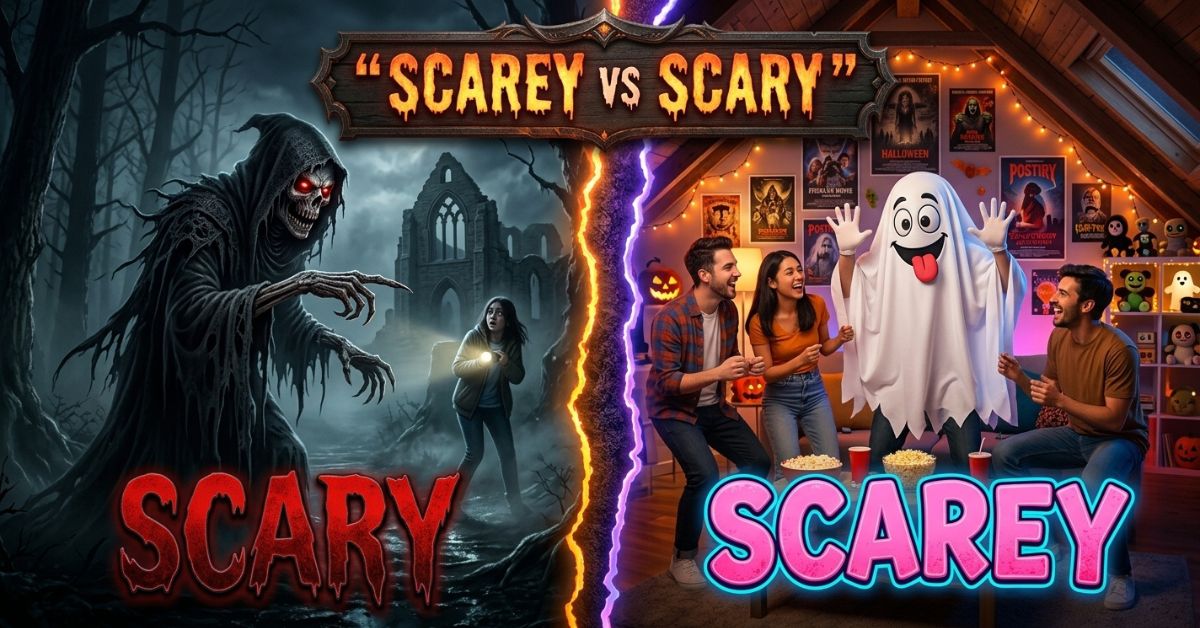
Have you ever typed scarey and wondered whether it should actually be scary? You are not alone. The two spellings look almost identical, and the extra e can seem logical because the base word is scare.
The simple answer is this: scary is the standard spelling used in modern English. It means frightening or causing fear. Oxford lists scary as an adjective meaning “frightening,” with the comparative scarier and superlative scariest.
There is one important detail, though. Scarey is not completely invented. Cambridge identifies it as a UK variant, while Collins also records scarey as a variant spelling of scary.
For schoolwork, professional writing, websites, exams, and general modern English, choose scary.
Scarey vs Scary Meaning in Plain English
Both scary and scarey can refer to something that causes fear or alarm. The major difference is their status and frequency in modern writing.
| Spelling | Meaning | Modern usage |
|---|---|---|
| scary | frightening or causing fear | Standard and preferred |
| scarey | same basic meaning | Variant spelling, less common |
For example:
That was a scary movie.
This is the spelling you should normally use.
Although scarey appears in dictionary records, using it can look like a spelling mistake to many readers. Therefore, scary is the safest choice for clear, standard English.
What Does Scary Mean? Definition, Context, and Usage
Scary is an adjective that describes something that makes you feel afraid, nervous, or alarmed.
Cambridge defines scary as “frightening” and gives examples involving scary movies, stories, people, moments, and situations.
You can use it for:
- A frightening movie
- A dangerous situation
- A strange experience
- A person who makes you uncomfortable
- A frightening sound
- A difficult or worrying situation
Examples
- The old house looked scary at night.
- That was a scary experience.
- I heard a scary noise outside.
- The storm became really scary.
- That horror movie was extremely scary.
Interestingly, scary does not always describe literal physical danger. People also use it for situations that feel worrying or intimidating.
For example:
The amount of work I have this week is scary.
Here, scary means extremely worrying or overwhelming rather than literally frightening.
Is Scarey a Word? Breaking the Myth
Yes, scarey is recorded as a word variant, so it is too absolute to say that it does not exist.
Cambridge lists scarey as a UK variant of scary. Collins similarly defines scarey as a variant spelling of scary. Wiktionary describes it as a dated form.
However, recognition in a dictionary does not mean both forms are equally useful in every situation.
The practical rule is:
Use scary in modern standard English.
This is especially important in:
- School assignments
- University writing
- Exams
- Professional emails
- Blog articles
- Business websites
- Formal documents
- International communication
You may encounter scarey in older material, British usage, informal writing, or user-generated content. That explains why the spelling continues to appear online.
The Real Difference Explained
The difference between scarey vs scary is mainly about standard usage rather than meaning.
Both forms are associated with the idea of causing fear. However:
Scary = standard modern spelling
Scarey = recognized but less common variant
This distinction is important because some online explanations incorrectly claim that scarey is always a completely wrong word. Dictionary evidence shows that this is not quite accurate.
If your goal is correct, widely accepted English, simply write scary.
Read More : Scrapped vs Scraped: Difference, Which One Is Correct?
The Grammar Behind the Correct Spelling of Scary
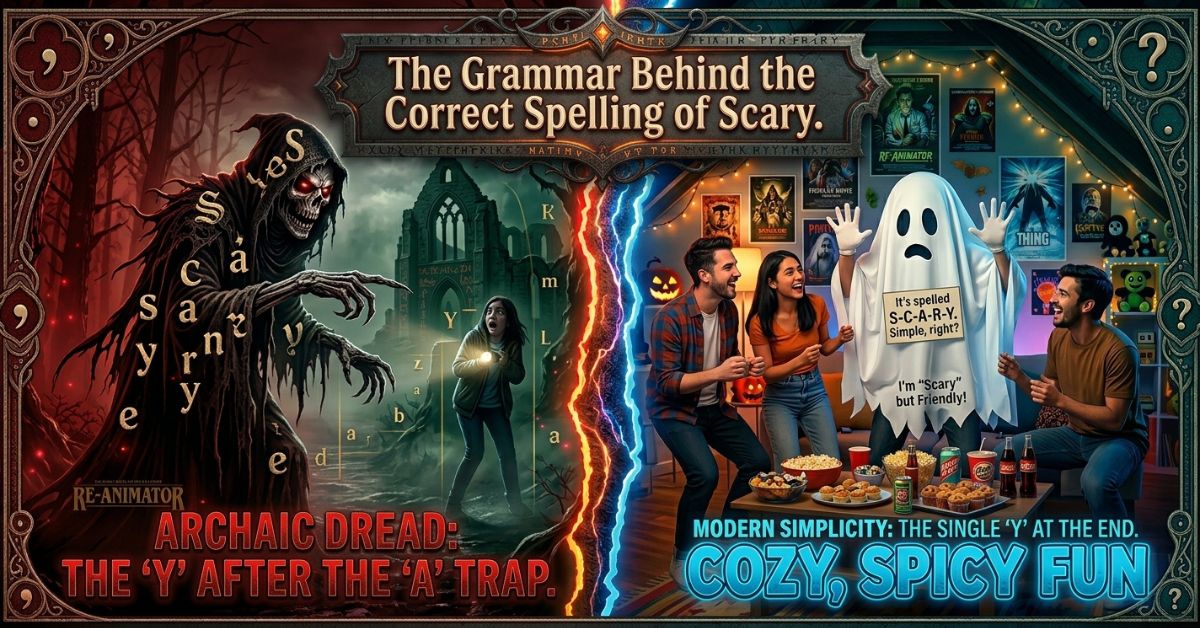
Scary is an adjective formed from scare.
A common spelling pattern in English is that a final silent e is removed before certain suffixes. In scary, the spelling becomes:
scare + y → scary
The final e does not remain in the standard spelling.
This is similar to other words where a final e changes before y:
- noise → noisy
- ice → icy
- shine → shiny
- taste → tasty
The pattern is not completely universal across English, but it helps explain why scary looks different from the base word scare.
The related forms are also useful to remember:
- scare
- scares
- scared
- scaring
- scary
- scarier
- scariest
- scarily
Oxford lists scarier as the comparative and scariest as the superlative form.
How to Spell Scary Correctly Without Hesitation
Use this simple memory trick:
Scare loses the final e before y: scary.
Think:
Scare → scary
Not:
Scare → scarey
You can also remember the comparative forms:
- scary
- scarier
- scariest
Not scareyer or scareist.
Quick spelling test
If you mean “frightening,” choose:
SCARY
For example:
It was a scary night.
Once you remember the basic form, the related forms become easier.
Using Scary in Real Sentences and Everyday Language
The word is common in everyday conversations, social media, entertainment, and informal writing.
Everyday examples
Conversation
“Did you hear that noise?”
“Yes. That was scary!”
Talking about movies
“That was the scariest movie I’ve ever watched.”
Talking about an experience
“Driving through that storm was scary.”
Talking about a person
“That guy looked scary at first.”
Talking about a situation
“It was scary when the lights suddenly went out.”
Oxford also gives common combinations such as scary movie, scary moment, scary experience, and scary-looking.
Scary vs Creepy vs Spooky
These words overlap, but they are not identical.
| Word | Main idea | Example |
|---|---|---|
| Scary | Causes fear | That movie was scary. |
| Creepy | Strange, uncomfortable, or slightly frightening | That empty house is creepy. |
| Spooky | Strange, mysterious, or associated with ghosts | The forest looks spooky at night. |
Scary is the broadest term.
Creepy often describes something that gives you an uncomfortable feeling without necessarily being dangerous. Oxford defines creepy as causing an unpleasant feeling of fear or slight horror and also uses it for something strange that makes you nervous.
Spooky is often associated with ghosts, darkness, mystery, Halloween, or supernatural ideas.
For example:
The abandoned hospital was creepy.
The haunted house was spooky.
The horror movie was scary.
Read More : Triple vs Tripple: Which Is the Correct One to Use?
Expanding Vocabulary with a Scary Synonym List
Using synonyms can make your writing more precise and interesting.
Common synonyms include:
- Frightening
- Terrifying
- Chilling
- Fearsome
- Alarming
- Disturbing
- Intimidating
- Horrifying
- Spooky
- Creepy
- Menacing
- Threatening
The strength of each word can vary.
Frightening is a direct synonym.
Terrifying usually suggests a much stronger level of fear.
Chilling can describe something that creates a deep feeling of fear or unease. Cambridge lists chilling as a synonym of scary.
Creepy focuses more on discomfort or strangeness.
Choosing the right synonym helps communicate exactly what you mean.
Scary vs Frightened Difference
This is another common English mistake.
Scary describes something that causes fear.
Frightened describes a person or animal experiencing fear.
Compare:
The movie was scary.
I was frightened by the movie.
The movie causes the feeling, so it is scary.
The person experiences the feeling, so the person is frightened.
The same distinction applies to scared:
The dog was scared.
The dog saw a scary stranger.
A useful shortcut is:
Scary = causes fear
Scared/frightened = feels fear
The verb scare itself means to frighten someone, while scared is its past form or participle.
Related Word Confusions You Should Avoid
English has many words that look or sound similar. Here are some worth remembering:
Scary vs Scared
Scary: causes fear.
Scared: feels fear.
Scary vs Scarey
Scary: standard modern spelling.
Scarey: recognized variant, but less common.
Scary vs Scarier
Scary: basic adjective.
Scarier: comparative form.
Example:
This movie is scarier than the first one.
Scary vs Scariest
Scariest: superlative form.
Example:
That was the scariest scene in the film.
Scary vs Scarce
These words have completely different meanings.
Scary means frightening.
Scarce means limited, rare, or difficult to obtain. Cambridge defines scarce as something that is not easy to find or get.
Why “Scarey” Still Appears in Searches and Content
There are several reasons people continue to search for or write scarey.
First, the spelling looks logical because the base word is scare. Someone may naturally assume that adding y produces scarey.
Second, scarey has historical and variant usage. Collins records it as a variant, while Wiktionary describes it as a dated form.
Third, search engines index huge amounts of user-generated content. Social posts, comments, old websites, forums, and informal articles can preserve uncommon spellings.
Therefore, seeing scarey online does not automatically prove that it is the preferred spelling.
For modern standard writing, scary remains the best choice.
English Practice Session
Test yourself before checking the answers.
Multiple Choice Questions
1. Which spelling is the standard modern form?
A. Scarey
B. Scary
C. Scarry
D. Scarie
2. What does scary mean?
A. Rare
B. Limited
C. Frightening
D. Happy
3. Which sentence is correct?
A. The film was scarey.
B. The film was scary.
C. The film was scarrie.
D. The film was scare.
4. Which word describes someone experiencing fear?
A. Scary
B. Scared
C. Scarey
D. Scarce
5. What is the comparative form of scary?
A. Scareyer
B. Scariest
C. Scarier
D. Scaryer
Fill in the Blanks
- The haunted house looked very ______ at night.
- I was ______ when I heard the strange noise.
- That was the ______ scene in the movie.
- Clean water can become ______ in some regions.
- The abandoned building looked ______ and mysterious.
Answers
Multiple Choice Answers
- B. Scary
- C. Frightening
- B. The film was scary.
- B. Scared
- C. Scarier
Fill in the Blanks Answers
- scary
- scared
- scariest
- scarce
- spooky
FAQs
Is it spelled scary or scarey?
Scary is the standard spelling used in modern English. Scarey is recorded as a variant, especially in British English.
What is the meaning of the word scarey?
Scarey has the same basic meaning as scary, referring to something frightening or causing fear, but it is a less common variant spelling.
Does scary have an E in it?
No. The standard spelling is scary, without an E between the R and Y.
What is the correct way to spell “scary”?
The correct standard spelling is scary: S-C-A-R-Y.
What is the full meaning of scarce?
Scarce means rare, limited, or not available in sufficient amounts. It is unrelated to the meaning of scary.
What is a fancy way to say “scary”?
Depending on context, you can use frightening, terrifying, chilling, fearsome, horrifying, or alarming.
Is “scaredly” a real word?
Scaredly exists in limited or nonstandard usage, but it is not the normal everyday way to express fear. Use scared, fearfully, or frightened depending on the sentence.
What is scardy?
Scardy is an informal or nonstandard form related to scared, often appearing in expressions such as “scaredy-cat.” It is not the standard adjective for fear.
Does “scarce” mean “scary”?
No. Scarce means rare or limited, while scary means frightening.
What is another word for scarce?
Common alternatives include rare, limited, insufficient, in short supply, uncommon, and hard to find.
Read More : Taught vs Tought Correct Spelling and Usage
Final Thoughts
When choosing between scarey vs scary, the safest answer is simple: use scary.
It is the standard modern spelling for an adjective meaning frightening or causing fear. Oxford uses scary as the main dictionary form, while Cambridge and Collins recognize scarey as a variant.
Remember the key distinction:
Scary = causes fear
Scared = feels fear
Scarce = limited or rare
Once you understand these differences, you can avoid the most common spelling and vocabulary mistakes and use scary confidently in everyday, academic, and professional English.

Finn Bradley is a grammar and language writer at Megazine Tech, focused on making English easier to understand. He researches grammar rules, vocabulary, sentence usage, punctuation, and common writing questions. Through clear explanations and practical examples, Finn helps readers build stronger communication skills and write with greater confidence in everyday situations.