


Have you ever typed emaculate and then stopped because something looked slightly off? You’re not alone. The two spellings look close, and the word can sound different when people say it quickly.
However, if you mean something that is perfectly clean, flawless, or free from mistakes, the correct modern spelling is immaculate. We focus on: Emaculate vs Immaculate?
There is one interesting wrinkle. Emaculate did exist historically as an obsolete English verb meaning “to clear from spots or stains.” That old usage doesn’t make it a modern alternative to immaculate. In everyday American English, schoolwork, professional writing, and online content, immaculate is the word you want.
The Short Answer?
Immaculate is the correct spelling when you mean spotless, flawless, or perfectly clean.
Emaculate is not the standard modern spelling of this adjective. If you write “The room was emaculate,” change it to “The room was immaculate.”
| Word | Modern standard use | Meaning |
|---|---|---|
| Immaculate | Yes | Spotless, flawless, perfectly clean, or without errors |
| Emaculate | No, when intended as the adjective | Usually a misspelling of immaculate |
Cambridge Dictionary defines immaculate as perfectly clean or tidy and also uses it for something perfect and without mistakes. Oxford gives the same two major modern senses.
So the quick rule is easy:
Immaculate = correct
Emaculate = usually incorrect in modern writing
Immaculate Meaning: What Does It Actually Mean?
Immaculate means extremely clean, neat, flawless, or free from faults.
The word can describe a physical object, a person’s appearance, a piece of work, a performance, or even a record. Its exact meaning depends on the context.
For example:
The hotel room was immaculate.
Here, immaculate means exceptionally clean and tidy.
Now consider:
She gave an immaculate performance.
In this sentence, the word means the performance had no noticeable mistakes or faults.
The word can therefore move beyond simple cleanliness. Cambridge lists both the “perfectly clean or tidy” sense and the “perfect and without any mistakes” sense.
Simple Breakdown
| Related word | Simple meaning |
|---|---|
| Spotless | Completely free from dirt or stains |
| Flawless | Without mistakes or defects |
| Pristine | Fresh, clean, and in excellent condition |
| Unblemished | Without damage, faults, or marks |
| Pure | Free from unwanted or harmful qualities |
| Impeccable | Extremely good and without fault |
Think of immaculate as a stronger version of “clean” or “excellent.” A clean room may still have a few things out of place. An immaculate room suggests that everything looks exceptionally neat.
Immaculate Definition in Grammar and Usage
Immaculate is an adjective. It modifies or describes a noun.
You can use it before a noun:
She wore an immaculate white dress.
You can also use it after a linking verb:
Her dress looked immaculate.
The word works naturally in both everyday and formal English.
Immaculate Definition (Grammar)
- Part of speech: Adjective
- Pronunciation: /ɪˈmæk.jə.lət/
- Main meanings: Spotlessly clean, flawless, pure, or free from faults
- Adverb form: Immaculately
- Related nouns: Immaculacy and immaculateness
Cambridge lists immaculately as the adverb form. It can describe something done in a perfectly clean, neat, or faultless way.
Example:
The kitchen was immaculate.
The adjective immaculate describes the noun kitchen.
Here is another example:
His presentation was immaculate.
This time, immaculate describes the quality of the presentation rather than its physical cleanliness.
Immaculate Adjective Meaning in Context
You can use immaculate in several contexts.
Cleanliness
The hotel kept every room immaculate.
Appearance
He arrived wearing an immaculate suit.
Performance
The pianist delivered an immaculate performance.
Writing
Her report was written in immaculate prose.
Record
The player maintained an immaculate record.
Oxford specifically gives examples involving an immaculate uniform, room, property, performance, and safety record.
Is “Emaculate” a Real Word?
This question needs a little more care than most spelling guides suggest.
If you’re asking whether emaculate is the correct modern adjective for something spotless or flawless, the answer is no. Use immaculate instead.
However, historical sources recorded emaculate as an obsolete verb. That older verb meant to remove spots, stains, or imperfections. Wiktionary traces it to Latin emaculatus, while older Webster material records the same obsolete meaning.
That distinction matters because “not a standard modern adjective” is more accurate than simply claiming the spelling has never existed.
Is emaculate a word?
Not as the standard modern adjective meaning “spotless” or “flawless.”
If you see emaculate in an email, essay, resume, article, or social media post today, the writer almost certainly intended immaculate.
Historically, however, emaculate appeared as an obsolete verb meaning to clear something from spots or imperfections. That usage is extremely rare and isn’t appropriate as a modern replacement for immaculate.
Emaculate Meaning
In modern everyday writing, emaculate doesn’t carry the adjective meaning people usually intend.
The historical verb to emaculate meant:
to clear from spots, stains, or imperfections.
For example, older dictionary records describe it as an obsolete verb. Modern readers are unlikely to recognize that historical use.
So if you’re describing a spotless room, flawless performance, or perfect appearance, choose immaculate.
Why This Matters
A spelling mistake can distract readers from an otherwise strong sentence.
Imagine writing:
The final report was emaculate.
The sentence intends to praise the report, yet the spelling error creates the opposite impression. In professional writing, academic work, resumes, product descriptions, and business emails, small errors can make readers question how carefully the rest of the text was checked.
The correct version is simple:
The final report was immaculate.
One letter changes the appearance of the word. More importantly, it changes whether the word fits standard modern usage.
Emaculate vs Immaculate Difference (Side-by-Side)
Here is the clearest comparison:
| Feature | Immaculate | Emaculate |
|---|---|---|
| Standard modern spelling | Yes | No, for the adjective |
| Part of speech | Adjective | Historically a verb |
| Modern meaning | Spotless, flawless, pure, or without faults | No standard modern adjective meaning |
| Historical meaning | Unstained or spotless | To remove spots or imperfections |
| Suitable for professional writing | Yes | No, unless discussing historical usage |
| Example | An immaculate room | Not an emaculate room |
| Related adverb | Immaculately | Not commonly used today |
The important point is this: immaculate and emaculate aren’t simply two modern spellings of the same word.
They have different histories. Immaculate remains a common modern adjective, while emaculate survives mainly as a historical or obsolete verb.
Why Do People Misspell “Immaculate”?
The mistake makes sense once you look at how people learn words.
Many people hear immaculate before they see it written. When someone speaks quickly, the beginning can sound less distinct than the spelling suggests. That makes it tempting to write emaculate from memory.
Common Reasons
1. The pronunciation can hide the spelling
The American English pronunciation is commonly represented as /ɪˈmæk.jə.lət/. The stress falls on the second syllable, which can make the opening sound less prominent.
2. Double letters are easy to forget
The correct spelling begins:
IMM
Not:
IM
And not:
EM
That double m is one of the easiest parts to lose when typing quickly.
3. People often spell unfamiliar words by sound
English spelling doesn’t always match pronunciation perfectly. If you’ve mostly heard the word in conversation, you may guess the spelling when you finally need to write it.
4. Fast typing causes missing letters
A quick phone message or rushed email can turn immaculate into emaculate without much thought.
Related Examples
English has plenty of words that invite similar spelling mistakes:
- Definitely → definately
- Separate → seperate
- Necessary → neccessary
- Accommodation → accomodation
- Recommend → reccommend
- Occurred → occured
The lesson is simple: familiar pronunciation doesn’t always guarantee correct spelling.
The Origin of “Immaculate” (This Makes It Stick)
Word history can make an awkward spelling much easier to remember.
Immaculate Word Origin
Immaculate comes from Latin immaculatus, meaning “unstained” or “unspotted.” The Latin word connects to macula, meaning a spot, stain, or blemish.
That origin fits the modern meaning beautifully.
Think of it this way:
No stain → no blemish → immaculate
The word entered English in the late Middle English period and gradually developed the modern senses of physical cleanliness, purity, and freedom from faults.
Why This Helps
Instead of memorizing ten letters at random, connect the spelling with the idea.
Immaculate = no macula = no spot
That little mental link makes the unusual imm beginning easier to remember.
How to Spell Immaculate Correctly (Without Second Guessing)
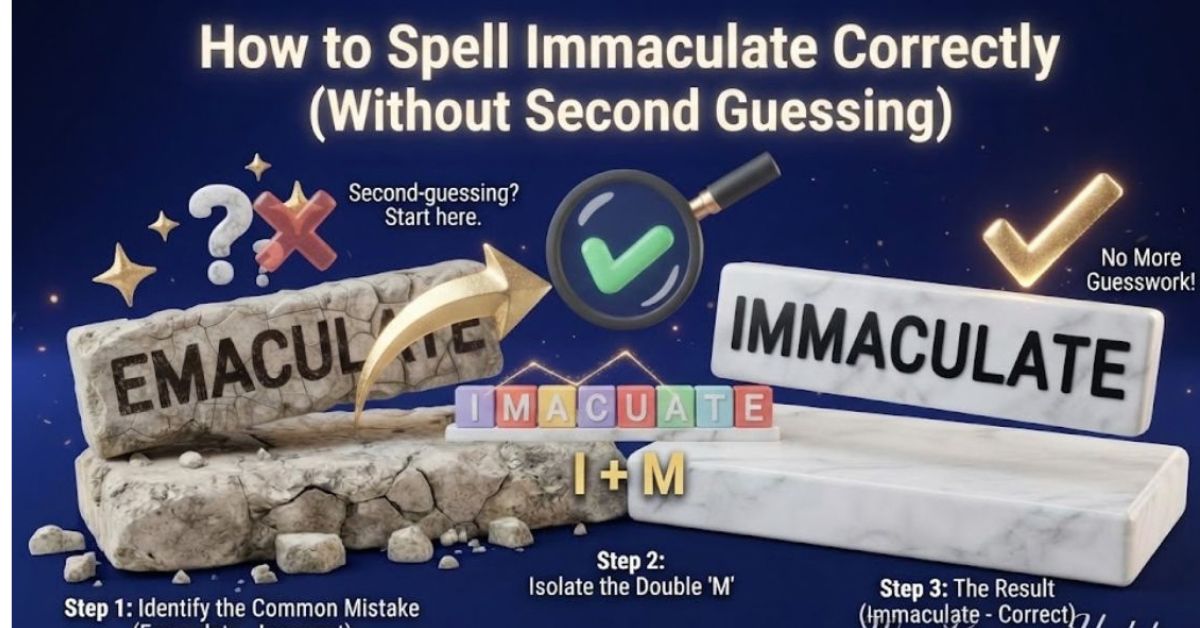
The correct spelling is:
I M M A C U L A T E
Break it into two easy parts:
IM + MACULATE
The most important part to remember is the beginning:
IMM
Memory Hacks That Work
Try this simple phrase:
IMmaculate starts with IM.
You can also connect it with the meaning:
No macula, no stain, immaculate.
Another useful trick is to picture a perfectly clean room. Put the word IMMACULATE on the mental picture. Linking the spelling to an image can make recall easier.
Quick Checklist
Before you type the word, check three things:
- Does it begin with IM?
- Does it contain two m’s at the beginning?
- Are you describing something spotless, flawless, or without faults?
If yes, immaculate is almost certainly the word you need.
How to Use Immaculate in a Sentence (Real Examples)
Once the spelling is clear, usage becomes much easier.
Immaculate in a Sentence (Everyday Use)
The hotel room was immaculate.
Her kitchen is always immaculate.
He arrived in an immaculate white shirt.
The old car was restored to immaculate condition.
The garden looked immaculate after the cleanup.
Immaculate Example Sentences by Context
Cleanliness
The restaurant keeps its kitchen immaculate.
Here, the word emphasizes exceptional cleanliness and order.
Performance
The team delivered an immaculate performance.
In this context, immaculate means extremely good and free from noticeable mistakes.
Appearance
She looked immaculate at the formal event.
This means her appearance was exceptionally neat, polished, and well presented.
You can also use the word for writing, records, timing, work, and other things that show an unusually high level of quality. Cambridge’s examples include immaculate prose, timing, records, and performance.
When to Use Immaculate in English
Use immaculate when ordinary words such as “clean,” “neat,” or “good” don’t quite express the level of quality you mean.
Best Situations
The word works especially well when describing:
- Spotless rooms and homes
- Clean clothing
- Polished appearance
- Excellent performances
- Faultless work
- Strong records
- Precise execution
- High-quality presentation
- Unblemished condition
For example, “The office was clean” sounds ordinary. “The office was immaculate” suggests a much higher standard.
Avoid Overuse
Because immaculate is a strong word, using it in every sentence can make your writing sound exaggerated.
Compare:
The room was clean.
with:
The room was immaculate.
The second sentence carries more emphasis. Save it for situations where that stronger meaning adds something.
Immaculate vs Perfect vs Impeccable
These words overlap, but they aren’t interchangeable in every sentence.
Immaculate vs Perfect
Immaculate often emphasizes cleanliness, condition, appearance, or freedom from flaws.
Perfect has a broader meaning. It can describe something that meets an ideal standard in almost any area.
For example:
The apartment was immaculate.
This focuses on its exceptional condition and cleanliness.
The timing was perfect.
This focuses on ideal timing.
Immaculate vs Impeccable
Impeccable means without fault or error and often works especially well for behavior, standards, style, judgment, or quality.
For example:
Her manners were impeccable.
His timing was impeccable.
Meanwhile:
His suit was immaculate.
Both words can overlap when describing quality. The choice depends on what you want to emphasize.
Comparison Table
| Word | Main idea | Example |
|---|---|---|
| Immaculate | Spotless, flawless, exceptionally neat | The house was immaculate. |
| Perfect | Without fault or ideal for the situation | The timing was perfect. |
| Impeccable | Without fault, especially in quality, behavior, or style | Her manners were impeccable. |
Cambridge lists faultless, flawless, impeccable, perfect, and unblemished among related words for immaculate.
Words Similar to Immaculate (Synonyms and Antonyms)
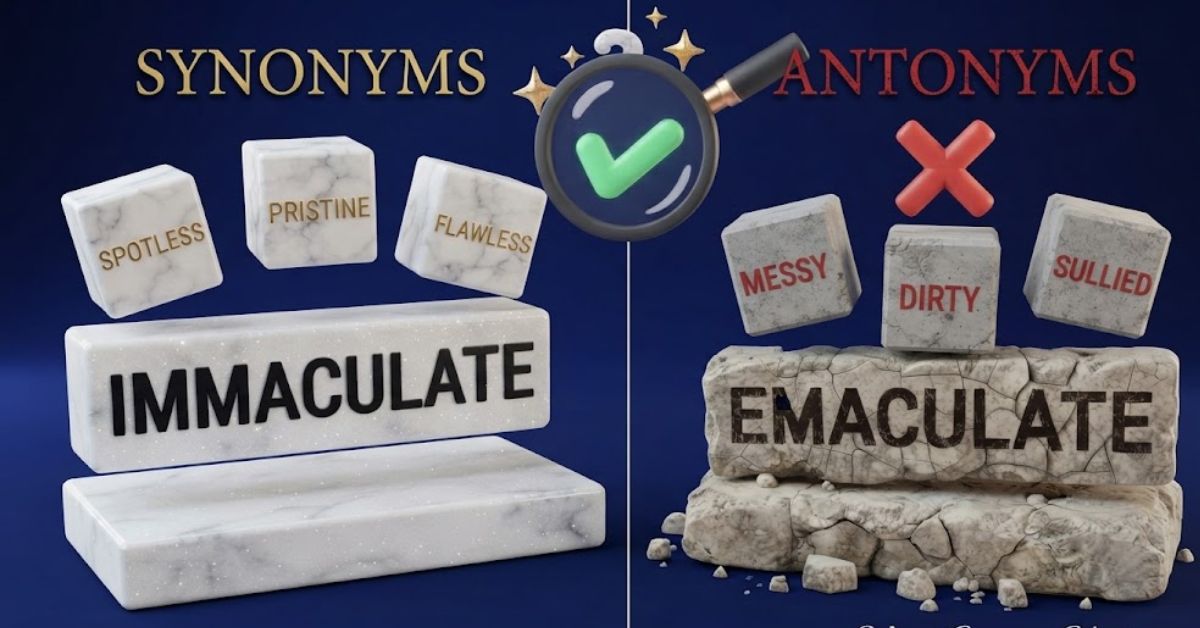
Immaculate Synonym List
Depending on the context, useful synonyms include:
- Spotless
- Pristine
- Flawless
- Impeccable
- Faultless
- Unblemished
- Untarnished
- Pure
- Clean
- Neat
- Perfect
Don’t treat every synonym as an exact replacement. Pristine, for example, often suggests something fresh, original, or untouched, while spotless focuses more directly on cleanliness.
Immaculate Antonyms
Common opposites include:
- Dirty
- Messy
- Untidy
- Stained
- Flawed
- Imperfect
- Blemished
- Unclean
- Damaged
The best antonym depends on the context. For a room, “messy” may work better than “imperfect.” For a performance, “flawed” makes more sense.
Common Spelling Mistakes Like “Emaculate”
The emaculate mistake belongs to a larger group of spelling errors caused by pronunciation, memory, or typing habits.
Other Grammar Spelling Errors
Watch out for these common examples:
| Incorrect | Correct |
|---|---|
| definately | definitely |
| seperate | separate |
| accomodation | accommodation |
| reccommend | recommend |
| neccessary | necessary |
| occured | occurred |
| emaculate | immaculate |
These mistakes may look small, but they can become noticeable in professional writing.
Why It Matters
Correct spelling improves clarity and credibility.
A reader might understand emaculate immediately. Still, understanding the intended word doesn’t make the spelling correct. In a resume, client email, article, school paper, or business proposal, proofreading helps your writing look polished.
There’s also an amusing irony here: spelling immaculate correctly matters most when you’re describing something as flawless.
One Word, Big Impact
A single missing letter can change the impression of an otherwise strong sentence.
Candidate A
“I maintain an emaculate workspace.”
The meaning is understandable, but the spelling mistake stands out.
Candidate B
“I maintain an immaculate workspace.”
Now the sentence looks polished and professional.
The difference is only a few characters, yet the second version immediately feels more careful.
That is why spelling isn’t just about passing a grammar test. It also affects how readers experience your writing.
How to Remember the Spelling of Immaculate (For Good)
Proven Techniques
Use these simple methods:
Break it apart:
IM + MACULATE
Remember the double M:
IMM is the key opening.
Connect it to its origin:
Macula means a spot or blemish, while immaculate carries the idea of being without a spot.
Use it in context:
Write sentences such as “The room was immaculate” until the spelling becomes familiar.
Read it regularly:
Seeing the correct form in books, articles, and professional writing reinforces the spelling naturally.
Spelling Confusion Immaculate
If emaculate keeps appearing in your drafts, don’t rely on pronunciation alone.
Remember this visual:
IMMACULATE
The word starts with IMM, not EMA.
The meaning also gives you a clue. When something is spotless, flawless, or free from defects, think:
immaculate = without a stain or flaw
That connection is far more useful than memorizing the letters without context.
Key Takeaways (Quick Breakdown)
- Immaculate is the correct modern spelling for the adjective meaning spotless or flawless.
- Emaculate is not the standard modern adjective.
- Historically, emaculate existed as an obsolete verb meaning to remove spots or imperfections.
- Immaculate is an adjective.
- It can describe cleanliness, appearance, performance, writing, condition, and records.
- The word comes from Latin immaculatus, connected with the idea of being unstained or unspotted.
- The easiest spelling trick is to remember IMM at the beginning.
- Immaculate, perfect, and impeccable overlap but emphasize slightly different ideas.
- In professional and academic writing, use immaculate when you mean spotless or flawless.
FAQs
What is the difference between emaculate and immaculate?
Immaculate is the standard modern adjective meaning spotless, flawless, or perfectly clean. Emaculate is generally incorrect in modern writing when used with that meaning.
Is emaculate a correct spelling?
Not as the modern adjective for something spotless or flawless. Historical dictionaries recorded emaculate as an obsolete verb meaning to clear away spots or imperfections.
Why do people spell immaculate wrong?
People often confuse the spelling because they hear the word before seeing it written, speak it quickly, forget the double m, or type too fast.
How to spell immaculate correctly?
Spell it IMMACULATE. A simple memory trick is IM + MACULATE, with two m’s at the beginning.
Can “immaculate” describe a person?
Yes. It can describe someone’s appearance, clothing, grooming, or overall presentation. For example, “She looked immaculate.”
Does immaculate mean perfect?
Sometimes. It can mean perfect or without mistakes, but it often emphasizes exceptional cleanliness, condition, or appearance.
Reference Cambridge Dictionary Definitions
The Cambridge Dictionary definition of immaculate lists meanings related to being perfectly clean or tidy and being perfect without mistakes.
Final Thought
The answer to “emaculate vs immaculate” is straightforward for modern everyday English: choose immaculate.
If you’re describing a spotless room, polished appearance, flawless performance, or error-free work, that is the spelling that belongs on the page.
There is one historical footnote worth remembering. Emaculate wasn’t simply invented as a typo. Older sources recorded it as an obsolete verb connected with removing spots or imperfections. That historical form, however, isn’t the modern adjective people need when they mean “spotless” or “flawless.”
So when the spelling starts to look suspicious, remember the simplest rule:
Immaculate starts with IM and has two m’s.
Once that sticks, the whole emaculate vs immaculate confusion becomes much easier to avoid.

Finn Bradley is a grammar and language writer at Megazine Tech, focused on making English easier to understand. He researches grammar rules, vocabulary, sentence usage, punctuation, and common writing questions. Through clear explanations and practical examples, Finn helps readers build stronger communication skills and write with greater confidence in everyday situations.