


Triple vs Tripple is one of the most searched spelling questions in English, and the answer is simple: “triple” is correct, and “tripple” is a misspelling. Despite this, thousands of people type “tripple” into search engines every month, often because the doubled consonant feels more natural when sounding the word out loud. This guide clears up the confusion completely. You will learn what triple means as an adjective, noun, and verb, where the word comes from, how it is used across sports, music, math, and business, and how to permanently stop making this spelling mistake.
By the end of this article, you will not only know the correct spelling but also understand why “tripple” seems so tempting, how “triple” compares to “treble,” and how to use the word confidently in everyday writing.
What Does “Triple” Mean?
At its core, triple relates to the number three. It can describe something made of three parts, an amount three times as large, or the act of multiplying something by three. The word is flexible because English allows it to function as three different parts of speech, which is part of why it causes confusion for learners.
Triple as an Adjective
Used as an adjective, triple describes something that has three parts, layers, or components.
- A triple cheeseburger has three beef patties.
- The hotel offered a triple room for our group of three.
- She achieved a triple crown in horse racing.
Triple as a Noun
As a noun, triple refers to a set of three things or a quantity that is three times another.
- In baseball, a triple is a hit that lets the batter reach third base.
- Ten is the triple of a little more than three.
Triple as a Verb
As a verb, triple means to increase something threefold or multiply it by three.
- The company managed to triple its revenue in two years.
- If you triple the recipe, you will need nine eggs instead of three.
Tripple, The Incorrect Variant

In Triple vs Tripple a”Tripple” with a double “p” does not exist in modern standard English. It is not listed in Merriam Webster, Oxford, Cambridge, or Collins dictionaries. The mistake usually happens for one of these reasons:
- English speakers often double consonants after short vowel sounds, as in “apple” or “little,” so the brain assumes “triple” should follow the same rule.
- Fast typing and autocorrect errors add an extra letter without the writer noticing.
- Non-native speakers sometimes borrow spelling patterns from words like “grippe” or “ripple,” which do have double consonants.
Whatever the reason, “tripple” is always flagged as an error in professional writing, academic papers, and formal communication. If you see it in a document, it should be corrected to “triple.”
Origin and Etymology
The word triple traces back to the Latin term “triplus,” meaning threefold, which itself comes from the Greek “triplous.” It entered English through Old French “triple” around the 14th century. The prefix “tri” meaning three appears across many related English words, including tricycle, tripod, triangle, and triplet.These are different words : Triple vs Tripple
Historical records show that spellings such as “tripill” and even “tripple” did appear in older English texts centuries ago, before spelling became standardized. Once dictionaries and printing conventions formalized English spelling in the 18th and 19th centuries, “triple” became the fixed, accepted form, and the double consonant version fell out of use entirely.
How to Use Triple Correctly
Correct usage depends on which part of speech you need. Here is a quick breakdown with practical guidance for each form.
Adjective
Place “triple” directly before the noun it describes.
- triple threat
- triple jump
- triple layer cake
Noun
Use “triple” as a standalone quantity or set, often following “a” or “the.”
- He hit a triple in the ninth inning.
- The recipe calls for a triple of the original batch.
Verb
Conjugate “triple” like a regular verb: triple, triples, tripled, tripling.
- Sales tripled after the marketing campaign.
- We are tripling the order this month.
Common Confusions
Several related errors and mix-ups tend to appear alongside theTriple vs Tripple debate:
- Writing “tripled” as “trippled”
- Confusing “triple” with “treble,” especially in British English
- Using “triple” when “triplicate” (three identical copies of a document) is actually meant
- Mixing up “triple” with “trilogy,” which refers to three related works, not a quantity
Being aware of these related terms helps you choose the right word every time, not just the correctly spelled one.
Triple in Specific Contexts
The word triple appears constantly across different fields, each with its own specific meaning and usage pattern.
Sports
In baseball, a triple lets a batter safely reach third base. In basketball, a triple refers to a three-point shot, and a “triple double” means a player reached double digits in three statistical categories in one game. Track and field has the triple jump, a three-phase jumping event.
Music
In music theory, triple time refers to a rhythm with three beats per measure, such as a waltz. A “triple” can also describe a chord or note structure built around groups of three. British musicians often use “treble” instead when referring to pitch, such as a treble clef.
Mathematics & Science
In mathematics, tripling a number means multiplying it by three. Scientists use “triple point” to describe the specific temperature and pressure at which a substance exists as a solid, liquid, and gas simultaneously. Chemistry also uses “triple bond” to describe three shared electron pairs between two atoms.
Business & Daily Life
Business reports frequently mention companies aiming to triple their revenue, output, or customer base. In everyday conversation, people order a “triple shot” of espresso, book a “triple room,” or ask for a “triple check” on important documents before submission.
Synonyms and Related Words
Depending on context, these words can substitute for triple:
- Threefold
- Treble (especially in British English)
- Ternary
- Triad
- Triplex
- Trio (for a set of three)
Choosing the right synonym depends on whether you need an adjective, a noun, or a verb, since not every synonym works in every grammatical role.
Pronunciation and Grammar
Triple is pronounced /ˈtrɪp.əl/, with stress on the first syllable, similar to the ending sound in “apple” or “simple.” Grammatically, it behaves as a regular word in all three of its roles:
- Adjective form: triple (no comparative or superlative form is typically used)
- Noun form: triple, plural triples
- Verb form: triple, triples, tripled, tripling
There is only ever one “p” in every form of the word, regardless of tense or grammatical role.
Common Spelling Mistakes
Writers commonly misspell triple in these ways:
- Tripple (extra p)
- Tripal or Triplle
- Trible (missing the p entirely)
- Trippled instead of tripled
None of these variants are accepted in any English dictionary. The only correct spelling, in every context and every English-speaking country like Triple vs Tripple, is “triple.”
Practical Examples in Sentences
- The bakery sells a triple chocolate cake that customers love.
- Our team’s productivity tripled after we adopted the new software.
- She scored a triple in the vocabulary game, earning three times the points.
- The gym offers a triple session package for serious athletes.
- Investors hope the stock price will triple within five years.
Tips to Avoid Spelling Mistakes
- Remember the rule: triple rhymes with “simple,” which also has one “p.”
- Break the word into syllables: tri plus ple, with no double letter.
- Use spell check tools, but do not rely on them completely since some autocorrect systems miss context-specific errors.
- Practice writing the word in full sentences rather than isolation, since context helps memory retention.
- Compare it to “double,” which also has a single consonant before the final syllable.
Comparison: Triple vs Tripple vs Treble
| Word | Correct? | Meaning | Common Region |
|---|---|---|---|
| Triple | Yes | Three times as much, or having three parts | Used worldwide, preferred in American English |
| Tripple | No | Not a real word, common misspelling | None, error only |
| Treble | Yes | Same core meaning as triple, three times as much | More common in British English, especially in sports betting and music |
According to language researchers studying the Cambridge Corpus of American English, American writers strongly favor triple as an adjective, noun, and verb, while British and Australian writers use both triple and treble, with treble appearing more often as a verb.
Key Takeaways
- “Triple” is the only correct spelling in standard English.
- “Tripple” is a common but incorrect variant with no dictionary recognition.
- Triple works as an adjective, a noun, and a verb.
- The word derives from Latin “triplus,” meaning threefold.
- “Treble” is a close British English alternative, especially in music and betting contexts.
Practice Session
Fill in the Blank Exercises
- The company plans to ______ its staff by next year.
- He hit a ______ to bring in two runners.
- This coffee shop offers a ______ shot espresso option.
Multiple Choice Exercises
- Which spelling is correct? a) Tripple b) Triple c) Tripel
- Which sentence uses triple correctly as a verb? a) “We tripled our savings this year.” b) “We tripple our savings this year.”
Sentence Correction Exercises
- Incorrect: “She scored a tripple in the game.” Correct: “She scored a triple in the game.”
- Incorrect: “Profits trippled last quarter.” Correct: “Profits tripled last quarter.”
Application Exercise
Write three original sentences [Triple vs Tripple] , one using triple as an adjective, one as a noun, and one as a verb. Then check each sentence against the rules explained above.
Quick Tips for Remembering Triple vs Tripple
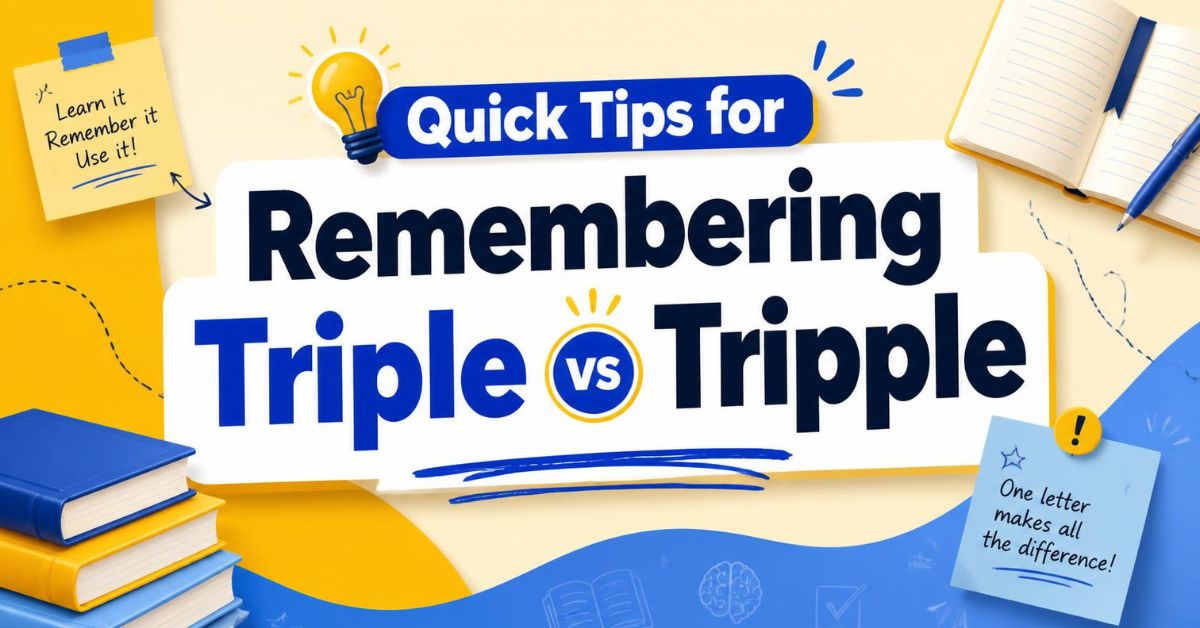
- Single “p,” just like “apple” and “simple.”
- If it looks like it has two p’s, it is wrong.
- Think of “tri” for three, then add “ple,” nothing extra.
Reference Cambridge Dictionary Definitions
The Cambridge Dictionary defines triple as an adjective meaning “consisting of three parts, things, or people, or three times the usual size,” and as a verb meaning “to become three times as much or as many, or to make something do this.” No entry for “tripple” exists in any Cambridge, Oxford, Merriam Webster, or Collins reference.
Read More : Togather or Together Which Is the Correct Word to Use?
FAQs
How do you spell Triple vs Tripple?
The correct spelling is “triple,” with a single “p.” “Tripple” is always incorrect.
Is tripple correct in English?
No, “tripple” is not recognized in any standard English dictionary and should always be corrected to “triple.”
Can triple be used as a verb?
Yes, triple functions as a verb meaning to multiply by three, as in “sales tripled this year.”
What is the triple technique?
In many fields, a “triple technique” refers to a method involving three repeated steps or checks, such as triple checking data for accuracy before submission.
Which is correct, triple or treble?
Both are correct English words with similar meanings [ Triple vs Tripple] . Triple is preferred in American English, while treble is more common in British English, especially in music and finance.
How do Americans spell triple?
Americans spell it “triple,” identical to British spelling. The only difference is that Americans use “triple” more consistently across all its grammatical forms, while British writers sometimes prefer “treble.”
Conclusion
The debate between Triple vs Tripple has a clear and permanent answer: “triple” is correct, and “tripple” is simply a spelling mistake with no dictionary support. Understanding the word’s three grammatical roles, its Latin origin, and its everyday use in sports, music, math, and business helps you use it with total confidence. Keep the single “p” rule in mind, compare it to familiar words like “apple” or “simple,” and you will never write “tripple” again.

Finn Bradley is a grammar and language writer at Megazine Tech, focused on making English easier to understand. He researches grammar rules, vocabulary, sentence usage, punctuation, and common writing questions. Through clear explanations and practical examples, Finn helps readers build stronger communication skills and write with greater confidence in everyday situations.