

Introduction
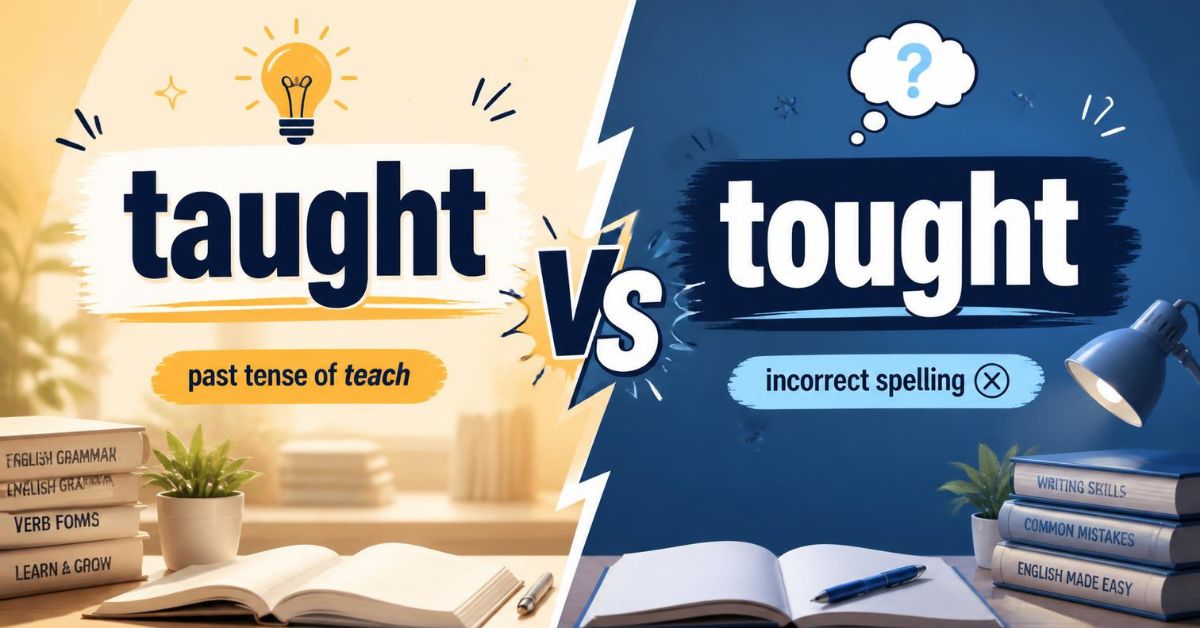
English spelling can be tricky, especially when two words look almost identical. Taught vs tought is a common example that confuses students, writers, and even fast typists. One spelling is correct, while the other is simply a mistake. Knowing the difference can save you from awkward errors in essays, emails, messages, and professional writing.
The correct word is taught. It is the past tense and past participle of teach. The spelling tought isn’t standard English. It often appears because people connect the sound with words such as thought, bought, or brought. Once you understand the pattern, the confusion becomes much easier to avoid. Let’s look at the meaning, grammar, pronunciation, examples, and simple memory tricks that make this spelling stick.
Taught vs Tought Quick Answer

If you’re wondering whether taught or tought is correct, the answer is simple: taught is correct.
Tought is a common misspelling. Standard English doesn’t use it as the past tense of teach.
When someone gave another person knowledge, instruction, training, or guidance in the past, use taught.
For example:
She taught me English last year.
The word taught works in many situations. A teacher can teach a subject. A parent can teach good manners. A coach can teach a new skill. Even an experience can teach you an important lesson.
| Word | Correct? | Meaning |
|---|---|---|
| Taught | Yes | Past tense of teach |
| Tought | No | Common misspelling |
Remember this basic pattern:
Teach → Taught
Not:
Teach → Tought
Example
Correct: My teacher taught me grammar.
Incorrect: My teacher tought me grammar.
The difference is only one letter, yet that small mistake can change the quality of your writing.
What Does Taught Mean in English?
Taught means gave someone knowledge, skills, instruction, training, or guidance in the past. It comes from the verb teach, which changes form because teach is an irregular verb.
The word isn’t limited to schools or classrooms. You can use it when discussing family lessons, workplace training, sports coaching, personal growth, or practical skills.
For example, a parent might say:
My mother taught me to be patient.
A manager might say:
Sarah taught me how to use the software.
An experience can also act as a teacher:
Failure taught him an important lesson.
So, the meaning of taught centers on learning that happened through instruction, guidance, or experience.
It can describe:
- Formal education
- Practical training
- Coaching
- Mentoring
- Parenting
- Life lessons
- Workplace instruction
- Skill development
Example
My grandfather taught me honesty and discipline.
Here, taught doesn’t mean classroom education. It means the grandfather helped the speaker learn important values.
Why People Get Confused

English spelling doesn’t always follow pronunciation. That’s where this little troublemaker enters the picture.
Taught can sound similar to words such as thought, bought, and caught. Because these words share related sounds, some people guess the spelling incorrectly and write tought.
Another source of confusion involves irregular verbs. English learners may expect the past tense of teach to follow a regular pattern.
They might think:
Teach → Teached
But English doesn’t work that way here.
The correct form is:
Teach → Taught
Pronunciation can also influence spelling. When you hear taught aloud, the silent gh doesn’t give you any clue that those letters belong in the word.
Example
Incorrect: She tought me French.
Correct: She taught me French.
The easiest solution is to memorize the complete verb pair instead of trying to spell the word from its sound.
Teach = present
Taught = past
That simple connection removes much of the confusion.
Explained Clearly
The difference between taught vs tought comes down to correctness.
Taught is the standard English word. It functions as the past tense and past participle of teach.
Tought is not the standard past form of teach. If you see it in a text, it usually represents a spelling error.
Consider these examples:
The professor taught economics.
My father taught me how to drive.
Life taught her to stay calm.
Each sentence describes teaching or learning that happened in the past.
Using the wrong spelling can make otherwise clear writing look careless. That matters in school assignments, resumes, emails, articles, and professional documents.
Think of it this way:
Taught carries meaning. Tought carries a mistake.
You don’t need a complicated grammar trick. Just remember that teach changes to taught in the past tense.
Example
Correct: He taught history last semester.
Incorrect: He tought history last semester.
The first sentence follows standard English grammar.
How to Spell Taught Correctly
If you’re asking how to spell taught, write it this way:
T-A-U-G-H-T
The spelling may look strange at first. The letters gh don’t produce a separate sound in modern pronunciation. However, English contains many words with historical spellings that don’t perfectly match their sounds.
Words such as bought, brought, and thought can help you remember the pattern.
A useful memory chain is:
Teach → Taught
You can also connect it with:
Buy → Bought
Think → Thought
These words share the familiar -aught/-ought spelling pattern.
Don’t try to spell taught only from pronunciation. That approach can easily lead you toward tought.
Instead, picture the word in a sentence.
She taught me how to cook.
Then remember the spelling from the complete sentence.
Example
She taught me how to cook.
The correct spelling contains au before gh:
t-a-u-g-h-t
That’s the form you should use in formal and informal writing.
What Is the Past Tense of Teach?
The past tense of teach is taught.
Teach is an irregular verb. Therefore, it doesn’t form its past tense by simply adding -ed.
You don’t say:
I teached the class.
You say:
I taught the class.
The same word taught also works as the past participle.
| Verb Form | Word |
|---|---|
| Base form | Teach |
| Past tense | Taught |
| Past participle | Taught |
| Present participle | Teaching |
| Third-person singular | Teaches |
Notice the change:
Teach → Taught → Taught
This pattern appears frequently in everyday English, so learning it will help you write and speak more naturally.
Example
I taught students last year.
For the present:
I teach students now.
For a perfect tense:
I have taught students for several years.
Understanding these forms makes the grammar much easier to use correctly.
When Should I Use Taught?
Use taught when an act of teaching, training, coaching, or guiding happened in the past.
The action could involve a formal lesson or something much more personal. For instance, a teacher taught mathematics. A coach taught a player a new technique. A parent taught a child good manners.
You can also use taught for lessons gained through experience.
That difficult experience taught me patience.
The action happened in the past, so taught fits naturally.
Common situations include:
- School lessons
- Workplace training
- Sports coaching
- Skill instruction
- Parenting
- Mentoring
- Personal development
- Life experiences
Example
My manager taught me the new software system.
Here, the manager provided instruction. The teaching occurred in the past.
Another example:
Failure taught him to plan carefully.
In this sentence, failure acts as the source of the lesson.
Taught in a Sentence with Examples
Seeing taught in a sentence helps you understand how naturally the word works in different contexts.
The subject doesn’t always need to be a person. Teachers, parents, coaches, mentors, experiences, and even mistakes can all appear with taught.
Here are several examples:
She taught me how to swim.
The professor taught history clearly.
My father taught me responsibility.
The coach taught the team a new strategy.
Travel taught her independence.
My mother taught me how to cook.
The trainer taught us workplace safety.
That experience taught him a valuable lesson.
Her mentor taught her useful communication skills.
Hardship taught them to appreciate small things.
Notice how the meaning changes slightly with each example. Sometimes taught means direct instruction. In other cases, it means learning through experience.
| Context | Example |
|---|---|
| Personal | She taught me kindness. |
| Academic | He taught chemistry. |
| Workplace | The trainer taught safety rules. |
| Sports | The coach taught a new technique. |
| Life lesson | Failure taught patience. |
Taught Pronunciation: How to Pronounce Taught
Many learners struggle with taught pronunciation because the spelling doesn’t match every sound they might expect.
Taught is commonly pronounced /tɔːt/ in many varieties of English. Depending on your accent, it may sound close to caught.
The gh in taught remains silent.
That means you don’t pronounce each letter separately. You say the word as one smooth sound.
Think of:
taught → tawt
The exact vowel sound can vary between accents. American English speakers may pronounce it differently from some British English speakers.
Example
She taught art at college.
In speech, the word sounds nothing like the spelling suggests at first glance. That’s one reason learners sometimes write tought.
A useful strategy is to learn the spelling and pronunciation together:
Taught = /tɔːt/
Then use it in short sentences until the connection becomes automatic.
Taught Grammar Rules: Why It Is Irregular
The verb teach is irregular because its past form doesn’t follow the common -ed pattern.
Regular verbs usually form the past tense by adding -ed.
For example:
Walk → Walked
Clean → Cleaned
Jump → Jumped
Teach follows a different pattern:
Teach → Taught
That’s why teached isn’t the standard past form.
The same idea appears with other irregular verbs:
| Present | Past |
|---|---|
| Teach | Taught |
| Think | Thought |
| Buy | Bought |
| Bring | Brought |
| Catch | Caught |
These forms may seem unpredictable. However, frequent exposure makes them easier to remember.
Example
He taught me grammar yesterday.
Not:
He teached me grammar yesterday.
The first sentence uses the correct irregular verb form.
Taught vs Thought Difference

Taught vs thought creates another common spelling mix-up because the two words can sound similar in some accents.
Their meanings, however, are completely different.
Taught relates to teaching.
Thought relates to thinking, believing, considering, or having an idea.
Compare these two sentences:
My teacher taught me English.
I thought the lesson was interesting.
The first sentence describes instruction. The second describes a mental opinion or idea.
| Word | Meaning | Example |
|---|---|---|
| Taught | Instructed or educated | She taught math. |
| Thought | Considered or believed | I thought it was easy. |
A quick memory trick can help:
Teach → Taught
Think → Thought
Once you connect each word with its base verb, the difference becomes much easier to remember.
Example
I thought the class was useful because she taught clearly.
Both words can appear in the same sentence because they perform different jobs.
Taught vs Tough vs Taut
These three words look and sound confusing, but their meanings couldn’t be more different.
Taught means instructed or educated.
Tough means difficult, strong, durable, or hard to handle.
Taut means stretched tightly or pulled firm.
Compare them:
| Word | Meaning | Example |
|---|---|---|
| Taught | Instructed | She taught English. |
| Tough | Difficult or strong | The exam was tough. |
| Taut | Tight or stretched | The rope was taut. |
Here’s an easy way to separate them.
If someone gives you a lesson, you were taught.
If something is difficult, it’s tough.
If a rope has no slack, it’s taut.
Example
The tough training taught the athlete discipline.
Both tough and taught appear here, but they have different meanings.
The training was difficult. It also provided a lesson.
Taught Synonym and Better Alternatives
Sometimes repeating taught several times can make your writing feel flat. Depending on the context, you can choose a more specific synonym.
Useful alternatives include:
- Instructed — formal teaching
- Educated — provided knowledge
- Trained — developed a practical skill
- Guided — helped someone make progress
- Coached — taught through practice
- Mentored — supported long-term growth
- Advised — offered useful direction
However, these words aren’t always interchangeable.
For example, coached fits sports particularly well:
The coach coached the players.
Mentored works better when someone provides ongoing professional guidance:
She mentored young professionals.
Example
The instructor taught the workers new safety procedures.
You could also write:
The instructor trained the workers in new safety procedures.
The second version emphasizes practical skill development rather than general instruction.
Why Tought Is Incorrect Spelling
Many people ask whether tought is a real English word. In standard modern English, it isn’t the correct past form of teach.
The correct form remains taught.
The mistake often happens because English pronunciation doesn’t always reveal spelling. When people hear taught, they may connect it with thought or other -ought words.
Typing quickly can cause the same problem.
However, you should avoid tought in:
- School assignments
- Resumes
- Emails
- Reports
- Blog posts
- Business documents
- Professional messages
One small spelling mistake may seem harmless. Still, repeated errors can affect how readers judge your writing.
Example
Incorrect: I tought English for five years.
Correct: I taught English for five years.
The second sentence uses the proper past form of teach.
What Does Tuff Mean?
Tuff is different from taught. Online, people often use tuff as an informal spelling of tough.
Its meaning depends heavily on context.
On social media, tuff can describe something impressive, stylish, intense, or difficult.
For example:
That outfit is tuff 🔥
The speaker may mean that the outfit looks impressive or cool.
In another conversation, someone might write:
That game was tuff.
Here, they may simply mean the game was difficult.
Meaning of Tuff
Online, tuff can suggest:
- Cool or impressive
- Stylish
- Strong
- Difficult
- Intense
- Hard-hitting
It works mainly in casual digital communication. For formal writing, tough remains the standard spelling.
Example
That edit is tuff 🔥
In this context, tuff expresses admiration rather than the meaning of taught.
How to Remember Taught Spelling Easily
A simple word connection can save you from this spelling mistake.
Remember:
Teach → Taught
Then connect it with two familiar irregular verbs:
Think → Thought
Buy → Bought
These patterns can help your brain recognize the unusual -aught/-ought letter combinations.
Another useful trick involves the middle letters.
Think:
T-A-U-G-H-T
The key part is A-U-G-H-T.
Don’t replace au with ou just because the pronunciation sounds similar.
You can also practice the word inside a sentence instead of memorizing isolated letters.
My teacher taught me English.
Write that sentence several times. Soon, the correct spelling will feel familiar.
Example
She taught piano last summer.
A quick memory chain:
Teach today → taught yesterday.
That simple contrast can make the correct form easier to recall.
Practice Session: Taught vs Tought

Practice helps turn a spelling rule into a natural habit. Instead of simply memorizing the answer, focus on the meaning and verb form.
Fill in the Blanks
Complete each sentence with taught.
- My teacher ______ me how to solve the problem.
- She ______ English grammar at school.
- The coach ______ the team a new technique.
- My parents ______ me the value of honesty.
- The experience ______ him patience.
- The professor has ______ thousands of students.
- The workshop ______ us communication skills.
- The mentor ______ valuable leadership lessons.
- Life has ______ me to stay strong.
- The instructor ______ safety rules before the course.
Multiple Choice
- Which spelling is correct?
a) Tought
b) Taught
c) Thought - She ______ me how to drive.
a) Tought
b) Taught
c) Taut - What is the past tense of teach?
a) Teached
b) Taught
c) Tought - Which word means instructed or educated?
a) Tough
b) Taught
c) Taut - Which spelling is incorrect?
a) Taught
b) Thought
c) Tought - The teacher ______ us grammar yesterday.
a) Tought
b) Taught
c) Teached - Which sentence is correct?
a) She tought me English.
b) She taught me English.
c) She teached me English. - What does taught mean?
a) Thinking
b) Giving instruction
c) Tightening - Which is the past form of teach?
a) Taught
b) Tought
c) Thinked - My father ______ me discipline.
a) Taught
b) Tought
c) Taut
Answer Key
Fill in the Blanks
- taught
- taught
- taught
- taught
- taught
- taught
- taught
- taught
- taught
- taught
Multiple Choice
- b) Taught
- b) Taught
- b) Taught
- b) Taught
- c) Tought
- b) Taught
- b) She taught me English.
- b) Giving instruction
- a) Taught
- a) Taught
FAQs
When should I use taught?
Use taught when someone gave instruction, training, guidance, or knowledge in the past. It is the past form of teach.
What is the meaning of being tough?
Being tough means being strong, resilient, durable, or able to handle difficult situations without giving up.
Is it taut or taught?
Taught means instructed, while taut describes something stretched tightly. The correct choice depends entirely on the sentence.
When to use thought or taught?
Use thought for ideas or opinions. Use taught when someone provided instruction, education, training, or guidance.
Is it thought me or taught me?
Use taught me when someone educated or guided you. Thought me is incorrect for this meaning in standard English.
What is meant by taught?
Taught means gave someone knowledge, skills, instruction, or guidance. It serves as the past tense of teach.
What is a better word than tough?
Depending on context, alternatives include strong, resilient, durable, difficult, demanding, challenging, and hardy.
How do you spell taught correctly?
The correct spelling is T-A-U-G-H-T. Taught is the past tense and past participle of teach.
What does tuff mean?
Tuff is informal online slang that can mean cool, impressive, intense, strong, or difficult, depending on context.
Conclusion
The difference between taught vs tought becomes easy once you connect the correct spelling with its base verb. Taught is the past tense and past participle of teach. It describes instruction, training, guidance, or lessons learned through experience. Tought is simply a common spelling mistake. When you write an essay, email, resume, or professional message, choose taught every time.
Remember the simple pattern: teach → taught. Don’t let pronunciation trick you into adding the wrong letters. If thought, tough, or taut causes confusion, check the meaning before choosing a word. A quick review can prevent an embarrassing typo. With regular sentence practice, the spelling becomes automatic. In short, taught vs tought isn’t a difficult grammar problem. Learn the pattern once, use taught correctly, and your writing will stay clear, polished, and confident.

Finn Bradley is a grammar and language writer at Megazine Tech, focused on making English easier to understand. He researches grammar rules, vocabulary, sentence usage, punctuation, and common writing questions. Through clear explanations and practical examples, Finn helps readers build stronger communication skills and write with greater confidence in everyday situations.