

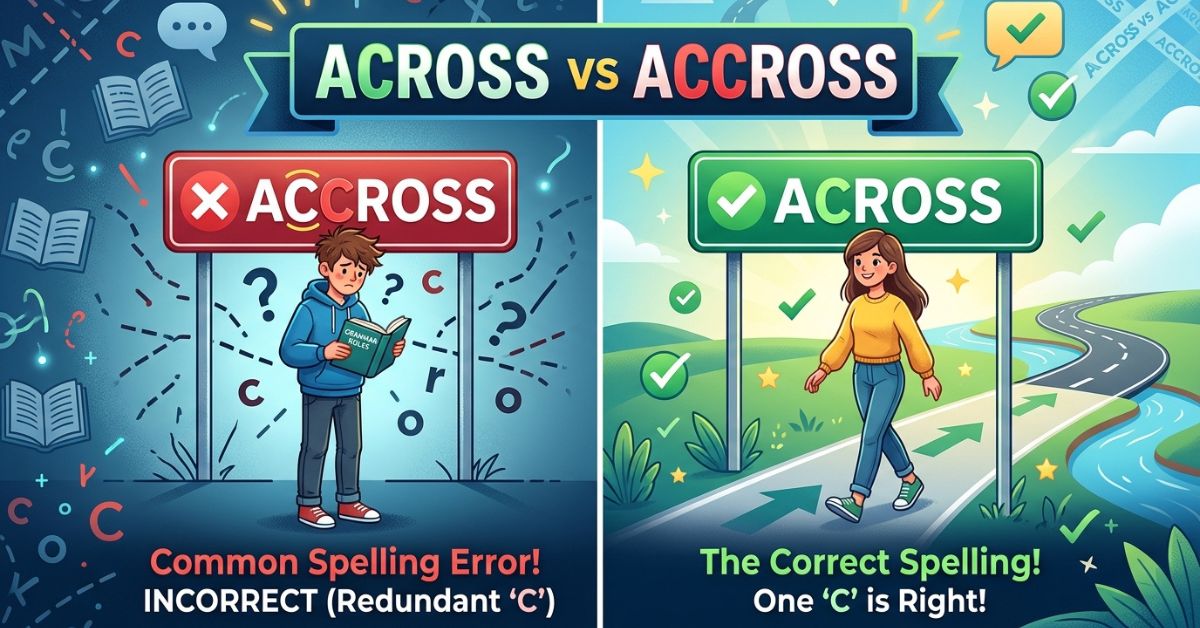
If you’ve ever stopped while typing and wondered whether “accross” or “across” is correct, you’re not alone. The two spellings look almost identical, but only one belongs in standard English.
The correct spelling is across, with one “c” and two “s’s.” Accross is a common misspelling.
The good news is that the difference is easy to remember once you understand what across means and how you use it. Whether you’re writing an email, school assignment, blog post, or everyday message, choosing the right spelling keeps your writing clear and polished.
The Correct Spelling Explained
The correct spelling is across.
Accross is not the standard spelling of the word. If you’re checking a sentence, article, essay, or professional document, choose across.
| Spelling | Correct? | Example |
|---|---|---|
| Across | Yes | We walked across the bridge. |
| Accross | No | We walked accross the bridge. |
The difference comes down to one extra letter. Across contains one c, while accross incorrectly adds another.
A simple way to remember it is to look at the word cross inside across:
a + cross = across
The word starts with a and then contains cross, which already has one c.
So if you’re unsure, remember:
Across = correct
Accross = misspelling
Major English dictionaries list across as the standard word and provide definitions for its use as a preposition and adverb.
What Does Across Mean in English?
Across generally describes movement from one side to another, a position on the opposite side, or something that extends or spreads over an area.
For example:
- She walked across the road.
- The store is across the street.
- A bridge stretches across the river.
- The news spread across the country.
The exact meaning depends on the sentence.
Cambridge Dictionary explains that across can refer to being on the opposite side of something or moving from one side to another. It can also describe something that occurs throughout an area.
Here are the main uses:
| Use | Meaning | Example |
|---|---|---|
| Movement | From one side to another | He ran across the field. |
| Position | On the opposite side | The bank is across the street. |
| Extension | From one side to another | A bridge crosses across the river. |
| Distribution | Throughout an area | The program operates across the country. |
| Width | From one side to the other | The table is six feet across. |
This makes across more versatile than it might first appear.
Accross vs Across Meaning Explained
There isn’t a separate meaning for accross and across.
That’s because across is the correct English word, while accross is a misspelling.
When someone writes accross, they usually intend to write across. The extra c doesn’t create a new word or a different definition.
| Word | Standard English Word? | Meaning |
|---|---|---|
| Across | Yes | From one side to another, opposite, throughout, or extending across |
| Accross | No | Misspelling of across |
For example:
Correct:
She walked across the street.
Incorrect:
She walked accross the street.
The meaning stays the same in the writer’s mind, but the spelling makes the second sentence incorrect.
So when searching for accross vs across meaning, the important point is simple: learn the meaning and usage of across, then avoid the extra c.
Why Is Across Spelled With One “C”?
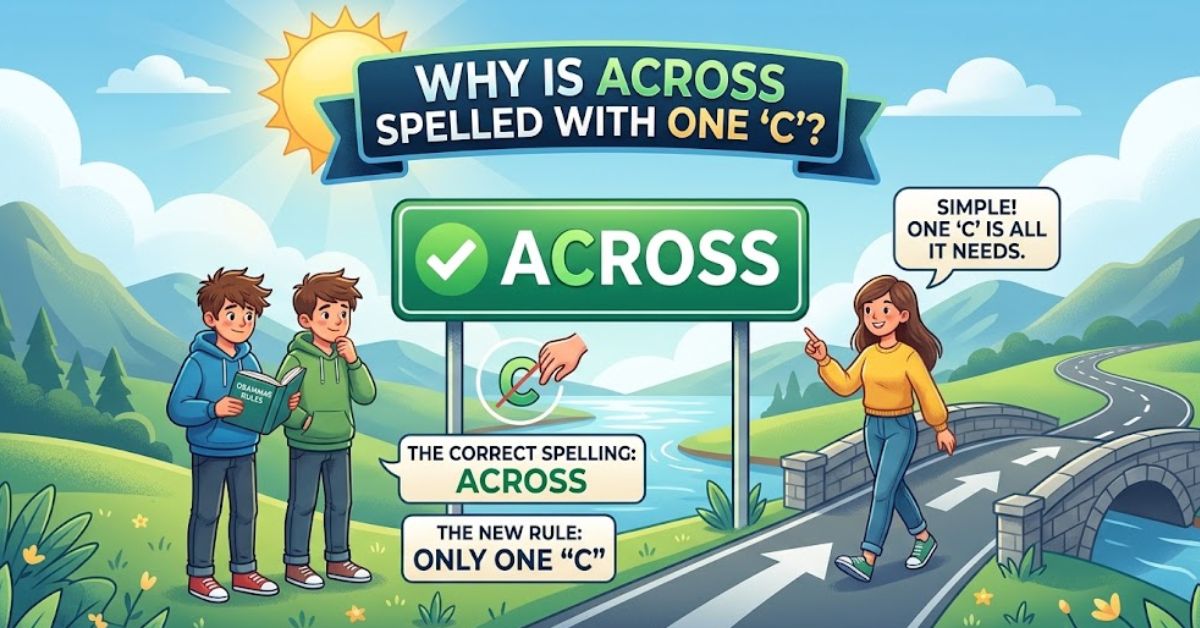
The spelling can seem strange because English contains many words with doubled consonants. However, across uses only one c.
The modern word has a long history. Oxford traces across to Middle English and ultimately to Old French expressions involving a cross. Its history does not support the modern spelling accross.
A useful spelling breakdown is:
a + cross = across
Notice the spelling of the base word:
cross
It has:
- one c
- one r
- one o
- two s’s
When you add a to form across, you don’t add another c.
Therefore:
a + cross → across
Not:
a + ccross → accross
English spelling doesn’t always follow a perfectly predictable pattern. That’s why it helps to remember the word visually instead of trying to invent a spelling rule every time you use it.
Read More : Manuel vs Manual: When to Use Each One in Writing
Why Do People Spell Across Wrong?
If across is such a common word, why does accross appear so often?
The mistake usually comes from familiar spelling patterns. English contains plenty of words with doubled consonants, so writers may instinctively add another c.
Words such as account, access, and accept begin with ac, which can make accross look believable at first glance.
Fast typing can also cause the mistake. When you type quickly, your fingers sometimes add or repeat a letter without you noticing.
Another reason involves pronunciation. When you hear across, the word starts with a short unstressed sound followed by the cross sound. Spelling from sound alone can therefore be unreliable.
Common causes include:
- Confusion with words beginning with acc
- Fast typing
- Weak visual memory of the word
- Writing from pronunciation rather than spelling
- Limited exposure to the correct written form
The easiest fix is repetition. Every time you write across, pay attention to its first few letters:
a-c-r-o-s-s
Once that pattern becomes familiar, the extra c starts to look out of place.
Accross vs Across Grammar Rules Explained
Across can function as both a preposition and an adverb.
As a preposition, it usually connects the word across with a noun or noun phrase.
We walked across the bridge.
Here, the bridge follows across.
As an adverb, across can appear without a noun immediately after it.
She hurried across.
Cambridge specifically identifies across as both a preposition and an adverb.
Across as a preposition
Use across when you want to describe a relationship involving movement, position, extension, or distribution.
Examples:
- They drove across the country.
- A cable runs across the ceiling.
- The pharmacy is across the street.
- Her family lives across the border.
Across as an adverb
As an adverb, across can describe movement without directly taking an object.
Examples:
- He walked across.
- She looked across and smiled.
- The child ran across to his mother.
You can also see across in expressions such as across from, which means opposite or on the other side.
The library is across from the school.
Oxford also lists uses involving movement, position, width, and distribution.
How to Use Across in a Sentence Correctly
The best way to understand across is to see how it behaves in everyday sentences.
1. Movement from one side to another
We walked across the bridge.
The person starts on one side and moves to the other.
2. Position on the opposite side
The coffee shop is across the street.
Here, across doesn’t describe active movement. It tells you where something is located.
3. Something extending from side to side
A large banner stretched across the wall.
The banner extends from one part of the wall to another.
4. Distribution throughout an area
The company has offices across the country.
Here, across means in many parts of the country.
5. Width
The swimming pool is 20 meters across.
In this construction, across describes the distance from one side to the other. The Cambridge Learner’s Dictionary also records this measurement use.
6. Something spreading over a surface
A smile spread across her face.
The expression starts in one area and extends over another part of the face.
These examples show why context matters. Across doesn’t always mean simple physical movement.
Across vs Through vs Over: Key Differences
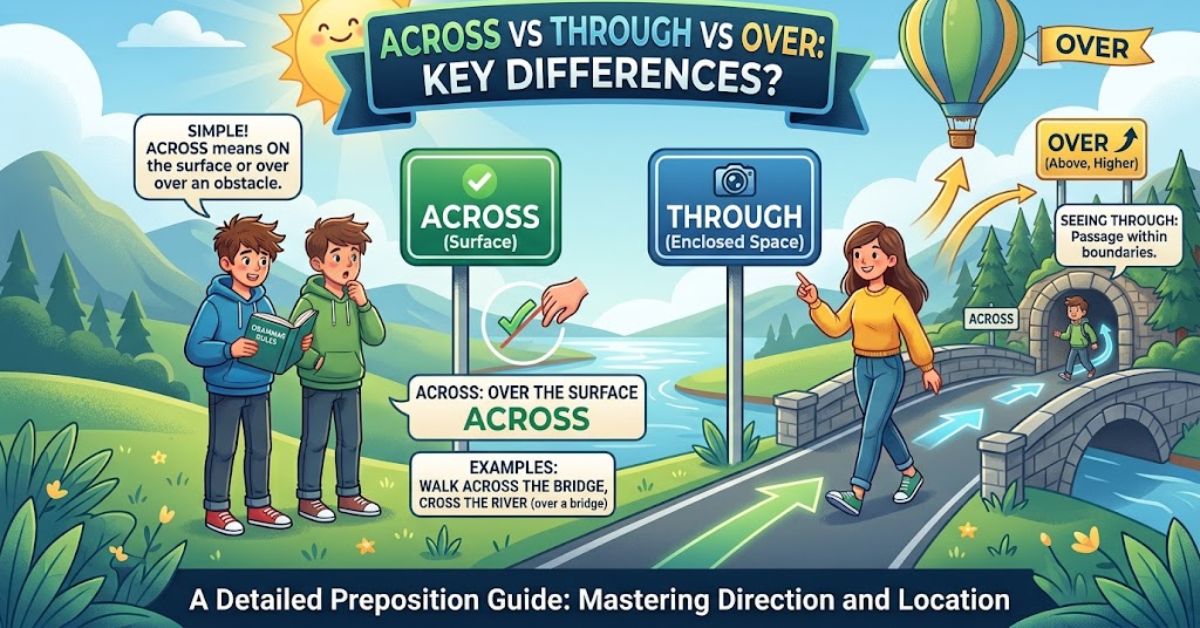
Across, through, and over can describe movement, but they don’t always mean the same thing.
Across
Use across when something moves from one side to another, often over a surface or defined area.
We walked across the field.
Through
Use through when something moves within or inside an enclosed, surrounding, or extended space.
We walked through the forest.
The forest surrounds the path, so through fits better.
Over
Use over when something is above another object or moves across it from a higher position.
The bird flew over the lake.
Cambridge specifically distinguishes these terms by noting that across focuses on moving from one side to another, while through applies when moving within something such as a forest or long grass. Over commonly refers to a higher position.
| Word | Main idea | Example |
|---|---|---|
| Across | From one side to another | Walk across the road. |
| Through | Within or inside something | Walk through the tunnel. |
| Over | Above something | Fly over the mountain. |
The distinction becomes easier when you picture the movement.
Across: side → side
Through: inside → through
Over: above → across
Synonyms and Similar Words to Across
The best synonym for across depends on its meaning in the sentence.
For example, opposite works when across describes location:
The hotel is across the street.
You could say:
The hotel is opposite the street.
In other contexts, throughout can work when across means distribution:
The policy applies across the organization.
The policy applies throughout the organization.
Other related words include:
- over
- opposite
- facing
- throughout
- crosswise
- crossways
- from side to side
- beyond
- past
However, don’t replace across automatically. Synonyms often carry slightly different meanings or fit different sentence structures. Cambridge and Collins both group words such as opposite, facing, over, throughout, and crosswise with different senses of across.
Read More : Dysregulated vs Disregulated: Correct Usage Explained
Across Spelling UK vs US: Any Difference?
No. Across has the same spelling in standard British and American English.
| Variety | Correct spelling |
|---|---|
| British English | across |
| American English | across |
| International English | across |
The difference between British and American English affects some spellings, such as colour/color and centre/center. However, across isn’t one of those words.
So whether you’re writing for a US audience, a UK audience, or an international audience, use:
across
Not:
accross
Oxford lists the standard British form as across and also provides an American English entry with the same spelling.
Is Accross Ever Correct to Use?
In standard English, accross is not the correct spelling of across.
You shouldn’t use accross in:
- Academic assignments
- Professional emails
- Business documents
- Blog posts
- Resumes
- Formal reports
- Schoolwork
- Standard English writing
If you encounter accross in an informal message, social media post, or user-generated text, it may simply be a spelling mistake.
There’s one important distinction, though. A misspelled form can appear in a person’s writing without becoming a valid English spelling. Seeing accross online doesn’t make it an accepted alternative.
When you mean movement from one side to another, position on the opposite side, or distribution over an area, use across.
The Impact of Spelling Errors on Writing
A single spelling mistake won’t always make a sentence impossible to understand. Still, repeated errors can distract readers and weaken the polish of your writing.
Consider these two sentences:
The team works across several departments.
The team works accross several departments.
The meaning remains understandable, but the second version contains an obvious spelling error.
In professional and academic writing, small mistakes can affect how carefully your work appears to have been prepared. That’s why proofreading matters.
A simple final check can catch many errors:
- Read the sentence slowly.
- Look for repeated letters.
- Check unfamiliar spellings in a reliable dictionary.
- Use spell-check tools as a second layer of protection.
- Read your final draft once before publishing or submitting it.
For a word like across, visual familiarity makes a big difference.
Practice Session
Fill in the Blanks
Choose across for each sentence.
- We walked ______ the road to reach the store.
- The message spread ______ the entire organization.
- She looked ______ the room and smiled.
- They drove ______ the country during their vacation.
- A bridge extends ______ the river.
Answers:
- across
- across
- across
- across
- across
Multiple Choice Questions
Choose the correct spelling.
1. She ran ______ the field.
a) accross
b) across
Answer: b) across
2. The bank is ______ the street.
a) across
b) accross
Answer: a) across
3. The news spread ______ the country.
a) accross
b) across
Answer: b) across
4. We walked ______ the bridge.
a) across
b) accross
Answer: a) across
5. Which spelling is correct?
a) Accross
b) Across
Answer: b) Across
A quick memory trick can help: “Across contains cross.” Since cross begins with one c, write a + cross = across.
FAQs
Is it “accross” or “across”?
Across is the correct spelling. Accross is a common misspelling and isn’t the standard form used in English dictionaries.
Why do people spell “across” with two c’s?
People often add a second c because English contains many words with doubled consonants, and fast typing can reinforce the mistake.
Is “accross” ever correct in any form of English?
No. When you mean the standard English word across, the correct spelling uses one c.
What does “across” mean in simple terms?
Across usually means from one side to another, on the opposite side, or throughout an area.
Can “across” be used in different ways in a sentence?
Yes. Across can function as a preposition or adverb and can describe movement, position, extension, distribution, or width.
Why is spelling “across” important?
Correct spelling makes your writing clearer and more polished. Using across instead of accross helps you avoid a common spelling error.
How can I stop making this mistake?
Remember a + cross = across. Writing the word correctly several times and checking it during proofreading can help make the spelling automatic.
Read More : Success vs Sucess: Which is Correct? Complete Guide
Final Takeaway
When choosing between accross vs across, the answer is straightforward: across is correct.
Use across when you describe movement from one side to another, a position on the opposite side, something extending from side to side, or something distributed throughout an area. It can also function as both a preposition and an adverb.
The spelling becomes easier to remember when you break it down:
a + cross = across
There’s no need for an extra c.
So the next time you hesitate between accross and across, go with across. That single spelling choice keeps your sentence correct in both American and British English.
Meta Description:
Accross vs across explained clearly. Learn the correct spelling, meaning, grammar, examples, differences, and an easy way to remember it.

Finn Bradley is a grammar and language writer at Megazine Tech, focused on making English easier to understand. He researches grammar rules, vocabulary, sentence usage, punctuation, and common writing questions. Through clear explanations and practical examples, Finn helps readers build stronger communication skills and write with greater confidence in everyday situations.