

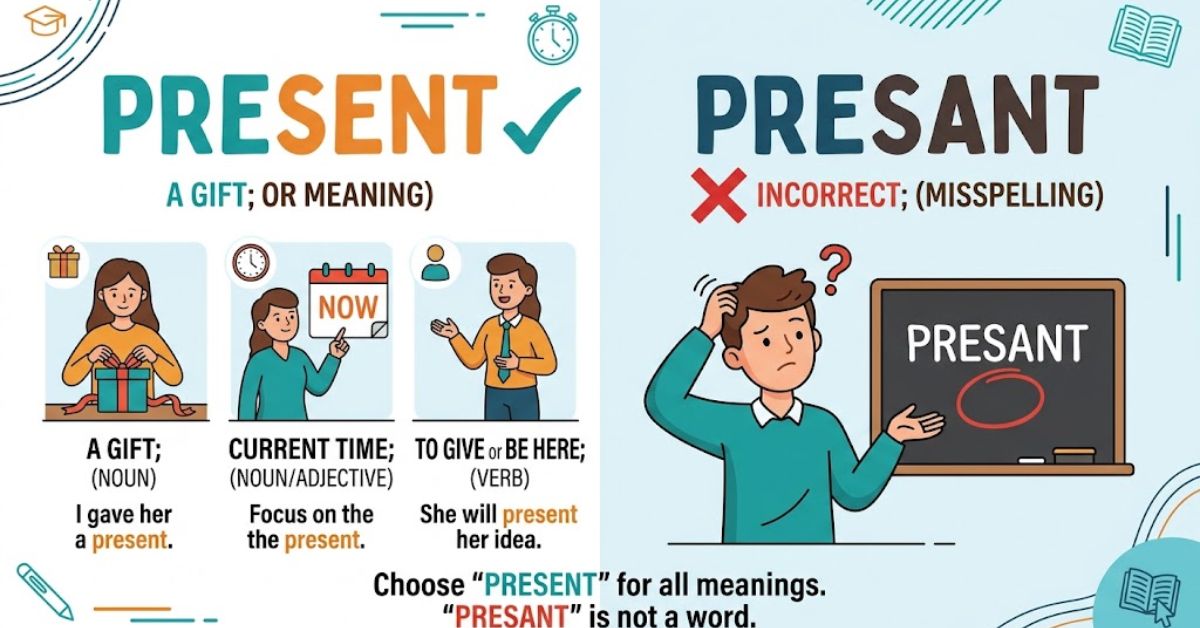
If you are wondering whether present vs presant is correct, the answer is simple: present is the correct spelling. Presant is a common misspelling and is not the standard spelling of the English word.
The confusion happens because the middle vowel in present can sound weak or unclear in everyday speech. This makes some people write the word as they hear it. However, the accepted spelling remains present in standard American and British English.
The word present is especially useful because it has several meanings. It can describe a gift, the current time, someone who is in a particular place, or the act of showing, giving, explaining, or submitting something. It can also function as a noun, adjective, or verb.
Why Correctly Spelling Present Matters
Correct spelling matters because present appears frequently in everyday, academic, and professional English.
A spelling mistake such as presant can make an email, school assignment, resume, report, or business document look careless. It can also confuse readers who are unfamiliar with the intended word.
For example:
- ❌ I bought her a birthday presant.
- ✅ I bought her a birthday present.
- ❌ He will presant his research tomorrow.
- ✅ He will present his research tomorrow.
Using the correct spelling also helps search engines, spellcheckers, and language tools identify the intended word more reliably.
The Core Rule for Present vs Presant
Remember this simple rule:
Present is correct. Presant is incorrect when you mean the standard English word.
Use present when you mean:
- A gift
- The current time
- Something existing now
- Someone who is in a place
- To show or explain something
- To give or award something
- To submit or formally produce something
Presant should not be used for these meanings in standard English.
How to Use Present Correctly
Present as a Noun Meaning a Gift
As a noun, present can mean something given to another person as a gift.
Examples:
- She gave me a birthday present.
- I bought a Christmas present for my brother.
- The children opened their presents after dinner.
- This watch was a graduation present.
Here, present and gift have very similar meanings.
Present as a Noun Meaning the Current Time
Present can also mean the time happening now, especially when contrasted with the past or future.
Examples:
- We should focus on the present.
- The story moves between the past and the present.
- Try to live in the present.
- The decision will affect both the present and the future.
In this use, the present means the current period or moment.
Present as an Adjective Meaning Current
As an adjective, present can describe something that exists or happens now.
Examples:
- We need to discuss the present situation.
- The present system has several problems.
- She is happy with her present job.
- The report examines the present condition of the company.
In this meaning, words such as current or existing now can often be used as alternatives.
Present as an Adjective Meaning Being There

Present can also mean that someone is physically in a particular place.
Examples:
- All students were present.
- The manager was present at the meeting.
- Were your parents present?
- Everyone present agreed with the decision.
This meaning is closely related to in attendance or being there.
Present as a Verb Meaning Show or Explain
As a verb, present means to show, explain, introduce, or communicate something to other people.
Examples:
- She will present her research tomorrow.
- He presented the results to the team.
- I need to present my ideas clearly.
- The student presented the project to the class.
This is the meaning you usually need when talking about giving a presentation.
Present as a Verb Meaning Give or Award
Present can also mean to formally give something to someone.
Examples:
- The director presented her with an award.
- The school presented certificates to the students.
- The mayor presented the medal to the winner.
This use is common in ceremonies and formal situations.
Present as a Verb Meaning Submit or Produce
In academic and professional English, present can mean to formally submit, provide, or put information before an audience.
Examples:
- Please present your report by Friday.
- The lawyer presented evidence to the court.
- The researcher presented her findings.
- Students must present their final projects.
Is There Any Exception Where Presant Is Correct?
For the ordinary meanings discussed here, no. Presant is not the standard spelling of present in modern English.
If you intend to write about a gift, current time, attendance, or showing something, use present.
How Do You Pronounce Present?
One interesting feature of present is that its pronunciation changes depending on its grammatical role.
As a noun or adjective, the stress is usually on the first syllable:
PREsent
Examples include:
- a birthday present
- the present situation
- everyone is present
As a verb, the stress normally moves to the second syllable:
preSENT
Examples include:
- present your report
- present an award
- present the results
Cambridge gives the noun and adjective pronunciation as /ˈprez.ənt/ and the verb as /prɪˈzent/.
Correct Examples of Present
Here are examples covering the most common uses:
- She gave me a birthday present.
- We should focus on the present.
- The present situation requires attention.
- All employees were present.
- She will present her project tomorrow.
- The principal presented him with an award.
- Please present your report to the committee.
- He wants to live in the present rather than worry about the future.
Present vs Presant: Incorrect vs Correct Examples
| Incorrect | Correct |
|---|---|
| birthday presant | birthday present |
| Christmas presant | Christmas present |
| presant situation | present situation |
| be presant at the meeting | be present at the meeting |
| presant your project | present your project |
| presant the award | present the award |
| focus on the presant | focus on the present |
The correction is straightforward: replace presant with present.
Why Do People Spell Present as Presant?

Phonetic Similarity
The unstressed middle vowel in present can be difficult to identify when someone hears the word quickly.
People sometimes hear a sound closer to an a and therefore write presant. This is especially common among English learners.
English Does Not Always Spell Weak Vowels Predictably
English spelling does not always provide a perfect representation of pronunciation.
An unstressed vowel may sound less distinct than a stressed vowel. That can encourage people to spell a word according to how they think it sounds.
Confusion Between -ant and -ent Endings
English contains many words ending in -ant and -ent.
This can create uncertainty when someone is unsure which ending belongs to a particular word.
The correct form is:
present
Not:
presant
Fast Typing
Typing quickly can produce simple spelling errors. Because presant looks very close to present, the mistake can easily go unnoticed.
Autocomplete and Spellcheck Limits
Spellcheck tools are useful, but they are not perfect. A typo may sometimes survive if the software does not immediately recognize the intended correction.
Always proofread important writing rather than relying entirely on automatic correction.
Translation Interference
People who learn English as an additional language may transfer spelling patterns from another language. Pronunciation habits can also influence how unfamiliar English words are written.
Common Mistakes Checklist
Before submitting your writing, check whether you have:
- Written present, not presant
- Used present for a gift
- Used present for the current time
- Used present for someone who is in attendance
- Used present when describing something current
- Used present as a verb for showing or explaining
- Used the correct pronunciation for noun and verb uses
- Checked important emails and assignments for spelling errors
Present vs Presant in Real English
Grammatically Correct English
Present is the correct form in standard English.
Example:
She will present her findings tomorrow.
Grammatically Possible but Unnatural Usage
Some sentences can be grammatically possible but sound awkward because the word choice does not fit the context.
For example, saying “I presented him a gift” may be understood, but “I presented a gift to him” or “I gave him a gift” may sound more natural depending on the context.
Natural Everyday English
In casual English, people commonly say:
- I got a present.
- She gave me a present.
- Everyone is present.
- I am presenting my project tomorrow.
- Let’s focus on the present.
Formal vs Informal Usage of Present
Present works in both formal and informal English.
Informal:
Thanks for the present!
Professional:
I will present the findings at tomorrow’s meeting.
Academic:
The study presents evidence supporting the proposed approach.
Formal usage often involves verbs such as present findings, present evidence, present a proposal, and present a report.
Present vs Presant Comparison Table
| Feature | Present | Presant |
|---|---|---|
| Standard English spelling | Yes | No |
| Dictionary word | Yes | No, for the intended meanings |
| Meaning: gift | Yes | No |
| Meaning: current time | Yes | No |
| Meaning: being there | Yes | No |
| Meaning: show or explain | Yes | No |
| Used in formal writing | Yes | No |
| Used in academic writing | Yes | No |
| Common reason for use | Correct spelling | Misspelling |
Memory Trick for Present vs Presant
Use this simple memory trick:
Present has “ent,” not “ant.”
Think:
Present = correct
Presant = spelling mistake
You can also connect the word to familiar phrases such as present time, birthday present, and present your ideas. Seeing the correct spelling repeatedly makes it easier to remember.
A Five-Step Way to Choose the Correct Spelling
When you are unsure, follow these steps:
- Identify the meaning.
Are you talking about a gift, now, attendance, or showing something? - Write present.
This is the standard spelling for all these meanings. - Check the ending.
The word ends with -ent, not -ant. - Read the sentence aloud.
Make sure the grammatical role makes sense. - Proofread important writing.
Pay special attention to schoolwork, resumes, emails, and reports.
Real-Life Situations Using Present Correctly
Job Interview
I am excited to present my qualifications and experience.
Business Meeting
Sarah will present the quarterly results.
Professional Email
I have attached the report that I will present during tomorrow’s meeting.
Text Message
Thanks for the birthday present!
School Presentation
I will present my project to the class today.
Exam
Please present your answer clearly and support it with evidence.
Present, Presence, Presents, and Presently
These words are related but should not be confused.
Present can mean a gift, current time, being somewhere, or showing something.
Presence is a noun referring to the state or fact of being present.
Example:
Her presence made everyone feel comfortable.
Presents can be the plural of present when referring to gifts.
Example:
The children opened their presents.
Presents can also be the third-person singular form of the verb present.
Example:
He presents the report every month.
Presently can mean soon in some varieties of English, while it can also mean currently in other usage. Context matters.
Expert Tips for Remembering and Using Present
Learn the Word as a Family
Instead of memorizing only one spelling, learn related forms together:
- present
- presents
- presented
- presenting
- presence
- presently
This helps you recognize the correct spelling more quickly.
Separate Spelling From Pronunciation
Do not assume every vowel sound tells you exactly which letter to write.
The spoken middle vowel can sound unclear, but the written form is still present.
Use Meaning Before Grammar Labels
You do not always need to identify whether a word is a noun or adjective first.
Ask what you mean:
- Gift? Present
- Now? Present
- Here? Present
- Show or explain? Present
The spelling stays the same.
Do Not Overcorrect
Not every unusual-looking use of present is an error. The word has several legitimate meanings and grammatical roles.
For example, present can correctly mean both a gift and the current time. Context tells you which meaning applies.
FAQ
Is Presant a Real English Word?
For the meanings normally intended by people who write it, presant is not the standard English word. The correct spelling is present.
Is It Presant or Present for a Gift?
Use present for a gift. For example, “She gave me a birthday present.”
How Do You Spell Present When Giving a Presentation?
The correct spelling is present. Example: “I will present my research tomorrow.”
Can Present Be Both a Noun and a Verb?
Yes. As a noun, present can mean a gift or the current time. As a verb, it can mean to show, explain, give, or submit something.
Why Does Present Have Two Pronunciations?
The pronunciation changes with its grammatical role. Nouns and adjectives normally stress the first syllable, while the verb normally stresses the second.
What Is the Past Tense of Present?
The past tense and past participle are presented.
Example: “She presented her research yesterday.”
What Is the -ing Form of Present?
The -ing form is presenting.
Example: “He is presenting his project today.”
Is Present Spelled Differently in British and American English?
No. Present is spelled the same way in standard British and American English.
Is Present the Same as Presence?
No. Present can describe being somewhere, while presence is the noun for the state or fact of being there.
Does Present Always Mean “Now”?
No. Present can mean now, but it can also mean a gift, being in attendance, or showing or giving something.
Mini Quiz: Present vs Presant
Choose the correct spelling in each sentence.
- She bought me a birthday ______.
- Everyone was ______ at the meeting.
- I will ______ my project tomorrow.
- We should focus on the ______.
- He received a Christmas ______.
Answers:
- Present
- Present
- Present
- Present
- Present
If you chose present every time, you have mastered the basic spelling rule.
Quick Summary
The difference between present vs presant is straightforward:
- Present is the correct standard English spelling.
- Presant is a common misspelling.
- Present can mean a gift.
- Present can mean the current time.
- Present can describe someone who is in a place.
- Present can describe something current.
- Present can mean to show, explain, give, award, or submit something.
- As a noun or adjective, present usually has first-syllable stress.
- As a verb, present usually has second-syllable stress.
- The spelling does not change between these meanings.
The easiest rule to remember is present ends in -ent, not -ant. When you mean the standard English word, always choose present.

Finn Bradley is a grammar and language writer at Megazine Tech, focused on making English easier to understand. He researches grammar rules, vocabulary, sentence usage, punctuation, and common writing questions. Through clear explanations and practical examples, Finn helps readers build stronger communication skills and write with greater confidence in everyday situations.