

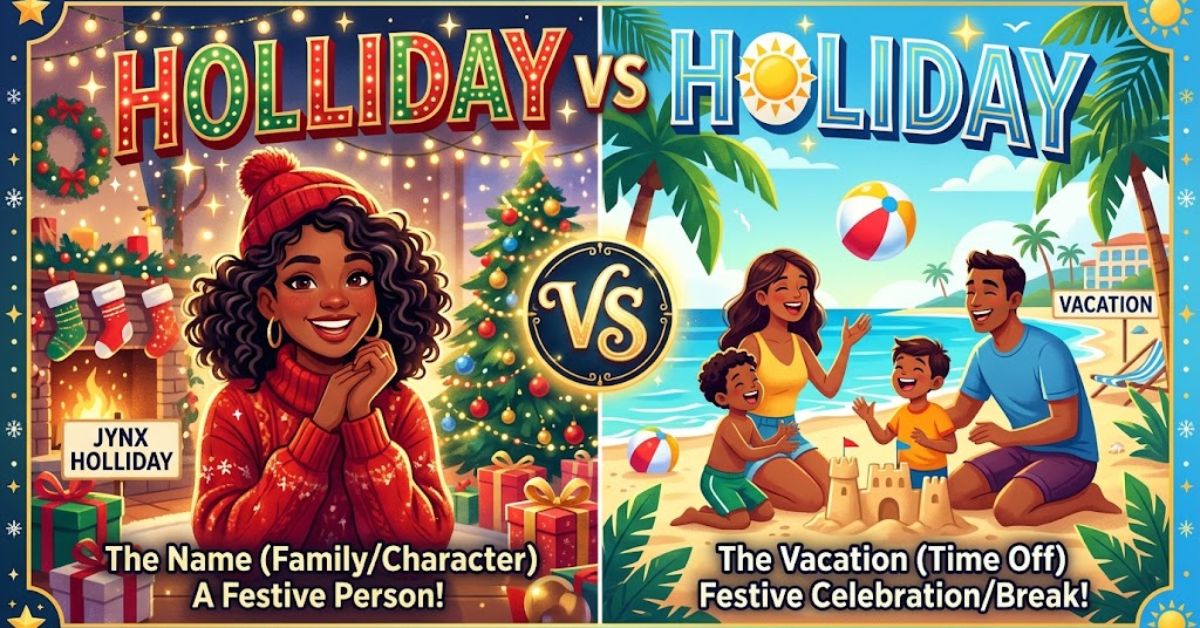
If you’re wondering whether to write Holliday vs Holiday, the answer is simple: holiday is the correct spelling for the ordinary English word. It has one l.
Use holiday when you mean a special day, a public or religious celebration, a day away from work or school, or a vacation in British English. Holliday, with two l’s, is not an alternative spelling of the common word. However, it can be correct when it appears as a person’s surname or another proper name.
For example:
Correct: We are planning a holiday next month.
Incorrect: We are planning a holliday next month.
Correct: Dr. Holliday called this morning.
The difference looks tiny, but context matters. Let’s break down exactly when each spelling works.
What Is the Difference Between Holliday and Holiday?
Holiday is the standard English spelling for the common word. It can describe a special day, an official day off, or a period away from work or school. In British English, it can also mean a vacation or recreational trip. Major dictionaries recognize these meanings and distinguish British usage from North American usage.
Holliday is different. It is not the standard spelling of the common noun. Instead, it can function as a proper name, especially a surname.
Compare these sentences:
- We enjoyed our holiday.
- Monday is a public holiday.
- We are going on holiday next week.
- Mr. Holliday will join the meeting.
The first three use the ordinary word. The last uses a name.
So, if you’re talking about a day off, celebration, or vacation, choose holiday.
Why Does the Correct Spelling Matter?
Spelling affects how polished and trustworthy your writing looks. A single extra letter can make an otherwise clear sentence appear careless.
The difference matters particularly in:
- School assignments
- Exams
- Job applications
- Business emails
- Reports
- Website content
- Advertisements
- Invitations
- Social media posts
- Professional documents
Consider a holiday greeting:
❌ Happy Hollidays!
✅ Happy Holidays!
Most readers will understand the first version. Still, the second version follows standard English spelling.
Correct spelling also helps search engines, spellcheckers, and readers understand exactly what you mean.
The Core Rule
The simplest rule is:
Use “holiday” with one l for the ordinary English word. Use “Holliday” with two l’s only when that spelling belongs to a proper name.
The standard spelling is:
H-O-L-I-D-A-Y
There is only one l.
So remember:
holiday = common English word
Holliday = possible proper name
holliday = incorrect when you mean the common word
How to Use Holiday Correctly
Holiday as a Special Day
Use holiday for a day associated with a national, religious, cultural, or other recognized celebration.
Examples include:
- Christmas is a major holiday.
- Monday is a public holiday.
- The office will close for the holiday.
- The school is closed for a national holiday.
In American English, this is one of the main uses of holiday. Cambridge and Oxford both define it as a day when people generally do not work or attend school, particularly because of a national or religious occasion.
Holiday as Time Away From Work
British English commonly uses holiday for time spent away from work or school for rest, travel, or recreation.
For example:
- We’re going on holiday next month.
- She spent her holiday in Spain.
- I need a summer holiday.
- They returned from their holiday yesterday.
American English generally uses vacation for this meaning.
So an American speaker is more likely to say:
I’m going on vacation next month.
A British speaker is more likely to say:
I’m going on holiday next month.
The spelling stays holiday in both varieties.
Holiday Before Another Noun
Holiday frequently appears before another noun to describe something connected with a holiday.
Common combinations include:
- holiday season
- holiday plans
- holiday travel
- holiday weekend
- holiday destination
- holiday package
- holiday decorations
- holiday break
- holiday pay
- holiday home
For example:
Our holiday plans changed because of the weather.
Here, holiday modifies plans. The spelling still contains only one l.
Holiday as a Verb
Holiday can also function as a verb, particularly in British English.
For example:
- They are holidaying in Spain.
- We holidayed in France last summer.
- She often holidays with her family.
Major learner dictionaries recognize this verb. In North American English, speakers commonly choose vacation instead.
When Holliday Is Correct
Holliday can be correct when it is part of a proper name.
For example:
- Mr. Holliday is waiting outside.
- Dr. Holliday published the report.
- Sarah Holliday sent an email.
- The historical figure Doc Holliday had this surname.
Never change a genuine name simply because it resembles a common English word.
If someone’s official name is Holliday, that spelling should remain unchanged.
Correct Examples of Holiday and Holliday
Here are examples showing the difference clearly:
- Conversation: Are you working on the public holiday?
- Travel: We’re going on holiday to Italy.
- American English: I’m taking a vacation next week.
- Work: The office will close for the holiday.
- School: Students return after the holiday break.
- Greeting: Happy Holidays!
- Business: Please check our holiday opening hours.
- Name: Professor Holliday will lead the meeting.
- Surname: The document was signed by James Holliday.
- Proper name: Check the official spelling before changing Holliday.
The important point is simple. Holiday describes the thing or period. Holliday can identify a person or another proper name.
Incorrect vs. Correct Examples
| Incorrect | Correct | Why |
|---|---|---|
| We are going on holliday. | We are going on holiday. | The common word has one l. |
| Happy Hollidays! | Happy Holidays! | The plural is holidays. |
| Monday is a public holliday. | Monday is a public holiday. | Public holidays use the standard noun. |
| Our holliday plans changed. | Our holiday plans changed. | Holiday is the correct modifier. |
| The school holliday starts Friday. | The school holiday starts Friday. | The common noun uses one l. |
| We booked a holliday package. | We booked a holiday package. | Holiday is the standard spelling. |
| Enjoy your holliday! | Enjoy your holiday! | The ordinary word has one l. |
| Mr. Holiday called. | Mr. Holliday called. | Use the person’s actual surname. |
| I spoke to Dr. Holiday. | I spoke to Dr. Holliday. | Preserve a genuine proper name. |
| Several hollidays are coming. | Several holidays are coming. | The plural is holidays. |
Why Do People Write Holliday Instead of Holiday?
The mistake is easy to make because the two forms look almost identical. Several factors can contribute to the confusion.
Pronunciation Does Not Clearly Show the Number of L’s
When you hear holiday, the pronunciation doesn’t tell you whether the written form contains one l or two.
English has many words whose spelling cannot be predicted perfectly from pronunciation. As a result, someone who has heard the word more often than they have seen it written may guess the wrong spelling.
The Two Spellings Look Very Similar
Compare:
holiday
holliday
Only one letter separates them.
That makes the mistake especially easy to overlook during fast typing or quick proofreading.
People See Holliday as a Real Name
Holliday genuinely exists as a proper name. That makes the spelling look legitimate.
For example:
Dr. Holliday is available now.
That sentence can be completely correct.
The problem starts when someone transfers the name spelling to the ordinary noun:
We are going on holliday.
That sentence needs holiday.
Writers Overgeneralize Double-L Patterns
English contains plenty of words with double consonants. Writers sometimes assume that a familiar-looking word should also contain two l’s.
That guess doesn’t work here.
The standard form is simply holiday.
Autocorrect Is Helpful but Not Perfect
Spellcheckers don’t always treat names the same way they treat ordinary vocabulary.
A program may flag lowercase holliday but accept Holliday because it recognizes a possible surname. That’s useful when you’re writing about a person, but it can also create confusion.
Context still matters.
Translation Can Increase Uncertainty
English learners may encounter different words for vacation, leave, holidays, and days off in other languages.
That can make spelling and vocabulary choices harder to separate.
The safest approach is to learn the English form directly:
holiday
Then learn the regional vocabulary difference:
British English: holiday
American English: vacation for recreational time away
Common Mistakes Checklist
Before submitting or publishing your writing, check these points:
- Write holiday, not holliday, for the common word.
- Write holidays, not hollidays, for the plural.
- Keep Holliday when it is someone’s genuine name.
- Don’t assume capitalization makes an incorrect spelling correct.
- Check the sentence before using find and replace.
- Don’t confuse spelling with the British and American vocabulary difference.
- Remember that holiday can also function as a verb in British English.
- Proofread names separately from ordinary vocabulary.
Holliday vs Holiday in Real English

Grammatically Correct and Natural
Holiday is the natural choice whenever you’re referring to a celebration, recognized day off, or vacation in British English.
Examples:
Christmas is a holiday.
We’re going on holiday in July.
The holiday season starts soon.
These forms are normal and widely understood.
Grammatically Possible but Less Natural in Some Contexts
Some expressions are grammatically possible but vary by region.
For example:
We are holidaying in Spain.
British English recognizes this verb. Many American speakers would instead say:
We’re vacationing in Spain.
Neither issue involves the spelling holliday. It is a vocabulary and regional usage difference.
Incorrect in Standard Common-Noun Use
The following is not standard:
We enjoyed our holliday.
The correct version is:
We enjoyed our holiday.
However, changing a person’s surname would be a different matter:
I spoke with Ms. Holliday.
If that is her actual name, the two l’s are correct.
American vs. British English
The spelling holiday does not change between American and British English.
The main difference concerns meaning and preferred vocabulary.
| Situation | American English | British English |
|---|---|---|
| Public day off | holiday | holiday |
| Religious celebration | holiday | holiday |
| National celebration | holiday | holiday |
| Recreational trip | vacation | holiday |
| Time away from work | vacation | holiday |
| Common spelling | holiday | holiday |
| Alternative spelling | holliday is incorrect | holliday is incorrect |
Oxford explains that British English commonly uses holiday for periods when people are away from work or school, while North American English generally uses vacation for that meaning.
There is also a North American use of the holidays for the late-November to early-January period associated with Thanksgiving, Christmas, Hanukkah, and New Year.
So:
British: We’re going on holiday.
American: We’re going on vacation.
But both can say:
Monday is a holiday.
Holliday vs Holiday Comparison Table
| Feature | Holiday | Holliday |
|---|---|---|
| Standard common word? | Yes | No |
| Number of l’s | One | Two |
| Means a public day off? | Yes | No |
| Means a religious celebration? | Yes | No |
| Means vacation in British English? | Yes | No |
| Used as a verb? | Yes, especially British | No |
| Can be a surname? | Yes | Yes |
| Can be part of a proper name? | Yes | Yes |
| Correct plural | holidays | Depends on the proper name |
| Example | We enjoyed the holiday. | Mr. Holliday called. |
The Easiest Memory Trick
Think of holiday as:
HOLI + DAY
The word historically developed from Old English hāligdæg, meaning “holy day.” Its meaning later expanded beyond religious observances.
A simple spelling trick is:
One holiday, one L.
You can also connect the word with the idea of a day off:
holiday = holy day
The memory trick isn’t a spelling rule. It simply gives you an easy way to remember the standard form.
How to Check the Spelling in Five Seconds
When you’re unsure, follow these steps:
- Ask what the word means in the sentence.
- If it means a celebration, day off, or vacation, write holiday.
- Check that it has only one l.
- If you see Holliday, ask whether it is a person’s or organization’s proper name.
- Keep the spelling if it belongs to a genuine name.
This quick check prevents both major errors: writing holliday when you mean the common noun and changing a legitimate Holliday name.
Real-Life Situations
In a Job Interview
You might explain your availability like this:
“I’ll be available throughout the holiday period.”
The spelling should be holiday.
In a Meeting
A manager might say:
“The deadline falls just after the public holiday.”
Here, holiday means an official day off.
In an Email
A professional message could say:
“Please note that our office will be closed for the holiday.”
Again, use one l.
In a Text Message
A British speaker might text:
“We’re finally going on holiday tomorrow!”
The casual setting doesn’t change the spelling.
In an Exam
Suppose you see this sentence:
The school will reopen after the winter ______.
The answer is:
holiday
Writing holliday would normally be considered a spelling error.
When Writing Someone’s Name
Suppose a contact is named:
Sarah Holliday
Don’t automatically change the surname to Holiday.
Proper names belong to the people, organizations, or places they identify. Their spelling should be checked against the official form.
Expert Tips
Check the Word’s Function Before Editing It
Don’t correct a word simply because it contains two l’s.
Compare:
We enjoyed the holiday.
Professor Holliday arrived.
The first sentence needs holiday. The second may correctly use Holliday as a name.
Be Careful With Find and Replace
A global replacement can cause unexpected problems.
If a document contains both:
holiday
and
Holliday
replacing every occurrence with holiday could accidentally alter someone’s surname.
Review each occurrence in context.
Remember the Plural
The standard plural is:
holiday → holidays
Not:
holliday → hollidays
Example:
We celebrate several public holidays each year.
Capitalization Does Not Create a New Spelling
Capitalizing an incorrect common noun doesn’t make it correct.
❌ The Holliday begins tomorrow.
✅ The holiday begins tomorrow.
But this is different:
✅ Dr. Holliday arrives tomorrow.
Here, the capital letter appears because Holliday is a proper name.
Separate Spelling From Vocabulary Choice
Don’t confuse two separate questions:
Spelling question: Is it holiday or holliday?
Vocabulary question: Should I say holiday or vacation?
The first has a clear answer for the common noun: holiday.
The second depends partly on regional English.
Frequently Asked Questions About Holliday vs Holiday
Is Holliday ever a correct spelling?
Yes. Holliday can be correct when it is part of a genuine proper name, especially a surname.
Is it holiday or holliday?
Use holiday for the standard English word. Holliday is not its alternative spelling.
Does holiday have one l or two?
Holiday has one l. The spelling is H-O-L-I-D-A-Y.
Why does Holliday sometimes appear online?
Because Holliday is used as a proper name, particularly as a surname.
Why doesn’t spellcheck always correct Holliday?
Spellcheckers may recognize Holliday as a legitimate proper name rather than an error.
Is the plural holidays or hollidays?
The correct plural of the common noun is holidays, with one l.
Is holiday spelled differently in British and American English?
No. Both use holiday. The main difference is that American English generally uses vacation for recreational time away.
Is holiday the same as vacation?
Sometimes. British English commonly uses holiday for a vacation, while American English generally uses vacation.
Does holiday come from holy day?
Yes. Holiday developed from the Old English word hāligdæg, meaning “holy day.”
Should holiday always be capitalized?
No. Use lowercase for the common noun unless normal capitalization rules require otherwise.
Is “Happy Hollidays” correct?
No. The standard greeting is “Happy Holidays!”
What is the easiest way to remember holiday?
Remember: One holiday, one L. You can also connect it with the historical idea of a “holy day.”
Mini Quiz: Holliday vs Holiday
| # | Question | Answer |
|---|---|---|
| 1 | Which is correct: holliday or holiday? | Holiday |
| 2 | Monday is a public _____. | holiday |
| 3 | We are going on _____ next week. | holiday |
| 4 | Which greeting is correct? | Happy Holidays! |
| 5 | What is the plural of holiday? | holidays |
| 6 | Is “Mr. Holliday” potentially correct? | Yes, if Holliday is his name. |
| 7 | Which word do Americans commonly use for recreational time away? | vacation |
| 8 | Which word do British speakers commonly use for recreational time away? | holiday |
| 9 | Does holiday have one l or two? | One l |
| 10 | Should you automatically change a surname from Holliday to Holiday? | No |
Quick Summary
Holiday is the correct spelling of the standard English word. It has one l.
Use holiday for public holidays, religious celebrations, days off, and similar occasions. British English also uses holiday for recreational time away from work or home, while American English generally prefers vacation for that meaning.
Holliday is not an alternative spelling of the common noun. However, it can be correct as a proper name, especially a surname.
The easiest rule is:
Holiday = one l
Holliday = use it only when that is the genuine proper-name spelling
When proofreading, always check the word’s context before changing it. That small habit keeps ordinary spelling errors out of your writing without accidentally changing someone’s name.
SEO Meta Description:
Holliday vs Holiday explained: learn the correct spelling, proper-name exception, US vs UK usage, examples, and an easy memory trick.

Finn Bradley is a grammar and language writer at Megazine Tech, focused on making English easier to understand. He researches grammar rules, vocabulary, sentence usage, punctuation, and common writing questions. Through clear explanations and practical examples, Finn helps readers build stronger communication skills and write with greater confidence in everyday situations.