

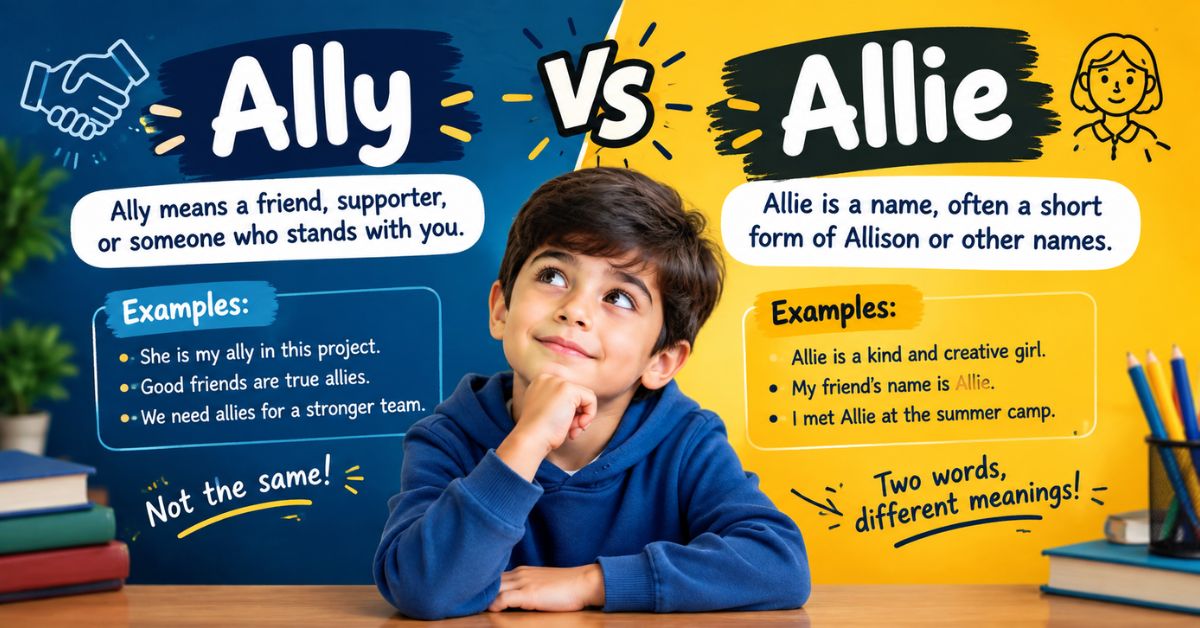
Have you ever typed Ally vs Allie and stopped to wonder which spelling belongs in your sentence? You’re not alone. These words look almost identical and can sound the same when you use ally as a noun.
The difference, however, is important. Ally is a regular English word that usually means a supporter, partner, or person, group, or country working toward a shared goal. Allie is generally a personal name or nickname.
There is one useful detail that often gets missed: Ally can also be someone’s name. When it is a person’s chosen name, you should use their exact spelling. The context tells you which word you need.
The Core Difference

The simplest way to remember the difference is:
| Word | Main meaning | Part of speech | Example |
|---|---|---|---|
| ally | A supporter, partner, or cooperating person or group | Noun or verb | She is a trusted ally. |
| Allie | A personal name or nickname | Proper noun | Allie called this morning. |
When ally means a supporter, it normally appears in lowercase unless it begins a sentence. Allie, when used as a person’s name, starts with a capital letter.
For example:
My closest ally helped me through the difficult project.
Allie helped me finish the project.
The first sentence describes a supportive relationship. The second identifies a person.
Both spellings can be correct. They simply do different jobs.
Ally Definition, History, and Usage
The word ally has a broad meaning. You can use it for an individual, organization, political group, business, or country that supports another person or group.
It often appears in discussions about friendship, teamwork, politics, war, business, advocacy, and cooperation.
Ally Definition
An ally is someone or something that supports another person, group, or country or works with them toward a shared purpose.
Cambridge Dictionary gives ally meanings connected with support, cooperation, and political or military relationships. It also lists the word as both a noun and a verb.
Cambridge Dictionary: ally definition
Ally as a noun
As a noun, ally means a supporter, partner, or cooperating person or group.
Examples include:
- A trusted coworker can become your ally at work.
- Canada is a close ally of the United States.
- She became an important ally during the campaign.
- The organization gained several new allies.
The plural form is allies, not allys.
An ally doesn’t have to be your close friend. A colleague may support you during a workplace dispute without having a personal friendship with you.
Ally as a verb
As a verb, ally means to join, connect, or cooperate with someone for a shared purpose.
You will often see it in the structure ally with or ally yourself with.
Examples:
- The two groups decided to ally with one another.
- Several organizations allied to protect the local environment.
- She refused to ally herself with the dishonest group.
There’s also an important pronunciation detail here. In American English, the noun ally is pronounced differently from the verb in many dictionary guides. Cambridge lists the noun as /ˈæl.aɪ/ and gives verb pronunciations including /əˈlɑɪ/.
Word Origins
The history of ally helps explain why the word carries an idea of connection.
The English word traces back through Middle English and Anglo-French to Latin alligare, meaning “to bind to.” That history fits the modern meaning nicely because allies become connected through cooperation or a shared interest.
The related word alliance carries the same basic idea of joining together.
That makes a simple memory trick possible:
ally → alliance → partnership
Ally in Politics Meaning
In politics and international relations, an ally is usually a person, political group, or country that cooperates with another for shared interests.
A political ally might provide diplomatic support, coordinate policy, cooperate on security, or work together during an international crisis.
The word also has a strong military meaning. A country can become an ally of another nation through an agreement involving defense or cooperation. Cambridge specifically includes this political and military sense in its definition.
For example:
The two countries became close allies.
The president met with several international allies.
During the conflict, allied countries coordinated their efforts.
Examples of modern political allies
Political relationships can change over time, so it’s better to treat specific alliances as historical or current relationships rather than permanent facts.
Common examples of contexts where you may see ally include:
- International relations
- Military cooperation
- Diplomatic partnerships
- Economic cooperation
- National security
- Election politics
- Strategic alliances
In historical writing, the Allies can also refer to the coalition of countries that fought the Axis powers during World War II.
Allie Meaning
Allie is generally a personal name or nickname. Unlike the common noun ally, it doesn’t normally mean a supporter or partner.
For example:
Allie joined the meeting at noon.
Here, Allie identifies a particular person.
However, names don’t follow exactly the same rules as dictionary words. A person can legally or personally spell their name Ally, Allie, Alli, or another variation.
That’s why the safest rule is simple: use the spelling the person actually uses for their name.
Allie Definition
Allie is commonly used as a given name or nickname. It can stand alone as a first name or serve as a shortened form of another name.
Examples include:
- Allie called me yesterday.
- I met Allie after class.
- Allie’s presentation was excellent.
Because it functions as a proper noun, capitalize it when referring to a person’s name.
Read More: Parents’ vs Parent’s Differences and Correct Usage
Related Articles You May Find Helpful
For reliable word definitions, pronunciation, and usage, consult established dictionaries such as Cambridge Dictionary.
Allie Name Meaning
The name Allie has several naming connections, and its exact background depends on the individual.
It can appear as a nickname or variant connected with names such as:
- Allison
- Alison
- Alexandra
- Alice
- Alyssa
- Other names beginning with “Al”
Allie can also be a person’s full given name rather than a shortened form.
One important distinction is often overlooked online: Allie is not exclusively a girl’s name in every naming tradition. It can function as a unisex given name, so context matters.
Allie Nickname Meaning
As a nickname, Allie can be a shortened or affectionate form of several longer names.
For example:
| Full name | Possible nickname |
|---|---|
| Allison | Allie |
| Alison | Allie |
| Alexandra | Allie |
| Alice | Allie |
| Alyssa | Allie |
Not every person named Allie uses it as a nickname. Some people have Allie as their official first name.
The same applies to Ally. If someone’s name is Ally, that spelling is correct even though ally also exists as a common English word.
Popularity of the Name Allie
Allie has a long history as a given name in the United States. The U.S. Social Security Administration maintains national baby-name data based on Social Security card applications.
Recent SSA data show that Allie ranked #569 for girls born in 2025, compared with #554 in 2024, a change of 15 places.
The SSA also warns that different spellings are counted separately. That means Allie, Ally, Alli, and similar forms aren’t automatically combined into one ranking.
U.S. Social Security Administration: Popular Baby Names
A Direct Comparison
| Feature | Ally | Allie |
|---|---|---|
| Common English word | Yes | No |
| Common noun | Yes | No |
| Verb | Yes | No standard verb use |
| Personal name | Yes | Yes |
| Meaning as a common word | Supporter or partner | Usually none as a common noun |
| Capitalization | Lowercase unless sentence-starting | Capitalized as a name |
| Plural | Allies | Not applicable as a name |
| Common context | Support, politics, teamwork, advocacy | Personal names and nicknames |
The biggest point is this: Ally and Allie aren’t simply two spellings of the same English noun.
How to Use Ally in a Sentence
The easiest way to use ally correctly is to ask whether the sentence describes support, cooperation, or partnership.
Examples as a noun
- She became my strongest ally during the project.
- Every leader needs a reliable ally.
- The company found an unexpected ally in the local community.
- Several countries are close allies.
- A good mentor can become an important ally.
Examples as a verb
- The two organizations decided to ally with each other.
- Several groups allied to support the proposal.
- The company chose to ally itself with an established partner.
The verb is less common in everyday conversation than the noun. Still, it’s grammatically correct and useful in formal writing.
Ally Synonyms
Depending on the context, useful synonyms for ally include:
- Supporter
- Partner
- Collaborator
- Associate
- Teammate
- Advocate
- Helper
- Companion
- Backer
- Defender
These words aren’t perfect substitutes in every sentence. For example, advocate emphasizes active support for a cause, while partner focuses more on cooperation.
How to Use Allie in a Sentence
Use Allie when you’re identifying a person whose name is Allie.
Examples:
- Allie called after the meeting.
- I asked Allie to review the document.
- Allie is joining us for dinner.
- Everyone thanked Allie for her help.
- I spoke with Allie yesterday.
Remember that capitalization matters when Allie functions as a proper name.
Ally vs Allie Examples in Sentences
| Sentence | Correct word |
|---|---|
| She has always been a trusted ___ during difficult times. | ally |
| ___ sent the report this morning. | Allie |
| The country gained another international ___. | ally |
| I invited ___ to the meeting. | Allie |
| A good coworker can become an important ___. | ally |
| ___ helped organize the event. | Allie |
| The two groups decided to ___. | ally |
| My friend ___ lives nearby. | Allie |
Related Articles You May Find Helpful
For additional grammar and vocabulary questions, use trusted dictionary sources to confirm definitions, pronunciation, and usage.
Common Grammar Mistakes With Ally vs Allie

Because these words can sound alike, writers sometimes choose the wrong spelling.
Using “Allie” when you mean “Ally”
Incorrect:
She is a strong Allie of the organization.
Correct:
She is a strong ally of the organization.
The sentence describes a supporter. It doesn’t identify someone named Allie.
Using “Ally” as someone’s name
This mistake requires more care.
If someone’s name is Allie, write:
Allie will join us tomorrow.
But if their actual name is Ally, then:
Ally will join us tomorrow.
Personal names don’t have one universal spelling. Always follow the person’s chosen or official spelling.
Capitalization errors
When ally means a supporter, don’t capitalize it in the middle of a sentence:
She is my closest ally.
When Allie is someone’s name, capitalize it:
Allie is my closest friend.
Why Ally vs Allie Creates Spelling Confusion
Three things make this pair easy to mix up.
Identical pronunciation
When ally functions as a noun, it has the same common pronunciation as Allie in American English.
That means your ears may not help you choose the spelling. Context has to do the job.
Nearly identical spelling
The words differ by only a small spelling pattern:
- Ally ends in y.
- Allie ends in ie.
That tiny difference changes the word’s identity.
Different grammatical roles
Ally can function as a noun or verb.
Allie generally functions as a proper noun when used as a person’s name.
This grammatical difference provides a useful clue when you’re unsure.
Read More : Mold vs Mould Which Spelling Is Correct?
When to Use Ally vs Allie
The decision becomes much easier when you focus on meaning rather than sound.
Are you describing a supporter or partner?
Use ally.
She became an important ally during the campaign.
Are you referring to someone’s name?
Use the person’s actual name spelling.
Allie is presenting the report.
If the person’s name is Ally, use Ally instead.
Quick reference table
| If you mean… | Use |
|---|---|
| A supporter | ally |
| A partner | ally |
| A cooperating country | ally |
| A political supporter | ally |
| Someone who joins forces with another group | ally |
| A person named Allie | Allie |
| A nickname spelled Allie | Allie |
| A person whose chosen name is Ally | Ally |
Ally in Social Advocacy
In social advocacy, an ally is someone who supports a community or cause, especially when that person isn’t part of the affected group themselves.
For example, a person may act as an ally by:
- Speaking up against unfair treatment
- Supporting inclusive policies
- Listening to affected communities
- Challenging discrimination
- Supporting equal opportunities
The word appears frequently in discussions about workplace inclusion, civil rights, LGBTQ+ advocacy, racial justice, and other social movements. Cambridge also includes this broader supportive meaning in its definition of ally.
Related Articles You May Find Helpful
When writing about social advocacy, use specific terms that explain the type of support involved rather than treating ally and advocate as exact synonyms.
Allie as a Cultural Name
Allie has also become familiar through books, movies, television, and popular culture.
One well-known example is Allie Hamilton, the central character in The Notebook. That cultural association has helped make the spelling recognizable to many English speakers.
Still, a fictional character doesn’t determine the meaning of the name. Allie remains a personal name that people may use as either a full name or nickname.
Tips to Remember the Ally vs Allie Spelling Difference
A few simple tricks can make this distinction stick.
Think about alliances
Think:
Ally → alliance → partnership
If you’re talking about support or cooperation, ally is probably the word you need.
Apply the name rule
If you’re referring to someone named Allie, write Allie.
If their name is Ally, write Ally.
The person’s actual spelling always wins.
Check the sentence context
Ask yourself:
Am I describing a supporter, or am I naming a person?
Supporter or partner → ally
Person’s name → use that person’s spelling, such as Allie
Reference Cambridge Dictionary Definitions
When you’re unsure about the dictionary meaning or grammatical function of ally, check a reliable reference.
Practice Session: Ally vs Allie
Try these before checking the answers.
Fill in the Blanks
- She became my closest ___ during the difficult project.
- ___ called me after lunch.
- Every country needs reliable international ___.
- I met ___ at the conference.
- A supportive colleague can become a valuable ___.
- ___ organized the presentation.
- The two organizations decided to ___.
- The country gained another powerful ___.
- My friend ___ lives in Chicago.
- She has always been a strong ___ of the project.
Answers
| Question | Answer |
|---|---|
| 1 | ally |
| 2 | Allie |
| 3 | allies |
| 4 | Allie |
| 5 | ally |
| 6 | Allie |
| 7 | ally |
| 8 | ally |
| 9 | Allie |
| 10 | ally |
FAQs
Is it spelled ally or Allie?
Both can be correct. Ally is the standard English word for a supporter or partner, while Allie is generally a personal name.
What is the difference between ally and Allie?
Ally means a supporter, partner, or cooperating person or group. Allie is usually a person’s name or nickname.
What does ally mean?
An ally is someone, a group, or a country that supports or cooperates with another toward a shared purpose.
Who is an ally?
An ally is a person, group, organization, or country that offers support, cooperation, or partnership.
Is an ally the same as a friend?
Not exactly. A friend usually describes a personal relationship, while an ally emphasizes support or cooperation around a particular goal.
What is a true ally?
A true ally consistently supports another person or group through meaningful actions, respect, cooperation, and encouragement.
Can a friend be an ally?
Yes. A friend can also be an ally when they actively support you or stand with you in a particular situation.
What does ally mean in war?
In war, an ally is a country that cooperates with another country, often through military, security, or strategic support.
How do you spell ally as a supporter?
When you mean a supporter or partner, spell it ally.
How do you spell Allie as a name?
If someone’s name is Allie, spell it Allie with a capital A. Always follow the person’s actual name spelling.
What is Allie short for?
Allie can be a nickname for names such as Allison, Alison, Alexandra, Alice, or Alyssa, although some people have Allie as their full first name.
Is Allie a girl’s name?
Allie is commonly used as a feminine name, but it can also function as a unisex given name. Naming conventions vary.
Can ally be used as a verb?
Yes. Ally can mean to join or cooperate with someone for a shared purpose.
What are some synonyms for ally?
Common synonyms include supporter, partner, collaborator, associate, advocate, teammate, and backer.
What is the opposite of ally?
Depending on context, possible opposites include enemy, opponent, rival, adversary, and foe.
How do you pronounce ally?
As a noun, ally is commonly pronounced like “AL-eye.” Cambridge gives /ˈæl.aɪ/ for the American noun pronunciation.
How do you pronounce Allie?
Allie is commonly pronounced the same as the noun ally in American English.
Can ally refer to a person, organization, or country?
Yes. Ally can describe an individual, organization, political group, business, or country that provides support or cooperates with another.
Can I call someone an ally?
Yes. You can call someone an ally when they support you, your group, or your cause through cooperation or meaningful action.
How can I remember the difference between ally and Allie?
Use this simple rule: supporter or partner = ally; person’s name = use the person’s actual spelling, such as Allie.
Why do people confuse ally and Allie?
People confuse them because the noun ally and the name Allie can sound the same while having different spellings and grammatical roles.
Read More : Success vs Sucess: Which is Correct? Complete Guide
Final Thoughts
The ally vs Allie difference looks small, but the meaning changes completely.
Use ally when you mean a supporter, partner, collaborator, or cooperating person, group, or country. Use Allie when that is someone’s name.
There’s one final rule worth remembering: personal names don’t have a single “correct” spelling. If someone’s name is Ally, write Ally. If their name is Allie, write Allie.
For the common English word, however, the spelling is clear:
Supporter or partner → ally
Person’s name → use their actual spelling
Once you focus on meaning instead of sound, this confusing pair becomes much easier to handle.

Finn Bradley is a grammar and language writer at Megazine Tech, focused on making English easier to understand. He researches grammar rules, vocabulary, sentence usage, punctuation, and common writing questions. Through clear explanations and practical examples, Finn helps readers build stronger communication skills and write with greater confidence in everyday situations.