


Until is the correct spelling. Untill is a common spelling mistake and is not the standard spelling in modern English.
Use until when you mean that something continues up to a particular time, event, or point.
For example:
- I will wait until 6 p.m.
- Please stay here until I return.
- The store is open until Friday.
- We talked until the restaurant closed.
The key spelling rule is simple: until has one L at the end.
What Is the Difference Between Until and Untill?
The difference is spelling, not meaning.
| Word | Correct? | Meaning |
|---|---|---|
| until | Yes | Up to a particular time or event |
| untill | No | Common misspelling of until |
Untill does not represent a different grammatical form. If you see it in standard English writing, it should normally be corrected to until.
For example:
Incorrect: I will stay untill Monday.
Correct: I will stay until Monday.
The confusion often comes from the word till, which is also correct and has a similar meaning. However, until ends with one L, while till ends with two.
Cambridge identifies until as both a preposition and a conjunction. It also notes that till and ’til are more informal alternatives.
Why It Matters
A single extra letter can turn a correct word into a spelling error.
That may not cause confusion in a casual text message. Most readers will understand what you mean. However, spelling matters more in situations where your writing represents you professionally.
Pay particular attention to until in:
- Job applications
- Resumes
- Cover letters
- Business emails
- Academic assignments
- Reports
- Exams
- Website content
- Professional messages
Compare these sentences:
Incorrect: I will be available untill Friday.
Correct: I will be available until Friday.
The meaning remains clear in both sentences. Only the second follows standard spelling.
The Core Rule
Remember this one rule:
UNTIL = ONE L
UNTILL = INCORRECT
The correct spelling is:
U N T I L
There is no spelling difference between American and British English for this word. Both use until.
A useful memory trick is to think of until as ending with the shorter form til. The extra L belongs to till, not until.
What Does Until Mean?
Until means up to a particular time, event, or point.
It usually shows that an action, condition, or situation continues and reaches an endpoint.
For example:
- We waited until noon.
- She studied until midnight.
- The office remains open until 6 p.m.
- Wait until the meeting ends.
- Don’t leave until I call you.
In each sentence, until identifies the point where the earlier situation ends or changes.
You can use it with a specific time:
- until 5 p.m.
- until midnight
- until Monday
- until tomorrow
- until next week
You can also use it with an event:
- until I arrive
- until the rain stops
- until everyone leaves
- until the meeting ends
- until you feel ready
How to Use Until
Until as a Preposition
Until works as a preposition when it comes before a noun or time expression.
Examples include:
- We stayed there until midnight.
- She worked until lunchtime.
- The office is open until Friday.
- The road will remain closed until Monday.
- I will be here until tomorrow.
Here, until connects the action or condition with a particular point in time.
Cambridge describes this use as meaning “up to” a particular time.
Until as a Conjunction
Until works as a subordinating conjunction when it introduces another clause containing a subject and verb.
For example:
- Wait until I arrive.
- Don’t leave until she comes back.
- We stayed inside until the rain stopped.
- Keep practicing until you feel confident.
- We won’t know until the results arrive.
In Wait until I arrive, the clause I arrive contains its own subject and verb.
The second clause gives the event that marks the endpoint of the waiting.
Use the Present Tense for Future Events After Until
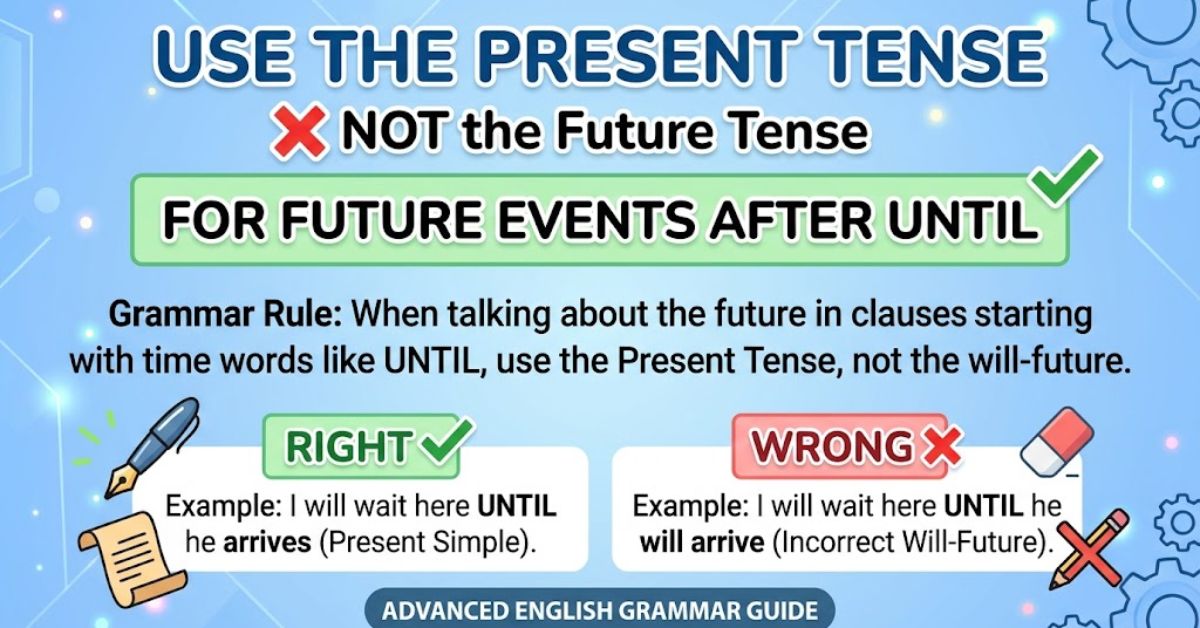
When until introduces a future event, English normally uses the present tense rather than will in the until clause.
Correct: I will wait until you arrive.
Incorrect: I will wait until you will arrive.
Another example:
Correct: We won’t start until everyone is ready.
Incorrect: We won’t start until everyone will be ready.
The future meaning already comes from the main clause. English normally uses the present form after until for that future reference. Cambridge specifically recommends present verb forms after until when referring to future events.
Correct Examples
Everyday Conversation
- I’ll wait until you get home.
- Don’t eat the cake until dinner.
- I stayed awake until midnight.
- Let’s talk until the movie starts.
- Wait until you see this.
- I will be available until 4 p.m. today.
- Please keep the documents safe until the meeting.
- The offer remains valid until Friday.
- The office will remain closed until Monday.
Workplace
- We cannot make a final decision until the manager arrives.
- The team worked until the project was completed.
- Please wait until everyone has reviewed the document.
- The system will remain offline until maintenance is complete.
School
- Students must remain in the classroom until the teacher arrives.
- I studied until I understood the chapter.
- Don’t submit your paper until you have checked it.
- The library stays open until 8 p.m.
Social Media
- I can’t wait until the weekend.
- Counting the days until our vacation.
- I stayed up until 2 a.m. watching the series.
- Wait until you see the final result!
Academic Writing
- The results remained stable until the final stage of the experiment.
- The trend continued until the final year of the study.
- The policy remained unchanged until researchers identified a significant difference.
- The participants were monitored until the study ended.
Incorrect vs. Correct
| Incorrect | Correct |
|---|---|
| I will wait untill you arrive. | I will wait until you arrive. |
| The shop is open untill 9 p.m. | The shop is open until 9 p.m. |
| She stayed untill midnight. | She stayed until midnight. |
| Don’t leave untill I return. | Don’t leave until I return. |
| We worked untill Friday. | We worked until Friday. |
| Wait untill the teacher arrives. | Wait until the teacher arrives. |
The correction is straightforward in every case: remove the extra L.
Why Do People Make This Mistake?
The spelling mistake makes sense when you look at common English spelling patterns.
Many familiar words end with double L:
- still
- fill
- will
- full
- skill
- hill
- drill
Then there is till, a legitimate English word that means much the same thing as until.
That creates an easy mental trap:
until → till → double L
But the spelling doesn’t work that way.
The correct forms are:
until
till
untill is incorrect
Fast typing can also cause the error. Someone may know the correct spelling but automatically add another L.
The best solution is simple repetition. Learn until as one complete word instead of rebuilding its spelling each time.
Common Mistakes Checklist
1. Adding a Second L
Incorrect: untill
Correct: until
The extra L is unnecessary.
2. Confusing Until With Till
Both words are correct.
I will wait until noon.
I will wait till noon.
However, till tends to sound more informal. Until is the safer choice for neutral and formal writing.
3. Using Until When You Mean By
This is a meaning problem rather than a spelling problem.
Incorrect: Please finish the report until Friday.
If Friday is the deadline, write:
Correct: Please finish the report by Friday.
Use until when something continues up to that time.
4. Using Until for Quantity
Don’t normally use until with a number representing quantity.
Incorrect: The hall can hold until 500 people.
Correct: The hall can hold up to 500 people.
Use up to for quantities and maximum numbers.
5. Using Until for Distance
Use as far as when talking about distance.
Incorrect: We drove until Lahore.
Better: We drove as far as Lahore.
This distinction separates time expressions from distance expressions.
Until in Real English
1. Grammatically Correct and Natural
I’ll wait until you arrive.
This sounds completely natural in everyday English.
The office is open until 6 p.m.
This also works naturally in professional communication.
2. Grammatically Possible but Less Natural
I will remain here until the conclusion of the meeting.
The sentence is grammatically possible, but it sounds formal and somewhat stiff.
A more natural version would be:
I’ll stay here until the meeting ends.
Good English isn’t only about correctness. Natural phrasing matters too.
3. Natural Everyday English
Wait till I get back.
This is normal in casual conversation.
The important point is that till is a legitimate word. It isn’t the same spelling mistake as untill.
Until vs. By: A Very Important Difference
This is one of the most useful distinctions to learn.
Until describes something that continues up to a particular time.
By gives a deadline by which something must happen.
Compare:
I will work until Friday.
The work continues up to Friday.
I will finish the work by Friday.
The work must be completed no later than Friday.
Another example makes the difference clearer:
The application process remains open until Monday.
The process continues through that time.
Submit your application by Monday.
Monday is the deadline.
Cambridge specifically recommends by, rather than until, when describing something that must happen before a particular deadline.
Until vs. Till
Until and till can often express the same basic meaning.
| Feature | Until | Till |
|---|---|---|
| Correct word | Yes | Yes |
| Meaning | Up to a time or event | Up to a time or event |
| Formal writing | Preferred | Less common |
| Casual speech | Common | Common |
| Standard English | Yes | Yes |
| Misspelling | Untill | Til when intended as till |
For example:
I waited until 8 p.m.
I waited till 8 p.m.
Both sentences are grammatical.
Cambridge notes that till and ’til are more informal than until.
American vs. British English
There is no American versus British spelling difference here.
American English uses:
until
British English also uses:
until
So these are correct in both varieties:
- The store is open until 9 p.m.
- The shop is open until 9 p.m.
- I will wait until Monday.
The spelling untill isn’t a British alternative. It is simply a misspelling.
Formal vs. Informal Usage
Until works across almost every style of English.
It fits:
- Academic writing
- Business emails
- Reports
- Professional documents
- Formal notices
- Everyday conversation
- Text messages
- Social media
Till is also correct, but it generally has a more conversational feel.
For example:
Formal or neutral: Registration remains open until Friday.
Casual: I’ll wait till Friday.
Both are understandable and grammatical. The choice depends mainly on tone.
Common Phrases With Until
Until now
Until now means up to the present time.
Until now, nobody had explained the problem.
Until then
Until then means up to a particular time mentioned earlier.
I’ll see you next week. Until then, take care.
Until recently
Until recently means up to a short time ago.
Until recently, the company operated from a small office.
Until further notice
This means something continues until another announcement changes it.
The building will remain closed until further notice.
Until next time
This phrase often appears when saying goodbye.
Thanks for joining us. Until next time!
Not until
Not until means not before a particular time or event.
The train didn’t arrive until midnight.
This construction often emphasizes that something happened later than expected.
Until vs. Before
Until and before can sometimes appear in similar sentences, but they express different relationships.
Wait here until I return.
Your waiting continues up to my return.
Leave before I return.
Your departure should happen earlier than my return.
Another comparison:
Don’t open the door until I arrive.
Keep the door closed while waiting for my arrival.
Close the door before I arrive.
The closing should happen earlier than my arrival.
Cambridge also distinguishes until from before when describing an event that must happen in advance.
Real-Life Situations
Job Interview
I’m available for an interview until 4 p.m. today.
Here, until identifies the endpoint of your availability.
Business Meeting
Please wait until everyone arrives before we begin.
The waiting continues until everyone arrives.
The discount will remain available until Friday.
The offer continues up to the stated time.
Text Message
Wait until I get there.
This is natural and conversational.
Exam
I studied until midnight.
This tells the reader when the studying stopped.
Academic Writing
The trend remained stable until the final year of the study.
Here, until marks the point at which the earlier condition ended or changed.
Memory Trick
Use this simple rule:
UNTIL = ONE L
UNTILL = TWO Ls = WRONG
Another useful trick is to connect until with the idea of one endpoint.
Think:
Until = up to one point in time.
If you’re typing untill, stop and remove one L.
Expert Tips
Tip 1: Learn the Word as a Whole
Don’t reconstruct the spelling letter by letter.
Train your eyes to recognize:
until
Tip 2: Watch for the Double L Trap
If you type untill, remove the second L.
The correct form is always:
until
Tip 3: Don’t Confuse Spelling With Meaning
The main issue in until vs. untill is spelling.
You don’t need two definitions. Untill isn’t a second meaning of until.
Tip 4: Learn Until With Common Patterns
Memorize useful combinations such as:
- wait until
- stay until
- work until
- open until
- closed until
- until tomorrow
- until Friday
- until I arrive
- until it ends
- until further notice
These patterns make correct usage easier to remember.
Tip 5: Learn By vs Until Together
This pair prevents many grammar mistakes.
by Friday = deadline
until Friday = continuation
That simple contrast is worth remembering.
Tip 6: Don’t “Correct” Till
Some learners assume till is wrong because it looks shorter.
It isn’t.
Till is a standard English word. It is often more informal than until.
Quick Reference
| Question | Answer |
|---|---|
| Correct spelling | until |
| Incorrect spelling | untill |
| Number of Ls in until | One |
| Meaning | Up to a time or event |
| Can until be a preposition? | Yes |
| Can until be a conjunction? | Yes |
| Is till correct? | Yes |
| Is till more informal? | Generally yes |
| Use by for | Deadlines |
| Use up to for | Quantities |
| Use as far as for | Distance |
| Future verb after until | Usually present tense |
| American spelling | until |
| British spelling | until |
Mini Quiz
- Which is correct: until or untill?
Answer: Until. - Complete the sentence: “I will wait ___ 6 p.m.”
Answer: Until. - Correct this sentence: “She stayed untill midnight.”
Answer: She stayed until midnight. - Which word normally gives a deadline: until or by?
Answer: By. - Which is correct: “I will wait until you arrive” or “I will wait until you will arrive”?
Answer: I will wait until you arrive. - Is till a correct English word?
Answer: Yes. - Which is correct for quantity: “until 500 people” or “up to 500 people”?
Answer: Up to 500 people. - Which is better for distance: “until Lahore” or “as far as Lahore”?
Answer: As far as Lahore.
FAQ
Is “untill” ever correct?
No. Untill is not the standard spelling of the English word until.
Does “until” have two Ls?
No. Until has only one L at the end.
Is “until” a preposition or a conjunction?
It can be both. It functions as a preposition before a time expression and as a conjunction when it introduces a clause.
Can I use “until” in formal writing?
Yes. Until is completely appropriate in academic, professional, business, and formal writing.
Is “till” grammatically correct?
Yes. Till is a standard English word that can often replace until, especially in informal contexts.
Is “’til” correct?
’Til appears in informal writing as a shortened form associated with until, but until is the safest choice in formal writing.
Should I say “until Friday” or “by Friday”?
Use until Friday for something that continues up to Friday. Use by Friday when Friday is the deadline.
Can I say “until 500 people”?
Normally, no. Use up to 500 people when describing quantity or capacity.
Can I use “until” for distance?
Normally, no. Use as far as when describing distance.
Should I use “will” after “until”?
Usually not when the until clause refers to a future event. Say until she arrives, not until she will arrive.
Is “until” the same in American and British English?
Yes. Both American and British English spell the word until with one L.
Quick Summary
Until is the correct spelling. Untill is an incorrect spelling and should not be used in standard English.
The word until means up to a particular time or event. It can function as a preposition or a conjunction, depending on what follows it.
For example, say:
I worked until midnight.
Wait until I arrive.
Don’t write:
I worked untill midnight.
The extra L is the entire spelling problem.
Also remember that till is a legitimate English word, although it tends to sound more informal. Don’t confuse it with untill, which is simply a misspelling.
For deadlines, choose by:
Submit the report by Friday.
For ongoing situations, choose until:
The office remains open until Friday.
For quantities, use up to. For distance, use as far as. When referring to a future event after until, English normally uses the present tense.
The easiest rule to remember is:
Until = one L. Untill = incorrect.

Finn Bradley is a grammar and language writer at Megazine Tech, focused on making English easier to understand. He researches grammar rules, vocabulary, sentence usage, punctuation, and common writing questions. Through clear explanations and practical examples, Finn helps readers build stronger communication skills and write with greater confidence in everyday situations.