

You wouldn’t expect really vs realy to cause much confusion. It seems simple: just one letter makes the difference. Yet somehow, that missing “l” keeps sneaking into emails, essays, text messages, and professional writing. It’s a small mistake, but it can affect the clarity and credibility of your writing.
The confusion often comes from fast typing, pronunciation, and unpredictable English spelling rules. If you’ve ever paused and wondered which is correct, realy or really, you’re not alone. This common spelling mistake happens more often than people realize.
The good news? Once you understand the spelling pattern and proper grammar rules, you can avoid this mistake with confidence.
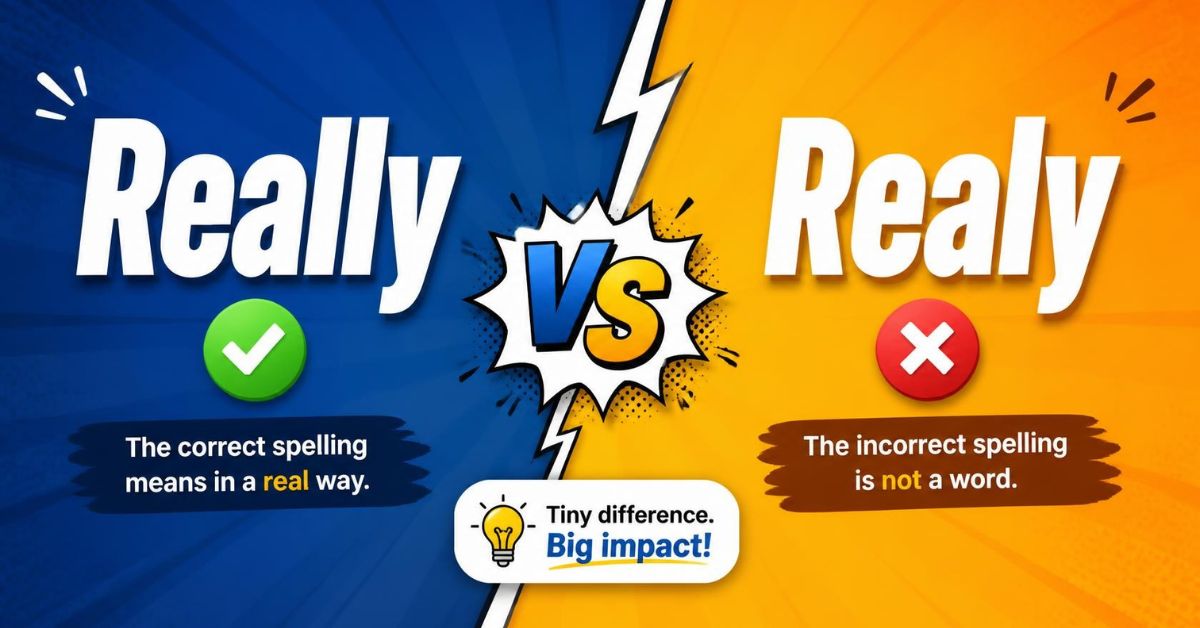
Core fact: “Really” is correct; “realy” is a misspelling.
So, let’s clear up the confusion with practical examples, English grammar rules, spelling tips, and exercises.
Really vs Realy: The Clear and Final Answer
If you’re searching for really vs realy or wondering which is correct, realy or really, the answer is simple and consistent across standard English.
- Really is the correct spelling.
- Realy is an incorrect spelling.
There are no exceptions in standard English writing. You should use “really” in academic assignments, professional emails, blog posts, social media captions, and everyday communication.
Although the mistake looks minor, it can make your writing appear rushed or poorly proofread. Understanding the correct spelling of really helps you communicate more clearly and avoid common English spelling errors.
Still, the mistake persists. Why does it happen so often?
The main reasons include typing too quickly, relying on pronunciation, and confusing the spelling pattern with other English words.
The Meaning of “Really”
To fully understand the really vs realy meaning, it helps to explore what “really” actually does in a sentence.
At its core, “really” is an adverb of degree, often called an intensifier in English grammar. That might sound technical, but the idea is simple.
“Really” strengthens what you’re saying. It adds emphasis, intensity, and sometimes emotion to a sentence.
Imagine describing a meal:
- The food was good.
- The food was really good.
The second sentence carries more emphasis. It makes your opinion sound stronger and more expressive. That’s the role of “really” in everyday English.
What Does Really Mean in English?
Depending on the context, the word “really” can express several meanings.
- Intensity: This is really important.
- Truth or sincerity: I really mean what I said.
- Surprise or disbelief: Really? That happened?
- Genuine interest: Do you really want to go?
- Confirmation: Is that really your final decision?
These different uses make “really” one of the most flexible words in everyday English.
You can use it in conversations, text messages, emails, essays, and other forms of communication. However, its tone and meaning depend on how you place it within a sentence.
Is Realy a Word? A Direct and Honest Explanation
Let’s address the confusion directly.
Is Realy a Word?
No. “Realy” is not a standard English word.
It has no accepted meaning in standard English usage. When someone writes “realy,” they usually intend to write “really” but accidentally leave out one letter.
You should avoid using “realy” in formal writing, academic work, business communication, and published content.
For example:
- Incorrect: I realy appreciate your support.
- Correct: I really appreciate your support.
The second sentence uses the proper English spelling and communicates the intended meaning without a spelling error.
Why Is Realy Incorrect in English?
The mistake usually comes from habit, pronunciation, or incorrect assumptions about English spelling.
People often:
- Rely on how words sound instead of remembering their correct spelling.
- Type quickly and accidentally leave out letters.
- Apply spelling patterns from similar words incorrectly.
- Skip proofreading when writing emails, assignments, or messages.
- Assume that a shorter spelling must be acceptable because it sounds right.
Because “really” can sound quick and compact when spoken, the brain may accept “realy” as a possible spelling. However, pronunciation doesn’t always reveal the correct spelling of an English word.
The best approach is to learn the correct spelling and recognize it whenever you write.
Realy Meaning in English: Incorrect Usage
Strictly speaking, “realy” has no recognized meaning in standard English. When it appears in writing, it generally indicates:
- A typing mistake.
- A spelling error caused by carelessness or unfamiliarity.
- A missing letter that wasn’t noticed during proofreading.
- An intentional misspelling in a username, brand name, or informal creative text.
Even in casual writing, “realy” may look like an accidental typo rather than a deliberate choice.
Remember that informal communication allows more flexibility in style, but the standard spelling remains really.
Grammar Rules for Really
Understanding really vs realy grammar removes guesswork and helps you write with confidence.
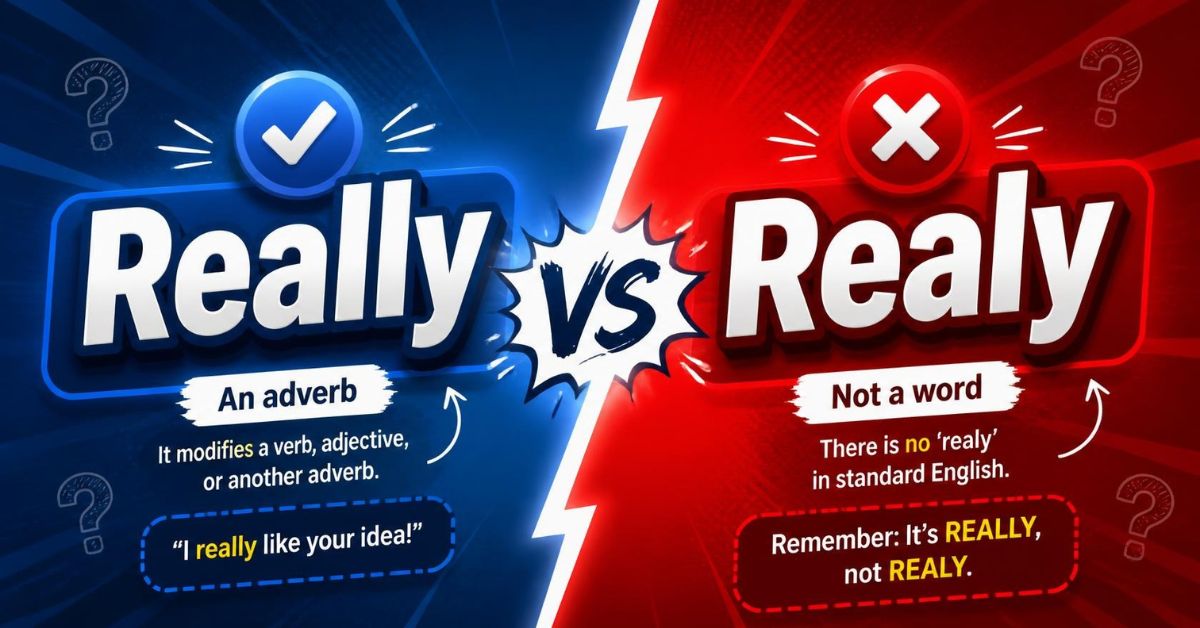
“Really” belongs to a group of words called adverbs. More specifically, it often functions as an intensifier, meaning it strengthens the meaning of another word or expression.
How to Use Really in Grammar
You will usually see “really” placed before the word or expression it modifies.
Examples:
- I really like this idea.
- She’s really talented.
- They worked really hard.
- The movie was really interesting.
- We really enjoyed our holiday.
In these sentences, “really” adds emphasis to a verb, an adjective, or an expression.
It can also appear at the beginning or end of a sentence, depending on the intended meaning and tone.
Examples:
- Really, you should try this.
- It’s a great solution, really.
- Do you really think so?
In each example, the word adds emphasis without changing the basic message.
Why Does Placement Matter?
Word placement affects sentence flow, naturalness, and clarity. Compare these sentences:
- I really understand this concept.
- I understand this concept, really.
The first sentence sounds natural in most situations. The second can work in conversation, but it sounds more like an afterthought or an attempt to reinforce the statement.
English usually places intensifiers close to the words or expressions they modify. This helps readers understand exactly what the writer wants to emphasize.
For example:
- She really loves reading.
- She loves reading really good books.
In the first sentence, “really” emphasizes how much she loves reading. In the second, it emphasizes the quality of the books.
The position of “really” can therefore influence the meaning and emphasis of a sentence.
Why Is “Really” Spelled with Two Ls?
This is where many spelling mistakes begin.
How to Spell Really Correctly
The correct spelling is really, not “realy.”
A helpful way to remember it is:
Real + ly = really
The base word “real” already ends in the letter “l.” When you add the suffix “-ly,” the original letter remains, and the suffix contributes another “l.”
The result is “really,” with two consecutive Ls.
This simple spelling pattern can help you remember the correct form whenever you write the word.
The Double-Consonant Pattern
When adding “-ly” to certain English words that already end in “l,” the resulting word contains two consecutive Ls. This pattern appears in several common adverbs.
Consider these examples:
| Base Word | Correct Form | Incorrect Form |
|---|---|---|
| Real | Really | Realy |
| Full | Fully | Fuly |
| Final | Finally | Finaly |
| Actual | Actually | Actualy |
| Usual | Usually | Usualy |
Notice how the final “l” in the base word remains when “-ly” is added. This pattern explains why “realy” is incorrect and why “really” is the proper spelling.
Learning these related words can improve your spelling accuracy and help you recognize similar mistakes.
Why Do We Drop the “E” in Truly?
English spelling rules can be confusing because different words follow different patterns.
For example:
- True → Truly
- Gentle → Gently
- Simple → Simply
In these examples, the final “e” is dropped before adding “-ly.”
However, the same rule doesn’t apply to “real.” The correct form is “really,” not “realy.”
This difference can cause confusion because English sometimes removes letters, sometimes retains them, and sometimes produces double letters.
The best strategy is to learn common word patterns alongside individual spellings rather than assuming that every word follows the same rule.
What Is the Difference Between Really vs Realy?
If you’re asking what the difference between really and realy is, the answer is straightforward.
“Really” is a correctly spelled English word with recognized meanings, grammatical functions, and proper usage.
“Realy” is a spelling error that doesn’t belong in standard English.
The difference may seem small, but correct spelling matters in professional and academic communication. A single missing letter can distract readers and make an otherwise well-written sentence appear less polished.
Compare the following examples:
- Correct: I really enjoyed the presentation.
- Incorrect: I realy enjoyed the presentation.
Both versions communicate the intended idea, but only the first follows standard English spelling.
When writing articles, essays, job applications, business emails, or website content, always choose “really.”
Really vs Realy in Sentences
Seeing correct and incorrect examples makes the difference easier to understand.
Correct Sentences With Really
- I really enjoyed the presentation.
- She’s really confident in her skills.
- He really understands the problem.
- We really appreciate your patience.
- The weather is really pleasant today.
- I really want to learn English.
- Are you really serious about this decision?
- This book is really helpful for beginners.
Each sentence uses “really” correctly to express emphasis, sincerity, or degree.
Incorrect Sentences With Realy
Here are examples of the same sentences with the common spelling mistake.
- I realy enjoyed the presentation.
- She’s realy confident in her skills.
- He realy understands the problem.
- We realy appreciate your patience.
- The weather is realy pleasant today.
The correction is simple: replace every instance of “realy” with really.
Although the difference is only one letter, correct spelling makes your writing easier to trust and more professional.
A Common Source of Confusion
Another frequent question involves the difference between “really” and “actually.”
Both words appear in everyday conversations, but they serve different purposes.
Really vs Actually: What’s the Difference?
“Really” often adds emphasis, expresses sincerity, or asks for confirmation.
“Actually” often introduces a fact, correction, clarification, or contrast with what someone might expect.
Compare these examples:
- I really like this idea.
- I actually like this idea.
The first sentence emphasizes how much the speaker likes the idea. The second may suggest that the speaker’s opinion differs from what someone expected.
Consider another example:
- She is really busy today.
- She is actually busy today.
The first emphasizes the degree of her busyness. The second may correct an assumption that she has free time.
Both words are correct, but they aren’t always interchangeable.
Understanding the difference between really and actually can help you choose more precise language in conversations, essays, and professional writing.
Pronunciation of Really: US vs UK English
Some spelling confusion comes from pronunciation.
How Do Americans Pronounce Really?
In American English, “really” is commonly pronounced /ˈriːli/, which sounds approximately like “REE-uh-lee” or “REE-lee,” depending on the speaker and speaking speed.
When people speak quickly, the word may sound shorter than it looks in writing. This can contribute to spelling mistakes, especially among people who rely heavily on pronunciation.
However, pronunciation should not determine the spelling. Regardless of how you say it, the standard spelling remains “really.”
Realy vs Really: British vs American English
This is not a regional spelling difference.
Both American and British English use really as the correct spelling.
| English Variety | Correct Spelling | Incorrect Spelling |
|---|---|---|
| American English | Really | Realy |
| British English | Really | Realy |
| Australian English | Really | Realy |
| Canadian English | Really | Realy |
You don’t need to change the spelling when writing for different English-speaking audiences. “Really” is the accepted form across these varieties of standard English.
Can You Use Really in Formal Writing?
Yes, but use it thoughtfully.
“Really” works well in conversational writing, blogs, personal emails, and everyday communication. It helps create a natural tone and allows you to emphasize important points.
However, in formal writing, the word can sometimes sound vague or less precise than a stronger alternative.
For example:
- General: This is really important.
- More precise: This is essential.
Another example:
- General: The results were really good.
- More precise: The results were excellent.
The revised sentences communicate the intended message more directly.
This doesn’t mean you should avoid “really” altogether. It simply means that you should consider your audience, purpose, and tone before using intensifiers in academic reports, business proposals, or professional documents.
Most importantly, remember that using “really” correctly is a matter of spelling and grammar, while deciding whether to replace it with a stronger word is a matter of style.
Common Spelling Mistakes and How to Avoid Them
The mistake “realy” belongs to a broader category of common English spelling errors. These mistakes often happen because of fast typing, unfamiliar spelling patterns, or a lack of proofreading.
Fortunately, a few simple habits can help you improve your English spelling.
1. Slow down when typing.
Typing quickly can cause you to skip letters, especially in familiar words. Take an extra moment to check words that you commonly misspell.
2. Remember the double L.
The easiest way to remember the correct spelling is to associate “really” with “real” and the suffix “-ly.” The original L stays, and another L appears in the suffix.
3. Proofread your writing.
Read your emails, essays, articles, and messages before sending or publishing them. A quick review can catch missing letters and other common spelling mistakes.
4. Use a spelling checker.
Digital spelling tools can highlight “realy” and suggest “really” as the correction. These tools are helpful, but you should still review their suggestions instead of accepting every change automatically.
5. Practice with example sentences.
Writing the correct word several times in different sentences helps reinforce its spelling and proper usage.
6. Read more English content.
Regular reading exposes you to correct spelling, grammar, vocabulary, and sentence structure. Over time, correctly spelled words become easier to recognize.
A simple mental reminder can help, too:
If you write “realy,” stop and check whether you’ve missed the second L.
An Example of Why This Mistake Matters
Imagine two professionals sending the same message to a client.
The first person writes:
“I realy appreciate your time.”
The second person writes:
“I really appreciate your time.”
The difference is subtle, but it can affect how polished the message appears. The second version follows standard English spelling, while the first contains an obvious typo.
In competitive environments, such as job applications, client communication, business proposals, and online publishing, small writing details can influence a reader’s impression.
One spelling mistake doesn’t automatically make someone a poor writer. However, repeated errors can distract readers from the message and make content appear less carefully prepared.
That’s why proofreading matters. Correct spelling helps you communicate your ideas clearly and present your work professionally.
How “Really” Fits Into English Grammar
To understand this word fully, it helps to look at the broader category of adverbs in English grammar.
Adverbs can modify verbs, adjectives, other adverbs, or entire sentences. They often explain how, when, where, or to what degree something happens.
It’s also useful to distinguish between adjectives and adverbs.
- Adjectives describe nouns or pronouns.
- Adverbs modify verbs, adjectives, other adverbs, or larger expressions.
For example:
- Adjective: The movie was interesting.
- Adverb: The movie was really interesting.
In the second sentence, “really” modifies the adjective “interesting” by increasing its intensity.
Consider another example:
- She runs quickly.
- She runs really quickly.
Here, “really” modifies the adverb “quickly,” adding emphasis to the description of how she runs.
This grammatical function makes “really” a useful intensifier in everyday English. It strengthens meaning without changing the basic subject or action of a sentence.
Really vs Very vs Truly
Sometimes, “really” isn’t the most suitable word for a sentence. Other adverbs can communicate similar ideas with slightly different meanings or tones.
| Word | Main Function | Typical Tone | Example |
|---|---|---|---|
| Really | General emphasis or sincerity | Conversational | I’m really happy. |
| Very | Emphasizes degree | Neutral | I’m very happy. |
| Truly | Expresses sincerity or genuine feeling | Sincere or expressive | I’m truly grateful. |
| Extremely | Expresses a high degree | Strong emphasis | The weather is extremely cold. |
| Absolutely | Expresses strong agreement or completeness | Emphatic | You’re absolutely right. |
Choosing the right word depends on the context.
For instance, “really” and “very” can both intensify adjectives, but they don’t work naturally with every expression. We commonly say “really enjoy,” while “very enjoy” is incorrect in standard English.
Similarly, “truly grateful” often emphasizes genuine appreciation, while “extremely grateful” emphasizes the degree of gratitude.
Learning these differences can expand your vocabulary and make your writing more precise.
Practice Exercises
Practice is one of the fastest ways to ensure you never confuse really vs realy again. These exercises help you recognize the correct spelling, understand proper usage, and improve your English grammar.
Fill in the Blank
Choose the correct word for each sentence. Remember: “really” is correct, while “realy” is a misspelling.
- I _____ enjoyed the movie; it was brilliant!
- She is _____ talented at playing the piano.
- Are you _____ sure this is the right address?
- The weather is _____ cold today!
- I can’t believe he _____ finished the marathon.
Answer Key
- Really
- Really
- Really
- Really
- Really
Correct the Mistakes
Identify and correct the spelling mistakes in these sentences.
- I realy want to try that new restaurant.
- She realy knows her subject well.
- He is realy excited about the promotion.
- We realy should leave early to avoid traffic.
Corrected Versions
- I really want to try that new restaurant.
- She really knows her subject well.
- He is really excited about the promotion.
- We really should leave early to avoid traffic.
Notice that the meaning of each sentence stays the same. Only the spelling changes.
Rewriting for Precision
Sometimes “really” is correct, but you can improve a sentence by choosing a more precise word.
Rewrite these sentences using stronger adjectives or suitable synonyms.
- The presentation was really good.
- She is really smart.
- That solution is really effective.
Possible Improvements
- The presentation was excellent.
- She is highly intelligent.
- That solution is extremely effective.
These alternatives demonstrate how word choice can make your writing more specific without changing the overall message.
Identify Misuse in Context
Read the paragraph below and identify every instance of “realy.”
“I realy enjoyed the workshop yesterday. The instructor was realy knowledgeable, and the exercises were really engaging. I hope they hold another session soon because it was realy helpful!”
Corrections
- First “realy” → really
- Second “realy” → really
- Third “realy” → really
The word “really” in “the exercises were really engaging” is already correct.
Tips for Practice
- Slow down when typing because even experienced English writers can accidentally drop letters.
- Proofread specifically for the double L in “really.”
- Remember the spelling pattern: real + ly = really.
- Read your sentences aloud to identify awkward wording, but check spelling visually, too.
- Practice distinguishing “really,” “very,” “truly,” and “actually.”
- Use spelling tools to catch mistakes before submitting or publishing your work.
Consistent practice helps you develop better spelling habits and improve your confidence in English writing.
Frequently Asked Questions About Really vs Realy
Is it really or realy?
Really is the correct spelling. “Realy” is a misspelling and should not be used in standard English writing.
Is realy ever correct?
No. “Realy” is not an accepted spelling of the standard English word. Use “really” in formal and informal writing.
What does really mean?
“Really” is an adverb that can express intensity, sincerity, truth, or surprise. For example, “I’m really happy” emphasizes happiness, while “Really?” can express surprise or disbelief.
Why does really have two Ls?
The word combines “real” with the suffix “-ly.” The final L in “real” remains, and the suffix adds another L, producing “really.”
What is the difference between really and very?
Both words can emphasize adjectives, but their usage differs. “Really” is common in conversational English and can also modify verbs and adverbs. “Very” typically intensifies adjectives and adverbs, as in “very happy” or “very quickly.”
Is really formal or informal?
“Really” is acceptable in both formal and informal English. However, in academic or professional writing, a more precise word may sometimes communicate your point more effectively.
Is really spelled the same in American and British English?
Yes. Both American and British English use “really.” There is no standard regional spelling difference between these varieties.
What are some synonyms for really?
Depending on the context, alternatives include “very,” “truly,” “extremely,” “genuinely,” and “absolutely.” Each has a slightly different meaning, so choose the word that best fits your sentence.
Final Thoughts
When it comes to really vs realy, there’s no debate: really is the only correct spelling in standard English.
That missing “l” in “realy” might creep into emails, reports, essays, or casual messages, but you can avoid the mistake by remembering the correct spelling and proofreading your work.
English spelling can be tricky, with double letters, dropped letters, and patterns that sometimes seem inconsistent. However, learning common spelling rules and practicing frequently can make writing much easier.
Remember the simple formula: real + ly = really.
Use “really” when you want to strengthen a statement, express sincerity, or emphasize a feeling. Choose more precise alternatives when the situation calls for stronger or more formal language.
Most importantly, don’t let a small spelling mistake undermine an otherwise excellent piece of writing. Check your spelling, apply the correct grammar rules, and write with confidence. Really strengthens your sentence; realy only highlights a typo.

Finn Bradley is a grammar and language writer at Megazine Tech, focused on making English easier to understand. He researches grammar rules, vocabulary, sentence usage, punctuation, and common writing questions. Through clear explanations and practical examples, Finn helps readers build stronger communication skills and write with greater confidence in everyday situations.