

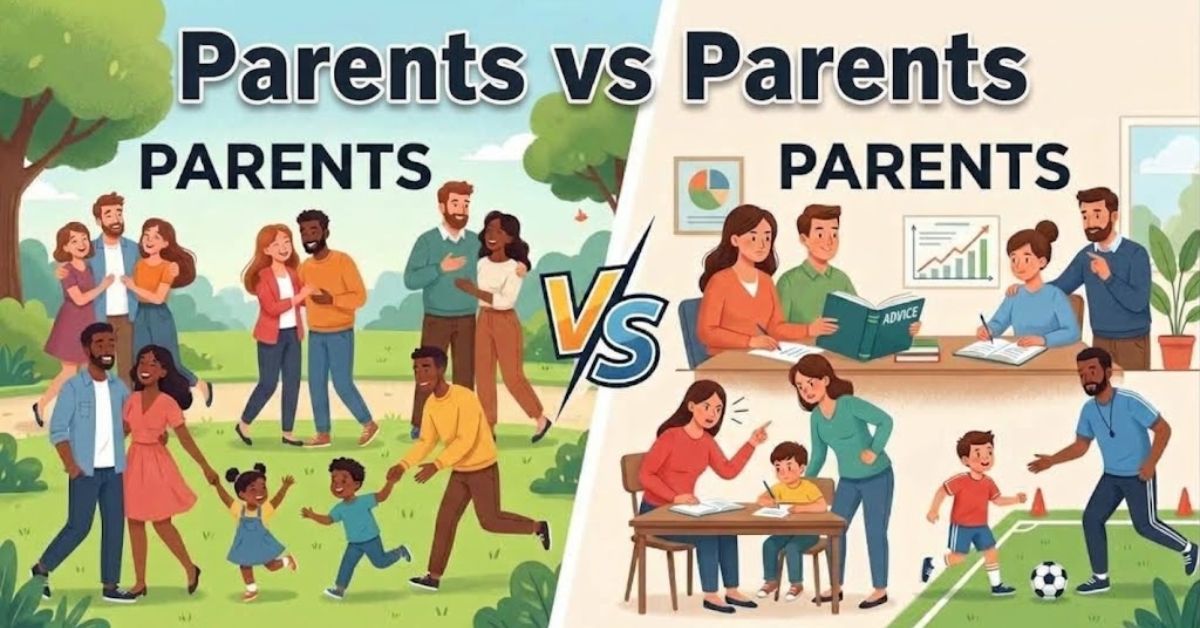
Choosing between parents, parent’s, and parents’ can feel surprisingly tricky. The words look almost identical, yet one small apostrophe can change the meaning of a sentence.
The rule itself is simple. Parents is the plural form of parent. Parent’s is the singular possessive form. Parents’ is the plural possessive form. Once you identify whether you mean one parent, several parents, or ownership, the correct form becomes much easier to choose.
This guide explains the difference with clear examples, tables, school-related phrases, common mistakes, and practice questions.
Quick Answer parents vs parent’s
Use parents when you mean more than one parent without showing possession. Use parent’s when one parent owns or is connected to something. Use parents’ when two or more parents own or are connected to something.
Quick Example
- Parents: My parents live nearby.
- Parent’s: My parent’s car is outside.
- Parents’: My parents’ car is outside.
The apostrophe doesn’t make parent plural. Instead, it shows possession or another close relationship between nouns. Standard English uses ’s with a singular noun and an apostrophe after the s with a regular plural noun ending in s.
Quick Reference Table
| Form | Meaning | Example |
|---|---|---|
| parent | One parent | My parent is here. |
| parents | More than one parent | My parents are here. |
| parent’s | Belonging to one parent | The parent’s phone rang. |
| parents’ | Belonging to multiple parents | The parents’ meeting starts at 6. |
What Do Parent’s and Parents’ Actually Mean?
The difference between parent’s and parents’ comes down to number and possession.
Parent’s starts with the singular noun parent. Adding ’s makes it possessive. For example, the parent’s signature means the signature of one parent.
Parents’ starts with the plural noun parents. Because parents already ends in s, you add only an apostrophe. For example, the parents’ signatures refers to signatures belonging to multiple parents.
This pattern follows the wider English possessive rule.
Meaning Table
| Form | Number | Possessive? | Meaning |
|---|---|---|---|
| parents | Two or more | No | More than one parent |
| parent’s | One | Yes | Something belonging to one parent |
| parents’ | Two or more | Yes | Something belonging to multiple parents |
A useful test is to ask “Whose?”
- Whose signature? The parent’s signature.
- Whose house? The parents’ house.
- Who arrived? The parents arrived.
The Core Grammar Rule Behind Apostrophes
Apostrophes have several jobs in English, but here they show possession or a relationship between nouns.
For a singular noun, add ’s:
the parent’s decision
For a regular plural noun ending in s, add only an apostrophe:
the parents’ decision
The order matters. First make parent plural by adding s. Then add the apostrophe to show possession.
Grammar Rule Table
| Noun type | Possessive rule | Example |
|---|---|---|
| Singular noun | Add ’s | parent’s |
| Regular plural ending in s | Add ’ | parents’ |
| Irregular plural | Usually add ’s | children’s |
| Plain plural | No apostrophe | parents |
For example, children’s books uses ’s because children is already an irregular plural that does not end in s. This distinction is part of the broader English possessive system.
Read More : Mold vs Mould Which Spelling Is Correct?
Parents’ vs Parent’s vs Parents in Real Life

Real sentences make the difference much easier to understand.
Consider these examples:
- The parents arrived early.
This simply identifies several parents. - The parent’s signature is required.
One parent needs to sign. - The parents’ signatures are required.
More than one parent needs to sign.
Notice how the meaning changes even though the three forms look almost the same.
Comparison Table
| Form | What it does | Example |
|---|---|---|
| Parents | Names multiple parents | The parents attended the event. |
| Parent’s | Shows one parent’s possession | The parent’s concern was understandable. |
| Parents’ | Shows multiple parents’ possession | The parents’ concerns were discussed. |
In spoken English, parent’s and parents’ can sound alike. Writing removes that ambiguity by showing exactly where the apostrophe belongs.
Parents Meeting or Parents’ Meeting (School Context Explained)
School communication creates one of the most common apostrophe questions: parents meeting or parents’ meeting?
When you mean a meeting associated with or involving multiple parents, parents’ meeting is a clear possessive construction.
For example:
The school scheduled a parents’ meeting for Friday.
However, English also uses noun modifiers in phrases such as parent meeting or parent-teacher conference, depending on the context and regional usage. So it isn’t always accurate to say that every noun phrase containing parents must have an apostrophe. The intended grammatical relationship matters.
Usage Table
| Phrase | Best choice | Example |
|---|---|---|
| Parents meeting | Usually avoid in formal writing | The parents meeting starts at 5. |
| Parents’ meeting | Clear possessive | The parents’ meeting starts at 5. |
| Parent’s meeting | One parent | The parent’s meeting with the teacher was private. |
| Parent-teacher conference | Common US term | The parent-teacher conference is tomorrow. |
For US readers, parent-teacher conference is especially common for a scheduled discussion between a teacher and a student’s parent or guardian.
Parents’ Name, Parent’s Name, and Signature Usage
Forms often make this distinction important.
If a form asks for information from one parent, use the singular possessive:
Parent’s name
If it refers to information belonging to multiple parents, use the plural possessive:
Parents’ names
The same logic applies to signatures.
Signature Table
| Situation | Correct form | Example |
|---|---|---|
| One parent signs | parent’s signature | A parent’s signature is required. |
| Multiple parents sign | parents’ signatures | Both parents’ signatures are required. |
| Parents simply arrive | parents | The parents arrived. |
The important question isn’t whether the family has one or two adults. Ask how many people the sentence identifies as the owner or source of the information.
Parents’ House vs Parent’s House (Ownership Clarity)
This is one of the easiest ways to see the difference.
Parent’s house means the house belongs to one parent.
Parents’ house means the house belongs to multiple parents.
For example:
She stayed at her parent’s house.
This could refer to one parent.
She stayed at her parents’ house.
This normally refers to both parents or multiple parents.
Ownership Table
| Phrase | Meaning | Example |
|---|---|---|
| parent’s house | One parent’s house | The parent’s house is nearby. |
| parents’ house | Multiple parents’ house | Their parents’ house is nearby. |
| parents house | Missing possessive marker when possession is intended | Avoid this form in standard writing. |
British Council grammar guidance gives the same basic pattern with parents’ house, showing that a plural noun ending in s takes the apostrophe after the s.
Plural vs Possessive Nouns (Why Errors Happen)
Many mistakes happen because writers confuse plural with possessive.
A plural tells you that there is more than one person or thing. A possessive tells you about a relationship, ownership, or association.
Compare:
The parents arrived.
Here, parents is simply plural.
The parents’ car is outside.
Here, parents’ is possessive because it connects parents with car.
Function Table
| Form | Function | Example |
|---|---|---|
| parents | Plural | The parents arrived. |
| parent’s | Singular possessive | The parent’s phone rang. |
| parents’ | Plural possessive | The parents’ phones rang. |
Apostrophes don’t normally create ordinary plurals. Writing parent’s simply to mean more than one parent is incorrect.
Read More : Manuel vs Manual: When to Use Each One in Writing
Common Mistakes with Parents’ vs Parent’s
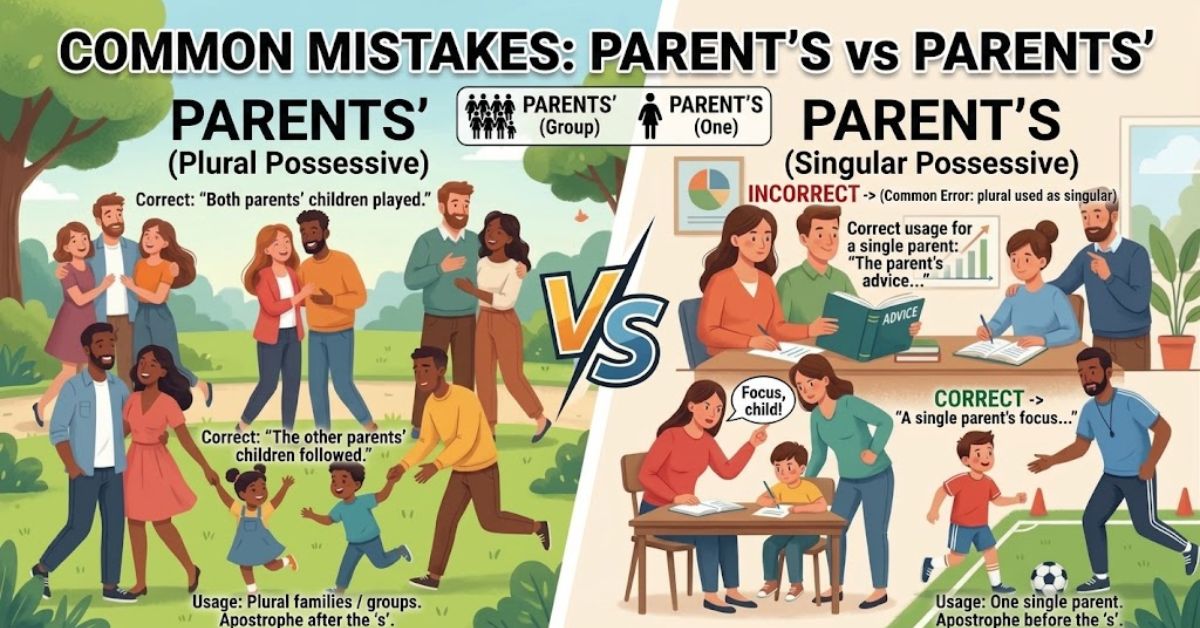
Most errors come from placing the apostrophe before the plural s, adding an unnecessary second s, or leaving the apostrophe out completely.
Mistake Table
| Incorrect | Correct | Why |
|---|---|---|
| parents’s house | parents’ house | The plural already ends in s. |
| parent’s meeting | parents’ meeting | Use plural possessive when multiple parents are involved. |
| parents house | parents’ house | The apostrophe marks possession. |
| parent house | parent’s house | One parent owns or is associated with the house. |
| parent’s for several parents | parents’ | The number of owners changes the form. |
A helpful trick is to identify the owner first. Then choose the possessive form.
Is It Parent’s or Parents’ Evening?
Both forms can be grammatically possible in the right context, but parents’ evening normally refers to a school event involving multiple parents.
For US readers, parent-teacher conference is often the more familiar phrase.
Event Table
| Phrase | Meaning | Usage |
|---|---|---|
| parents’ evening | Event involving multiple parents | Common in British English |
| parent’s evening | Evening associated with one parent | Possible in a specific context |
| parent-teacher conference | Meeting between parents and teachers | Common US English |
The underlying possessive rule remains the same across US and UK English. The terminology for school events can differ by region.
Why Apostrophe Placement Matters
A tiny punctuation mark can change the number of people involved.
Compare:
The parent’s opinion was recorded.
This refers to one parent.
The parents’ opinions were recorded.
This refers to multiple parents.
The apostrophe acts almost like a small signpost. It tells the reader where possession begins and how many owners the sentence has.
Clarity Table
| Sentence | Meaning |
|---|---|
| The parent’s opinion mattered. | One parent gave the opinion. |
| The parents’ opinions mattered. | Multiple parents gave opinions. |
| The parents arrived. | Multiple parents arrived. |
Clear punctuation matters especially in forms, school notices, emails, reports, and professional documents.
English Writing Tips for Possessives
You don’t need to memorize dozens of complicated rules. Use a simple three-step check.
Process Table
| Step | Question | Example |
|---|---|---|
| 1 | How many owners? | One or several? |
| 2 | Is possession shown? | Does something belong to them? |
| 3 | Where does the apostrophe go? | parent’s or parents’? |
Try this shortcut:
One parent → parent’s
Several parents → parents’
Several parents with no possession → parents
If you’re unsure, ask “Who does it belong to?” That question often solves the problem immediately.
School Communication Errors
Apostrophe mistakes can make school communication look careless, especially when they appear in official notices.
Compare these examples:
Less clear:
Parents meeting will be held Friday.
Clearer:
The parents’ meeting will be held Friday.
Another example:
Less precise:
Parent signature required.
Clearer:
A parent’s signature is required.
For a US school, you might also see:
Parent or guardian signature required.
That wording avoids unnecessary ambiguity when either an eligible parent or guardian can sign.
Table
| Unclear or incorrect | Better wording |
|---|---|
| Parents meeting Friday | Parents’ meeting Friday |
| Parent’s signatures required | Parents’ signatures required |
| Parents house address | Parents’ home address |
| Parent signature required | A parent’s signature is required |
Practice Section
Practice makes the distinction much easier. Choose the form that matches the meaning of each sentence.
Fill in the Blanks
Fill each blank with parents, parent’s, or parents’.
- My ______ arrived at the school early.
- The ______ signature is required.
- The ______ meeting begins at 6 p.m.
- My ______ house is near the park.
- Both ______ opinions were considered.
- The ______ car needs repairs.
- The teacher spoke with the ______ after class.
- The ______ names were listed on the form.
- A ______ decision can affect the child.
- The ______ were invited to the event.
Multiple Choice Questions
Choose the correct answer.
- The school arranged a ______ meeting.
A) parents
B) parent’s
C) parents’ - My ______ house is nearby.
A) parents
B) parent’s
C) parents’ - Both ______ signatures are required.
A) parents
B) parent’s
C) parents’ - The ______ arrived before the teacher.
A) parents
B) parent’s
C) parents’ - The ______ decision was carefully considered.
A) parent’s
B) parents’
C) parents - A ______ signature is enough for this form.
A) parents
B) parent’s
C) parents’ - The ______ house was renovated last year.
A) parent’s
B) parents’
C) parents - The teacher contacted the ______.
A) parent’s
B) parents’
C) parents - The ______ opinions differed.
A) parent’s
B) parents’
C) parents - The ______ phone was left in the classroom.
A) parent’s
B) parents
C) parents’
Answers
Fill in the Blanks
| No. | Answer |
|---|---|
| 1 | parents |
| 2 | parent’s |
| 3 | parents’ |
| 4 | parents’ |
| 5 | parents’ |
| 6 | parent’s |
| 7 | parents |
| 8 | parents’ |
| 9 | parent’s |
| 10 | parents |
Multiple Choice
| No. | Correct answer |
|---|---|
| 1 | C, parents’ |
| 2 | C, parents’ |
| 3 | C, parents’ |
| 4 | A, parents |
| 5 | A, parent’s |
| 6 | B, parent’s |
| 7 | B, parents’ |
| 8 | C, parents |
| 9 | B, parents’ |
| 10 | A, parent’s |
FAQ’s
What is the difference between parents vs parent’s?
Parents is plural, while parent’s is the singular possessive form showing something connected to one parent.
Is parents’ meeting correct grammar?
Yes. Parents’ meeting is correct when the meeting involves or relates to multiple parents.
When should I use parent’s vs parents’?
Use parent’s for one parent and parents’ for two or more parents.
Does parents need an apostrophe?
No. Use parents without an apostrophe when it simply refers to more than one parent.
Is it parent’s or parents’ evening?
Parents’ evening normally refers to an event involving multiple parents, although US English often uses parent-teacher conference.
Can I write parents’s?
No. Parents’ is the standard plural possessive form because parents already ends in s.
What is correct parents house or parents’ house?
Use parents’ house when the house belongs to or is associated with multiple parents.
Why does apostrophe placement matter?
Apostrophe placement shows whether the possessive noun is singular or plural, which can change the meaning of the sentence.
Is parents singular or plural?
Parents is plural. The singular form is parent.
What does parent’s mean?
Parent’s is the singular possessive form, meaning something belongs to or relates to one parent.
What does parents’ mean?
Parents’ is the plural possessive form, meaning something belongs to or relates to multiple parents.
Is parents correct without an apostrophe?
Yes. Parents is correct when you simply mean more than one parent and aren’t showing possession.
Why do people confuse parents vs parent’s?
The forms look and sound similar, especially in speech, while the apostrophe changes the grammatical function.
How can I avoid mistakes with parents vs parent’s?
First decide whether you’re talking about one parent or multiple parents. Then decide whether you’re showing possession.
Read More : Success vs Sucess: Which is Correct? Complete Guide
Final Verdict
The difference between parents, parent’s, and parents’ becomes simple once you focus on two questions: How many parents are involved? and Are you showing possession?
Remember these three forms:
- Parents = more than one parent
- Parent’s = something belonging to one parent
- Parents’ = something belonging to multiple parents
So, write “My parents arrived” when you’re simply talking about multiple parents. Write “My parent’s car” when one parent owns or is connected to the car. Write “My parents’ car” when the car belongs to multiple parents.
When an apostrophe starts causing trouble, don’t overthink it. Find the owner first. Once you know whether that owner is singular or plural, the correct form usually falls into place.
SEO Meta Description:
Learn the difference between parents, parent’s, and parents’. Get clear rules, examples, tables, common mistakes, and practice questions.

Finn Bradley is a grammar and language writer at Megazine Tech, focused on making English easier to understand. He researches grammar rules, vocabulary, sentence usage, punctuation, and common writing questions. Through clear explanations and practical examples, Finn helps readers build stronger communication skills and write with greater confidence in everyday situations.