

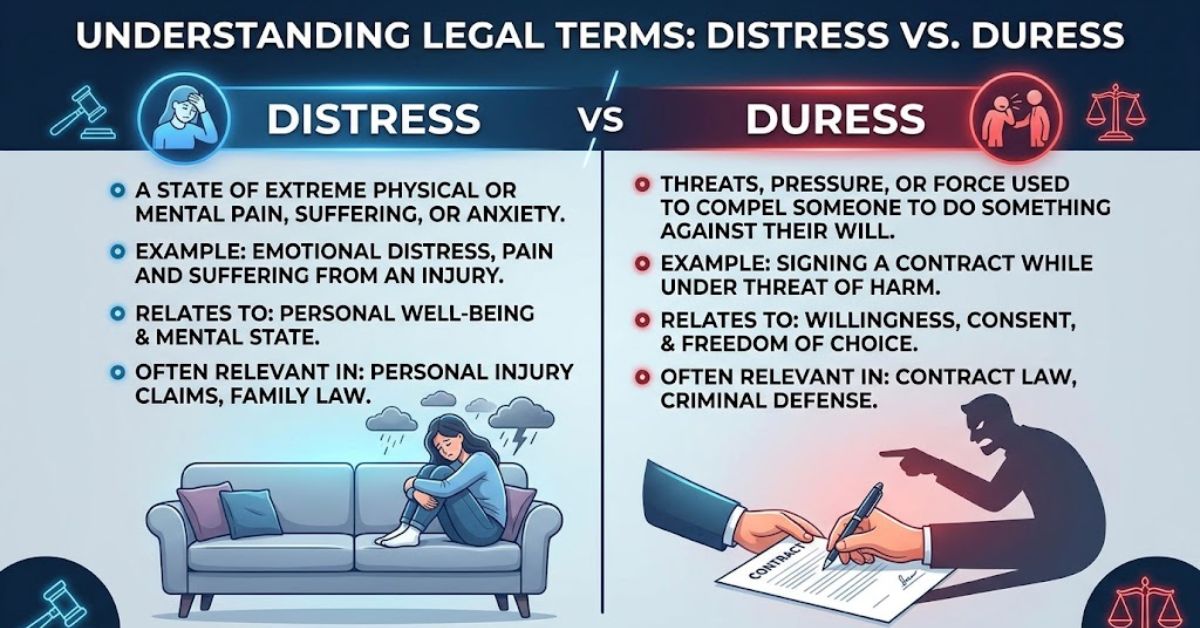
Distress vs duress is a common English word-choice problem because the two words look and sound similar. However, they describe different kinds of difficult situations.
Distress usually means suffering, pain, anxiety, hardship, or serious difficulty. Duress means pressure, threats, force, or coercion that causes someone to act against their free choice.
A simple way to remember the difference is:
Distress = suffering.
Duress = coercion.
This distinction matters in everyday English, professional writing, and especially legal contexts. The sections below explain how to choose the right word naturally.
What Is Distress vs Duress?
Distress describes a state of emotional, physical, financial, or general suffering. Someone may experience distress after receiving bad news, losing a job, facing an accident, or dealing with serious financial problems.
Duress describes pressure or coercion that influences someone’s decision or action. It is especially common when threats, intimidation, force, or a lack of meaningful choice are involved.
For example:
She was in distress after the accident.
This describes her condition.
She signed the agreement under duress.
This explains why she signed it.
The first sentence focuses on suffering. The second focuses on coercion.
Why It Matters
Choosing the wrong word can change the meaning of a sentence.
If you say someone is under duress, you normally suggest that an outside person or force pressured them into an action. If you say someone is in distress, you describe their suffering or difficult condition.
This distinction becomes especially important in contracts, workplace complaints, legal writing, medical communication, and formal documents. In legal contexts, duress can have a specific meaning involving coercion and lack of free choice.
The Core Rule
Use distress when the main idea is suffering.
Use duress when the main idea is coercion or forced action.
Simple Formula
Hardship, pain, anxiety, danger, or suffering → distress
Threats, force, intimidation, or coercion → duress
For example:
The family was in distress after the flood.
The employee signed the document under duress.
This rule handles most everyday word-choice situations.
How to Use Distress
Distress is commonly used as a noun, although it can also function as a verb.
It can describe emotional suffering, physical difficulty, financial trouble, danger, or a serious need for help.
Normal Uses of Distress
Common expressions include:
- emotional distress
- physical distress
- financial distress
- mental distress
- severe distress
- signs of distress
- in distress
- distress signal
- cause distress
- experience distress
The word can describe both people and situations.
The patient showed signs of physical distress.
The company is experiencing financial distress.
The news caused considerable emotional distress.
Examples
Here are several natural examples:
The child was in distress after getting separated from her parents.
Losing his job caused him considerable distress.
The passengers were clearly in distress.
The company entered financial distress after several major losses.
The rescue team responded to the distress signal.
Notice that none of these examples requires someone to force another person to act.
Distress as a Verb
Distress can also mean to cause someone emotional pain, anxiety, or suffering.
The news distressed her.
I didn’t mean to distress you.
The accident deeply distressed his family.
The verb form is useful when the sentence focuses on the person or event causing emotional suffering.
How to Use Duress
Duress is primarily a noun. It describes coercive pressure that affects someone’s freedom to choose.
The most familiar expression is under duress.
He signed the contract under duress.
She claimed that she acted under duress.
Common Uses of Duress
Duress commonly appears with situations involving:
- threats
- intimidation
- coercion
- forced agreements
- forced confessions
- serious pressure
- physical threats
- legal disputes
- contractual decisions
Duress is more formal than ordinary words such as pressure or stress.
Important Usage Note
The phrase under duress is standard English.
Do not normally say “in duress” when you mean that someone was being forced.
Compare:
She signed the contract under duress.
Not:
She signed the contract in duress.
The legal meaning of duress can be more specific than ordinary pressure, and the exact legal requirements depend on the jurisdiction and circumstances.
Correct Examples of Distress and Duress
Distress:
The injured passenger was in distress.
Duress:
The witness claimed that the statement was made under duress.
Distress:
The financial crisis caused widespread distress.
Duress:
The employee said he was pressured into signing the agreement under duress.
The key question is simple: Are you describing suffering, or are you describing coercion?
Incorrect vs Correct Usage of Distress and Duress
| Incorrect | Better | Reason |
|---|---|---|
| She was under distress after the accident. | She was in distress after the accident. | “In distress” is the natural expression. |
| He signed the contract in duress. | He signed the contract under duress. | “Under duress” is the standard phrase. |
| I was under duress because of my exam. | I was stressed about my exam. | An exam does not automatically involve coercion. |
| The patient was under duress after surgery. | The patient was in distress after surgery. | The sentence describes suffering. |
| She signed because of threats and was in distress. | She signed under duress and was in distress. | Both words can apply to different aspects of one situation. |
Similar Sound and Spelling
Distress and duress are easy to confuse because both begin with d and end with a similar stress-like sound.
They also both appear in discussions about difficult situations. That visual and conceptual similarity encourages people to treat them as synonyms.
They are not synonyms.
Distress focuses on the condition or suffering.
Duress focuses on the coercive pressure causing an action.
Overgeneralizing the Meaning of “Pressure”
One major mistake is treating every kind of pressure as duress.
You can feel pressure before an exam, job interview, deadline, presentation, or difficult conversation. That does not automatically mean you are under duress.
For example:
I felt a lot of pressure before my interview.
This is natural.
I was under duress before my interview.
This sounds much stronger and suggests coercion or serious compulsion.
When ordinary stress is enough to explain the situation, use stress or pressure instead.
Autocomplete and Spellcheck Problems
Typing quickly can make these words even easier to confuse. Autocomplete may suggest a similar-looking word, while spellcheck may not identify a context problem because both words are correctly spelled.
A useful editing habit is to read the complete sentence after accepting an automated suggestion.
Ask:
Does this sentence describe suffering, or does it describe forced action?
That one question catches many errors.
Translation Interference
Direct translation can also cause confusion because words meaning pressure, suffering, distress, force, or compulsion do not always map perfectly between languages.
A translation may use one broad word where English uses several more precise terms.
If the original meaning is emotional suffering, distress may be appropriate. If the meaning involves coercion or threats, duress may be the better choice.
Always translate the meaning of the situation rather than matching words one for one.
Mistake 1: Using Duress for Normal Stress
An exam, deadline, difficult meeting, or job interview can create stress without creating duress.
Better:
I was stressed before the interview.
Use duress when a person is being compelled through serious pressure, threats, or coercion.
Mistake 2: Saying “In Duress”
The standard expression is:
under duress
For example:
He admitted that he signed under duress.
“Under duress” is widely used in formal and legal English.
Mistake 3: Using Distress in Legal Situations
Distress can certainly appear in legal writing, but it does not automatically mean coercion.
For example, emotional distress refers to psychological suffering. By contrast, duress can concern coercion that affects a person’s free choice.
Legal terminology should therefore be used carefully rather than treating the two words as interchangeable.
Mistake 4: Assuming Similar Words Have Similar Uses
Similar spelling does not guarantee similar meaning.
Compare:
Distress: “The family experienced severe distress.”
Duress: “The defendant claimed he acted under duress.”
The words belong to related areas of meaning, but their grammatical patterns and meanings differ.
Mistake 5: Ignoring the Cause of the Situation
The cause often reveals which word you need.
If the cause is illness, grief, loss, danger, pain, or hardship, distress is usually appropriate.
If the cause is a threat, intimidation, force, or coercion that compels an action, duress is more appropriate.
Grammatically Correct but Less Natural
Some sentences may be grammatically possible but still sound unnatural because the word is too formal or does not fit the context.
Distress
She was experiencing distress because of her workload.
This is grammatically correct, but everyday English would often use:
She was stressed because of her workload.
Distress sounds more serious or formal than ordinary stress.
Duress
I was under duress because my friend asked me to choose a restaurant.
The grammar is possible, but the meaning sounds exaggerated.
Duress suggests much stronger pressure, especially when someone’s freedom to choose is seriously compromised.
Natural Everyday English
Distress
Natural examples include:
The dog appeared to be in distress.
She was in distress after hearing the news.
The accident caused him considerable distress.
Duress
Duress is less common in casual conversation.
Natural formal examples include:
He signed the agreement under duress.
She said the confession was made under duress.
In casual situations, pressure, stress, or force is often more natural.
American vs British English
There is no major difference in the basic meaning of distress and duress between American and British English.
Both varieties use:
- in distress for suffering or danger
- under duress for coercion or forced action
Duress is relatively formal in both varieties and appears especially often in legal, contractual, and official contexts.
Formal vs Informal Usage
The context should influence your word choice.
Formal Usage
In formal writing, these words can be useful:
The claimant reported significant emotional distress.
The agreement was allegedly signed under duress.
Informal Usage
In everyday conversation, simpler alternatives often sound better:
I was really stressed.
She was upset after the accident.
He felt pressured to agree.
Using a highly formal word when a simple one works can make a sentence sound unnatural.
Distress vs Duress Comparison Table
| Feature | Distress | Duress |
|---|---|---|
| Main meaning | Suffering or serious difficulty | Coercion or forced action |
| Main focus | Condition or experience | Pressure affecting free choice |
| Common phrase | In distress | Under duress |
| Emotional suffering | Yes | Not necessarily |
| Physical suffering | Yes | Not the main meaning |
| Financial problems | Yes | Sometimes, if coercive |
| Threats | Can cause distress | Can constitute duress |
| Legal use | Emotional distress and other specialized uses | Strong legal association |
| Everyday use | Fairly common | More formal |
| Part of speech | Noun and verb | Mainly noun |
| Simple synonym | Suffering | Coercion |
Distress vs Duress vs Stress
These three words are related but should not be treated as interchangeable.
Stress usually describes pressure or strain caused by demanding circumstances.
Distress describes more serious suffering, anxiety, pain, or difficulty.
Duress describes coercive pressure that compels someone to act.
Think of them like this:
Stress: “This situation is difficult.”
Distress: “This situation is causing me serious suffering.”
Duress: “Someone or something is compelling me to act.”
This distinction is especially useful when writing about workplace problems, legal matters, health, or personal experiences.
Memory Trick
Remember:
Distress has an “I” idea: how you feel inside.
Duress has a “do” idea: pressure that makes you do something.
A simpler version is:
Distress = suffering.
Duress = coercion.
If you can remember those two words, you can usually choose correctly.
Real-Life Situations: Distress vs Duress in Context
1. Job Interview Situation
Distress
She felt distress after being rejected from several jobs.
The sentence describes emotional suffering.
Duress
He accepted the job under duress after being threatened with serious consequences.
Here, the focus is coercion rather than ordinary interview anxiety.
2. Workplace Meeting Situation
Distress
The employee experienced distress after receiving upsetting news during the meeting.
The word describes the employee’s emotional state.
Duress
The employee claimed he signed the resignation letter under duress.
The important detail is that pressure or coercion influenced the decision.
3. Email Writing Situation
Distress Example
The customer expressed significant distress about the delayed medical appointment.
Duress Example
The customer stated that the agreement had been signed under duress.
The second sentence is much more serious and formal.
4. Text Message Situation
Natural:
I’m really stressed about tomorrow’s exam.
Unnatural:
I’m under duress because of tomorrow’s exam.
Unless someone is actually coercing you, stress is the natural choice.
5. Exam Situation
Distress
The student experienced considerable distress after receiving the result.
The result caused emotional suffering.
Duress
The student was forced to submit the answer under duress.
This would require an unusual situation involving coercion or serious pressure.
6. Legal Situation
Distress
The plaintiff claimed that the incident caused severe emotional distress.
Duress
The defendant argued that the agreement was entered into under duress.
The second example focuses on whether coercive pressure affected the person’s free choice. In actual legal disputes, whether conduct legally qualifies as duress depends on the applicable law and facts.
Mini Quiz: Distress vs Duress
Choose distress, duress, or stress.
- The passengers were clearly in ___ after the accident.
- She signed the contract under ___.
- I felt a lot of ___ before my final exam.
- The bad news caused him considerable ___.
- He claimed that the confession was made under ___.
Answers:
- distress
- duress
- stress
- distress
- duress
The pattern is consistent: suffering means distress, coercion means duress, and ordinary pressure often means stress.
Expert Tips Textbooks Often Skip
1. Look at the Direction of the Problem
Distress focuses on what a person is suffering.
Duress focuses on pressure being applied to a person’s decision or behavior.
2. Distress Can Be Temporary or Long-Term
Distress does not have to last for only a few minutes. Someone may experience temporary distress after an accident or long-term distress because of ongoing hardship.
3. Duress Usually Requires an External Source
Duress generally involves pressure, threats, force, or coercion coming from outside the person’s free choice.
That is why ordinary anxiety before an exam is not normally called duress.
4. Do Not Replace “Stress” With “Duress”
Stress is often the better word for deadlines, exams, busy schedules, interviews, and ordinary workplace pressure.
Reserve duress for situations involving much stronger compulsion.
5. Legal Meaning Is More Specific
In law, duress can be a specific doctrine rather than a general synonym for pressure. For example, legal discussions may involve contracts, threats, physical coercion, or economic duress. The precise requirements vary by jurisdiction.
Frequently Asked Questions About Distress vs Duress
What is the main difference between distress and duress?
Distress means suffering, pain, anxiety, or serious difficulty, while duress means coercion or pressure that forces someone to act.
Can distress and duress be used interchangeably?
No. Distress describes suffering, while duress describes coercive pressure or forced action.
Is it correct to say “under distress”?
Usually not when you mean suffering. The natural expression is “in distress.”
Is “under duress” always correct?
“Under duress” is the standard phrase when someone acts because of coercion, threats, or serious compulsion.
Can a person experience both distress and duress?
Yes. A person can be under duress and experience distress because of the coercive situation.
Is distress a stronger word than stress?
Usually, yes. Distress often suggests more serious suffering or difficulty than ordinary stress.
Is duress only used in legal writing?
No, but it is much more common in formal and legal contexts than casual conversation.
What is another word for distress?
Depending on context, alternatives include suffering, anguish, anxiety, hardship, pain, and trouble.
What is another word for duress?
Depending on context, alternatives include coercion, compulsion, force, intimidation, and pressure.
Why do people confuse distress and duress?
They look and sound similar, and both can describe difficult situations involving pressure or suffering.
Which word should I use in everyday conversation?
Use distress for serious suffering and stress for ordinary pressure. Use duress when coercion or forced action is genuinely involved.
Quick Summary
The difference between distress vs duress becomes easy once you focus on the main idea.
Distress means suffering. It can involve emotional pain, physical difficulty, financial hardship, danger, anxiety, or serious trouble.
Duress means coercion. It describes pressure, threats, intimidation, or force that causes someone to act against their free choice.
Remember these two natural patterns:
In distress = suffering or danger
Under duress = coercion or forced action
For ordinary deadlines, exams, interviews, and busy schedules, stress or pressure is usually more natural than duress.
The fastest test is to ask: “Is this person suffering, or is someone forcing them to act?” If the answer is suffering, choose distress. If the answer is coercion, choose duress.

Finn Bradley is a grammar and language writer at Megazine Tech, focused on making English easier to understand. He researches grammar rules, vocabulary, sentence usage, punctuation, and common writing questions. Through clear explanations and practical examples, Finn helps readers build stronger communication skills and write with greater confidence in everyday situations.