

Suing is the correct spelling. Sueing is incorrect in standard English.
The confusion is understandable because the base verb is sue, so it may seem logical to add -ing and write sueing. English spelling doesn’t work that way here. When sue takes the -ing ending, the final e drops:
sue → suing
The word suing means taking legal action against a person or organization. It can describe an ongoing legal action or function as a gerund when the activity itself becomes the subject or object of a sentence. Major dictionaries list suing as the standard -ing form of sue.
Quick Answer: Suing vs Sueing?
| Form | Correct? | Meaning |
|---|---|---|
| Suing | Yes | Taking legal action |
| Sueing | No | Common misspelling |
| Sue | Yes | Base verb |
| Sued | Yes | Past tense and past participle |
| Sues | Yes | Third-person singular present |
Correct: She is suing the company.
Incorrect: She is sueing the company.
The easiest rule to remember is:
Sue + ing = suing
Don’t keep the final e.
Why Is Suing Correct Instead of Sueing?
The answer comes from a common English spelling rule.
When many verbs end in a silent e, the e disappears before a suffix beginning with a vowel is added. Since -ing begins with a vowel, the final e usually gets dropped. Cambridge gives examples such as hope → hoping, lose → losing, and write → writing.
Apply the same pattern to sue:
sue → su + ing → suing
So:
- Sue → suing
- Make → making
- Write → writing
- Dance → dancing
- Hope → hoping
- Use → using
- Drive → driving
The spelling sueing incorrectly keeps the final e.
Is “Sueing” Ever Correct?
No. Sueing is not the standard spelling of the -ing form of sue.
If you’re writing an email, school assignment, business document, article, or legal discussion, use suing.
For example:
Incorrect: The customer is sueing the manufacturer.
Correct: The customer is suing the manufacturer.
What Does Suing Mean?
Suing means taking legal action against a person or organization, generally by making a legal claim in court.
For example:
- The customer is suing the company for damages.
- The employee is suing the employer over unpaid wages.
- The homeowner is suing the contractor over a contract dispute.
- The family is suing the manufacturer after an alleged product defect.
Cambridge defines sue as taking legal action against a person or organization, especially by making a legal claim for money after harm has occurred. Oxford similarly defines it as making a claim against someone in court.
The exact legal process can vary by jurisdiction. Therefore, “suing” should be understood as a general English term rather than a complete description of every court procedure.
Is Suing a Verb or a Noun?
Suing comes from the verb sue, but its grammatical role can change depending on the sentence.
It can function as a present participle:
She is suing the company.
Here, suing forms part of the present continuous verb phrase is suing.
It can also function as a gerund:
Suing a company can be expensive.
Here, suing names an activity and acts like a noun.
That distinction is useful because the same spelling can perform different grammatical jobs.
Sue, Sues, Sued, and Suing: Verb Forms
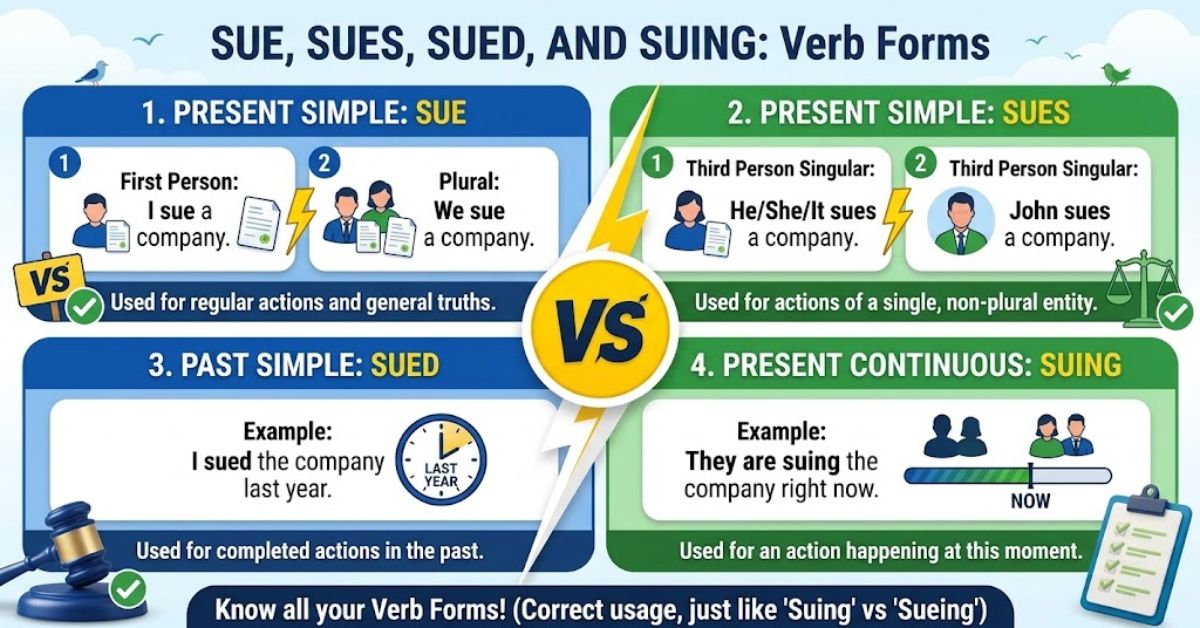
Knowing all the forms makes the spelling much easier to remember.
| Verb form | Grammar | Example |
|---|---|---|
| Sue | Base form | They plan to sue the contractor. |
| Sues | Third-person singular | She sues companies over serious disputes. |
| Sued | Past tense | He sued the company last year. |
| Sued | Past participle | The company has been sued before. |
| Suing | Present participle | They are suing the manufacturer. |
| Suing | Gerund | Suing can be expensive. |
Notice something important: only the -ing form changes the spelling from sue to suing.
The base verb remains sue.
The past form remains sued.
The third-person form remains sues.
When Should You Use Suing?
Use suing when you need the -ing form of sue.
The most common pattern is a form of be + suing:
- I am suing the company.
- She is suing her landlord.
- They are suing the manufacturer.
- He was suing his former business partner.
- The workers were suing their employer.
You can also use suing as a gerund:
- Suing should be a last resort.
- She considered suing after the negotiations failed.
- They discussed suing over the contract dispute.
- Suing a business may involve substantial costs.
Suing vs Filing a Lawsuit
Suing and filing a lawsuit are closely related, but they aren’t always identical in emphasis.
Suing is the broader everyday expression for taking legal action against someone.
Filing a lawsuit focuses more specifically on formally starting a court case by submitting the required legal documents.
For example:
The customer is suing the retailer.
This tells the reader that the customer is pursuing legal action.
The customer filed a lawsuit against the retailer.
This emphasizes the formal filing of the case.
The distinction matters in precise writing, especially when describing real legal events.
Suing vs Threatening to Sue
Another important distinction is the difference between suing and threatening to sue.
If someone says:
I will sue if you don’t fix the problem.
That person is threatening to sue. The statement doesn’t necessarily mean a lawsuit has already been filed.
Compare that with:
The customer is suing the company.
This indicates that legal action is actually being pursued.
So don’t use suing when you only mean that someone mentioned or threatened legal action.
Common Reasons Someone Might Sue
The word suing can appear in many legal and business contexts.
Common examples include:
- Breach of contract
- Property disputes
- Negligence
- Defamation
- Unpaid wages
- Product-related claims
- Employment disputes
- Property damage
- Alleged financial losses
- Copyright or trademark disputes
However, the existence of a dispute doesn’t automatically mean someone has a valid legal claim. The applicable law, evidence, court procedure, and facts determine whether a claim can succeed.
Suing in Everyday English
You don’t have to use suing only in formal legal documents.
It commonly appears in everyday conversation, news writing, workplace communication, and online discussions.
For example:
She’s thinking about suing her former employer.
They are suing the landlord over the security deposit.
The company said it would sue over the dispute.
He threatened to sue after the agreement fell apart.
These sentences use the correct spelling while showing different stages of possible or ongoing legal action.
Suing in Professional and Formal Writing
In professional writing, accuracy matters more than dramatic wording.
If legal action has only been discussed, say:
The client is considering suing the contractor.
If legal action has actually begun, you might say:
The client is suing the contractor.
If the case happened in the past:
The client sued the contractor last year.
These forms communicate different facts. Choosing the right verb form helps prevent ambiguity.
Common Mistakes With Suing
The most common mistake is simply writing sueing instead of suing.
Here are several examples:
| Incorrect | Correct |
|---|---|
| She is sueing the company. | She is suing the company. |
| They are sueing their landlord. | They are suing their landlord. |
| He considered sueing the contractor. | He considered suing the contractor. |
| The business was sueing its supplier. | The business was suing its supplier. |
| We discussed sueing for damages. | We discussed suing for damages. |
A second mistake is using sue where suing is required:
Incorrect: They are sue the company.
Correct: They are suing the company.
After are, the present participle is required in this structure.
Suing vs Sueing Examples
Here are some natural examples you can use as a quick reference:
- She is suing her former employer.
- The company is suing its supplier over a contract dispute.
- They are considering suing the manufacturer.
- He threatened to sue the newspaper.
- Suing can be expensive and time-consuming.
- The customer decided against suing after receiving a refund.
- The family is suing for damages.
- They discussed suing over the property dispute.
In every example, suing keeps the final e out of the word.
How Do You Pronounce Suing?
Suing is commonly pronounced approximately like “SOO-ing.”
The word has two syllables:
suing → SOO-ing
The spelling can look unusual because the letters don’t behave exactly as you might expect from the base word sue. The pronunciation doesn’t change the spelling rule, however.
Oxford lists the -ing form as suing with the pronunciation /ˈsuːɪŋ/.
Is Suing Spelled the Same in American and British English?
Yes. Suing is the standard spelling in both American and British English.
Unlike words such as color/colour or center/centre, this word doesn’t have a different American and British spelling.
You can write:
The company is suing the contractor.
for either American or British English.
Oxford lists suing as the -ing form in its American English dictionary as well.
Why Do People Write “Sueing”?
The mistake usually comes from looking at the base verb and simply adding -ing.
A writer sees:
sue + ing
and naturally produces:
sueing
The problem is that English spelling often changes the base word when an ending is attached.
For many verbs ending in silent e, that e disappears:
- hope → hoping
- write → writing
- make → making
- use → using
- dance → dancing
- sue → suing
Once you recognize the pattern, suing becomes much easier to remember.
Are There Exceptions to the Final E Rule?
Yes. This is where a little caution helps.
The general rule says that a final e is often dropped before -ing, but English has exceptions.
For example:
- see → seeing
- agree → agreeing
- dye → dyeing
- singe → singeing
Cambridge notes that forms ending in -ee, -ye, and -oe can retain the final e before -ing.
That doesn’t change the answer for sue.
The correct form is still:
sue → suing
Not:
sue → sueing
Suing vs Sueing: Easy Memory Trick
Here’s the simplest way to remember the spelling:
Sue loses the e before -ing.
Think:
SUE + ING = SUING
You can also remember the familiar pattern:
MAKE → MAKING
WRITE → WRITING
SUE → SUING
If you remember “drop the final e”, you’ll avoid the most common mistake.
What Are Synonyms for Suing?
The best alternative depends on the context.
Common related expressions include:
- taking legal action
- bringing a lawsuit
- filing a lawsuit
- pursuing a legal claim
- pursuing legal action
- litigating
- bringing an action
- taking someone to court
These expressions aren’t always exact substitutes.
For example, threatening legal action means someone is warning that they may take action. Suing generally refers to legal action that is actually being pursued.
Suing vs Sueing: Final Verdict
When choosing between suing vs sueing, always use suing.
The correct spelling is formed by removing the final e from sue before adding -ing:
sue → suing
Sueing is a misspelling, not an alternative form.
Remember the basic verb family:
sue → sues → sued → suing
Once that pattern becomes familiar, this spelling question is easy to settle. Whether you’re writing a school assignment, professional email, article, or legal discussion, suing is the form you want.
FAQs About Suing vs Sueing
Which is correct, suing or sueing?
Suing is correct. Sueing is a misspelling of the -ing form of sue.
Why is suing spelled without the e?
The final e in sue is dropped before the -ing ending, producing suing.
What does suing mean?
Suing means taking legal action against a person or organization, usually by making a legal claim in court.
Is suing a verb?
Yes. Suing is the present participle of sue and can also function as a gerund.
Is sueing ever correct?
No. Sueing is not the standard spelling of the -ing form of sue.
What is the past tense of sue?
The past tense of sue is sued.
What is the present participle of sue?
The present participle of sue is suing. Oxford and Cambridge both list this form.
What is the difference between sue and suing?
Sue is the base verb, while suing is its -ing form. For example, “They plan to sue” and “They are suing.”
Is suing the same as filing a lawsuit?
They are closely related, but suing is broader while filing a lawsuit specifically emphasizes formally initiating a court case.
How do you use suing in a sentence?
Use suing for an ongoing action or as a gerund, such as “She is suing the company” or “Suing can be expensive.”
Is suing correct in American English?
Yes. Suing is the standard form in American English.
Is suing correct in British English?
Yes. British English also uses suing, not sueing.
How do you pronounce suing?
Suing is commonly pronounced “SOO-ing,” with two syllables. Oxford gives the pronunciation /ˈsuːɪŋ/.
What is an easy way to remember suing?
Remember sue → suing. Drop the final e before adding -ing.

Finn Bradley is a grammar and language writer at Megazine Tech, focused on making English easier to understand. He researches grammar rules, vocabulary, sentence usage, punctuation, and common writing questions. Through clear explanations and practical examples, Finn helps readers build stronger communication skills and write with greater confidence in everyday situations.