

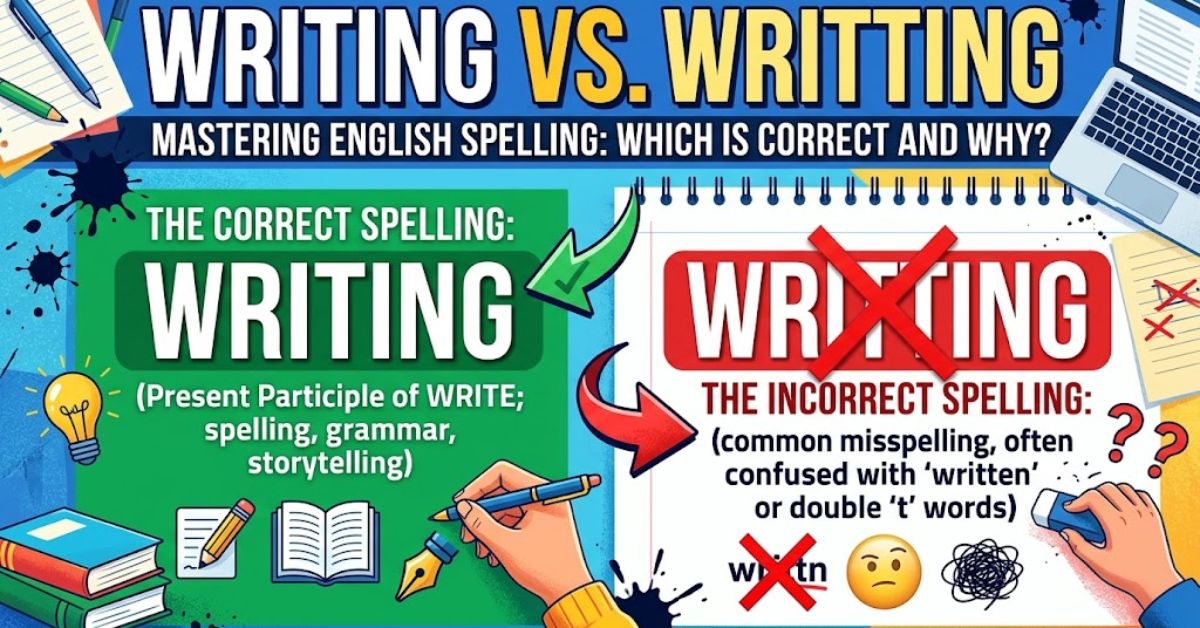
Writing is the correct spelling. Writting is a misspelling and isn’t accepted as a standard English word. The rule is simple: when you add -ing to the verb write, remove the final silent e. Don’t double the t.
Write → remove e → writ + ing → writing
That tiny spelling change causes plenty of confusion like Writing vs Writting . Words such as running and sitting double their final consonants, which makes writting look believable. However, write follows the silent-e spelling rule instead.
Whether you’re writing an email, college essay, business report, text message, or novel, use writing with one t.
What Is Writing?
Writing is the -ing form of the verb write. Depending on the sentence, it can function as part of a verb phrase, a gerund, or a noun.
As a verb form, it can describe an action in progress:
- She is writing an email.
- They are writing their answers.
- I’m writing a new article.
As a noun, writing can refer to the activity, skill, style, or product of putting thoughts into written language.
- Writing takes practice.
- Her writing is clear and engaging.
- Academic writing requires careful research.
The spelling doesn’t change between these uses. It’s always writing, never writting.
Why Does the Difference Matter ?
One extra t may seem harmless. Yet spelling affects how readers judge your work.
Imagine sending a résumé that says, “Excellent writting skills.” The reader will probably understand your meaning. Unfortunately, the error undermines the very skill you’re claiming.
Correct spelling becomes particularly important in:
- School and university assignments
- Job applications and résumés
- Business emails
- Academic papers
- Professional reports
- Website content
- Client proposals
In casual texting, someone will probably understand writting. That doesn’t make it correct. Using writing consistently keeps your communication accurate and professional.
The Core Rule
Here’s the easiest rule to remember:
When adding -ing to write, drop the final silent e and keep one t.
The transformation looks like this:
WRITE → WRIT → WRITING
This pattern appears in many verbs ending with a silent e:
| Base Verb | -ing Form |
|---|---|
| write | writing |
| make | making |
| drive | driving |
| hope | hoping |
| smile | smiling |
| use | using |
Notice what doesn’t happen. You don’t double the final consonant.
Therefore:
write → writing ✓
write → writting ✗
How to Use Writing Correctly
Knowing the spelling is useful. Knowing how writing functions in real sentences makes the lesson stick.
1. Use Writing for the Action Happening Now
In a progressive verb construction, writing can describe an activity happening now or around the present period.
- I am writing an email.
- She is writing her assignment.
- They’re writing a new proposal.
The basic structure is:
Subject + am/is/are + writing
2. Use Writing After Certain Verbs
Writing can follow verbs that express preferences, beginnings, endings, or activities.
- She enjoys writing stories.
- He started writing professionally.
- I love writing about travel.
- They stopped writing when class ended.
Here, writing commonly functions as a gerund.
3. Use Writing as a Noun
Sometimes writing names an activity, skill, style, or body of written work.
- Writing requires patience.
- His writing has improved.
- Good writing makes difficult ideas easier to understand.
Context tells you exactly what the noun means.
4. Use Writing in Professional Contexts
The word appears naturally throughout workplace English.
- I’m writing the monthly report.
- She’s writing a proposal for the client.
- He’s responsible for writing product descriptions.
- We’re writing the meeting notes.
Professional communication doesn’t require a different spelling.
5. Use Writing in Academic English
Students and researchers also use writing regularly.
- Students are writing their final essays.
- Academic writing requires evidence.
- She’s writing her research paper.
- Clear writing strengthens an argument.
Again, the spelling remains unchanged.
Correct Examples
Seeing the word in different situations makes it easier to remember:
- I’m writing an email to my professor.
- She enjoys writing short stories.
- They’re writing notes during the lecture.
- Good writing takes time.
- He’s writing a business proposal.
- The students are writing their answers.
- Her writing has improved this semester.
- We’re writing new instructions for customers.
Every example uses one t.
Incorrect vs. Correct
| Incorrect | Correct | Reason |
|---|---|---|
| I am writting an email. | I am writing an email. | The t isn’t doubled. |
| She is writting a story. | She is writing a story. | Write becomes writing. |
| He enjoys writting. | He enjoys writing. | Writing is the correct gerund. |
| They were writting notes. | They were writing notes. | The spelling stays writing. |
| She is writeing a report. | She is writing a report. | Drop the silent e. |
| I love writting poetry. | I love writing poetry. | Keep only one t. |
Why Do People Make This Mistake?
The mistake isn’t completely random. English has several rules for forming -ing words, and learners sometimes mix them together.
The short-vowel pattern causes confusion
Look at these familiar words:
run → running
sit → sitting
swim → swimming
stop → stopping
Each one doubles its final consonant.
It’s easy to look at write and assume:
write → writting
However, write doesn’t follow that pattern. Its final e helps signal a different vowel pattern in the base word. When -ing arrives, the silent e disappears:
write → writing
Compare:
| Consonant Doubling | Silent-E Removal |
|---|---|
| run → running | write → writing |
| sit → sitting | make → making |
| stop → stopping | hope → hoping |
| swim → swimming | drive → driving |
Keeping these patterns separate prevents the mistake.
Visual similarity can also cause the error
Another troublemaker is written.
Look at the word family:
- write
- writes
- wrote
- written
- writing
- writer
Because written contains two t’s, some people unconsciously carry that spelling into writing. However, they’re different grammatical forms with different spellings.
Common Mistakes Checklist
Mistake 1: Doubling the T
Incorrect: writting
Correct: writing
Don’t copy the consonant-doubling pattern from sitting or running.
Mistake 2: Keeping the E
Incorrect: writeing
Correct: writing
Remove the final silent e before adding -ing.
Mistake 3: Confusing Writing With Written
Incorrect: I have writing the report.
Correct: I have written the report.
Use written as the past participle after have, has, or had.
Mistake 4: Assuming Every Verb Doubles Its Final Consonant
English doesn’t automatically double the final consonant before -ing.
Compare run → running with write → writing. Different word structures trigger different spelling patterns.
Mistake 5: Trusting Spellcheck Without Learning the Rule
Spellcheck can catch writting, but it can’t replace understanding.
Learn write → writing, and you’ll recognize the correct form even when autocorrect isn’t available.
Writing in Real English
Knowing a spelling rule matters most when you can use it naturally.
Grammatically correct and natural
These sentences sound completely normal:
- I’m writing an email.
- She enjoys writing fiction.
- His writing is excellent.
- We’re writing a report.
The word works naturally in conversation, education, business, and digital communication.
Grammatically possible but not the best choice
Consider:
I’m writing every day.
That’s grammatical in the right context. However, if you’re describing a regular habit, I write every day may sound more direct.
The issue isn’t spelling. It’s the tense and intended meaning.
Natural everyday English
Common combinations include:
- writing an email
- writing a book
- writing notes
- writing a report
- writing about something
- writing a message
- writing an essay
You’ll encounter these phrases everywhere from classrooms to group chats.
American vs. British English
There’s no American versus British spelling debate here.
Both varieties use:
writing ✓
Neither standard variety uses:
writting ✗
So whether you’re creating content for readers in New York, London, or anywhere else, writing remains the standard spelling.
Formal vs. Informal Usage
The spelling doesn’t change with formality.
Use writing in formal settings such as academic papers, business reports, applications, and official correspondence.
Use the same spelling in texts, captions, comments, and social media posts.
Informal language may change your vocabulary or tone. It doesn’t turn writting into a correct spelling.
Writing vs. Writting: Comparison Table
| Feature | Writing | Writting |
|---|---|---|
| Correct spelling | Yes | No |
| Standard English word | Yes | No |
| Base verb | write | Incorrectly formed |
| Number of t’s | One | Two |
| Can function as a verb form | Yes | No |
| Can function as a noun | Yes | No |
| Used in American English | Yes | No |
| Used in British English | Yes | No |
| Suitable for formal English | Yes | No |
| Example | She is writing. | She is writting. ✗ |
Writing vs. Written
Both words come from write, but they’re not interchangeable.
Writing
Writing is the present participle and can also function as a gerund or noun.
- She’s writing a letter.
- I enjoy writing.
- Writing takes practice.
It often refers to an ongoing activity or the general act or skill of producing text.
Written
Written is the past participle of write.
- She has written a letter.
- He had written the instructions.
- The report was written yesterday.
Compare these two:
I’m writing the report.
I’ve written the report.
The first focuses on an activity in progress. The second indicates completion in a perfect construction.
Memory Trick
Use this quick formula:
WRITE – E + ING = WRITING
Or remember this sentence:
“Writing loses the E and keeps one T.”
If you type writting, return to the base word write. Remove e, add ing, and you’re done.
Real-Life Situations
In an interview
Interviewer: “What are you working on?”
Candidate: “I’m writing a proposal for a new client.”
Here, writing describes an activity in progress.
In a workplace meeting
“Who’s writing the meeting notes?”
The sentence uses the standard -ing form of write.
In an email
“I’m writing to confirm our appointment.”
This is a natural professional expression.
In a text message
“I’m writing it now. Give me a minute.”
Casual communication still uses writing.
In an exam
“The students are writing their answers.”
Again, there’s only one t.
In an academic paper
“Effective academic writing requires clear organization.”
Here, writing functions as a noun describing a type of communication.
Mini Quiz
Test yourself before checking the answers.
| Question | Answer |
|---|---|
| Writing or writting? | Writing |
| “I’m ___ an email.” | writing |
| Writeing or writing? | writing |
| “She has ___ a letter.” | written |
| Run or running? | running |
| Does writing contain two t’s? | No |
| Is writting correct in British English? | No |
| “Good ___ takes practice.” | writing |
If you remembered WRITE – E + ING, you probably got them all.
Expert Tips
1. Learn the base word first
When an -ing spelling feels uncertain, return to its base verb.
For this word:
write → writing
That method works better than memorizing an isolated spelling.
2. Do not apply consonant doubling automatically
Words such as run and sit double their final consonants. That doesn’t mean every English verb follows the same rule.
Always consider the structure of the base word.
3. Watch the final silent e
Many verbs ending with a silent e drop it before -ing:
- make → making
- hope → hoping
- drive → driving
- write → writing
Recognizing the pattern makes spelling much easier.
4. Do not let pronunciation dictate the spelling
English spelling doesn’t always mirror pronunciation perfectly.
Listening to writing alone won’t reliably tell you whether it contains one t or two. The base word and spelling rule provide the answer.
5. Remember the word family
Learn related forms together:
write → writes → wrote → written → writing → writer
Seeing the whole family helps you avoid confusing writing with written.
FAQ
Is “writting” a correct English word?
No. Writting is a common misspelling. Use writing in standard English.
Why is writing spelled with one t?
Because write drops its final silent e before -ing. The t doesn’t need to double.
Is it writeing or writing?
Writing is correct. Remove the silent e from write before adding -ing.
Is writting ever acceptable in informal English?
Not as the standard spelling of writing. Informal context doesn’t change the correct spelling.
Do Americans spell it “writing”?
Yes. Writing is the standard spelling in American English.
Do British people spell it “writing”?
Yes. British English also uses writing, with one t.
Why does “written” have two t’s but “writing” has one?
They’re different forms of write and follow different word formations. Written has two t’s, while writing has one.
Is “writing” a verb or a noun?
It can be both. In “She is writing,” it’s part of a verb phrase. In “Writing takes practice,” it functions as a noun.
What is the easiest way to remember writing?
Remember the formula: WRITE – E + ING = WRITING. Drop the e and keep one t.
Why do people write “writting”?
People often overapply consonant doubling from words such as sitting and running. That rule doesn’t apply to write.
Is “writing” the same as “written”?
No. Writing is the -ing form of write, while written is its past participle.
Conclusion
The writing vs writting question has one clear answer: writing is correct. Writting is a misspelling.
Remember the basic transformation:
WRITE – E + ING = WRITING
The final silent e disappears, while the t stays single. Don’t confuse this pattern with consonant doubling in words such as running and sitting. Also remember that written is a separate past-participle form, which explains its double t.
Whether you’re writing an essay, sending a business email, posting online, or texting a friend, the rule stays the same. One t, no e: writing.

Finn Bradley is a grammar and language writer at Megazine Tech, focused on making English easier to understand. He researches grammar rules, vocabulary, sentence usage, punctuation, and common writing questions. Through clear explanations and practical examples, Finn helps readers build stronger communication skills and write with greater confidence in everyday situations.