

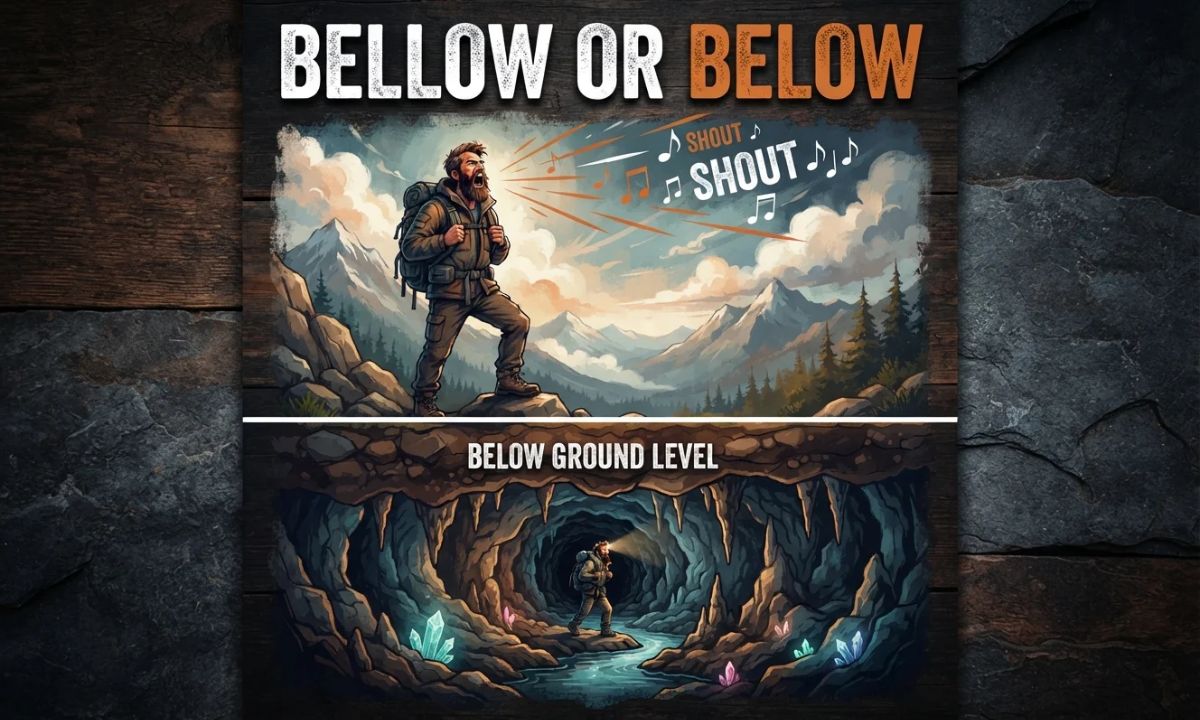
You’re about to hit send on an important email. Then you freeze. Is it “see bellow” or “see below”? Don’t worry, you’re not alone. Bellow or below is one of the most common English spelling confusion cases, because the two similar sounding words look almost identical on screen. Spellcheck won’t catch it either. Both are real words. Let’s fix that.
Here’s the short answer. Below means a lower position or level, while bellow means a deep roar or a loud shout. One is a preposition, the other is a verb. In this guide, you’ll learn the meaning, correct spelling, pronunciation, and usage of each word, plus simple memory tricks you’ll actually use. No grammar degree needed, just a few minutes.
Bellow or Below: Quick Answer
Below means lower than something else. You use it for physical position, amounts, and ranks.
Bellow means a deep roar or a loud shout. It’s a verb and a noun, and it has nothing to do with direction.
So when you point readers to something further down the page, the word is below with one L. If a bull, a coach, or a thunderstorm makes a thunderous sound, that’s a bellow with two Ls.
What Does “Bellow” Mean?
Think of the loudest voice you’ve ever heard at a football match. That’s the territory of bellow.
It covers any loud sound that comes from deep in the chest. People use it for angry shouting, big laughter, and animal calls.
Bellow Meaning, Spelling, and Pronunciation
The bellow meaning is simple. To bellow is to shout loudly in a deep, booming voice.
The spelling has two Ls and two Es, and it’s said as “BEL-oh.” The stress lands on the first syllable, and the ending sounds like “oh.”
As a part of speech, bellow works as both a verb and a noun. You can bellow an order, and you can also let out a bellow.
How to Use “Bellow” in a Sentence
Here are a few bellow examples you can borrow.
- The sergeant had to bellow over the noise of the engines.
- Nobody expected such a bellow from a tiny man.
- Fans bellowed the chorus until their throats hurt.
Notice the pattern. Each sentence has a voice or a sound in it.
The past tense is bellowed. So “she bellowed across the yard” is correct, and “she bellow across the yard” isn’t.
What Is a Bellow Used For?
People mostly use bellow to describe volume and emotion. A bellow can show rage, pain, joy, or plain urgency.
Writers love it because it paints a picture fast. “He shouted” is fine, but “he bellowed” lets you hear the room shake.
Animals get in on it too. Cattle, bulls, moose, and alligators are all known to bellow, especially in mating season.
Read More: Feet or Foot: Correct Meaning, Usage, and Grammar Guide
Bellows: The Tool Used for Fire
Here’s where it gets tricky. Bellows is also a noun for an air blowing device.
You squeeze it, and a jet of air hits the coals. A blacksmith uses one to make a fire burn hotter, and campers use smaller ones to wake up a lazy flame.
It looks like a different word, but it isn’t random. The device took its name from an old term for a bag, and we’ll get to that in the history section.
What Does “Below” Mean?
Below is a calm, everyday word. It shows up in emails, manuals, weather reports, and school notes.
Its job is to place one thing lower than another. It never makes a sound.
Below Meaning and Correct Usage
The below meaning is “in a lower place” or “less than a certain level.” It works as a preposition and as an adverb.
As a preposition, it sits before a noun: “The cat slept below the window.” As an adverb, it stands alone: “The answers are listed below.”
You can also use it for less than a number or standard. Think “below average,” “below the limit,” or “below cost.”
How to Use “Below” in a Sentence
Try these below examples.
- The basement is below the kitchen.
- Temperatures dropped below freezing last night.
- Please check the notes below before you reply.
Each one points to a lower position or a low level. That’s the whole idea.
Here’s a quick trick. If you could swap in under or beneath and the sentence still works, below is probably right.
Below or Above: Understanding the Difference

Below or above is a pair of opposites. Above means higher, and below means lower.
A picture on the wall hangs above the sofa, and the sofa sits below the picture. Same scene, two viewpoints.
This pair helps with memory too. Nobody mixes up “above” with a roaring sound, so remember that below belongs on the same team as above.
Is It Correct to Say “The Below”?
You’ll see “the below” in legal papers and business emails. For example: “Please review the below information.”
Many style guides call this a bit clumsy. It uses below like an adjective, which some editors dislike.
A cleaner option is “the information below.” Most readers find it smoother, and it still sounds natural.
Bellow vs. Below: Key Differences
These two words look like twins, but they live very different lives. One describes a position, and the other describes a sound.
They also differ in grammar. Below is a preposition or adverb, while bellow is a verb or noun.
Which One Is Correct, Below or Bellow?
Both are correct words. The right one depends on what you mean.
If you mean “lower than,” choose below. If you mean “to roar or shout,” choose bellow.
So when you write “see below,” you’re always safe with one L. “See bellow” would mean something odd, like telling the reader to look at a roar.
Bellow or Below: Comparison Table
| Feature | Bellow | Below |
| Meaning | A deep roar or loud shout | Lower than something |
| Part of speech | Verb, noun | Preposition, adverb |
| Spelling | Double L, double E | Single L |
| Pronunciation | BEL-oh | bih-LOH |
| Example | The bull let out a bellow. | See the chart below. |
| Past tense | Bellowed | Not applicable |
The Origin and History of Bellow and Below
Words carry old baggage. A little word origin story can make the spelling stick.
Both words come from Middle English, but they took separate roads. That’s why they only look alike by accident.
The Etymology of “Bellow”
The etymology of bellow points back to Old English bylgan, which meant to roar. Many experts link it to the Proto-Indo-European root bhel-, which relates to sound.
German has a cousin in bellen, meaning to bark. You can hear the echo of that sound even today.
The bellows device likely comes from an old word for “belly” or bag. Picture a leather bag that swells and squeezes, and the name makes sense.
Read More: Patient or Pacient: Correct Spelling, Meaning, and Usage
The Etymology of “Below”
Below is a compound. It joins the prefix “be” with the root word “low.”
In Middle English, you’d see spellings like bilooghe. Over time, the spelling smoothed into the one we know.
So below literally means “by the low part.” That’s a handy way to remember it, since the meaning is hiding in the word.
British English vs. American English Spelling
Good news here. British English vs American English doesn’t change either word.
Both regions spell them the same way: bellow and below. No extra letters, no swapped endings.
Pronunciation shifts slightly with accent, but the spelling variation problem simply doesn’t exist for this pair. You can write confidently on either side of the Atlantic.
Common Mistakes with Bellow or Below
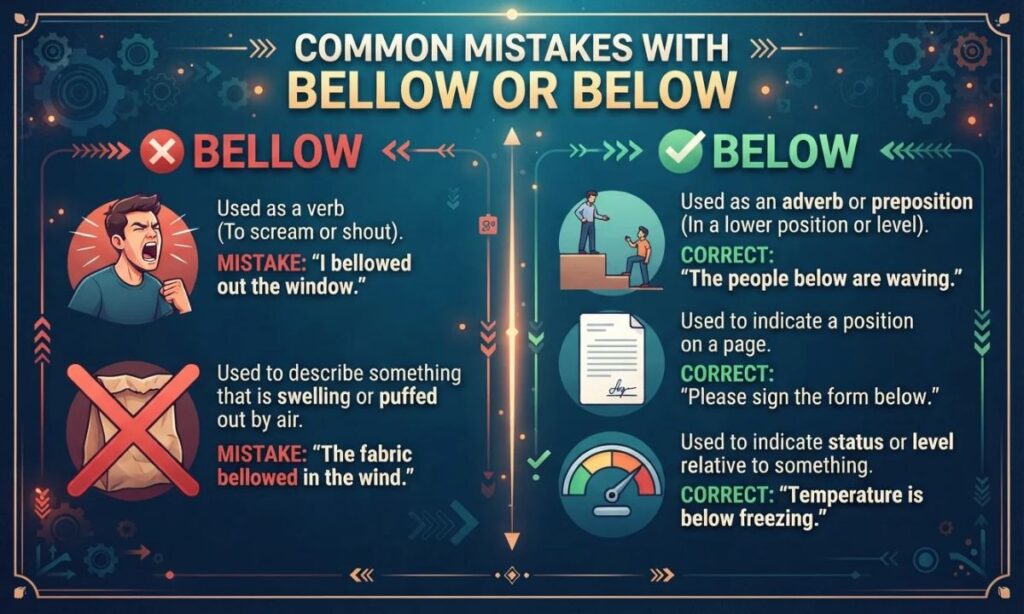
Most common spelling mistakes here come from autopilot typing. Your fingers hit double L because it feels familiar.
Spellcheck won’t always save you either. Both words are real, so the software sees nothing wrong.
Wrong: “Please See the Instructions Bellow”
This is the classic slip. It shows up in emails, forms, and even product pages.
The writer wants to point downward, but the word they typed means a roar. The sentence ends up sounding funny.
Correct: “Please See the Instructions Below”
Drop one L and the problem disappears. “Please see the instructions below” is clean and clear.
Remember, below points to a place on the page. Nothing in that sentence makes noise.
Wrong: “The Crowd Started to Below in Excitement”
This one flips the error. The writer wants a loud sound but picks the position word.
It sounds odd because below isn’t a verb in that sense. Nobody can “below” in excitement.
Correct: “The Crowd Started to Bellow in Excitement”
Now the sentence works. A crowd can bellow, because bellowing is a loud sound people make.
Add the second L and you get the right picture. Simple fix, big difference.
Common Errors with “Low Bellow” and “Below Zero”
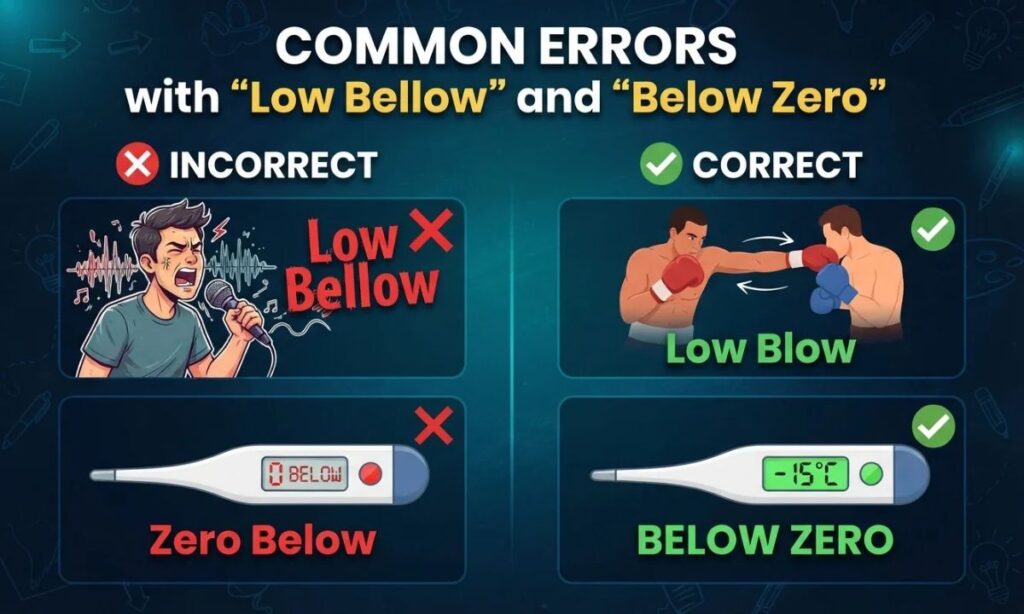
People sometimes write “low bellow” when they mean “below.” They hear “low” inside the word and get tangled.
Another frequent slip is “bellow zero.” The right phrase is below zero, since it means a temperature lower than zero.
If you ever write “bellow zero,” picture a thermometer roaring at you. That mental image will fix the spelling fast.
Bellow or Below in Everyday Examples
Real life gives you plenty of practice. Let’s look at how each word shows up day to day.
For below, think of emails: “Details are below.” Think of weather: “It’s going to be below freezing.” Think of reviews: “This product scored below expectations.”
For bellow, think of stories. A captain bellows orders on a ship. A farmer hears a cow bellow at dawn.
Here’s a quick mix. “The coach had to bellow, because the scores were below what he expected.”
That single sentence uses both words correctly. Try writing your own, and you’ll feel the difference right away.
How to Remember the Difference Between Bellow and Below
Here are some spelling memory tricks that actually work.
- Bellow has two Ls, and so does a loud roar. Two Ls, two big lungs.
- Below has one L, like a single line. A line sits low on the page.
- Bellow sounds like “bell.” Bells ring loudly, and so does a bellow.
- Below hides the word “low.” Low means lower, which is what below means.
Pick the one that sticks for you. You only need one good hook.
Another easy habit is to read the sentence aloud. If it’s about direction or level, write below, and if it’s about noise, write bellow.
Bellow or Below: Usage and Search Trends
If you check Google Trends, you’ll notice a pattern. Below gets far more searches, because people use it constantly in daily writing.
Searches for bellow tend to come from people checking the spelling, the definition, or the meaning of a name or phrase. Many of those searches are really typos.
This tells us something useful. People aren’t confused about the sound of these words, they’re confused about the written English.
The Oxford English Dictionary lists both words as separate entries. That backs up what we’ve covered: different roots, different jobs, and no overlap in meaning.
Frequently Asked Questions
Is Bellow and Below the Same Word Spelled Differently?
No. They’re two separate words with different meanings, pronunciation, and origins.
They only look alike because they share most of their letters. That’s a classic case of similar sounding words causing English spelling confusion.
Can Bellow Ever Mean the Same Thing as Below?
No, it can’t. Bellow never means lower than, and below never means a roar.
If you mix them up, readers will notice. Keep the direction word and the sound word apart.
Is It “See Bellow” or “See Below”?
It’s see below. That’s the correct form every time.
The phrase tells readers to look further down the page, so it needs the position word. Only one L is needed.
What Is the Past Tense of Bellow?
The past tense is bellowed. For example: “He bellowed across the field.”
The same form works as a past participle. “She had bellowed until she lost her voice” is perfectly fine.
Can Animals Bellow?
Yes, and they do it a lot. Bulls, cows, elk, moose, and alligators are famous for their deep animal roar.
Humans borrow the word for that same booming quality. That’s why we say a loud person “bellows like a bull.”
Is Below Ever Used as a Noun?
Rarely, but yes. In formal writing, you might see “the below” or “from below.”
Phrases like “the view from below” are normal. Still, most writers prefer to keep it as a preposition or adverb.
Is Below Used the Same Way in British and American English?
Yes. British English and American English treat it identically in spelling and meaning.
You may hear tiny differences in accent. The grammar and usage stay the same.
What Does “Bellow” Mean in Different Contexts?
In daily speech, it means to shout loudly. In nature, it describes animal calls.
In workshops, the bellows is a tool that pushes air into a fire. In writing, a bellow can also be a noun for any big, booming cry.
What Is the Expansion of Bellow?
Bellow isn’t an acronym, so it has no expansion. It’s a regular English word.
If you see it as a surname, such as the writer Saul Bellow, that’s a name and not a short form of anything.
Is Bellow Related to Netflix?
Not as a word. It has no special link to Netflix.
People may search it because of a show title, a character, or a caption they came across. The word itself still keeps its usual meaning.
Conclusion
So, which one is it? If you’re pointing to a lower position, choose below. If you’re describing a thunderous sound, choose bellow. That’s the heart of the bellow and below difference, and it works in both British English and American English. Remember bellowed as the past tense too. Easy, right?
Next time you write see below, you’ll do it with confidence. Got a tricky word pair of your own? Share it in the comments, and send this guide to a friend who still types “see bellow.” Your everyday English writing will look sharper, one small word at a time.

Finn Bradley is a grammar and language writer at Megazine Tech, focused on making English easier to understand. He researches grammar rules, vocabulary, sentence usage, punctuation, and common writing questions. Through clear explanations and practical examples, Finn helps readers build stronger communication skills and write with greater confidence in everyday situations.