

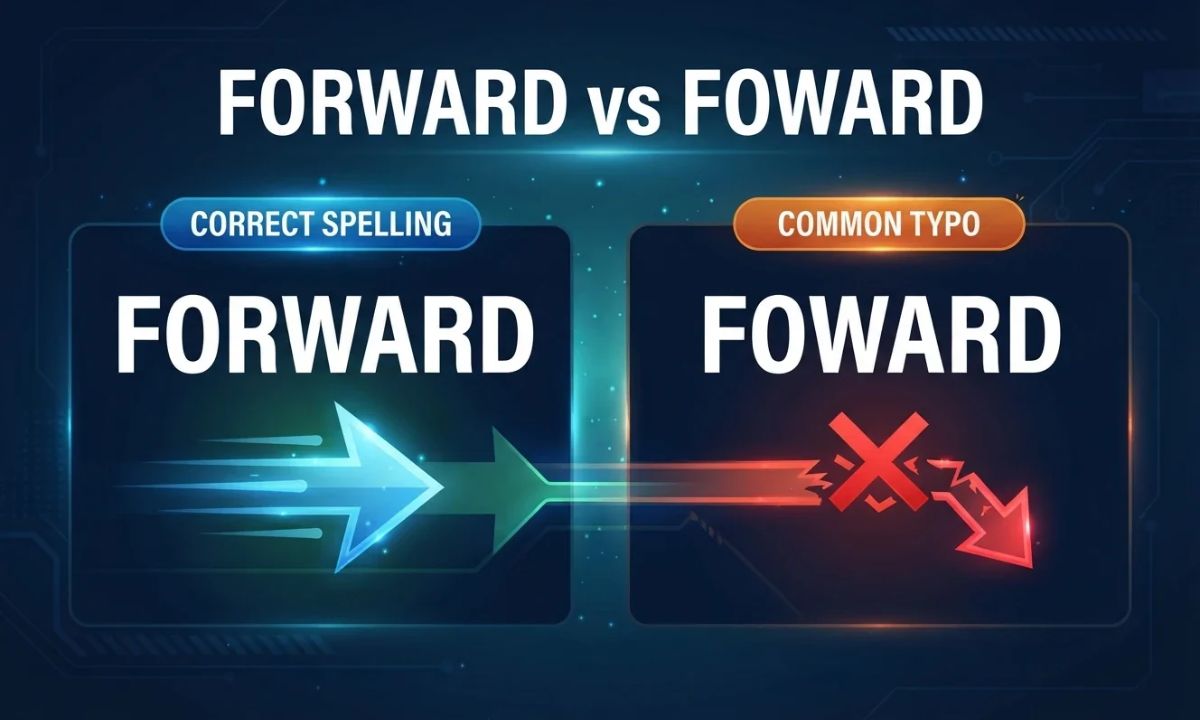
You’re typing fast, you hit send, and a tiny doubt creeps in. Sound familiar? Is it forward or foward? Here’s the straight answer: forward is the correct spelling, and foward is a common typo that no dictionary definition supports. The Foward vs Forward confusion happens because the first r is soft in speech, so it slips out during keyboard typing.
In this guide, you’ll get the forward meaning, the pronunciation in American English and British English, and the word origin from Old English. You’ll also see sentence examples, a simple memory trick, and how forward vs foreword differs. Each section is short, practical, and built for quick proofreading. Stick around, and you’ll never second-guess this spelling again.
Forward vs Foward – Quick Comparison Table
Sometimes you just need the answer fast. This table covers the Foward vs Forward question at a glance.
| Feature | Forward | Foward |
| Correct spelling? | Yes | No |
| In standard dictionaries? | Yes | No |
| Part of speech | Adverb, adjective, verb, noun | None |
| Origin | Old English foreweard | A common typo |
| Safe for emails and essays? | Always | Never |
See the pattern? One is a standard English word, and the other is a slip of the fingers.
If you remember only one thing, remember this. Every time you mean “toward the front” or “ahead,” you need the r.
Is “Foward” a Real Word?
No, it isn’t. Major references like Merriam-Webster, the Oxford Dictionary, and the Cambridge Dictionary list only forward. You won’t find foward as an entry anywhere in them.
So if you’ve wondered whether foward or forward might both work, the answer is a firm no. Foward is a spelling error, plain and simple.
That said, you’ll still see it online all the time. Spotting it in a text or a comment doesn’t make it right. It just proves how often people hit that typing mistake.
Read More: Ambience or Ambiance: Meaning, Spelling, and Usage Guide
What Does “Forward” Mean?
The forward meaning depends on how the word is used. Because forward works as several parts of speech, it shows up in far more places than you’d guess.
As an adverb, it means toward the front or ahead. “Please step forward” is a good example.
As an adjective, it can describe something at the front, like the forward section of a plane. It can also describe someone bold, as in “That was a forward question.”
As a verb, it means to send something on. You forward an email, a package, or a phone call.
As a noun, it names a player position in sports. Think of a forward in soccer or basketball.
So what about foward meaning? It has none, because it isn’t a word. Search engines see that question constantly, and the honest answer is that people mean forward.
Forward Spelling and Pronunciation Guide
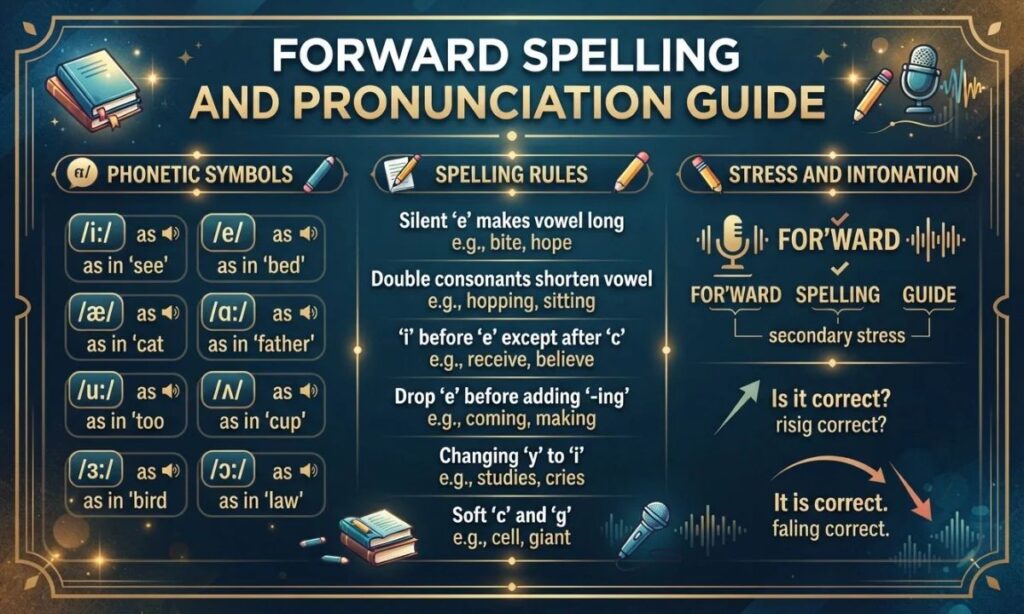
Spelling and sound are tied together here. If you say the word clearly, you’ll hear the r that foward leaves out.
Let’s break it down into pronunciation, definition, and a simple method you can use.
Forward Pronunciation in American English
In American English, you pronounce the r clearly. It sounds like “FOR-werd,” with the stress on the first part.
The second syllable is soft and quick. Most speakers drop it to a light “werd” sound.
Forward Pronunciation in British English
In British English, the first r is usually silent, so it sounds more like “FOR-wud.” The word still keeps that second syllable.
Here’s the catch. When you don’t hear the r, your brain may skip it when you type. That’s one reason the foward misspelling sneaks in.
How to Pronounce Forward Correctly
Say it in two beats: for and ward. Then put them together without pausing.
Try it out loud right now. If you can hear “for” at the start, you’ll know the r belongs there.
Forward Definition and Meaning
The plain forward definition is “toward the front, or onward in time or direction.” That covers almost every use you’ll meet.
It also works in phrases like moving forward, looking forward, fast forward, and forward thinking. All of them keep the same spelling, no exceptions.
Where Did the Word “Forward” Come From?
The word origin helps a lot here. Forward comes from Old English foreweard, which joins two parts: fore and weard.
Fore means “in front,” and weard points to a direction. Put them together and you get “toward the front.”
That second part also lives on in toward and backward. Notice the r in each of those? It’s the same ward ending, and it’s a handy clue.
Over centuries, the historical spelling shifted a bit, but the pieces never lost their r. So when you write forward, you’re honoring a very old building block of the English language.
Read More: Receive or Recieve: Correct Spelling, Meaning, and Usage
Biblical and Historical Use of “Forward”
The word has been around for a long time. You’ll find it in the King James Bible, for example, in Exodus 14:15, where the people are told to “go forward.”
That verse is one of the most quoted examples of the word in early English. It shows how steady the forward correct spelling has been across centuries.
Fast forward to today, and the meaning hasn’t changed much. We still use it to talk about progress, movement, and the next step. Only the typos have gotten more creative.
How to Use “Forward” Correctly in a Sentence
Let’s make this practical. A good rule is to ask what job the word does in your sentence.
Here are some sentence examples to show forward in a sentence across each role:
- Adverb: “The line moved forward slowly.”
- Adjective: “She sat in the forward cabin.”
- Verb: “Can you forward me that email?”
- Noun: “He plays forward for the local team.”
These cover the main grammar rules you need. The spelling stays identical in every case, which makes your life easier.
When in doubt, swap in “ahead” or “send on.” If one of those fits, you’re using forward and you need the r. Good word usage is mostly a quick check like that.
Real-Life Examples of “Forward” in Everyday Use
You’ll meet this word in places you’d never expect. In business writing, you might close an email with “I look forward to hearing from you.” It’s polite and common.
In sports commentary, announcers talk about a forward pushing up the field. A single typo there would show up on a live screen, and that’s not a great look.
In daily chats, you say things like “Let’s move forward” after a tough meeting. You might also tell a friend, “Forward that to me.” Each time, the spelling matters because people judge writing clarity fast.
Here’s a quick story. A friend of mine once sent a client proposal with “foward” in the subject line. Nobody said anything, but the reply took three days. Maybe a coincidence, maybe not.
Why Do People Keep Spelling “Forward” as “Foward”?
There are a few real reasons behind this spelling confusion. The first is sound. In many accents, that first r gets softened, so the word seems shorter than it looks.
The second is speed. When you type fast on a mobile keyboard, your thumb can skip a letter without you noticing. That’s a classic keyboard typing slip.
The third is how our eyes work. Your brain reads shapes, not letters, so “foward” looks close enough to pass at a glance. Proofreading is what catches it.
So is it a lack of intelligence? Not at all. It’s just how fast, casual typing works.
Common Spelling Mistakes Related to “Forward”
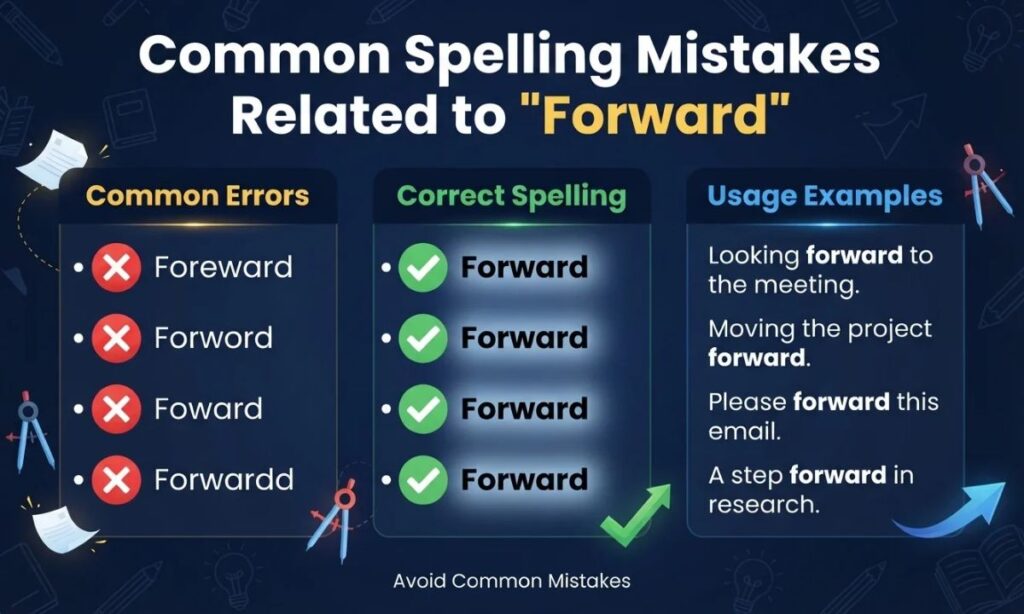
This isn’t the only word that causes trouble. There are plenty of words people often misspell, and they usually share one trait: a letter that’s easy to skip or swap.
Here are a few well-known common spelling mistakes:
- Definitely often becomes “definately.”
- Espresso often becomes “expresso.”
- Toward and towards get mixed up, though both are acceptable. Toward is more common in American English, while towards is popular in British English.
- Forward becomes “foward” or even “foreward.”
The forward spelling mistake that people make most is dropping the first r. The second most common is adding an extra e and writing “foreward,” which belongs to a different word entirely.
If you collect these typing errors in English, you start to see a pattern. Most come from sound, speed, or habit.
Looking Forward or Looking Foward – Which Is Correct?
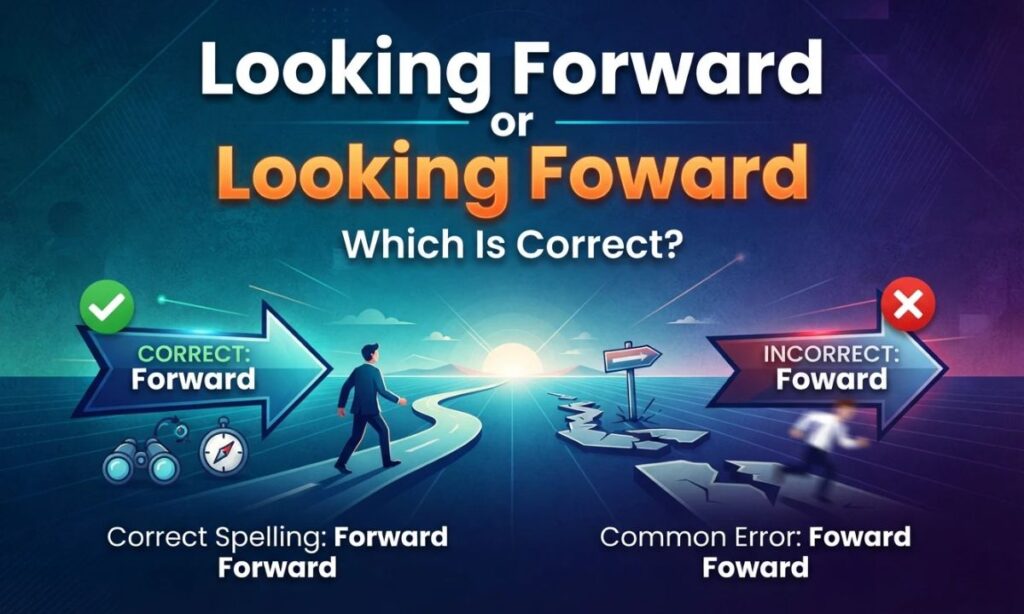
Looking forward is correct. Always. “Looking foward” is an error, even when it appears in an otherwise polished email.
You’ll see this phrase everywhere in work messages. “I’m looking forward to our call” is a safe, friendly line, and the spelling matters because it’s often the last thing a reader sees.
The same goes for moving forward, forward thinking, and fast forward. Each one keeps the full spelling. When it comes to Foward vs Forward, the phrase doesn’t change the answer.
Which Spelling Should You Use: Forward or Foward?
Use forward, every time. There’s no region, style guide, or special case where foward is acceptable.
That applies in American English and British English alike. It also applies to casual chats, school essays, and business emails. The Foward vs Forward debate really has just one winner.
Here’s a simple rule for the forward spelling rule. If the word has “for” at the start and “ward” at the end, it’s right. Think of it as for + ward, two clear chunks.
Forward vs Foreword and Other Commonly Confused Words
Now for the twist. Forward vs foreword is a real pair, and both are real words. The difference is meaning.
Foreword (with an e) is a short introduction at the start of a book. You’d read it before chapter one. Forward means ahead or to send on.
A quick trick helps. A foreWORD is made of words at the front of a book. So the word sits inside foreword.
Other pairs cause trouble too. Affect vs effect is a classic. Affect is usually a verb meaning to influence, while effect is usually a noun meaning a result. And take effect is correct, while take affect is not.
These are the same kind of grammatical correctness questions as Foward vs Forward. The fix is the same too: learn the meaning, then check the spelling.
Does Autocorrect Save You? Spell Checkers and Mobile Keyboards
Many people assume their phone will catch every slip. Sometimes it does, but not always.
A spell checker can fix foward most of the time, because the word has no dictionary match. But autocorrect can also change words you meant to keep, and it won’t help when you type a real word that’s wrong, like foreword instead of forward.
So treat your tools as a helper, not a safety net. A final read-through is still the best proofreading habit you can build.
Frequently Asked Questions About Forward vs Foward
Here are quick answers to the questions people ask most. Each one is short on purpose.
Is It Spelled Foward or Forward?
It’s spelled forward. The r after the first o is required.
Is “Foward” Ever Correct in English?
No. Foward isn’t recognized in standard dictionaries, so it’s never correct in formal or casual writing.
What Is the Difference Between Foward and Forward?
Forward is a real word with several meanings. Foward is a misspelling and has no meaning of its own.
Is It Looking Forward or Looking Foward?
It’s looking forward. Use it in emails, cover letters, and chats without worry.
Why Do People Misspell Forward?
Mostly because of sound and speed. The r is soft in speech, and fast typing on a phone makes it easy to skip.
Why Do Some People Pronounce Forward Differently?
Accents shape sound. In British English the first r is often silent, while American English speakers pronounce it more clearly.
Does Autocorrect Always Fix “Foward”?
Not always. It usually catches it, but it can miss it in rushed messages or when settings are off. Reread before you send.
What Is an Easy Trick to Remember the Spelling of Forward?
Think for + ward. If you can hear “for” and “ward” as two chunks, the r stays in place.
Final Thoughts
So, here’s the takeaway. Forward is always right, and foward is always a spelling error. Whether you’re writing an email, a school essay, or a quick text, the r stays. Remember for + ward, and you’re set. That small habit protects your writing clarity every time.
Keep an eye on look-alikes like foreword, affect vs effect, and toward vs towards. Let autocorrect help, but always give your message a final proofreading pass. Small checks save big embarrassment. Which common spelling mistakes trip you up the most? Drop a comment, and share this guide with a friend who types too fast.

Finn Bradley is a grammar and language writer at Megazine Tech, focused on making English easier to understand. He researches grammar rules, vocabulary, sentence usage, punctuation, and common writing questions. Through clear explanations and practical examples, Finn helps readers build stronger communication skills and write with greater confidence in everyday situations.