

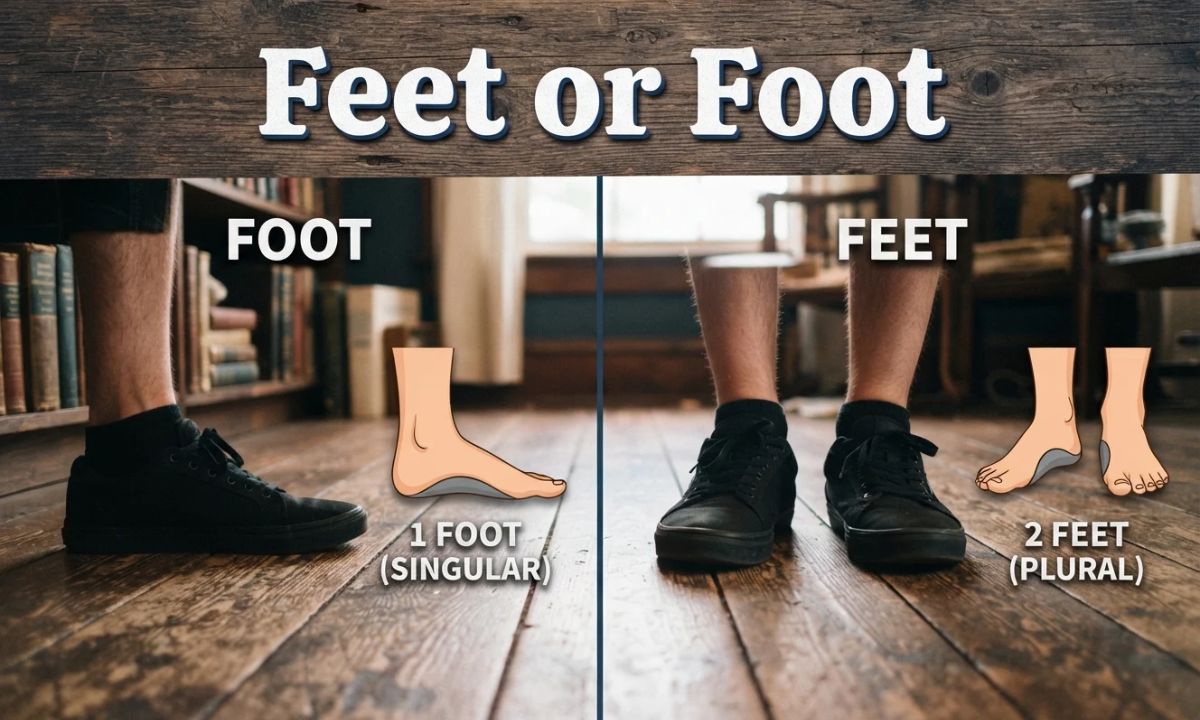
Is it six foot or six feet? You’ve probably typed that sentence, stared at it, and deleted it twice. Feet or foot trips up native speakers and English learners alike, because foot is an irregular plural noun that doesn’t follow the usual “add an s” rule.
Here’s the quick answer. Use foot for one, feet for more than one, and foot again in a compound adjective like a ten-foot fence. This guide shows you the correct plural of foot, the difference between a body part and a unit of measurement, and how British English and American English handle height. You’ll also learn the common mistakes to avoid. Nothing stuffy, just clear examples you can use in emails, essays, and captions.
Feet or Foot – Quick Answer
Here’s the short version of feet or foot. Use foot for one, and use feet for more than one.
That covers the body part and the unit of measurement. The only twist comes with a compound adjective before a noun, where foot stays singular and gets a hyphen.
So you write “one foot,” “two feet,” and “a ten-foot fence.” The fence is ten feet long, but the adjective drops the “s.” That single rule solves most of the confusion.
Feet vs Foot: Simple Examples
Examples work better than rules, so here are a few. Read them out loud and notice how natural they sound.
- My left foot hurts after that hike.
- Both feet were soaking wet.
- The table is one foot wide.
- The hallway is twelve feet long.
- We bought a six-foot ladder yesterday.
See the pattern? A single thing gets foot, a group gets feet, and a hyphenated modifier goes back to foot.
What Does Feet Mean?
Feet is the plural of foot. It names more than one body part, or more than one unit of length in the imperial system.
You use it for “my feet are cold” and for “the pool is eight feet deep.” Zero also takes the plural, so you’d say “zero feet of clearance.”
What Does Foot Mean?
Foot is the singular form. It can mean the body part at the end of your leg, the base of something, or a unit of measurement.
You’ll see it in “at the foot of the mountain” and “the foot of the bed.” It also shows up in a handful of idioms, which we’ll get to later.
Read More: Receive or Recieve: Correct Spelling, Meaning, and Usage
What Is the Difference Between Feet and Foot?
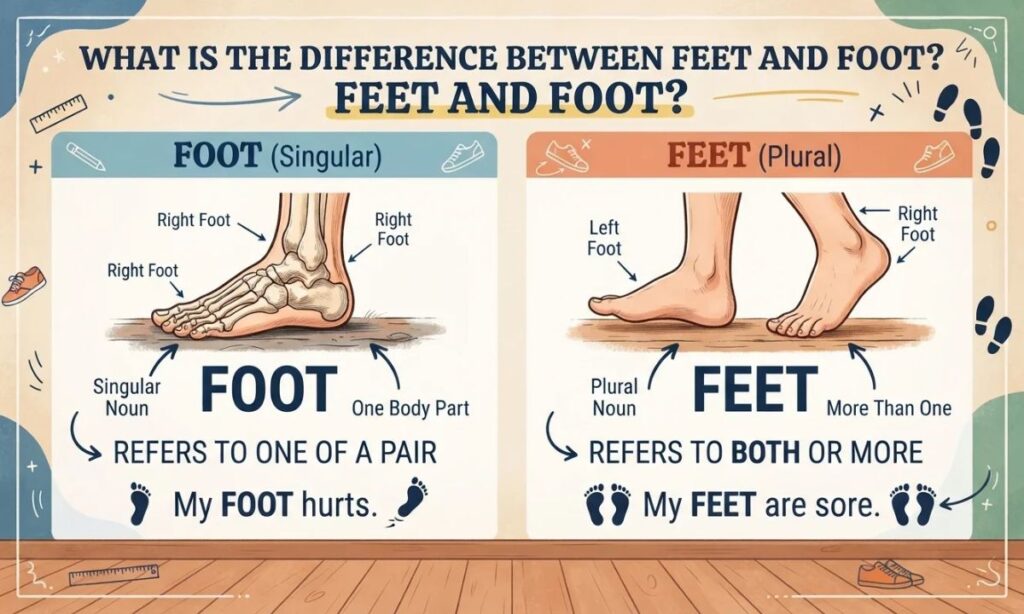
The difference between foot and feet is simply number. One is singular, and the other is plural.
What makes it tricky is that English doesn’t just add an “s.” Foot belongs to the group of irregular plural nouns, so the word itself changes shape.
Once you see it in context, it clicks. Let’s walk through the situations where people get stuck.
Feet and Foot Difference in Body Parts
With the body, the logic is easy. You have one foot on the pedal, but two feet on the ground.
A podiatrist might say, “Show me your right foot.” Then she’d add, “Now let’s check both feet.”
Feet or Foot in Height
Height is where feet or foot causes real arguments. Formal English prefers feet, as in “He is five feet tall.”
In casual speech, though, people often say “he’s six foot.” That’s an informal height expression, and it’s very common in everyday talk.
5 Feet or Foot: Which Is Correct?
For a standard sentence, “five feet” wins. Write “She is five feet tall,” and nobody will blink.
If you add inches, both versions appear. “Five feet six inches” is formal, while “five foot six” is the friendly spoken shortcut.
10 Feet or Foot: Correct Measurement
For a plain measurement, go with “ten feet.” The rope is ten feet long, and the room is ten feet wide.
But put the number in front of a noun, and the rule flips. You’d build a ten-foot fence or a ten-foot wall.
6 Feet or Foot Tall
“He is six feet tall” is the standard form. “He is six foot tall” shows up in speech and casual writing.
You can also say “a six-foot man” with a hyphen. The compound adjective rule explains why the “s” disappears.
3 Feet or Foot in a Sentence
Let’s try “three” so the pattern sticks. “The puppy is three feet from the couch” works perfectly.
Now switch it to “a three-foot gap.” Same idea, but the number and noun team up as an adjective.
Left Foot or Left Feet?
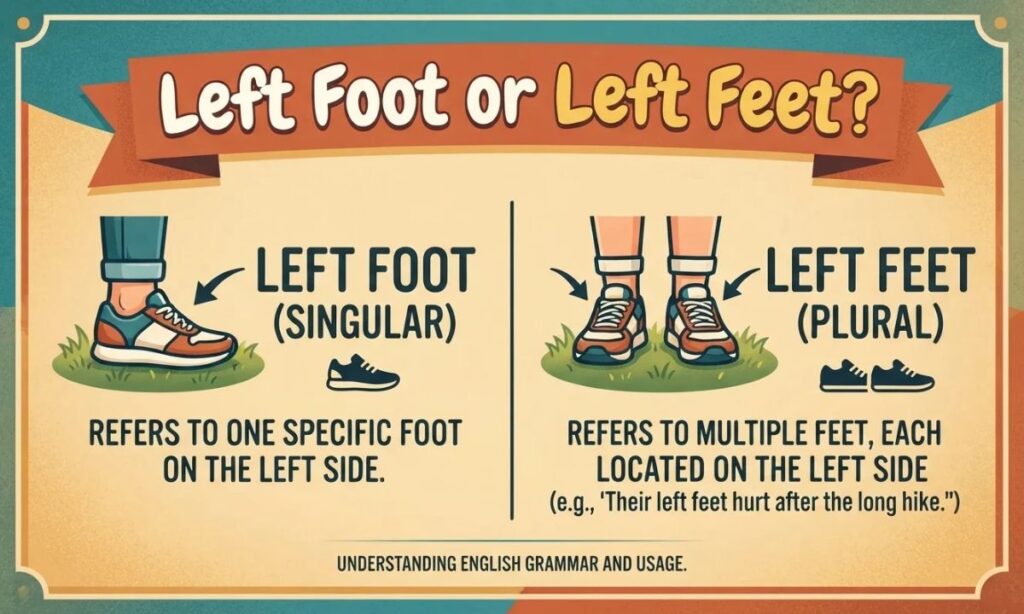
It’s always left foot. You only have one left one, so the singular fits.
“Left feet” would only make sense if you meant several people’s left feet. A dance teacher might say, “You’ve all got two left feet,” which is a joke about clumsiness.
Feet or Foot Massage
People search “foot massage” far more than “feet massage.” Here foot acts like an adjective that describes the type of massage.
You’ll also see “foot spa,” “foot cream,” and “foot pain.” English often uses the singular form this way, even when you mean both feet.
Which Form of Foot or Feet Should You Use?
To choose the right form, ask yourself two quick questions. How many are there, and is the word acting as a noun or a modifier?
That’s the whole foot spelling rule and feet spelling rule in one breath. Let’s break it into three situations.
Singular Body Part or Measurement
Use foot when you mean exactly one. “I stepped on a Lego with my bare foot” is a painful example.
The same goes for one unit of length. “The shelf sticks out one foot” is correct and clear.
Read More: Infront vs In Front: Which Is Correct and Why Does It Matter?
Plural Body Parts and Measurements
Use feet for two or more, and for any number except one. That includes decimals, so “1.5 feet” takes the plural.
It also covers vague amounts like “a few feet” or “several feet.” If you can count more than one, reach for feet.
Foot in Compound Adjectives
This is the rule that causes the most mix-ups. When a measurement works as an adjective before a noun, it stays singular and takes a hyphen.
So you write a six-foot ladder, a ten-foot wall, and a two-foot ruler. Compare that with “the ladder is six feet tall,” where the measurement comes after the noun.
Common Mistakes with Feet or Foot
Most errors fall into three buckets. Once you spot them, they’re easy to avoid.
Think of these as the common grammar mistakes that sneak into emails, captions, and school essays.
Can I Write “Feets”?
Short answer: no. Feets isn’t standard English, because feet is already plural.
You may see it in jokes, song lyrics, or playful dialect writing. In formal writing, skip it.
Is “Foots” Ever Correct?
As a plural noun, foots is wrong. Nobody says “two foots” in standard English usage.
There is one exception, and it’s a verb. When someone “foots the bill,” the word is a verb in third person, as in “She foots the bill every time.”
Foot or Feet Before a Noun
This one hurts the most people. Writers see a number like “ten” and automatically type “feet,” even before a noun.
Remember that a compound adjective doesn’t take a plural. Write “a ten-foot pole,” not “a ten-feet pole.”
The Origin of Feet or Foot
Why is this word so odd? The story goes back a long way. Foot comes from Old English fōt, and its plural was fēt.
Both trace back to Proto-Germanic. The weird plural came from a process called i-mutation, also known as umlaut.
In plain terms, a later sound changed the vowel in the middle of the word. That vowel change gave us the “oo” to “ee” shift we still see today.
The same thing happened to goose and geese, and to tooth and teeth. These words are like fossils from an older stage of the English language.
British English vs American English Usage
The good news is that British and American writers agree on the basics. Both say “one foot” and “two feet.”
The differences show up in style, in habits, and in which system people use for everyday measuring. Let’s look at each side.
Feet or Foot in British English
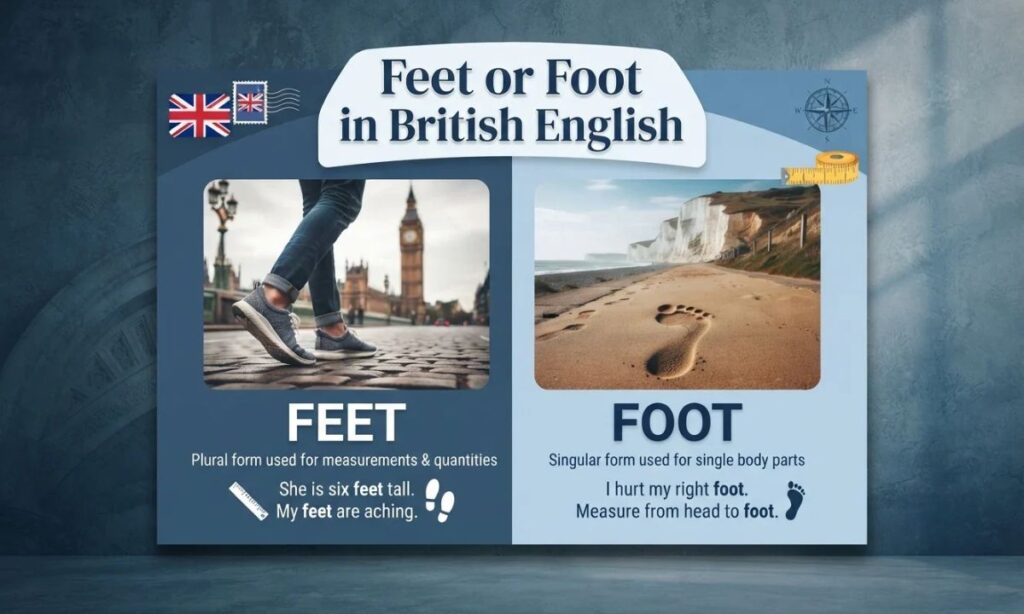
In the UK, people often use metres for official purposes. Yet they still say “six foot” when they describe a person’s height.
A British speaker might say, “He’s about six foot two.” It sounds natural in conversation, though a formal report would probably say “six feet two inches.”
Feet or Foot in American English
The US still relies on the US customary system, so feet are part of daily life. People measure rooms, fences, and runways in feet.
Americans also say “six foot” in casual talk. In published work, “six feet tall” or “6 feet tall” is the safer choice.
Feet vs Foot Comparison Table
| Situation | Correct form | Example |
| One body part | foot | My right foot is sore. |
| More than one body part | feet | Both feet are cold. |
| Plain measurement, more than one | feet | The yard is 20 feet wide. |
| Measurement of exactly one | foot | It’s one foot long. |
| Compound adjective before a noun | foot | a ten-foot fence |
| Casual height talk | foot (informal) | He’s six foot two. |
Feet or Foot in Everyday Examples
Grammar rules feel abstract until you see them in action. Here’s how feet or foot plays out in real writing.
Each setting has its own flavor, so you’ll want to match your word choice to the audience.
1. Emails
In a professional email, clarity beats cleverness. Write “The banner is eight feet wide” or “We need a six-foot table.”
If you’re emailing a friend, “he’s six foot” is totally fine. Just match the tone of the conversation.
2. News Writing
Reporters stick to tidy rules. They write “a 12-foot alligator” and “the alligator measured 12 feet.”
Notice how the numeral and hyphen team up before the noun. That consistency helps readers scan quickly.
3. Social Media
On social platforms, anything goes, and informal writing rules the feed. You’ll see “just sat on my feet for hours” and “six foot of pure chaos.”
Still, double-check before you post a business caption. A typo like “feets” can look sloppy to potential customers.
4. Formal Writing
In academic writing and reports, choose feet for measurements. Write “The wall is ten feet high,” and keep hyphens for adjectives.
Many writers also add metric equivalents in parentheses, such as “ten feet (about three meters).” It helps international readers.
Feet or Foot – Usage and Search Trends
People search for this topic all the time. Common queries include “six foot or six feet,” “feet or foot massage,” and “foots or feet.”
Those searches spike around school assignments, job applications, and real estate listings. When people describe heights and room sizes, they want a quick, reliable answer.
The interest also reflects how confusing irregular plural forms can be. Anyone learning English has to memorize these oddballs one by one.
Does Style Guide Advice Change the Answer?
Yes, a little. AP Style uses figures for dimensions and distances, so you’d write “He is 6 feet tall” and “a 6-foot man.”
The Chicago Manual of Style leans toward spelling out smaller numbers in general text. For technical writing, it allows numerals with units.
Both guides agree on the key point. Use feet after a number for plural measurement, and use foot in a hyphenated modifier.
When in doubt, check the guide your publisher or school follows. Consistency matters more than the specific choice.
Quick Tricks to Remember the Rule
Here’s a simple mental test. If you can swap in “long” or “tall” after the measurement, use feet.
If the number sits right before a noun, like “ladder” or “fence,” use foot. That’s your hyphen signal.
- “The rope is ten ___ long” gives you feet.
- “A ten-___ rope” gives you foot.
Another trick is to imagine the phrase with “one.” You’d say “a one-foot ruler,” never “a one-feet ruler,” so the singular makes sense with any number.
Idioms and Phrases with Foot and Feet
These two words show up in plenty of expressions. Knowing them helps your writing sound natural.
- On foot means walking, as in “We went on foot.”
- Set foot means to enter, as in “She never set foot in that house again.”
- At the foot of the mountain describes the base.
- Foot the bill means to pay for something.
- Get cold feet means to lose your nerve.
- Think on your feet means to react quickly.
Notice that “on foot” never becomes “on feet.” Fixed expressions keep their shape, so learn them as chunks.
Feet vs Foot: Quick Comparison Table
| Feature | Foot | Feet |
| Number | Singular | Plural |
| Body part | One foot | Two feet |
| Measurement | One foot (12 inches) | Several feet |
| Compound adjective | six-foot ladder | Not used |
| Informal height | six foot two | six feet two |
| Verb use | foots the bill | Not used |
One foot equals 12 inches, which is about 0.3048 meters. Keep that handy if you convert between the imperial system and metric.
Frequently Asked Questions
Here are quick, direct answers to the questions people ask most. Skim them or jump to the one you need.
What Is the Plural of Foot?
The plural of foot is feet. It’s an irregular plural, so you don’t add “s.”
Is It 1 Foot or 2 Feet?
Both are right, in the right place. Use “1 foot” for one, and “2 feet” for two.
Which Is Correct, 5 Foot or 5 Feet?
In standard writing, “5 feet” is correct. “5 foot” works in casual speech and before a noun, as in “a 5-foot desk.”
Is It “Six Foot” or “Six Feet”?
For formal writing, say “six feet tall.” For relaxed conversation, “six foot” is widely accepted.
Is “On Foot” or “On Feet” Correct?
The correct phrase is on foot. It’s a fixed idiom meaning “by walking.”
Which Form Does AP Style Recommend?
AP style recommends figures with the plural, like “6 feet tall.” Before a noun, it uses a hyphenated singular, like “a 6-foot man.”
Should I Use Foot or Feet Before a Noun?
Use foot with a hyphen. Write “a ten-foot wall” and “a two-foot gap.”
Conclusion
So, feet or foot? Use foot for a single body part or one unit of length, and use feet for more than one. When a measurement sits before a noun, like a six-foot ladder, keep foot singular and add a hyphen.
Remember that feets and foots aren’t standard English, and that “six foot tall” works best in casual talk. Formal writing prefers six feet tall. Keep the imperial system in mind when you convert inches to meters. Have a grammar question about height or measurement? Share it in the comments, and pass this guide to a friend who needs it.

Finn Bradley is a grammar and language writer at Megazine Tech, focused on making English easier to understand. He researches grammar rules, vocabulary, sentence usage, punctuation, and common writing questions. Through clear explanations and practical examples, Finn helps readers build stronger communication skills and write with greater confidence in everyday situations.