

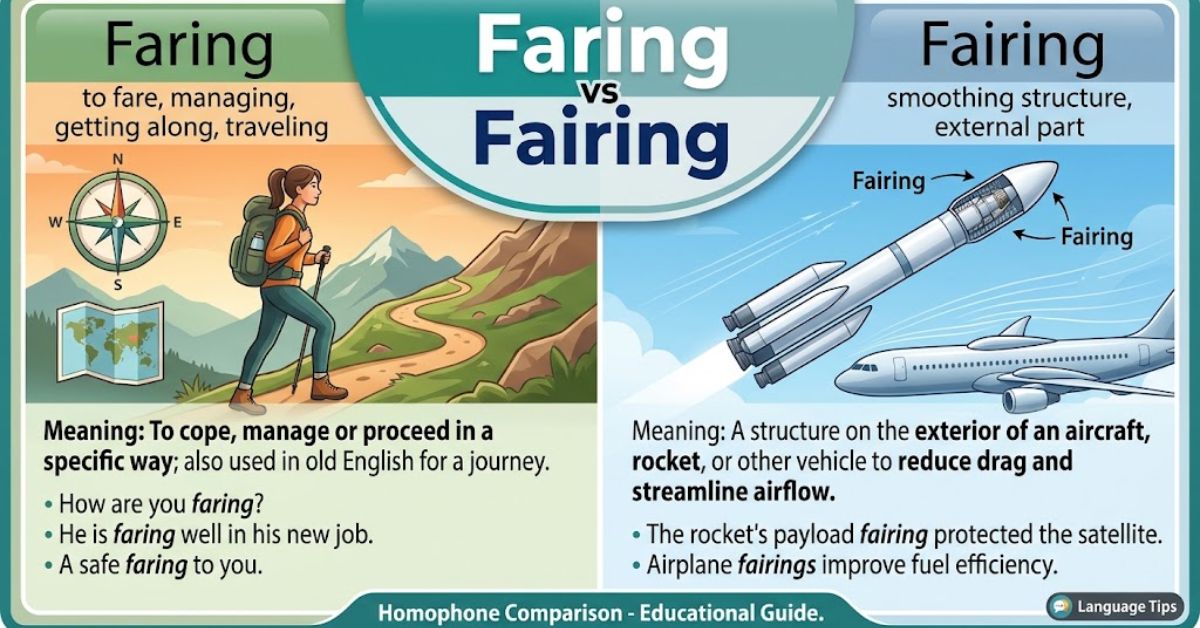
Faring vs fairing is confusing because both words look similar and usually sound alike. However, they don’t mean the same thing.
Faring comes from the verb fare. It describes how someone or something is doing, coping, progressing, or performing. That’s why “How are you faring?” is correct.
Fairing, by contrast, usually refers to a smooth or streamlined structure. You’ll commonly encounter the word when discussing motorcycles, aircraft, rockets, bicycles, and engineering.
There’s one wrinkle worth knowing. In specialized technical language, fairing can also describe smoothing or shaping a surface.
Quick answer: Use faring for performance or progress. Use fairing for a streamlined component or technical smoothing process.
Once you connect each spelling with its base meaning, the difference becomes surprisingly easy to remember.
What Are Faring vs fairing?
The simplest way to understand faring vs fairing is to trace each word back to its source.
Faring is the present participle of fare. As a verb, fare can describe how a person, organization, project, or other subject performs under particular circumstances.
For example:
- The students are faring well this semester.
- How is the new business faring?
- Our team is faring better after the changes.
In these sentences, faring essentially means doing, progressing, or performing.
Fairing usually has a technical meaning. It commonly names a structure designed to create a smoother exterior, manage airflow, or reduce drag.
Motorcycles, airplanes, rockets, bicycles, and other machines may have fairings.
The difference boils down to this Faring vs fairing:
Faring = doing or progressing
Fairing = streamlined structure or technical smoothing
Why It Matters
One extra letter can completely change your meaning.
Imagine emailing a coworker:
How are you fairing in your new position?
Your coworker will probably understand you. Still, the spelling is incorrect because you’re asking how the person is doing. The correct sentence is:
How are you faring in your new position?
Correct word choice matters even more in professional emails, academic papers, applications, reports, and published content.
Technical contexts raise the stakes further. An engineer discussing an aircraft fairing means a physical structure. An analyst saying an airline is faring poorly means the company isn’t performing well.
Same sound. Very different job.
The Core Rule
Here’s the fastest rule for choosing between Faring vs fairing:
- If doing, coping, managing, progressing, or performing makes sense, use faring.
- If you’re discussing a streamlined component, airflow, shaping, or smoothing, use fairing.
- If you’re asking how somebody is doing, write “How are you faring?”
Try replacing the questionable word with doing.
“The company is doing well” makes sense.
Therefore, “The company is faring well” also works.
“The motorcycle’s doing is cracked” makes no sense. You need fairing because you’re naming a physical component.
How to Use Faring vs fairing
When to Use Faring
Use faring when describing how somebody or something is managing or performing.
People can fare well or badly. So can businesses, projects, teams, economies, products, animals, and even plants.
Examples:
- How are the new employees faring?
- The startup is faring better than expected.
- Our tomato plants are faring well despite the heat.
- The project isn’t faring as well after the budget cuts.
The grammatical term for faring is present participle. In simpler language, it’s the -ing form of the verb fare.
When to Use Fairing
Use fairing when referring to a structure or component designed to create a smoother shape or manage airflow.
Common examples include:
- motorcycle fairing
- aircraft fairing
- rocket fairing
- payload fairing
- bicycle fairing
For example:
The mechanic replaced the motorcycle’s damaged front fairing.
Here, fairing names an actual component. It has nothing to do with how well the motorcycle is performing.
Fairing Can Also Be an -ing Verb
Here’s a detail many basic grammar guides overlook.
Fairing can function as a verb in specialized contexts.
The verb fair can refer to making a surface or shape smooth and properly blended. Engineers, boat builders, restorers, and other specialists may therefore talk about fairing a hull or fairing a surface.
For example:
The restoration crew is fairing the repaired hull before painting it.
In this sentence, fairing means smoothing or shaping.
That technical use is why the shortcut “faring is a verb, fairing is a noun” isn’t completely reliable.
Why Faring Is Not Spelled Fareing
The base word is fare, yet its -ing form is faring, not fareing.
Why?
English usually drops a final silent e before adding -ing.
Consider these examples:
- make → making
- write → writing
- move → moving
- fare → faring
Therefore, when you mean doing or progressing, write faring.
Correct Examples of Faring vs fairing
Real sentences make the distinction much clearer.
Faring:
- How are you faring after your first week?
- The students are faring better after tutoring.
- Small businesses are faring well this quarter.
- Our new product is faring better than expected.
- How is the project faring after the deadline change?
Fairing:
- The motorcycle’s front fairing was scratched.
- Engineers inspected the aircraft fairing.
- The rocket’s payload fairing protects sensitive equipment.
- The mechanic removed the damaged fairing.
- The crew is fairing the repaired surface before applying paint.
Notice the pattern. Faring evaluates condition or performance. Fairing usually identifies a technical structure or describes smoothing.
Incorrect vs. Correct
| Incorrect | Correct | Reason |
|---|---|---|
| How are you fairing? | How are you faring? | You’re asking how someone is doing. |
| Our team is fairing well. | Our team is faring well. | The sentence describes performance. |
| The motorcycle faring is cracked. | The motorcycle fairing is cracked. | A physical component is a fairing. |
| She is fareing better. | She is faring better. | Fare drops its final e before -ing. |
| The aircraft faring needs repair. | The aircraft fairing needs repair. | The sentence refers to an aircraft structure. |
| The workers are faring the hull. | The workers are fairing the hull. | Technical fairing can mean smoothing or shaping. |
Why People Make This Mistake
They Sound the Same
Faring and fairing are homophones in ordinary pronunciation. They sound alike despite having different spellings and meanings.
Your ears can’t reliably solve this puzzle. Context can.
Their Spellings Overlap
Compare them:
faring
fairing
Only one letter creates the visible difference. Since both spellings are legitimate English words, the wrong choice can still look convincing.
Writers Think of Fair Before Fare
Fair is extremely familiar.
You see it in phrases such as fair price, fair decision, and fair game. Because of that familiarity, writers may instinctively choose fairing when they hear the word aloud.
For performance, however, think of fare, not fair.
The Spelling Rule Hides the Base Word
The relationship between fare and faring isn’t visually obvious because the final e disappears.
fare → faring
Someone unfamiliar with the silent-e rule might write fareing or mistakenly switch to fairing.
Spellcheck May Not Catch It
Spellcheckers excel at spotting nonexistent words.
The problem? Both faring and fairing are real words.
Software must understand context to identify the error. Even sophisticated grammar tools can occasionally miss context-sensitive word choices.
Proofread for meaning, not spelling alone.
Translation Can Encourage Literal Choices
English learners may translate a word meaning doing, managing, or progressing from another language.
Because faring and fairing sound alike, choosing by pronunciation can lead to the wrong spelling.
A better strategy is to identify the underlying meaning first.
Common Mistakes Checklist
Before publishing your sentence, check these common problems:
- Writing “How are you fairing?” instead of “How are you faring?”
- Writing fareing instead of faring
- Assuming fairing is always a spelling error
- Using faring for motorcycle or aircraft components
- Assuming only people can be faring well
- Believing fairing can only function as a noun
- Choosing the spelling based solely on pronunciation
When in doubt, ask one question: Does this mean doing or progressing?
If yes, faring is probably your word.
Faring vs Fairing in Real English

Grammatically Correct English
“How are you faring with your new workload?” is grammatically correct.
Likewise:
The company is faring well despite higher costs.
Both sentences use faring to describe performance, progress, or condition.
Grammatically Possible but Unnatural English
Correct grammar doesn’t always produce the most natural conversation.
For instance:
I am faring well, thank you.
There’s nothing grammatically wrong with that sentence. However, it can sound unusually formal during a casual conversation.
Most people would simply say:
I’m doing well, thanks.
Good writing considers both correctness and context.
Natural Everyday English
In everyday conversation, you’ll often hear:
- How are you doing?
- How’s it going?
- How have you been?
- How are things going?
How are you faring? can sound more deliberate. It’s particularly useful when asking how somebody is coping with a specific situation.
For example:
How are you faring with the new workload?
Here, faring feels precise rather than overly formal.
American vs. British English
The main faring vs fairing rule remains the same in American and British English.
In both varieties, faring can describe how someone or something is doing. Fairing can refer to an aerodynamic or streamlined structure.
British English also has an older meaning of fairing: a present or gift, particularly one associated with a fair. That sense is uncommon in modern American conversation.
For most writers, it doesn’t affect the central rule.
How are you faring? remains correct on both sides of the Atlantic.
Formal vs. Informal Usage
Faring isn’t inherently formal. Still, it often sounds more deliberate than doing.
Professional examples include:
- How are the new hires faring during training?
- The industry is faring better than analysts predicted.
- How are residents faring after the disruption?
During casual conversation, you might prefer:
- How are you doing?
- How’s everything going?
- How are things?
Fairing works differently. Its use depends mainly on subject matter rather than formality. A motorcycle mechanic may use fairing casually because it’s an ordinary technical term in that workplace.
Faring vs Fairing Comparison Table
| Feature | Faring | Fairing |
|---|---|---|
| Base word | Fare | Fair or noun fairing |
| Common role | Verb form | Noun, sometimes technical verb form |
| Main meaning | Doing, coping, progressing | Streamlined structure, smoothing or shaping |
| Common subjects | People, teams, businesses, projects | Motorcycles, aircraft, rockets, surfaces |
| Common phrase | Faring well | Motorcycle fairing |
| Example | The company is faring well. | The fairing was damaged. |
| Technical context | Performance or condition | Engineering, aerodynamics, surface shaping |
Faring vs Fairing vs Fare vs Fair
These four words become easier to separate when you compare their functions.
| Word | Common Function | Meaning | Example |
|---|---|---|---|
| fare | Verb | Perform or get along | How did you fare? |
| fare | Noun | Transportation cost | The bus fare increased. |
| faring | Verb form | Doing or progressing | She’s faring well. |
| fair | Adjective | Just or reasonable | That’s a fair decision. |
| fair | Noun | Public event | We visited the county fair. |
| fairing | Noun | Streamlined structure | The fairing is damaged. |
| fairing | Verb form | Smoothing or shaping | They’re fairing the surface. |
The everyday relationship worth remembering is:
fare → faring → doing
fair → fairing → smoothing
Memory Trick
FAIRING Contains AIR
Look inside fAIRing.
It contains AIR.
Many technical fairings interact with airflow or create a smoother exterior shape.
Think:
AIR inside FAIRING = airflow = technical fairing
It’s not an etymological rule. It’s simply a useful memory trick.
FARING Comes From FARE
For faring, return to the base verb:
FARE → FARING
Ask:
How did she fare?
Now change the tense:
How is she faring?
One memory route uses AIR. The other uses FARE.
Real-Life Situations
Interview
After an interview, someone might ask:
How do you think you fared?
Once you start the job, they might ask:
How are you faring in your new role?
Both sentences concern performance.
Meeting
A manager might say:
The campaign is faring better in smaller markets.
The speaker is evaluating results. Therefore, faring is correct.
A professional check-in might say:
I wanted to see how your team is faring with the new system.
This wording sounds polished without becoming stiff.
Text Message
You could text:
How are you faring with all that studying?
That’s correct, although “How’s the studying going?” sounds more casual.
Exam
Consider this sentence:
The motorcycle’s damaged ___ needs replacement.
Choose fairing because the blank names a physical component.
Now consider:
The motorcycle team is ___ better this season.
Choose faring because you’re describing performance.
Expert Tips
Use these shortcuts when you’re unsure:
- Find the base word. If the meaning comes from fare, use faring.
- Try the doing test. If doing preserves the meaning, faring usually works.
- Ignore pronunciation. These words sound alike.
- Watch performance words. Well, badly, better, and worse often accompany faring.
- Look for technical nouns. Motorcycle, aircraft, rocket, payload, hull, and surface can signal fairing.
- Don’t assume faring only applies to people. Businesses, economies, projects, crops, and products can fare well.
- Proofread for context. Spellcheck can’t always distinguish two correctly spelled words.
Quick Summary
Faring and fairing are both correct English words, but they aren’t interchangeable.
Faring comes from fare and describes how someone or something is doing, coping, progressing, or performing. That’s why “How are you faring?” and “The company is faring well” are correct.
Fairing usually refers to a streamlined structure found on motorcycles, aircraft, rockets, and other engineered objects. In specialist technical usage, fairing can also describe smoothing or shaping a surface.
Remember two simple clues:
FARE → FARING = doing
AIR inside FAIRING = airflow or technical structure
And skip fareing. The silent e disappears before -ing.
FAQ
Is it faring or fairing?
Both are correct words. Use faring for doing or progressing and fairing for a streamlined structure or technical smoothing.
Is it “How are you faring?” or “How are you fairing?”
“How are you faring?” is correct because you’re asking how someone is doing, coping, or progressing.
Is it “faring well” or “fairing well”?
Write faring well when you mean doing well. It comes from the verb fare.
Is “faring” an old-fashioned word?
No. Faring remains standard English, although doing or getting on may sound more casual in everyday conversation.
Can an object or organization be “faring well”?
Yes. Companies, projects, products, teams, economies, crops, and other subjects can all be described as faring well.
Is “fareing” ever correct?
Not as the standard present participle of fare. English drops the final silent e, producing fare → faring.
Can fairing be used as a verb?
Yes. In specialist contexts, fairing can describe smoothing, shaping, or blending a surface or form.
Is a motorcycle body panel called a faring or fairing?
The correct spelling is fairing when referring to the motorcycle’s streamlined bodywork or related component.
Are faring and fairing homophones?
Yes, in ordinary English pronunciation they generally sound alike despite having different spellings and meanings.
Does fairing have a meaning outside engineering?
Yes. Fairing also has an older British noun sense referring to a present or gift, especially one associated with a fair.
Meta Description: Faring vs fairing explained with meanings, grammar rules, examples, spelling tips, common mistakes, and an easy memory trick.

Finn Bradley is a grammar and language writer at Megazine Tech, focused on making English easier to understand. He researches grammar rules, vocabulary, sentence usage, punctuation, and common writing questions. Through clear explanations and practical examples, Finn helps readers build stronger communication skills and write with greater confidence in everyday situations.