


You typed the word, and something felt off. Was it reinforce or reenforce? If you’ve ever paused mid-sentence to wonder, you’re in good company. English spelling confusion trips up even seasoned writers.
Here’s the quick answer. Reinforce is the correct spelling of reinforce in standard English. Reenforce is a rare variant that most editors treat as a spelling mistake. In this guide on reinforce vs reenforce, you’ll see the reinforce meaning, real examples, how it differs from enforce, and simple tricks to remember the right form. Whether you reinforce a wall, reinforce an argument, or reinforce positive behavior, you’ll spell it right every time.
Reinforce vs Reenforce: Which Spelling Is Correct?
Reinforce is correct. You’ll see it in every major English dictionary, in news writing, in textbooks and in legal documents.
Reenforce isn’t wrong in the sense of being gibberish. It’s simply a rare variant, and most editors will change it on sight.
Think of it like “gray” and “grey.” Both exist, but one is the clear default. With reinforce vs reenforce, the default wins by a mile.
If you’re writing for a client, a teacher or Google, pick reinforce. You’ll never get a red mark for it.
What Does Reinforce Mean?
The reinforce meaning is simple. To reinforce something is to strengthen it or add extra support.
A reinforce definition usually covers two ideas. One is physical, like making a wall or beam harder to break. The other is abstract, like making an idea, habit or feeling stronger.
Picture a friend telling you your presentation was great. That praise helps you reinforce your confidence, even though nothing physical changed.
Both uses come from the same core idea: make stronger. Once you hold onto that, the word is easy to use.
Is Reenforce a Word?
Yes, but with an asterisk. Some dictionaries, including Merriam-Webster, record reenforce as a variant of reinforce.
That means it has a paper trail. It doesn’t mean it’s a good choice.
The reenforce meaning is identical to reinforce. The reenforce dictionary meaning simply points you back to the standard word.
So if someone asks, “Is reenforce a real word?”, you can say it exists, but it’s outdated and uncommon. Most readers will see it as a typo.
Read More: Seamless vs. Seemless: Which Spelling Is Correct?
Reinforce vs Reenforce: Meaning and Examples
Here’s the twist: the meaning doesn’t change at all. Reinforce vs reenforce is a spelling question, not a meaning question.
Let’s see both in action.
- Reinforce: The engineers will reinforce the bridge with extra steel before winter.
- Reenforce: The engineers will reenforce the bridge with extra steel before winter.
Same sentence, same meaning. Only the first looks natural to modern eyes.
Try a softer example. “Regular practice helps reinforce what you learned in class.”
If you swapped in the variant, readers might pause and wonder if you made a mistake. Why risk that?
Reinforce vs Enforce: What’s the Difference?

People mix these up all the time, and it makes sense. They look alike and sound alike.
But the reinforce vs enforce gap is real. To enforce means to make people follow a rule or law. To reinforce means to strengthen something.
For example, police enforce a law. A builder reinforces a wall.
A teacher might enforce a rule about phones in class. Then the same teacher might reinforce positive behavior with praise. One word controls, the other builds.
Here’s a quick test. If you’re talking about rules, penalties or compliance, you want enforce. If you’re talking about strength, support or repetition, you want reinforce.
Reinforce vs Re-enforce: When to Use Each
This is where the hyphenated word re-enforce enters the picture. Some older texts use a hyphen to show the prefix re- attached to enforce.
In that form, re-enforce can literally mean “enforce again.” A court might re-enforce an old ruling, for instance.
That’s a rare use, though. Most writers who type re-enforce actually mean reinforce.
So here’s the practical rule for reinforce vs re-enforce:
- Use reinforce when you mean to strengthen or support.
- Use re-enforce only when you truly mean “enforce again,” and even then, consider rewording it.
If you want zero confusion, write “enforce again” in plain words. Your reader will thank you.
Reinforce vs Reenforce: Quick Comparison
Sometimes a table beats a paragraph. Here’s how the three forms stack up.
| Form | Status | Meaning | Best use |
| Reinforce | Standard | Strengthen or support | Almost every situation |
| Reenforce | Rare variant | Same as reinforce | Avoid in modern writing |
| Re-enforce | Hyphenated form | Often “enforce again” | Rare legal or technical cases |
Glance at that table whenever you doubt yourself. The correct spelling of reinforce never changes.
How to Use Reinforce in a Sentence
Knowing a word is one thing. Using it smoothly is another.
Here are real examples of reinforce in a sentence, grouped by situation.
In construction:
- Workers reinforce a foundation with steel beams and concrete before building upward.
- The city plans to reinforce the old bridge with extra supports.
In daily life:
- A quick thank you can reinforce trust between coworkers.
- Writing a few lines each morning helps reinforce a habit.
In arguments and writing:
- A single statistic can reinforce an argument better than three paragraphs of opinion.
- Your conclusion should reinforce your main point, not repeat it word for word.
In parenting and psychology:
- Parents often reinforce positive behavior by noticing good choices out loud.
Notice the pattern. You’re always adding strength to something that already exists.
Read More: Infront vs In Front: Which Is Correct and Why Does It Matter?
Reinforce Synonyms and Related Words
Using the same word five times in one article gets old. Good news: you have options.
Common reinforce synonyms include:
- Strengthen
- Support
- Fortify
- Bolster
- Buttress
- Back up
- Toughen
Each one has a slightly different flavor. Fortify feels military or protective. Bolster works well for confidence and arguments.
Pick based on tone. For business reports, “bolster” sounds sharp. For a casual chat, “back up” feels natural.
Reinforce Meaning in Spanish
Many readers search for the reinforce meaning in Spanish, so let’s cover it. The main translation is reforzar.
The noun reinforcement usually becomes refuerzo. For reinforcements in a military sense, Spanish speakers say refuerzos.
For example, “We need to reinforce the roof” becomes “Necesitamos reforzar el techo.”
Interestingly, the French word renforcer sits close to this family too. That’s a hint about the word’s roots, which we’ll get to shortly.
What Is the Difference Between Reinforcement and Reenforcement?
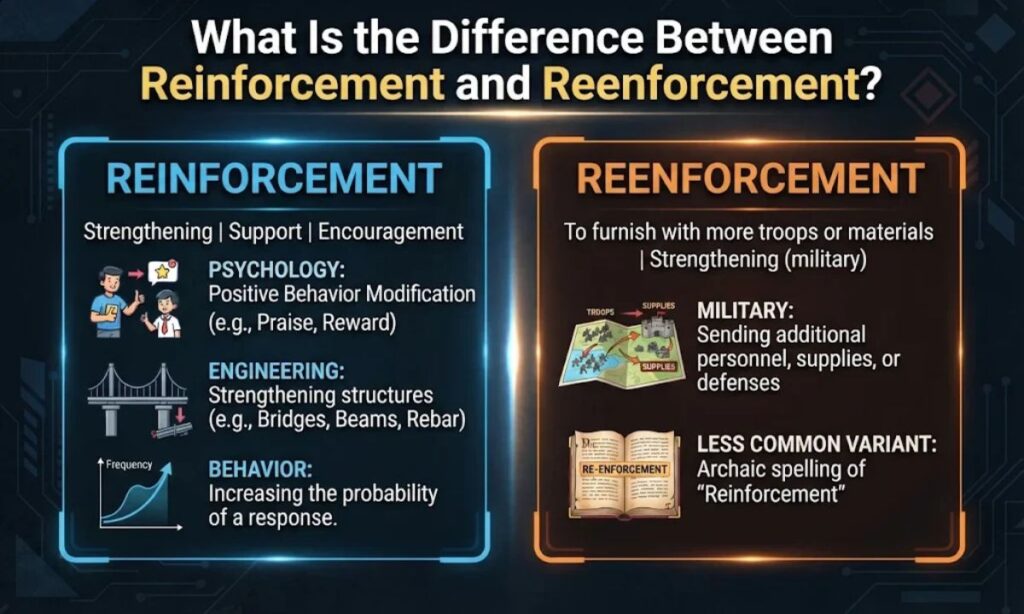
Here we go again with the same split. Reinforcement is the standard noun form of reinforce.
Reenforcement is the rare variant. It follows the same logic as reenforce and carries the same stigma.
The reinforcement meaning depends on context. In building, it’s the material you add for strength, like steel bars in concrete.
In psychology, it’s a consequence that makes a behavior more likely to repeat. Positive reinforcement adds something pleasant, like a reward. Negative reinforcement removes something unpleasant.
In military language, reinforcements are extra troops sent to help. The reinforcements meaning here is simply backup.
Stick with reinforcement in all three cases. It’s the only form you’ll see in serious writing.
Why Is It Reinforce and Not Reenforce?
Blame history and a bit of tidiness. The word entered English in the early 1600s, formed from the prefix re- and an older form of enforce.
Over time, English writers merged the pieces into one smooth word. That’s the reinforce word origin in a nutshell, and it’s why the etymology points back to French.
Think about “reinvent” and “reappear.” We rarely stack double vowels with a hyphen when a word has settled down.
Because reinforce became the dominant form in print, dictionaries gradually treated the others as variants. Usage shaped the rule, not the other way around.
Common Reinforce Spelling Mistakes
Even confident writers slip here. Spotting these common spelling mistakes will save you embarrassment.
- Reenforce (the rare variant)
- Re-enforce (when you don’t mean “enforce again”)
- Reinforse (swapping the c for an s)
- Renforce (dropping the i, probably from French influence)
- Reinforcment (skipping the e in the noun form)
The reenforce spelling mistake is the most common of the bunch. It looks logical, which is exactly why it sneaks past people.
Run a quick check before you publish. A good spell checker will flag most of these, though autocorrect sometimes swaps in the wrong word entirely.
Why Do People Confuse Reinforce and Reenforce?
It comes down to how we read and speak. When you say “reinforce,” you can hear a small “re-en” sound in the middle.
That sound tempts your brain to spell it re-en-force. Your ear says one thing, and the dictionary says another.
The prefix doesn’t help either. We see re- in words like “rewrite” and “rebuild,” so adding it to enforce feels natural.
Add English spelling confusion in general, and you’ve got the perfect trap. English loves to break its own patterns.
How to Remember the Correct Spelling of Reinforce
Memory tricks work better than rules. Try one of these.
Picture the word rein hiding inside it. A rein controls a horse, which adds strength and guidance. Rein-force gives you “force” with some control.
Another trick: say it slowly as rein-FORCE. The “i” connects the two chunks, so there’s no room for an extra “e.”
Pick the one that sticks. You’ll rarely misspell it again.
Is Reinforce Spelled Differently in British and American English?
Nope. This one’s refreshingly simple. Both American and British English spelling use reinforce.
Unlike “color” and “colour,” there’s no regional split here. Both Oxford Dictionary and Merriam-Webster treat reinforce as the headline entry.
So if your boss asks which version to use for a global audience, you can relax. Standard English has one clear winner.
Reinforce vs Reenforce: Reddit Discussions and Common Usage

Spelling debates love a good forum thread. On Reddit and similar sites, you’ll find people asking, “Is reenforce acceptable?” or “Did my teacher mark me wrong?”
The common answer is blunt. Most commenters say reinforce is the safe choice, and the variant looks like an error.
That tells you something useful about real-world usage. Readers don’t check footnotes. They react to what looks right.
For professional writing, formal writing and legal writing, stick with reinforce. For everyday language, the same advice applies.
Where Reinforce Shows Up in Real Life
The word travels far beyond grammar guides. Here are a few places you’ll bump into it.
In fitness, trainers talk about reinforcing joint stability with controlled strength work. A stronger muscle around the knee protects the joint.
In relationships, small gestures reinforce trust between partners. A kept promise says more than a speech.
In parenting, caregivers reinforce good habits through attention and praise. It’s less about prizes and more about noticing.
In business, a manager might reinforce company values during a team meeting. Repetition makes ideas stick.
Different worlds, same idea: add strength where it matters.
Frequently Asked Questions
Is Reenforce Ever Correct?
Technically, yes. Some dictionaries list it as a variant.
In practice, it’s outdated, and most editors will correct it. Use reinforce and you’re safe.
What Does Reenforce Mean?
It means the same as reinforce: to strengthen or add support.
The only difference is the spelling, and the spelling is the part that looks off to modern readers.
Is It Reenforcement or Reinforcement?
It’s reinforcement. That’s the standard noun form found in dictionaries and professional writing.
Reenforcement is a rare variant you can skip.
Why Is Reinforce Spelled Without an Extra E?
Because the word merged over time into a single smooth form. The old split between re- and enforce faded as writers settled on reinforce.
Today, the extra “e” survives only in rare variants.
Can Reinforce and Enforce Be Used Interchangeably?
No. Enforce is about making people follow rules, while reinforce is about strengthening.
You enforce a rule, but you reinforce a wall. Swapping them changes your meaning completely.
Final Thoughts: Reinforce or Reenforce?
So, reinforce vs reenforce isn’t a close call. Reinforce wins in every major English dictionary, from Merriam-Webster to the Oxford Dictionary. Reenforce and re-enforce only linger as old variants, and enforce carries a different meaning entirely.
Keep it simple. Use reinforce when you mean to strengthen or add extra support, and reinforcement for the noun form. Your spell checker will thank you, and your readers won’t stumble. Got a word pair that confuses you? Share it in the comments, and pass this guide to a friend who writes a lot.

Finn Bradley is a grammar and language writer at Megazine Tech, focused on making English easier to understand. He researches grammar rules, vocabulary, sentence usage, punctuation, and common writing questions. Through clear explanations and practical examples, Finn helps readers build stronger communication skills and write with greater confidence in everyday situations.