

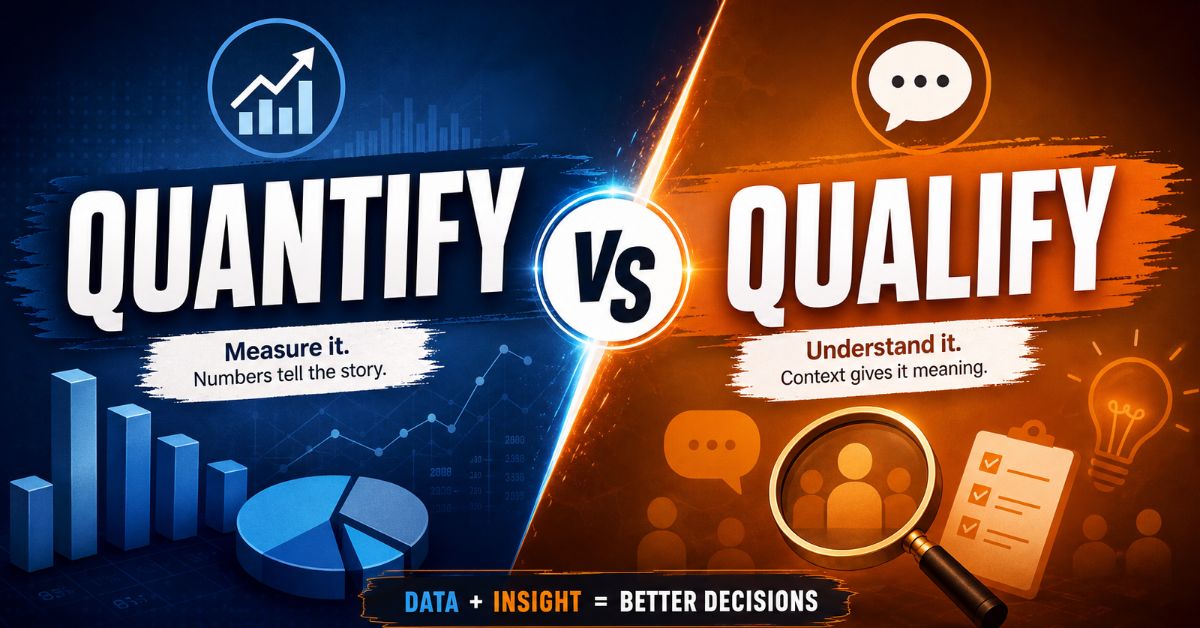
Many people confuse Quantify vs Qualify because these two words look and sound similar. However, they have completely different meanings and uses in English. Choosing the correct word helps you communicate clearly, especially in academic writing, business reports, and everyday conversations.
Quantify means to measure, count, or express something using numbers, figures, or data. In contrast, qualify means to meet specific requirements, become eligible, describe something, or add conditions to a statement.
Although both words are verbs, they serve different purposes. Understanding their meanings will help you avoid common spelling and grammar mistakes.
In this guide, you’ll learn the definitions, differences, pronunciation, sentence examples, and common uses of quantify and qualify. You’ll also discover how these words relate to quantitative and qualitative information.
Quantify vs Qualify: Quick Answer
The main difference is simple: quantify means measuring something with numbers, while qualify means meeting requirements or describing something.
| Word | Meaning | Example |
|---|---|---|
| Quantify | To measure or express something in numbers | The company quantified its losses at $2 million. |
| Qualify | To become eligible, describe, or limit something | She qualified for the scholarship. |
The Simple Rule
- Quantify = Quantity = Numbers
- Qualify = Quality = Description or Eligibility
If you’re discussing amounts, measurements, or statistics, use quantify.
If you’re discussing requirements, descriptions, or eligibility, use qualify.
What Does Quantify Mean?
The verb quantify means to measure, count, or express something numerically.
It involves turning information into measurable data. Whenever you assign a number or value to something, you’re quantifying it.
For example, instead of saying that a business made a good profit, you can quantify its earnings by stating that it earned $50,000.
The word comes from the Latin term quantus, which means “how much” or “how many.”
Examples
- Scientists quantified the amount of plastic in the ocean.
- The company quantified its annual losses.
- Researchers tried to quantify customer satisfaction.
- The manager quantified the team’s performance.
- The study quantified the effects of pollution.
In each example, the goal is to measure something or express it using numerical information.
Common Situations Where We Use Quantify
You may encounter quantify in different professional and academic situations, including:
- Business reports
- Financial statements
- Scientific research
- Surveys and statistics
- Marketing performance analysis
- Risk assessments
- Customer satisfaction studies
Examples in Everyday Life
You probably quantify things more often than you realize.
| Situation | Quantified Measurement |
|---|---|
| Weight loss | 10 pounds |
| Savings | $5,000 |
| Walking | 8,000 steps |
| Study time | 3 hours |
| Sleep | 7.5 hours |
Numbers help people understand, compare, and evaluate information. That’s why businesses, researchers, and professionals regularly quantify their results.
Why Quantifying Matters
Quantifying information makes it easier to understand results and measure progress.
Consider these two statements:
- Sales improved.
- Sales increased by 35%.
The second statement provides more specific information because it quantifies the improvement.
Without measurements, people often depend on assumptions rather than clear evidence. Numbers help businesses evaluate performance and make informed decisions.
Benefits of Quantifying Information
Quantifying information offers several advantages:
- Makes results measurable.
- Helps identify trends.
- Improves decision-making.
- Makes comparisons easier.
- Creates accountability.
- Reduces guesswork.
Measurement also helps organizations understand whether their strategies are working and where improvements are necessary.
Common Phrases That Use Quantify
The word quantify frequently appears in professional, academic, and business communication.
Common expressions include:
- Quantify risks
- Quantify damages
- Quantify performance
- Quantify costs
- Quantify benefits
- Quantify results
- Quantify data
- Quantify losses
Sentence Examples
- Analysts quantified the company’s debt.
- Doctors quantified the patient’s improvement.
- Researchers quantified the impact of climate change.
- The accountant quantified the financial losses.
- The team quantified its marketing results.
What Does Qualify Mean?
The verb qualify has several meanings depending on the context.
Generally, it means:
- To become eligible for something.
- To meet specific requirements.
- To describe or modify something.
- To limit or clarify a statement.
- To provide someone with the necessary training or certification.
The word comes from the Latin term qualis, meaning “of what kind.”
Unlike quantify, qualify usually focuses on conditions, descriptions, and eligibility rather than numerical measurements.
Qualify Meaning: Becoming Eligible
One of the most common meanings of qualify is to meet the requirements for something.
When someone qualifies for a competition, scholarship, job, or loan, it means they have fulfilled the necessary conditions.
Examples
- She qualified for the finals.
- He qualified for a mortgage.
- They qualified for government assistance.
- The student qualified for a scholarship.
- Our team qualified for the national championship.
In each sentence, someone meets specific requirements to become eligible for an opportunity.
Common Requirements for Qualification
| Situation | Requirement |
|---|---|
| University admission | Grades and test scores |
| Loan approval | Credit score and income |
| Scholarship | Academic performance |
| Marathon | Meeting qualifying time |
| Job position | Experience and education |
Qualify Meaning: Limiting or Modifying a Statement
Qualify can also mean adding conditions or details to make a statement more accurate.
Sometimes a statement sounds too general. Adding specific information helps explain when, where, or under what circumstances it applies.
Examples
- I need to qualify my earlier comments.
- The witness qualified his statement.
- The report qualifies its conclusions.
- She qualified her opinion with additional information.
For example:
Original statement:
“The product is excellent.”
Qualified statement:
“The product is excellent for small businesses.”
The second statement adds a specific condition and makes the meaning more precise.
Qualify Meaning: Describing Something
In grammar, a word can qualify another word by describing or modifying it.
For example:
- The blue car.
- The old house.
- The extremely happy child.
- She speaks softly.
Words such as adjectives and adverbs provide additional information about nouns, verbs, or other expressions.
This use of qualify helps make sentences more descriptive and meaningful.
Qualify Meaning: Becoming Certified
Qualify can also refer to gaining the necessary training, education, or certification to perform a particular job.
Examples
- The course qualifies students to become accountants.
- The certification qualifies technicians to work on aircraft.
- The program qualifies workers for management roles.
- Her training qualified her to teach young children.
In these examples, qualification involves developing the skills or meeting the standards needed for a particular profession.
Quantify vs Qualify: The Main Differences
Although these words look similar, their meanings and purposes are different.
| Feature | Quantify | Qualify |
|---|---|---|
| Meaning | Measure using numbers | Describe or make eligible |
| Related Question | How much? How many? | What kind? Under what conditions? |
| Involves Numbers | Usually yes | Usually no |
| Common Fields | Finance, research, statistics | Education, grammar, employment |
| Purpose | Measurement | Description or eligibility |
| Example | Quantify expenses | Qualify for a job |
The easiest way to remember the difference is to connect quantify with quantity and qualify with quality.
Quantify vs Qualify Examples
Sentence examples make it easier to understand how these words work in everyday English.
Correct Use of Quantify
- The survey quantified customer satisfaction.
- The accountant quantified company losses.
- Scientists quantified pollution levels.
- We need to quantify the project’s total expenses.
- The researchers quantified the results of their experiment.
Correct Use of Qualify
- She qualified for the competition.
- He qualified as an engineer.
- The report qualified its findings.
- They qualified for financial assistance.
- My brother qualified for the final round.
Incorrect Usage Examples
Using quantify instead of qualify, or the other way around, can change the entire meaning of a sentence.
| Incorrect | Correct |
|---|---|
| She quantified for the tournament. | She qualified for the tournament. |
| We need to qualify our profits. | We need to quantify our profits. |
| Scientists qualified the data. | Scientists quantified the data. |
| He quantified for the Olympics. | He qualified for the Olympics. |
Always consider the meaning before choosing between these two verbs.
Quantify in Business and Finance
Business professionals frequently use quantify when discussing financial performance, expenses, and measurable results.
Companies need numerical information to understand their progress and identify areas that require improvement.
Things Businesses Commonly Quantify
- Revenue
- Expenses
- Customer satisfaction
- Employee productivity
- Marketing effectiveness
- Return on investment
- Sales performance
Example
A marketing team might say:
“Our campaign generated 4,200 new customers.”
This is quantified information because the team uses a specific number to measure its results.
Without measurable information, businesses may struggle to evaluate their performance and make effective decisions.
Case Study: Quantifying Customer Satisfaction
Imagine a software company wants to understand whether customers are satisfied with its new product.
Instead of relying on assumptions, the company conducts a customer satisfaction survey.
The results are:
| Rating | Percentage |
|---|---|
| Excellent | 48% |
| Good | 36% |
| Average | 12% |
| Poor | 4% |
The company has successfully quantified customer opinions by converting survey responses into percentages.
These numbers also help the business identify areas where improvements may be necessary.
Quantifying Risk in Business
Risk management depends heavily on quantification.
Businesses measure different types of risks to understand potential problems and prepare suitable strategies.
Common examples include:
- Financial losses
- Cybersecurity threats
- Market volatility
- Operational disruptions
- Investment risks
Banks, for example, calculate the probability of borrowers defaulting on loans.
Quantifying these risks helps organizations make decisions based on measurable information rather than intuition alone.
Qualify in Business and Professional Settings
Businesses also use qualify regularly, but its meaning is different from quantify.
In professional environments, qualify often refers to checking whether someone meets specific requirements.
It can apply to potential customers, employees, job applicants, and loan applicants.
Lead Qualification in Marketing
Sales teams spend considerable time qualifying leads.
A qualified lead is a potential customer who meets certain conditions and shows interest in purchasing a product or service.
Marketing Qualified Lead (MQL)
A Marketing Qualified Lead is someone who has shown interest in a business through activities such as:
- Downloading a guide.
- Visiting the website several times.
- Signing up for a newsletter.
- Reading product information.
Sales Qualified Lead (SQL)
A Sales Qualified Lead is a potential customer who shows stronger buying intentions.
For example, they may have:
- Requested pricing.
- Asked for a product demonstration.
- Contacted the sales team.
- Expressed readiness to purchase.
Lead qualification helps companies focus their time and resources on potential customers who are more likely to buy.
Employee Qualifications
Many professions require specific qualifications before someone can perform certain duties.
For example:
| Profession | Qualification |
|---|---|
| Doctor | Medical degree and license |
| Lawyer | Law degree and bar exam |
| Pilot | Flight certification |
| Accountant | CPA certification |
| Teacher | Teaching license |
These qualifications demonstrate that individuals have the necessary education, training, or certification for their professional responsibilities.
Loan Qualification
Banks and financial institutions use qualification criteria to decide whether someone is eligible for a loan.
They commonly consider:
- Income
- Credit score
- Employment history
- Debt levels
- Financial stability
For example, someone may earn a good salary but still fail to qualify for a mortgage because of excessive debt.
In this context, qualify means meeting the lender’s eligibility requirements.
Quantify vs Qualify in Research
Research frequently uses both terms, but they serve different purposes.
Quantify focuses on numerical measurements, while qualify can relate to descriptions, conditions, or the interpretation of information.
Understanding this distinction also helps explain quantitative and qualitative research.
Quantitative Research
Quantitative research focuses on numbers, measurements, and statistical information.
Researchers collect measurable data to identify patterns, compare results, and test ideas.
Common methods include:
- Surveys
- Polls
- Experiments
- Statistical analyses
- Numerical assessments
Example
A researcher asks participants:
“How many hours do you sleep each night?”
Participants provide numerical answers, which researchers can analyze and quantify.
Qualitative Research
Qualitative research explores people’s experiences, opinions, feelings, and observations.
Instead of focusing mainly on numerical measurements, it aims to understand why people think or behave in certain ways.
Common methods include:
- Interviews
- Focus groups
- Case studies
- Observations
- Open-ended questions
Example
A researcher asks:
“How do you feel about remote work?”
Participants may explain their experiences, preferences, and challenges.
These responses provide descriptive information rather than simple numerical measurements.
Quantitative vs Qualitative Data
Quantitative and qualitative data represent two different types of information.
| Quantitative Data | Qualitative Data |
|---|---|
| Numbers | Descriptions |
| Statistics | Opinions |
| Measurable | Observational |
| Structured | Open-ended |
| Numerical results | Personal experiences |
Example
Question:
How satisfied are customers?
Quantitative answer:
Customer satisfaction score: 8.7 out of 10.
Qualitative answer:
Customers appreciate the company’s quick customer support.
Both types of information are useful. Quantitative data measures results, while qualitative data helps explain experiences and opinions.
Quantify vs Qualify in Grammar
Grammar uses the word qualify in a specific way.
A word qualifies another word when it modifies, describes, or limits its meaning.
For example, adjectives and adverbs add details that help readers understand a sentence more clearly.
Adjectives Qualify Nouns
Examples:
- Beautiful flower
- Large building
- Expensive watch
- Interesting story
In these examples, the adjectives describe the nouns and provide additional information.
Adverbs Qualify Verbs
Examples:
- Runs quickly
- Speaks softly
- Works efficiently
- Drives carefully
The adverbs describe how an action happens.
The word quantify is less commonly used in traditional grammar explanations because it generally refers to measuring something numerically.
Common Mistakes People Make
Quantify and qualify look similar, so writers sometimes use them incorrectly.
Understanding their meanings can help you avoid these mistakes.
Mistake: Using Quantify Instead of Qualify
Incorrect:
“He quantified for the Olympics.”
Correct:
“He qualified for the Olympics.”
Athletes must meet specific performance standards to become eligible for the Olympics. Therefore, qualify is the correct word.
Mistake: Using Qualify Instead of Quantify
Incorrect:
“We need to qualify our expenses.”
Correct:
“We need to quantify our expenses.”
Expenses can be measured using numerical values, so quantify is the appropriate choice.
Mistake: Assuming the Words Are Interchangeable
Quantify and qualify are not synonyms.
Replacing one with the other can completely change the meaning of a sentence.
For example:
- We quantified the results.
- We qualified the results.
The first sentence means that we measured the results numerically. The second suggests that we added conditions or limitations to the results.
Always choose the word that matches your intended meaning.
An Easy Trick to Remember the Difference
You don’t need to memorize complicated grammar rules to understand these words.
A simple memory trick can help you remember their meanings.
Quantify = Quantity
Think about:
- Quantity
- Numbers
- Counting
- Measuring
- Statistics
Whenever you need to measure something, think of quantify.
Qualify = Quality
Think about:
- Quality
- Description
- Conditions
- Eligibility
- Requirements
Whenever you discuss meeting requirements or describing something, think of qualify.
This simple connection makes it easier to remember which word belongs in a sentence.
Real-World Examples of Quantify and Qualify
Here are some everyday situations that show when to use each word.
| Situation | Correct Word |
|---|---|
| Measuring annual profit | Quantify |
| Applying for a scholarship | Qualify |
| Calculating website traffic | Quantify |
| Becoming eligible for benefits | Qualify |
| Measuring carbon emissions | Quantify |
| Earning a driver’s license | Qualify |
| Calculating monthly expenses | Quantify |
| Meeting university admission requirements | Qualify |
These examples show that the correct choice depends on whether you’re discussing measurement or eligibility.
Why Writers and Professionals Need to Know the Difference
Using the wrong word can make your writing confusing and reduce its accuracy.
Consider these sentences:
“We quantified for the government grant.”
This sentence is incorrect because receiving a grant involves meeting eligibility requirements.
Correct version:
“We qualified for the government grant.”
Now consider another example:
“We qualified our sales increase at 20%.”
This sentence is incorrect because the sales increase is being measured numerically.
Correct version:
“We quantified our sales increase at 20%.”
Using the right word makes your communication clearer and more professional.
FAQs
1. What is the main difference between Quantify and Qualify?
Quantify means to measure or express something using numbers, figures, or data. Qualify means to meet requirements, become eligible, or limit and clarify the meaning of a statement.
2. Is Quantify used only with numbers?
Quantify is mainly used when discussing measurements, statistics, amounts, percentages, or other numerical information. Its purpose is to express something in measurable terms.
3. What does Qualify mean in grammar?
In grammar, qualify means to modify, limit, or describe another word or statement. Adjectives and adverbs often provide additional information that makes meaning more specific.
4. What is the difference between Quantitative and Qualitative?
Quantitative refers to information based on numbers, measurements, and statistics. Qualitative focuses on qualities, descriptions, characteristics, experiences, and observations.
5. How can I remember Quantify vs Qualify?
Remember that quantify is connected to quantity, which relates to numbers and measurements. Qualify is connected to quality, conditions, requirements, and descriptions.
Conclusion
Understanding the difference between Quantify vs Qualify makes your writing, speaking, and professional communication clearer. Quantify means measuring something with numbers and data, while qualify means meeting requirements, becoming eligible, or adding clarification to a statement.
Whether you’re writing research papers, business reports, academic assignments, or everyday emails, using these words correctly improves your English vocabulary and grammar. Remember the simple rule: quantify relates to quantity, while qualify relates to quality, conditions, and eligibility. With regular practice and real-life examples, you’ll confidently choose the correct word and communicate with greater precision.

Finn Bradley is a grammar and language writer at Megazine Tech, focused on making English easier to understand. He researches grammar rules, vocabulary, sentence usage, punctuation, and common writing questions. Through clear explanations and practical examples, Finn helps readers build stronger communication skills and write with greater confidence in everyday situations.