

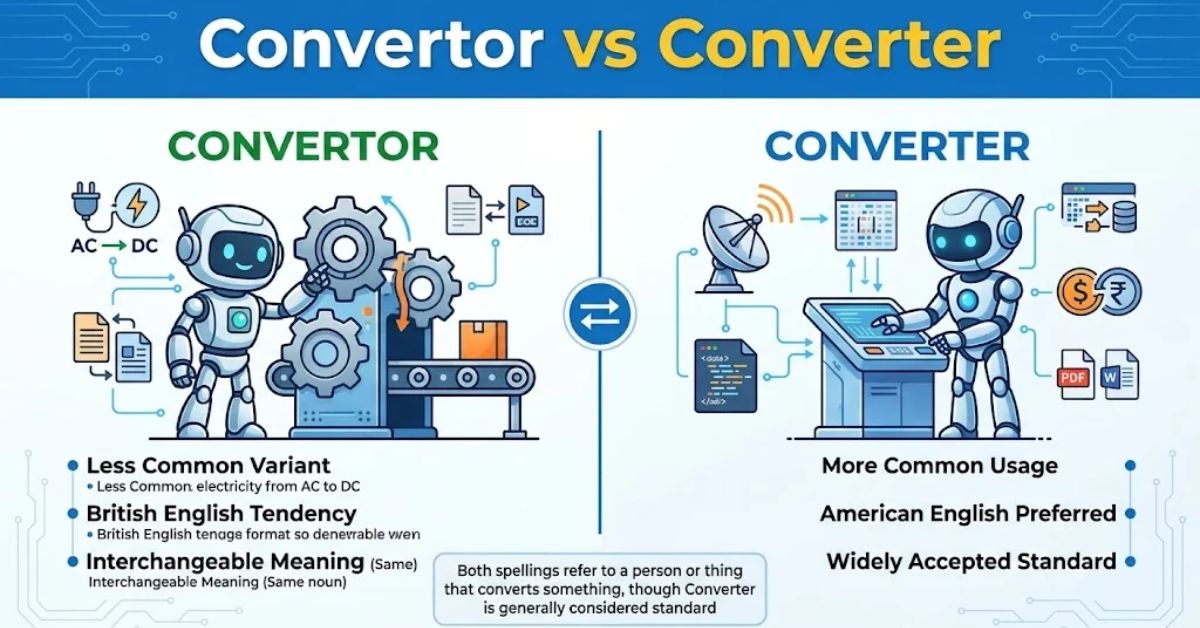
Convertor vs Converter is a common English spelling question that often confuses writers because both words have similar meanings and spellings. When discussing digital tools, apps, electrical devices, mechanical equipment, or signal conversion, choosing the correct term can be challenging. Both spellings describe a person, device, or program that changes something from one form into another. However, Converter is the preferred and more widely used spelling in modern English, while Convertor appears less frequently in certain technical contexts. Understanding their meanings, usage, and spelling differences helps improve vocabulary, avoid common writing mistakes, and make everyday and professional communication clearer.
Quick Answer: Is It Convertor or Converter?
Converter is the preferred and more commonly used spelling in modern English. However, convertor is also recognized as an alternative spelling in some dictionaries and technical contexts.
Both words have the same meaning, but their popularity and usage differ.
| Word | Correct? | Recommended? | Usage |
|---|---|---|---|
| Converter | Yes | Yes | Very common |
| Convertor | Yes | Rarely | Less common |
If you’re writing an article, email, report, or website page, choose converter.
Examples:
- PDF converter
- Currency converter
- Video converter
- Unit converter
- Catalytic converter
Although convertor isn’t necessarily incorrect, it is much less familiar to most readers.
What Does “Converter” Mean?
The word converter comes from the verb convert, which means to change something from one form, condition, or purpose into another.
A converter is a person, device, or software program that changes something into a different form.
Common Definitions of Converter
A converter can refer to:
- A machine that changes materials or energy.
- A software tool that changes file formats.
- An electronic device that transforms electrical signals.
- A person who changes something from one form to another.
Examples
| Converter Type | Purpose |
|---|---|
| Currency converter | Changes one currency into another |
| PDF converter | Changes files into PDF format |
| Video converter | Changes video formats |
| Power converter | Converts electrical energy |
| Unit converter | Changes one measurement unit into another |
Examples of Converter in Sentences
- I used a currency converter before booking my trip.
- The software includes an image converter and a video converter.
- My laptop requires a power converter when I travel overseas.
- This website offers a useful PDF converter.
- A catalytic converter helps reduce harmful vehicle emissions.
These examples show how converter appears in everyday English, technology, and engineering.
What Does “Convertor” Mean?
Convertor is an alternative spelling of converter. It describes a person, machine, or device that changes something from one form into another.
Although some dictionaries recognize this spelling, it is much less common in everyday writing.
Definition of Convertor
A convertor means a device or person that converts something into another form.
For example:
- Electrical convertor
- Power convertor
- Signal convertor
- Frequency convertor
Why Does “Convertor” Exist?
English sometimes allows different spellings for words with similar meanings.
Consider these examples:
| Spelling One | Spelling Two |
|---|---|
| Color | Colour |
| Gray | Grey |
| Advisor | Adviser |
| Catalog | Catalogue |
The difference between convertor and converter is another example of spelling variation. Over time, converter became the more widely accepted choice.
Convertor vs Converter: What’s the Difference?
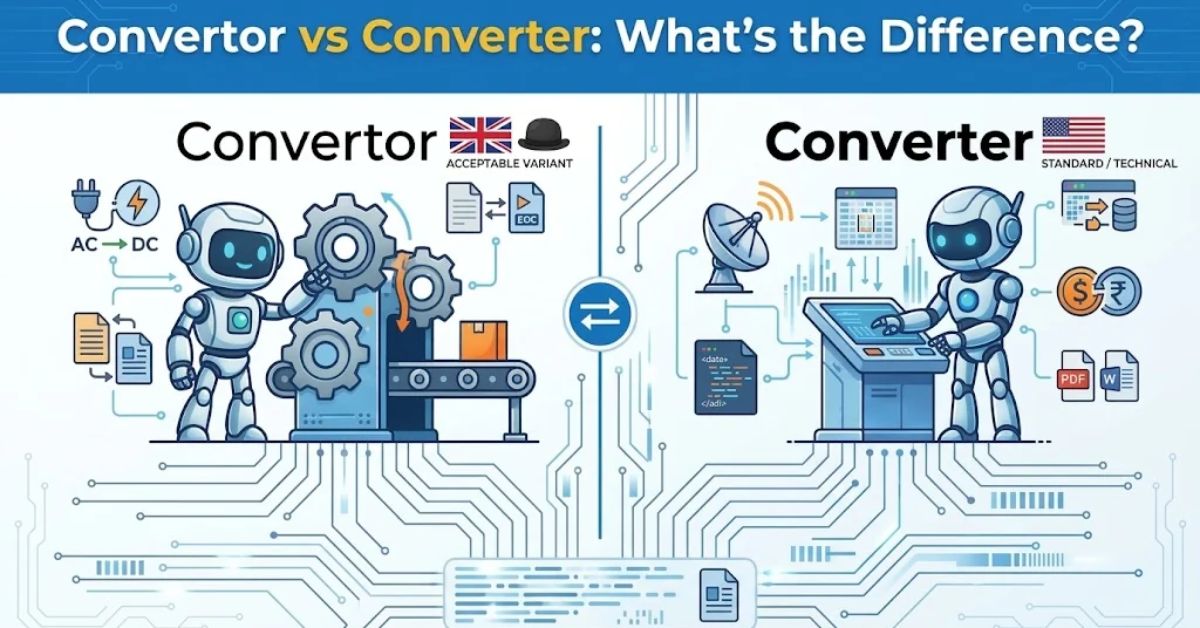
The main difference between these words is their frequency and preferred usage, not their meaning.
| Feature | Converter | Convertor |
|---|---|---|
| Meaning | Changes something into another form | Same meaning |
| Correct spelling | Yes | Yes, as a variant |
| Everyday writing | Preferred | Uncommon |
| Technology | Widely used | Less common |
| Engineering | Common | Occasionally used |
| Popularity | Very high | Much lower |
Think of converter as the standard choice and convertor as its less frequently used alternative.
Which Spelling Is More Popular?
Converter is significantly more popular in modern English.
You can see this preference in common search phrases and technology-related terminology.
| Search Phrase | Common Usage |
|---|---|
| Currency converter | Very common |
| Currency convertor | Rare |
| PDF converter | Very common |
| PDF convertor | Rare |
| Video converter | Very common |
| Video convertor | Rare |
The spelling converter appears frequently in educational resources, software applications, technical documents, and business websites.
Why Is “Converter” More Popular?
Several reasons explain why converter has become the preferred spelling.
1. It Sounds More Natural
Many English nouns end in -er.
Examples include:
- Driver
- Writer
- Teacher
- Builder
- Converter
This familiar spelling pattern makes converter feel natural to English speakers.
2. Dictionaries Prefer It
Major English dictionaries commonly list converter as the primary spelling. This makes it a safer choice for students, writers, and professionals.
3. Technology Standardized It
Software companies and technology providers generally use converter in product descriptions and application names. This has helped establish it as the familiar spelling.
Why Do People Use “Convertor”?
Although converter is more popular, convertor still appears in certain situations.
Technical Industry Usage
Some engineering and electrical documents use convertor when describing specialized equipment.
Product Names
A company may intentionally use convertor in its official product or brand name.
Spelling Assumptions
Some writers assume convertor follows the same pattern as words such as:
- Actor
- Creator
- Generator
- Operator
However, converter remains the more familiar spelling.
Typographical Errors
Sometimes people write convertor simply because they confuse the two spellings.
Is “Convertor” Wrong?
No. Convertor is recognized as an alternative spelling, but it is not the preferred choice in most modern English writing.
Both words communicate the same basic meaning.
However, using converter is generally better because readers recognize it more easily.
When Is It Acceptable to Use “Convertor”?
You can use convertor when:
- Referring to an official product name.
- Quoting technical documentation.
- Discussing historical spelling variations.
- Following a company’s established branding.
- Reproducing the exact wording of a technical source.
In other situations, converter is the safer option.
Convertor vs Converter in Technology
Technology is one of the most common areas where this word appears.
File Converter
A file converter changes a document or file from one format into another.
Examples:
- DOC to PDF
- PNG to JPG
- MP4 to AVI
Video Converter
A video converter changes video files into different formats so they can work with various devices and applications.
Audio Converter
An audio converter changes sound files between formats.
Examples:
- WAV to MP3
- FLAC to MP3
- AAC to WAV
Image Converter
An image converter changes pictures from one file format into another.
Examples:
- JPG to PNG
- PNG to WEBP
- BMP to JPG
In these examples, converter is the preferred spelling.
Convertor vs Converter in Finance
Financial platforms use currency converters to help people calculate the value of different currencies.
Currency Converter
A currency converter helps users compare exchange rates and calculate international prices.
| Currency Pair | Purpose |
|---|---|
| USD to EUR | Travel planning |
| USD to GBP | International business |
| USD to PKR | Money transfers |
For example, someone traveling from Pakistan to the United States can use a currency converter to estimate the value of Pakistani rupees in US dollars.
Convertor vs Converter in Engineering
Engineering is another field where both spellings may appear.
Examples include:
- Power converter
- Rotary converter
- Frequency converter
- Signal converter
However, converter remains the more widely recognized spelling in modern technical communication.
Catalytic Converter: A Perfect Example
A catalytic converter is an important part of a vehicle’s exhaust system.
It helps:
- Reduce harmful vehicle emissions.
- Convert certain toxic gases into less harmful substances.
- Support environmental standards.
Notice that the established automotive term is catalytic converter, not catalytic convertor.
Converter Examples in Everyday Life
You probably use different types of converters more often than you realize.
Unit Converter
Changes measurements from one unit into another.
Examples:
- Miles to kilometers
- Inches to centimeters
- Pounds to kilograms
Temperature Converter
Changes temperature measurements between different scales.
Examples:
- Celsius to Fahrenheit
- Fahrenheit to Celsius
- Celsius to Kelvin
Currency Converter
Calculates the value of one currency in another currency.
Power Converter
Changes electrical power from one form or voltage level into another.
Media Converter
Changes images, videos, and audio files into different formats.
Common Words That Follow the Same Pattern
English has many nouns that end in -er. These words often describe someone or something that performs an action.
| Verb | Noun |
|---|---|
| Teach | Teacher |
| Build | Builder |
| Write | Writer |
| Drive | Driver |
| Convert | Converter |
This familiar pattern helps explain why converter is the more natural spelling for most English speakers.
Why English Allows Multiple Spellings
English has developed through influences from several languages, including Latin, French, Germanic languages, and Greek.
As a result, some words have more than one accepted spelling.
Examples include:
| Version One | Version Two |
|---|---|
| Gray | Grey |
| Advisor | Adviser |
| Catalog | Catalogue |
| Judgment | Judgement |
Similarly, convertor exists as an alternative spelling of converter, although the two forms are not equally popular.
Should You Use Converter or Convertor for SEO?
If you are writing website content, blog posts, product descriptions, or software pages, converter should be your primary spelling.
It is the more familiar version and is commonly used in search phrases.
Examples include:
- PDF converter
- Currency converter
- Video converter
- YouTube converter
- Unit converter
Best Practices
Use Converter in:
- Website URLs
- Page headings
- Meta titles
- Meta descriptions
- Product descriptions
- Blog articles
Use Convertor Sparingly
Include the alternative spelling when:
- Answering spelling-related questions.
- Explaining technical terminology.
- Discussing spelling variations.
- Referring to an official product name.
Most importantly, maintain spelling consistency throughout your content.
Dictionary Definitions
Major English dictionaries generally recognize converter as the standard spelling.
Convertor may also appear as an alternative spelling, depending on the dictionary.
Dictionary Consensus
| Dictionary | Commonly Listed Form |
|---|---|
| Merriam-Webster | Converter |
| Cambridge Dictionary | Converter |
| Oxford Dictionary | Converter |
For everyday communication, converter is the recommended choice.
The Psychology Behind Familiar Spellings
Readers are more comfortable with words they recognize.
When someone encounters an unfamiliar spelling, they may:
- Pause to understand the word.
- Assume it contains a spelling mistake.
- Question the quality of the content.
- Lose confidence in the information.
Using familiar spelling improves readability and makes your writing easier to understand.
Common Mistakes People Make
Assuming Convertor Is the Standard
Converter is the more widely accepted spelling in modern English.
Thinking Convertor Is Always Wrong
Convertor is recognized as an alternative spelling, even though it is uncommon.
Using Both Spellings in One Article
Switching between converter and convertor without a reason can make your writing look inconsistent.
Choose one spelling and use it throughout your content.
Which Spelling Should Businesses Use?
Businesses should generally use converter in their marketing materials and professional communication.
This applies to:
- Product pages
- Software tools
- Business websites
- Technical descriptions
- Educational content
- Blog articles
Consistent spelling helps businesses create clear and professional content.
Which Spelling Should Students Use?
Students should choose converter for school assignments, essays, examinations, and other academic writing.
It is the more familiar spelling and is generally the safer option when following standard English conventions.
Which Spelling Should Writers Use?
Professional writers should also prefer converter in most situations.
The main exceptions include direct quotations, historical documents, and official product names that intentionally use convertor.
Following consistent spelling conventions makes articles, reports, and other written materials easier to read.
FAQs
Is Converter or Convertor the Correct Spelling?
Converter is the preferred spelling in modern English. Convertor is also recognized as an alternative spelling, but it is much less common.
Do Convertor and Converter Have Different Meanings?
No. Both words describe someone or something that changes one form into another. Their main difference is spelling preference and frequency of use.
Why Is Converter More Widely Used?
Converter follows a familiar English spelling pattern and is commonly used in dictionaries, technology, software, and everyday communication.
Where Is Convertor Commonly Used?
Convertor occasionally appears in engineering documents, electrical terminology, older technical materials, and official product names.
How Can I Avoid Using the Wrong Spelling?
Use a trusted dictionary and consider your writing context. For most everyday and professional situations, choose converter.
Conclusion
Understanding convertor vs converter is simple once you know that both words share the same basic meaning. However, converter is the preferred spelling in modern English and appears more frequently in everyday writing, technology, finance, and engineering.
Although convertor is recognized as an alternative, it is rarely necessary in general communication. Whether you are writing a school assignment, business report, website article, or product description, choosing converter is the safest option. Stick to this spelling, maintain consistency, and make your writing clear and professional.

Finn Bradley is a grammar and language writer at Megazine Tech, focused on making English easier to understand. He researches grammar rules, vocabulary, sentence usage, punctuation, and common writing questions. Through clear explanations and practical examples, Finn helps readers build stronger communication skills and write with greater confidence in everyday situations.