

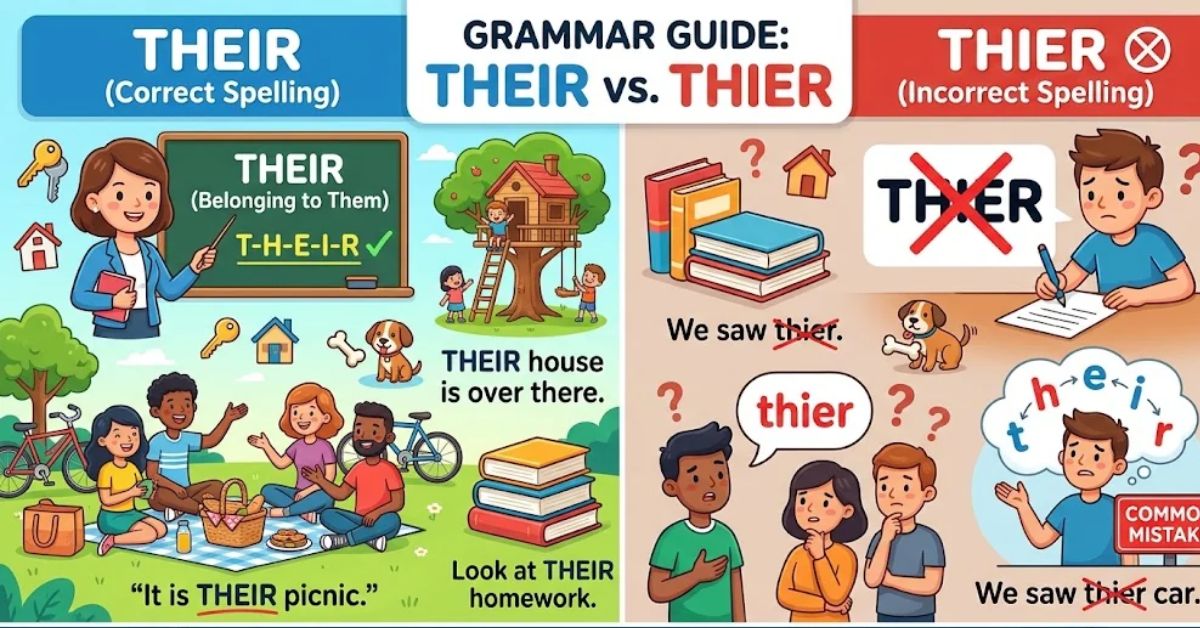
Choosing between Their vs Thier can be confusing because both spellings look almost identical. However, only one is correct in standard English. Their is the correct spelling, while Thier is a common spelling mistake.
Many English learners and even native speakers accidentally type Thier instead of Their because the letters “i” and “e” are easy to reverse. However, Their is the correct possessive determiner used to show that something belongs to someone.
For example, you can write “Their house is beautiful” or “Their ideas inspired everyone.” On the other hand, “Thier” has no accepted meaning in modern standard English and should be corrected to “Their.”
Understanding this spelling difference can improve your writing, grammar, and communication skills. It also helps you avoid mistakes in emails, academic assignments, business documents, and everyday conversations.
Whether you’re writing a school assignment, blog post, social media caption, or professional email, using the correct spelling makes your writing clearer and more polished.
The Quick Answer: Their vs Thier
| Word | Correct? | Meaning |
|---|---|---|
| Their | Yes | Shows possession or ownership |
| Thier | No | Misspelling of “their” |
Correct Examples
- Their house is beautiful.
- Their children go to school nearby.
- The employees submitted their reports.
- Their new car looks expensive.
- The students completed their assignments.
Incorrect Examples
- Thier house is beautiful.
- I borrowed thier book.
- The students forgot thier homework.
- Thier parents live nearby.
The answer is simple: Use “Their” whenever you want to show that something belongs to someone. Never use “Thier.”
What Does “Their” Mean?
The word Their is a possessive determiner in English grammar. It shows ownership or possession and tells readers that something belongs to a person or group.
In simple words, it means something belongs to them.
Examples
- Their car is parked outside.
- Their ideas changed the project.
- The dogs wagged their tails.
- Their family lives in Chicago.
- The teachers checked their assignments.
In each sentence, Their identifies who owns something.
| Owner | Thing Owned |
|---|---|
| They | Car |
| They | Ideas |
| Dogs | Tails |
| Teachers | Assignments |
Think of Their as a label that communicates one simple idea: “This belongs to them.”
Understanding Possessive Determiners
English uses several possessive determiners to show ownership. Each one connects a person or group with something that belongs to them.
| Pronoun | Possessive Determiner |
|---|---|
| I | My |
| You | Your |
| He | His |
| She | Her |
| We | Our |
| They | Their |
Examples:
- My phone
- Your computer
- His jacket
- Her handbag
- Our house
- Their garden
The word Their works like My, Your, and Our. However, it usually refers to something belonging to more than one person.
Is “Thier” a Real Word?
No. Thier is not a correctly recognized English word in standard modern English.
It is generally used as a spelling mistake when someone accidentally reverses the letters “i” and “e” in Their.
Why Does It Look Correct?
The mistake happens because the two spellings look almost identical. When people type quickly, they sometimes place letters in the wrong order without noticing.
For example:
- Recieve instead of Receive
- Freind instead of Friend
- Beleive instead of Believe
- Thier instead of Their
These are common spelling mistakes caused by confusing letter patterns.
Although these incorrect spellings may look familiar, they should always be replaced with the correct versions.
Why Do People Write “Thier” Instead of “Their”?
The spelling mistake is surprisingly common. Even people who understand English grammar may accidentally type the wrong version.
Here are some common reasons.
The “I Before E” Rule
Many English learners remember the famous spelling rule:
“I before E except after C.”
However, English has several exceptions, and Their is one of them.
Other examples include:
- Weird
- Foreign
- Height
- Leisure
- Their
Because English spelling doesn’t always follow predictable patterns, people sometimes write Thier instead of Their.
Fast Typing
Most modern communication happens quickly. People regularly type emails, text messages, social media comments, and workplace documents.
When typing in a hurry, your fingers may accidentally switch the positions of two letters.
For example, you might intend to write:
“Their office is beautiful.”
But accidentally type:
“Thier office is beautiful.”
This small typing mistake can easily go unnoticed without proofreading.
The Brain Fills in the Gaps
Readers often recognize familiar words even when their internal letters are mixed up.
For example:
“Aoccdrnig to rscheearch, you can raed tihs snetnece.”
Although the letters are mixed up, many readers can still understand the sentence.
Similarly, your brain may recognize Thier as the word Their, allowing the spelling mistake to pass unnoticed.
Pronunciation Doesn’t Help
Both spellings are usually pronounced exactly the same way.
Their is pronounced:
/ðer/
Because the pronunciation offers no difference, you cannot identify the correct spelling by listening alone. You need to remember the correct letter order.
What Does “Their” Actually Do in a Sentence?
The word Their usually appears before a noun to show ownership.
It helps readers understand who something belongs to.
Structure
Their + noun
Examples:
- Their dog
- Their car
- Their office
- Their children
- Their school
You can also place adjectives between Their and the noun.
Examples:
- Their new apartment
- Their expensive computer
- Their beautiful garden
- Their hardworking employees
In all these examples, Their identifies ownership or association.
Examples of “Their” in Everyday Writing
You can use Their in different situations, including family conversations, school assignments, workplace communication, and sports discussions.
Family Examples
- Their parents live in Chicago.
- Their daughter won the competition.
- Their home overlooks the lake.
- Their children enjoy playing outside.
School Examples
- The students forgot their notebooks.
- The teachers graded their exams.
- The children completed their homework.
- The classmates shared their ideas.
Business Examples
- The company updated their policies.
- The employees changed their schedules.
- The managers reviewed their reports.
- The business improved their customer service.
Sports Examples
- The players celebrated their victory.
- The team packed their equipment.
- The athletes practiced their skills.
- The supporters cheered for their favorite team.
Singular Their: Can “Their” Refer to One Person?
Yes. Their can refer to one person when the person’s gender is unknown, irrelevant, or when they use they/them pronouns.
This usage is known as singular They or singular Their.
Examples
- Someone forgot their keys.
- Every student should submit their assignment.
- A customer can return their purchase within thirty days.
- Each employee must update their information.
In the past, some grammar books preferred sentences such as:
“Everyone should bring his or her notebook.”
Today, this construction can sound repetitive and unnecessarily complicated.
A simpler and more natural alternative is:
“Everyone should bring their notebook.”
Why Singular Their Matters
Singular Their has become an important part of modern English because it:
- Sounds natural in everyday communication.
- Avoids awkward and repetitive wording.
- Supports gender-neutral writing.
- Makes sentences easier to understand.
- Works when a person’s gender is unknown.
Many modern English dictionaries and widely used style guides recognize singular They and its related forms.
It is especially useful in academic writing, workplace communication, and situations where inclusive language matters.
Their vs There vs They’re
Many English learners confuse Their, There, and They’re because these words sound alike. However, they have completely different meanings and grammatical uses.
| Word | Meaning | Example |
|---|---|---|
| Their | Shows possession | Their car is new. |
| There | Refers to a place | The keys are over there. |
| They’re | Means “they are” | They’re going home. |
Their
Their shows ownership or possession.
Example:
Their house is beautiful.
This means the house belongs to them.
There
There usually refers to a place or location.
Example:
Put the books over there.
It tells someone where to put the books.
They’re
They’re is a contraction of They are.
Example:
They’re planning a vacation.
You can replace They’re with They are without changing the basic meaning.
Easy Trick to Remember the Difference
A simple way to remember these three words is to focus on their meanings rather than their pronunciation.
If You Mean:
- Ownership: Use Their.
- Location: Use There.
- They are: Use They’re.
Examples:
Sentence: They’re coming tomorrow.
Can you replace They’re with They are?
Yes. The sentence becomes:
“They are coming tomorrow.”
Therefore, They’re is correct.
Another example:
“Their house is over there.”
Here, Their shows ownership, while There identifies a location.
Common Mistakes With Their and Thier
Many people make spelling mistakes when typing quickly. However, understanding the difference between common incorrect forms can help you improve your English.
Mistake One: Using “Thier”
Incorrect: Thier dog is friendly.
Correct: Their dog is friendly.
Always remember that the correct spelling follows the letter pattern “ei.”
Mistake Two: Using “There”
Incorrect: There house is beautiful.
Correct: Their house is beautiful.
Use Their because the sentence describes something that belongs to someone.
Mistake Three: Using “They’re”
Incorrect: They’re house is beautiful.
Correct: Their house is beautiful.
They’re means They are, so it cannot replace Their when showing ownership.
Why Correct Spelling Matters
Some people consider spelling mistakes minor. However, using the correct spelling makes your writing easier to understand and helps you communicate professionally.
In School
Teachers often deduct marks for repeated spelling mistakes. Correct spelling also makes essays, assignments, and examinations easier to read.
At Work
Professional emails and reports should be clear and accurate. Repeated spelling errors can make your communication appear careless.
In Business
Customers often expect businesses to communicate professionally. Correct grammar and spelling help create a positive impression.
Online Writing
Blog posts, website content, and social media captions represent your writing skills. Frequent errors can reduce readers’ confidence in your content.
Good spelling sends a simple message: You pay attention to details.
Real-World Case Study: A Costly Typing Error
Imagine a marketing company sending thousands of promotional emails with the sentence:
“Visit thier website today.”
The spelling mistake appears in every email and quickly attracts attention.
The company may need to correct the message, resend the campaign, and deal with an unprofessional impression.
The lesson is simple: Even a small spelling mistake can affect how people view your communication.
Always check important emails, advertisements, and business documents before sending them.
Why “Their” Is One of the Most Misspelled Words
The word Their is frequently misspelled because people accidentally reverse the positions of its middle letters.
This type of error is called a letter transposition.
Here are some examples:
| Incorrect | Correct |
|---|---|
| Freind | Friend |
| Recieve | Receive |
| Thier | Their |
| Acheive | Achieve |
| Beleive | Believe |
These mistakes happen because familiar words can be recognized quickly, even when their letters are not arranged correctly.
Taking a few seconds to review your writing can help you catch these errors.
Memory Tricks to Remember the Correct Spelling
If you frequently confuse Their and Thier, a few simple tricks can help you remember the correct spelling.
Remember the Word “Heir”
The word Their contains the letters found in Heir.
An heir is someone who inherits property or possessions.
Since inheritance involves ownership, you can connect the word Heir with Their.
Remember:
Heir → Ownership → Their
Think About Belongings
Whenever you want to show ownership, ask yourself:
“Whose is it?”
If the answer is “theirs,” then you should use Their.
For example:
- Their house
- Their books
- Their clothes
- Their business
This simple question can help you choose the correct spelling.
Practice the Phrase
Repeat this sentence:
“Their house is over there, and they’re happy.”
This sentence includes all three commonly confused words.
- Their = Ownership
- There = Location
- They’re = They are
Practicing this sentence can help you remember their different meanings.
Examples of Correct Usage
Here are additional examples showing how to use Their correctly in everyday English.
Possession
- Their vacation starts next week.
- Their manager approved the project.
- Their children enjoy reading.
- Their garden looks beautiful.
Organizations
- The company announced their new pricing.
- The university introduced their scholarship program.
- The organization updated their policies.
Animals
- The birds built their nests.
- The cats cleaned their paws.
- The dogs wagged their tails.
- The horses returned to their stable.
Examples of Incorrect Usage
The following sentences demonstrate how Thier can make a sentence incorrect.
Incorrect
- Thier car is broken.
- I borrowed thier laptop.
- Thier family moved away.
- The students submitted thier projects.
Correct
- Their car is broken.
- I borrowed their laptop.
- Their family moved away.
- The students submitted their projects.
Remember that Thier is a spelling error, not an alternative form of Their.
Their in Academic Writing
Academic writing requires clear language, correct grammar, and accurate spelling.
The word Their is commonly used in essays, research papers, assignments, and educational materials.
It can also refer to one person when the person’s gender is unknown.
Example:
“A participant may withdraw their consent at any time.”
This sentence is simple and avoids unnecessarily complicated wording such as “his or her consent.”
Using correct spelling and grammar helps make academic writing more readable and professional.
Their in Professional Communication
Professional communication often requires clear and straightforward language.
You may use Their in workplace emails, business reports, presentations, and company documents.
Examples:
- Every employee should update their password.
- Each customer must confirm their address.
- The managers reviewed their monthly reports.
- The applicants submitted their documents.
Using Their correctly makes your sentences easier to understand and helps maintain a professional writing style.
Common Sentences Using Their
Review these sentences to understand the correct usage.
| Sentence | Correct? |
|---|---|
| Their dog is friendly. | Yes |
| Their office opens at nine. | Yes |
| I borrowed their pen. | Yes |
| Thier office opens at nine. | No |
| I borrowed thier pen. | No |
Practice Exercise
Test your understanding by choosing the correct word for each sentence.
Questions
- _____ house is on the corner.
- The students forgot _____ homework.
- _____ going to the concert tonight.
- Put the bags over _____.
- Somebody left _____ jacket.
Answers
- Their
- Their
- They’re
- There
- Their
Practice these examples regularly to become more confident with English spelling.
Mini Quiz
Correct the following sentence:
“Thier dog is over there because they’re owner forgot it.”
Answer:
“Their dog is over there because their owner forgot it.”
Explanation:
- Their dog = Shows ownership.
- There = Refers to a location.
- Their owner = Shows ownership.
FAQs
1. Is “Thier” Ever the Correct Spelling?
No. Thier is a misspelling in standard English. The correct spelling is Their, which is used to show ownership or belonging.
2. What Does “Their” Mean?
Their means something belongs to them. For example, “The students forgot their books.” It is commonly used in spoken and written English.
3. Why Do People Confuse “Their” and “Thier”?
People usually confuse these spellings because they accidentally reverse the letters “i” and “e.” This typing mistake is common because both words look almost identical.
4. How Can I Remember the Correct Spelling of “Their”?
Remember that Their follows the letter pattern “ei,” not “ie.” You can also connect Their with ownership to make the spelling easier to remember.
5. Can Using “Thier” Affect My Writing?
Yes. Writing Thier instead of Their can make your work look less professional. Correct spelling improves readability, accuracy, and communication.
Conclusion
Understanding the difference between Their vs Thier is easy once you remember that Their is the only correct spelling in standard English. It is a possessive determiner that shows ownership or belonging, while Thier is simply a common spelling mistake.
Whether you’re writing an email, school assignment, blog post, or social media caption, using Their correctly makes your writing clearer and more professional.
The easiest way to remember the difference is to connect Their with ownership. Practice using it in everyday sentences and check your writing before sharing it. With a little attention, you can avoid this common spelling mistake and improve your English writing skills.

Finn Bradley is a grammar and language writer at Megazine Tech, focused on making English easier to understand. He researches grammar rules, vocabulary, sentence usage, punctuation, and common writing questions. Through clear explanations and practical examples, Finn helps readers build stronger communication skills and write with greater confidence in everyday situations.