

Ever stared at a form and wondered whether your group is an association or an organization? You’re not alone. The association vs organization question trips up students, founders, and writers every single day.
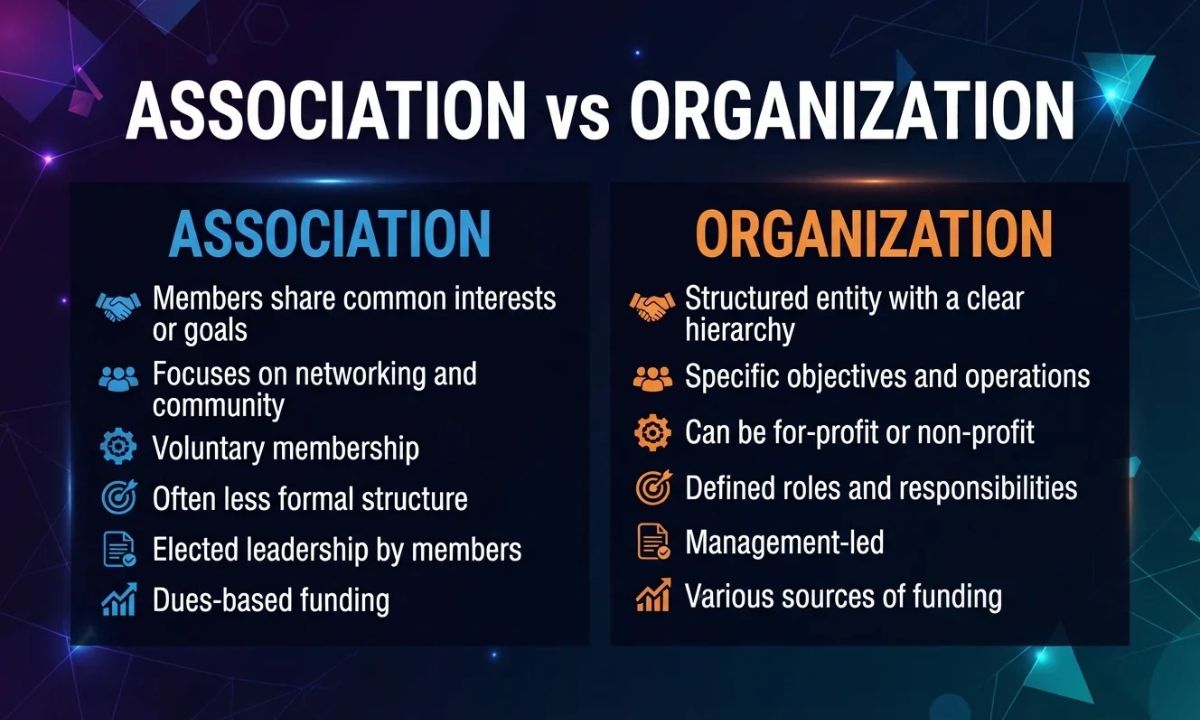
Here’s the short version. An association is a member-based group built around a shared interest, while an organization is any structured group with defined roles and a purpose. Every association is an organization, but not the other way around.
This guide breaks down the difference between association and organization in plain words. You’ll see real examples, learn when to use each term, and avoid costly mistakes in legal documents, business communication, and nonprofit registration. Let’s clear this up for good.
Association vs Organization: Key Differences Explained
Ever typed “Association vs Organization” into Google because a form, a contract, or a website asked you to pick one? You’re not alone.
An association is a group of people who join together around a shared interest. An organization is any structured group with a purpose, and an association is one type of it.
Quick Answer: Association vs Organization
Every association is an organization, but not every organization is an association. That one line settles most confusion.
Think of “organization” as the big umbrella. Under it sit companies, charities, agencies, and member-based associations.
Key Difference in Meaning and Purpose
The association meaning centers on people choosing to come together. They pay dues, vote, and pursue a common goal.
The organization meaning centers on structure. It has defined roles, a hierarchy, and systems that get work done, with or without members.
Association and Organization Examples
The American Medical Association is a professional association. Doctors join it, pay fees, and shape its policies.
Amazon is an organization, and so is the United Nations. Neither depends on dues-paying members the way an association does.
When to Use Association or Organization
Pick your word based on who holds the power. If members steer the ship, say association. If a board, owners, or a government steers it, say organization.
Context matters too. A neighbor’s newsletter and a court filing call for different words.
Read More: Patient or Pacient: Correct Spelling, Meaning, and Usage
When to Use “Association”
Use “association” when people join voluntarily and share a profession, hobby, or community. A homeowners association is the classic case.
You’d also use it for a trade association, an alumni group, or a parents’ club. Members, bylaws, and elections usually come with the territory.
When to Use “Organization”
Use “organization” when you mean a broad entity or you aren’t sure of its legal form. It’s the safe, flexible choice.
It fits a nonprofit organization, a government agency, or a global body like the WHO. It also works as a general label for any business organization.
Association or Organization in Business and Nonprofits
In association vs organization in business, the line follows ownership. A company belongs to owners or shareholders, while an association belongs to its members.
Nonprofits blur things a bit. A food bank may call itself an organization, while a nurses’ group calls itself an association.
Membership-Based Association Examples
The National Association of Realtors serves real estate agents. The American Bar Association serves lawyers.
Your local community association works the same way, just smaller. Members vote, pay dues, and get professional development, networking, or services in return.
Association vs Organization in Different Contexts
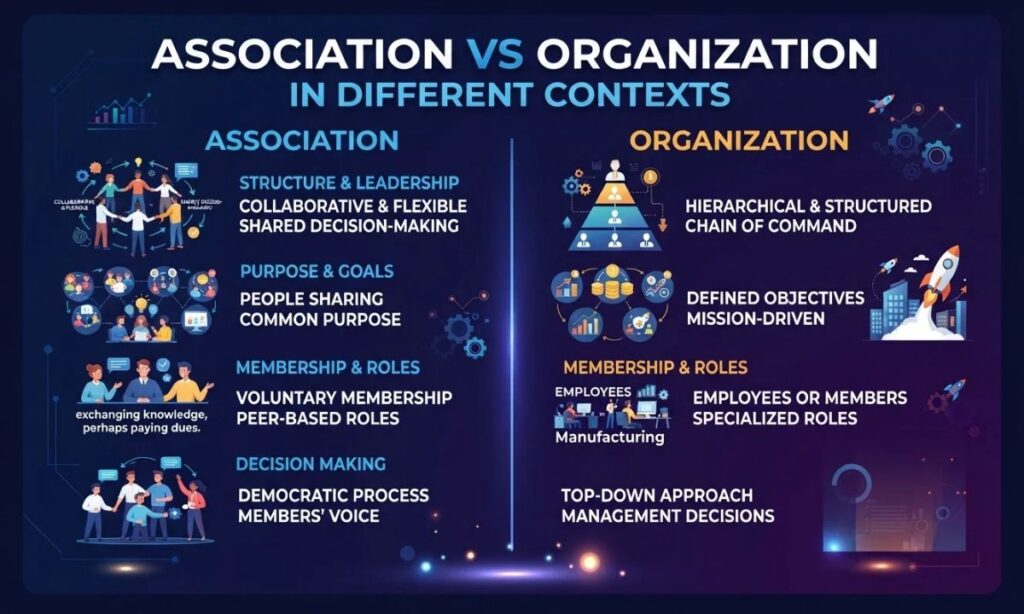
The words shift slightly depending on the field. A sociologist, a lawyer, and a mathematician will each use them differently.
Knowing those shifts keeps you from sounding off in the wrong room. Let’s walk through the main ones.
Difference Between Association and Organization in Sociology
Sociologists treat an association as a group formed around a specific goal, usually with voluntary entry. A chess club fits.
An organization, in their view, is a larger formal structure with rules and hierarchy. Hospitals and universities are textbook examples of organizational structure.
Organizational Association Examples
Sometimes the two overlap. The Red Cross is an organization with volunteers, chapters, and a governance structure, yet it also welcomes members.
Likewise, a labor union is an association of workers wrapped in a formal organization. Real life rarely fits tidy boxes.
What Is an Association in Mathematics?
In math and statistics, association means a relationship between two variables. When one changes, the other tends to change too.
It has nothing to do with groups of people. Ice cream sales and sunburns show association, though neither causes the other.
Association vs Federation
A federation is an association of associations. Think of national soccer bodies joining FIFA.
An ordinary association has individual or business members. A federation has other groups as members, which makes it one layer higher.
Organization vs Corporation
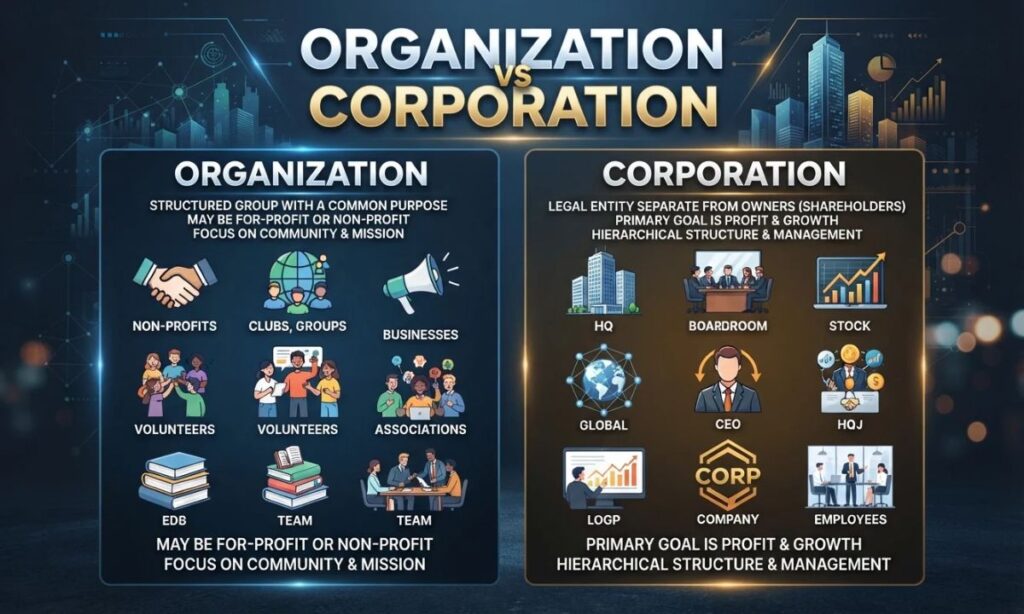
A corporation is a specific legal entity that owns assets, pays taxes, and issues shares. An organization is the generic term.
So a corporation is always an organization. A neighborhood book club is an organization too, but it isn’t a corporation.
Association and Corporation Difference
A corporation exists to earn profit for shareholders. An association exists to serve members and their shared purpose.
The association vs corporation question also affects control. Shareholders vote by shares owned, while association members often get one vote each.
Association vs Company
A company sells goods or services to make money. An association usually collects dues and returns value through advocacy, training, or events.
Some associations do run revenue-generating programs. Still, their core mission isn’t profit-driven.
The Origin and Meaning of Association and Organization
Both words have old roots, and those roots explain a lot. They show why one feels personal and the other feels structural.
A quick look back makes the modern difference easier to remember.
Etymology of Association
“Association” comes from the Latin associare, meaning to join as a partner. It entered English through French in the 1500s.
The idea was always about people choosing to team up. That personal flavor never really left.
Etymology of Organization
“Organization” traces back to the Greek organon, meaning tool or instrument. Later it described a body with working parts.
Picture a machine with many pieces working together. That image fits the organizational management side of the word.
Read More: Reinforce vs Reenforce: Meaning, Spelling and Examples
How Their Meanings Developed
Association stayed close to friendship, clubs, and voluntary bonds. Organization grew alongside factories, governments, and big institutions.
By the 1800s, both words filled legal documents and everyday speech. Today they overlap, but their original flavors still show.
Association vs Organization in British and American English
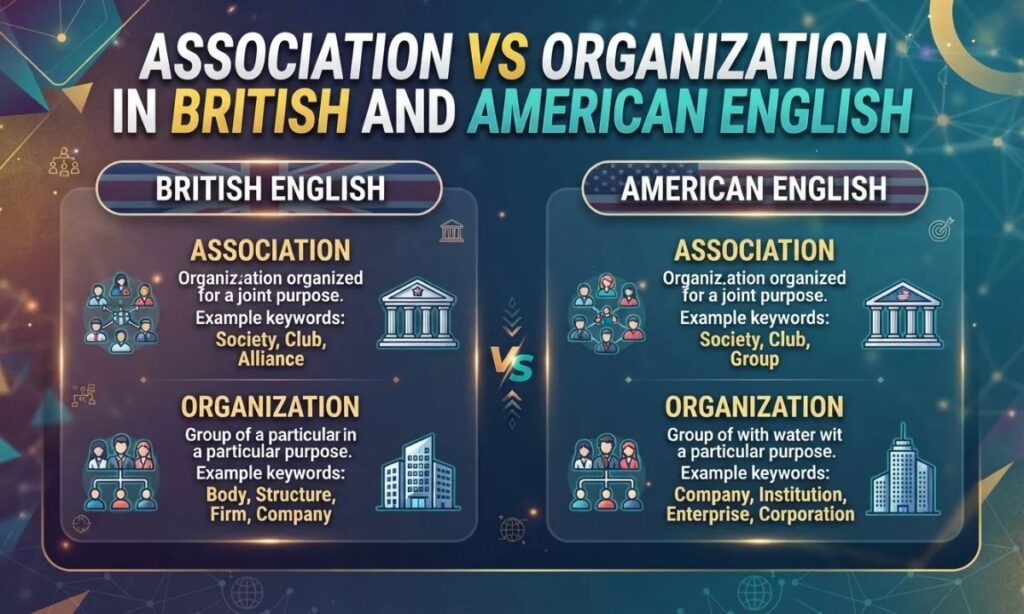
Both varieties use both words with the same core meanings. The differences are mostly about spelling and small habits.
Nobody will misunderstand you either way. Still, being consistent looks professional.
British English vs American English Usage
Americans use “organization” for nearly any group. British writers use it too, but often prefer “association” or “society” for member groups.
In the UK, you’ll also see “society” for clubs and charities. In the United States, “association” dominates professional and neighborhood groups.
Does the Meaning Change by Region?
Not really. The meaning holds steady across Australia, Canada, the UK, and the US.
What changes is legal vocabulary. A group that registers as an association in one country may need a different filing in another.
Organization vs Organisation Spelling
“Organization” with a z is standard in American and Canadian English. “Organisation” with an s is standard in British and Australian English.
Oxford spelling in the UK accepts the z, which surprises many people. Pick one style and stick with it.
Association and Organization in Everyday Examples
You meet both words daily without noticing. Seeing them in real settings makes the difference stick.
Here are a few places where they show up.
Association and Organization in Business
A trade association like the National Retail Federation lobbies for stores. Each store, meanwhile, is its own business.
Your employer is an organization with departments and managers. Your industry group is an association you might join.
Examples in News Articles
Headlines say “the Air Line Pilots Association” when members speak. They say “the organization” when describing something broader, like the Red Cross.
Reporters choose carefully because public service groups and member groups act differently. The wording signals who holds the power.
Examples in Academic Writing
Scholars write about “organizational behavior” when studying workplaces. They write about “voluntary associations” when studying civic life.
Mixing the two can cost you clarity in a paper. Check your sources and match their terms.
Association and Organization on Social Media
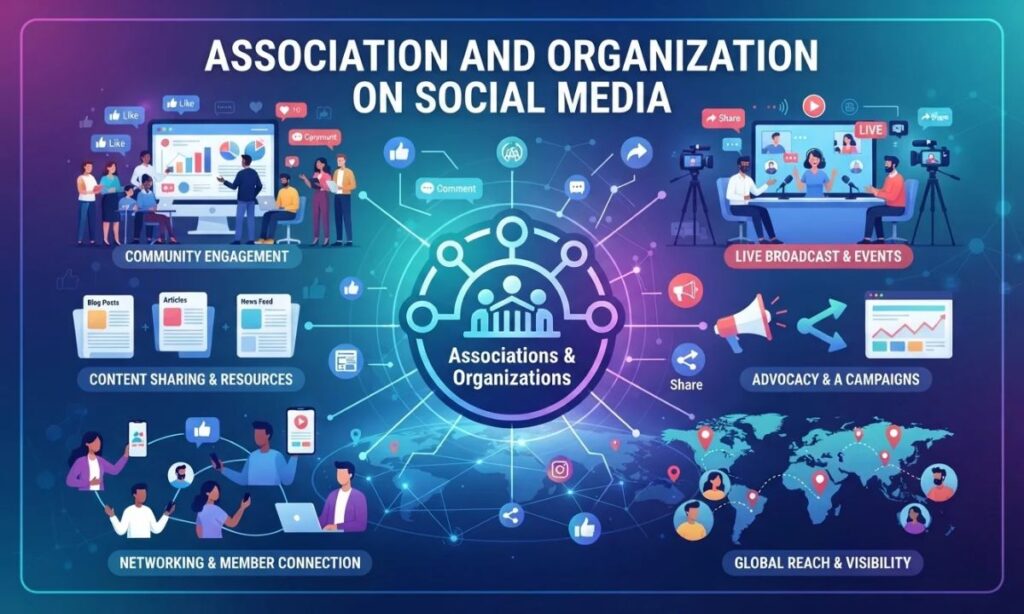
A bio saying “member of the Texas Bar Association” signals professional credibility. A bio saying “works at a global organization” says very little.
Brands also pick based on tone. “Association” feels communal, while “organization” feels corporate.
Examples in Formal Communication
A formal letter might open with “On behalf of our association.” A grant proposal might say “our nonprofit organization.”
Choose the term that matches your legal status. In business communication, accuracy builds trust.
Common Mistakes When Using Association and Organization
Most errors come from treating the words as twins. They’re cousins at best.
Spot these slip-ups and you’ll avoid embarrassing edits later.
Using Association and Organization as Exact Synonyms
Calling every group an association can mislead readers. A hospital isn’t an association, even though it’s a group of people.
Using “organization” for a member club isn’t wrong, but it hides the membership angle. Precision helps readers.
Choosing the Wrong Term for a Legal Entity
Legal papers care about exact labels. Articles of association, articles of organization, and articles of incorporation aren’t interchangeable.
Filing under the wrong name can delay nonprofit registration or create tax headaches. Check your state or country’s rules first.
Ignoring Context and Audience
A doctor audience may prefer “association.” A government audience may expect “organization” or “agency.”
Ask who’s reading and what they expect. Then match the word to their world.
Association vs Organization: Comparison Table
Here’s a quick side-by-side for the association vs organization comparison.
| Feature | Association | Organization |
| Core idea | People joined by shared interest | Any structured group with a goal |
| Membership | Usually required | Optional |
| Control | Member-driven | Board, owners, or government |
| Funding | Dues, events, sponsors | Sales, grants, taxes, donor-driven gifts |
| Typical examples | Homeowners association, bar association | Company, charity, agency |
| Legal documents | Bylaws, articles of association | Articles of organization or incorporation |
Related Terms and Their Differences
Several nearby words cause the same confusion. Clearing them up helps you write with confidence.
Let’s run through the usual suspects.
Institution vs Organization
An institution is an established system or practice, like marriage, a university, or a court. It carries long-term social weight.
An organization is simply a group with structure. Every institution has organizations inside it, but not the reverse.
Society vs Association
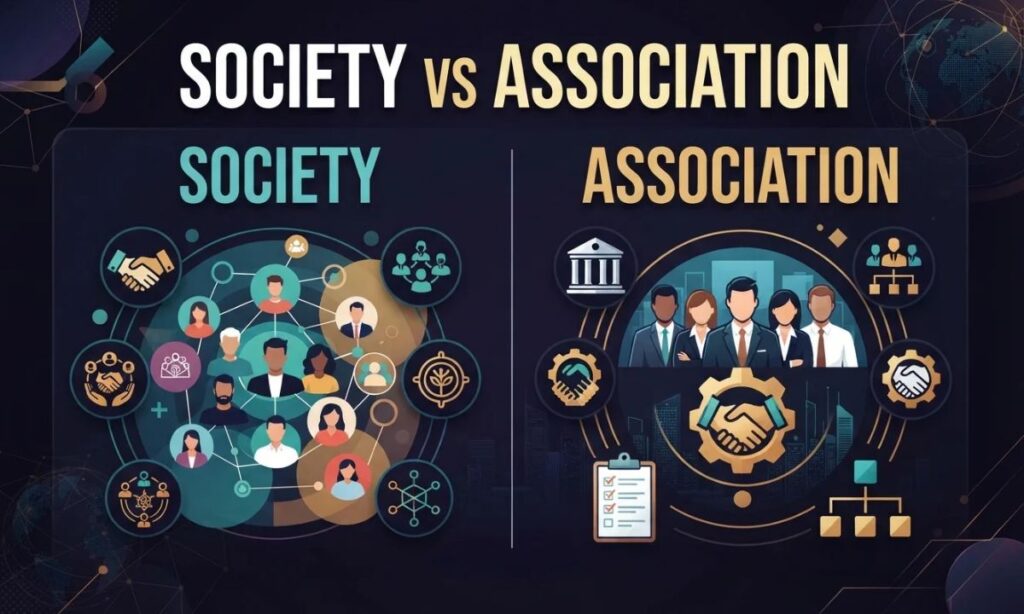
A society often stresses culture, learning, or tradition. Examples include the Royal Society or a historical society.
In the association vs society debate, the main gap is style. Societies feel scholarly and British, while associations feel practical and professional.
Company vs Organization
A company trades for profit. An organization can be a company, a charity, or a club.
If you’re unsure, “organization” is the safer umbrella. “Company” works only when money-making is the point.
Foundation vs Association
A foundation usually holds funds and gives grants. It’s often donor-driven and run by a board.
An association is member-led and fee-based. That’s the clearest split in foundation vs association.
Association vs Federation
A federation unites groups, while an association unites people. Many national sports bodies are federations.
If your members are other associations, call it a federation. Otherwise, stay with association.
Organization vs Corporation
A corporation is a legal form with shareholders and limited liability. An organization is a broader, looser label.
Use “corporation” only when the legal status fits. Otherwise, “organization” keeps you accurate.
Association vs Organization: Search Trends and Usage
People search both terms for different reasons. Students want definitions, while business owners want filing help.
Understanding that intent shapes how you write about either word.
Search Popularity and Usage Data
“Organization” is the far more common word in everyday use. “Association” appears mostly in professional and legal terms.
Queries like “articles of association vs articles of organization” spike around business registration seasons. That’s a useful clue for planning content.
Regional Usage Trends
US searchers lean toward “homeowners association” and “nonprofit organization.” UK searchers often look up “articles of association” for company setup.
Spelling queries also vary, with “organisation” popular in Britain and Australia. Regional habits show up clearly in search.
Frequently Asked Questions
Is an Association the Same as an Organization?
No. An association is a type of organization built around members and shared purpose. An organization can be much broader.
Can a Nonprofit Be Called an Association?
Yes, when it’s membership-based and member-run. A charitable association or professional group are common examples.
What Is the Difference Between an Association and a Corporation?
A corporation is a legal entity owned by shareholders and often aimed at profit. An association serves its members and usually isn’t built to distribute profit.
What Is the Difference Between an Association and a Company?
A company sells products or services for revenue. An association gathers members around a common goal and funds itself through dues and programs.
What Is an Example of an Association?
The American Bar Association, a local parent-teacher association, and a homeowners association all qualify. Each runs on member participation.
Is Organization a British Spelling?
No, the z spelling is American, though Oxford style in Britain also accepts it. “Organisation” is the common British form.
What Are the Seven Types of Organizations?
Common lists include sole proprietorships, partnerships, corporations, LLCs, nonprofits, cooperatives, and government bodies. Different textbooks group them slightly differently.
Is “Organisation” Different from “Organization”?
Not in meaning. Only the spelling changes between regions.
Which Term Is More Professional: Association or Organization?
Neither wins on its own. Use the one that matches your structure, because accuracy is what looks professional.
What Does “Articles of Association” Mean?
It’s a document, common in the UK and some other countries, that sets a company’s internal rules. It covers things like voting rights, directors, and meetings.
When Should I Use “Organizational” vs “Associational”?
Use “organizational” for structure, management, or organizational behavior. Use “associational” for ties between members or voluntary group life.
Conclusion
The association and organization difference comes down to people versus structure. An association runs on members, bylaws, and a common goal. An organization is the wider umbrella, covering companies, charities, agencies, and nonprofit organizations.
So next time you face the association vs organization choice, check who holds the power and what your legal status is. Then pick the term that fits your audience, whether that’s a court, a donor, or a reader. Accuracy is what builds professional credibility.

Finn Bradley is a grammar and language writer at Megazine Tech, focused on making English easier to understand. He researches grammar rules, vocabulary, sentence usage, punctuation, and common writing questions. Through clear explanations and practical examples, Finn helps readers build stronger communication skills and write with greater confidence in everyday situations.