

You’re writing a restaurant review, a hotel listing, or a simple email, and one word makes you pause. Ambience or ambiance? Both spellings are correct, and both describe the mood and atmosphere of a place. The real difference comes down to your readers and where they live.
Here’s the quick rule. Ambience is the British English spelling and works well for international English and technical writing. Ambiance keeps the original French spelling and fits American lifestyle writing and hospitality writing. In this guide, you’ll learn the ambience meaning, the word origin, pronunciation, and common spelling mistakes. You’ll also see real examples, so you can choose the correct spelling with confidence every time.
Ambience or Ambiance – Quick Answer
Here’s the short version if you’re in a hurry. Ambience or ambiance means the same thing: the mood and atmosphere of a place. Only the spelling changes with region.
Ambience
Ambience is the Anglicized spelling used in the UK, Australia, India, and most Commonwealth countries. It also dominates in technical writing about sound, like audio production and sound design.
Use it when your readers are mostly British or international. It’s also the safer pick for acoustic ambience and ambient sound work.
Ambiance
Ambiance keeps the original French spelling. Americans and Canadians favor it, especially in lifestyle writing, restaurant reviews, and hotel atmosphere copy.
It looks a bit fancier on the page. That’s one reason luxury lifestyle content leans toward it.
What Does Ambiance Mean?
The ambiance meaning is simple. It describes the character, feel, and spirit of a place or situation.
Think of walking into a coffee shop on a rainy Tuesday. The soft jazz, dim bulbs, and smell of roasted beans create the ambiance. You feel it before you can explain it.
The ambience definition in most dictionaries matches this. It’s the atmosphere of a place and the mood it puts you in.
Ambiance in a Sentence
Examples make this stick, so here are a few. “The candlelit ambiance made our anniversary dinner unforgettable.”
“I loved the hotel, but the lobby ambience felt cold.” And “The cafe’s warm ambience keeps me working there for hours.”
Notice how the word works as a noun. You can describe it with adjectives like cozy, relaxed, upscale, or tense.
Read More: Withdraw vs Withdrawal: Meaning, Usage & Grammar Guide
Ambiance and Its French Meaning
The French word ambiance means almost the same thing. French speakers use it for the mood of a party, a room, or a whole city.
French also uses it casually. Someone might say a gathering has “de l’ambiance,” meaning it has energy and life.
English borrowed the idea along with the French spelling. That’s why ambiance feels so natural to American writers.
Is Ambience a Feeling?
Yes, in a way. Ambience is the feeling a space creates, but it isn’t the same as the emotion you personally feel.
A place has an aura and your mood responds to it. The vibe comes from the setting, and your feeling is the reaction.
Say a library feels quiet and calm. That calm belongs to the ambience, and your relaxed shoulders are the result.
What Is Ambience Used For?

People use the word in many fields. Interior design relies on it to describe lighting, color, and texture.
Hospitality writing uses it constantly. A hotel listing might promise a “tranquil ambience” because guests want to know how a place feels, not just what it offers.
In film production and sound design, ambience also means background environmental sound. Think of crowd murmur, wind, or distant traffic layered under a scene.
Ambience of a Person
You can also describe a person’s ambience, though it’s less common. It points to the aura someone gives off when they enter a room.
A calm teacher might bring a peaceful ambience to a noisy classroom. A nervous manager can do the opposite.
Most writers stick to places, though. Using it for people can sound poetic, so save it for creative or editorial content.
Ambience or Ambiance Pronunciation
Good news here. Ambience or ambiance is pronounced nearly the same in English. Most speakers say AM-bee-unts.
Some people stress the first syllable more crisply. Others soften the ending a little.
You won’t confuse anyone by saying either spelling out loud. The difference is almost entirely on paper.
Ambience Pronunciation in French
In French, ambiance sounds closer to “ahm-bee-AHNSS.” The vowels are nasal and the stress falls late.
English speakers rarely copy this. Some do it for fun when describing a very Parisian cafe.
If you’re speaking English, use the English version. Over-pronouncing it can sound a little showy.
Ambience or Ambiance Pronunciation in Canada
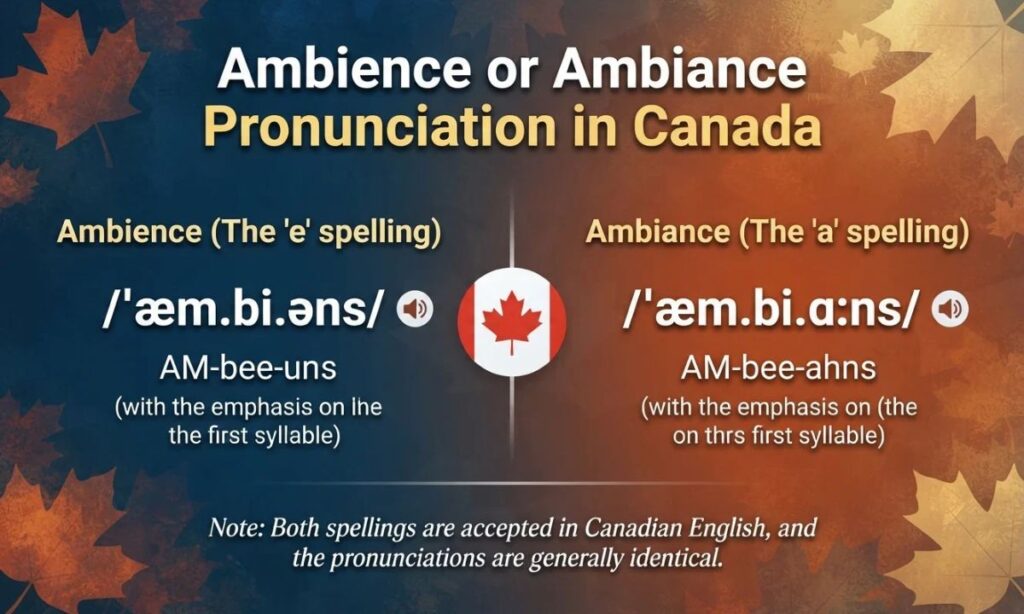
Canada mixes British and American habits. You’ll hear AM-bee-unts across the country, and spelling varies by publication.
Many Canadian outlets use ambiance, especially in restaurant and travel writing. Government and academic documents often follow their own house style.
When in doubt, check your style guide. Consistency matters more than the choice itself.
The Origin of Ambience or Ambiance
Here’s the etymology, and it’s pretty fun. The word traces to the Latin word ambiens, meaning “going around” or “surrounding.”
Think about that for a second. Atmosphere literally surrounds you, so the Latin root fits perfectly.
French turned it into ambiance in the 1800s. English picked it up, and the spelling difference soon appeared.
English writers liked the idea but not always the French origin of the spelling. Some adapted it into ambience to fit English patterns, much like “color” and “colour.”
That’s how we ended up with two forms. Neither is a mistake, just a branch in the family tree of English spelling conventions.
British English vs American English Spelling
The British vs American spelling split follows a familiar pattern. Americans simplified or kept foreign forms, and Britain leaned toward the Anglicized ones.
Here, though, it runs a bit backwards. America kept the French form (ambiance), and Britain adapted it (ambience).
That surprises many people. They assume America always simplifies, but not this time.
Ambience or Ambiance in British English
In the UK, ambience is the standard. Dictionaries like Oxford and Collins list it as the main entry, with ambiance as a variant.
You’ll see it in newspapers, hotel brochures, and academic papers from British universities. It’s also common in India, South Africa, and Australia.
If your readers sit in Commonwealth countries, ambience is the natural pick. It fits their regional preference.
Ambience or Ambiance in American English
In the US, ambiance is more common in everyday writing. Merriam-Webster accepts both but lists ambiance first.
You’ll spot it on menus, spa websites, and travel blogs. It carries a slightly upscale feel.
Still, ambience appears in American writing too. Neither one will raise eyebrows.
Read More: Hustle vs Hussle: Which Is Correct Spelling and Usage?
Examples of Regional Spelling
A London reviewer might write, “The pub’s cozy ambience won us over.” A New York blogger might say, “The rooftop ambiance was unbeatable.”
An Australian travel site could say, “Enjoy the relaxed ambience of the harbor.” A Texas steakhouse might promise “rustic ambiance and live music.”
Same meaning, different spelling. That’s the whole story.
Which Spelling Should You Use?
Pick based on your audience, not on which one looks smarter. Your readers’ location is the deciding factor.
Then stay consistent through the whole piece. Mixing forms looks sloppy to editors and readers alike.
When to Use Ambiance
Choose ambiance if you write for American or Canadian readers. It’s also a good fit for restaurant reviews, luxury lifestyle content, and hospitality writing aimed at US travelers.
It carries the original French spelling, which adds a little polish. That suits candlelit ambiance and boutique hotel copy.
Many US brands prefer it for exactly that reason.
When to Use Ambience
Choose ambience for British, Australian, Indian, or international English audiences. It’s also the go-to in technical writing about ambient sound, ambient light, and ambient music.
In audio production, “room ambience” is a standard term. Engineers record it to make scenes sound real.
It’s also easier to type correctly. Fewer people stumble on the “ie” ending.
Ambience or Ambiance for Global Content
If you publish for a worldwide readership, ambience is usually the safer choice. It’s widely understood and fits Global English and International English habits.
Some writers choose based on search demand instead. Check search volume in your target country before you commit.
Whichever you choose, add it to your editorial style notes. Your whole team will thank you.
Ambience or Ambiance in Everyday Examples
Rules are fine, but real examples help more. Let’s see how the word shows up in daily life.
Email Example
“Hi Sara, I booked us a table at Luna. The ambience is quiet and romantic, so we can actually talk. See you at 7.”
Short, friendly, and clear. In a work email, use the spelling your company already uses.
Social Media Post
“Sunday brunch with great food and even better ambiance. Totally worth the wait! #brunchvibes”
Social posts allow looser writing. Still, the spelling should match your audience and your brand.
Chat Message
“Dinner was okay, but the ambience was amazing. You’d love it.”
Nobody checks spelling in chats. Yet it’s a nice reminder that both forms feel natural in casual use.
Formal Writing
“The study examined how lighting and acoustic ambience affect customer satisfaction in hospitality settings.”
In formal writing and academic writing, follow your journal or institution’s rules. Most British journals prefer ambience, while many American ones accept ambiance.
Ambience or Ambiance – Google Trends and Usage Data
Curious which spelling wins online? Google Trends data generally shows ambiance getting heavier search interest in the US and Canada. Ambience leads in the UK, India, and much of Africa.
Exact numbers change over time, so check current usage data yourself. It takes two minutes and gives you a clear answer for your market.
This matters for content optimization. If your readers search one spelling, mention both naturally on the page.
Context of Use
Context shapes spelling more than geography sometimes. Restaurant atmosphere and hotel environment pages in the US lean toward ambiance.
Meanwhile, sound design and acoustic pages lean toward ambience. The word “ambient” itself, as in ambient temperature, has no spelling dispute at all.
So think about your topic, your readers, and your platform. Those three clues usually settle it.
Ambience Spelling and Common Mistakes
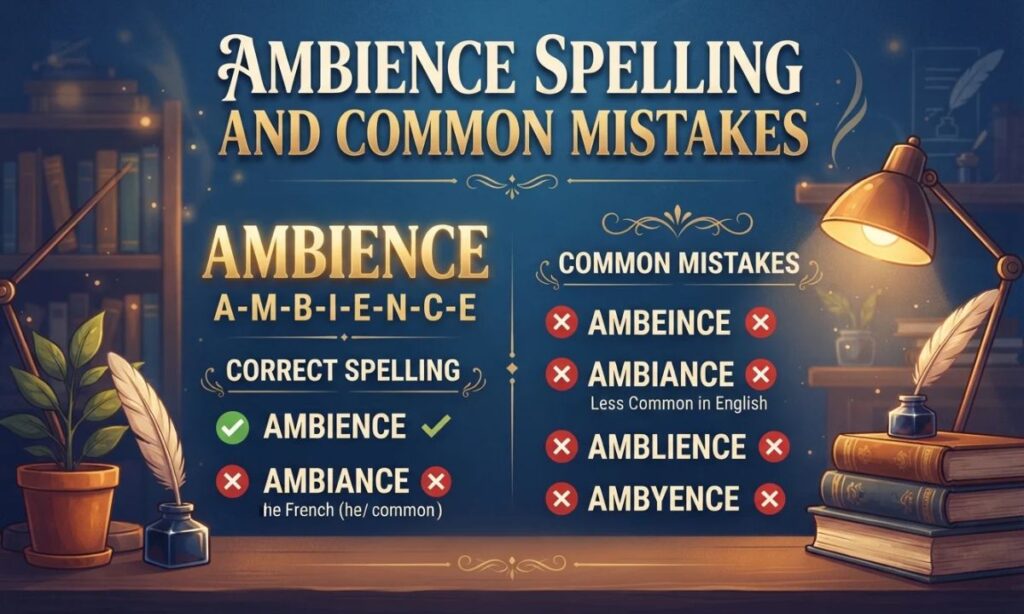
Even confident writers slip here. Let’s look at the common spelling mistakes and how to dodge them.
Mixing Both Spellings
The biggest error is using both forms in one article. A reader might think you made a typo.
Fix it with a quick find and replace before publishing. One spelling per document, always.
Confusing the Meaning
Some people mix up ambience with ambition or ambiguity. They look alike, but they mean very different things.
Ambition is a strong desire to achieve something. Ambiguity means something is unclear.
“The restaurant has great ambition” and “the restaurant has great ambience” say very different things. Double-check before you hit send.
Incorrect Spelling Variations
Watch for typos like “ambeince,” “ambiense,” or “ambeance.” Spellcheck usually catches them, but not always in captions or images.
Remember the pattern: A-M-B, then I, then E or A, then N-C-E. Say it slowly if you need to.
Overusing Ambience or Ambiance
Here’s a subtle problem. Writers sometimes repeat the word until it loses all meaning.
Try synonyms like atmosphere, mood, setting, tone, feel, or vibe. Better yet, describe what you actually see and hear.
“Soft lamps, quiet jazz, and wooden tables” tells readers more than the word ambiance ever could.
Ambience or Ambiance – Comparison Table
Here’s a quick side-by-side view.
| Feature | Ambience | Ambiance |
| Main region | UK, Commonwealth | US, Canada |
| Origin | Anglicized form | Original French spelling |
| Common use | Technical, audio, academic | Lifestyle, hospitality, reviews |
| Pronunciation | AM-bee-unts | AM-bee-unts |
| Meaning | Mood and atmosphere | Mood and atmosphere |
| Safe for global content | Yes | Yes, with US focus |
The meaning never changes. Only your audience decides which column to pick.
Ambience or Ambiance Frequently Asked Questions
Is Ambience or Ambiance Correct?
Both are correct. Ambience is the British English spelling and ambiance is the American English spelling.
Choose one based on your readers. Then use it throughout.
Why Do People Say Ambiance?
People say it because it mirrors the French word ambiance. Americans kept that original French spelling, and it feels a bit elegant.
Repeated use in menus, ads, and reviews made it familiar. Habit does the rest.
Do Ambience and Ambiance Have Different Pronunciations?
In English, no. Both sound like AM-bee-unts.
Only a French pronunciation sounds different. That one is nasal and ends with a softer stress.
Which Spelling Do Dictionaries Prefer?
It depends on the dictionary. British ones like Oxford and Collins list ambience first.
American ones like Merriam-Webster list ambiance first. Both include the other as a valid variant.
Can I Use Ambiance in Formal Writing?
Yes, absolutely. Ambiance is acceptable in formal writing, academic papers, and editorial content.
Just check your style guide first. Some publishers require one specific form.
What Is the Adjective Form of Ambience?
The usual adjective is ambient. It describes surrounding conditions, as in ambient light, ambient sound, or ambient temperature.
Writers also say “ambient music” for soft, atmospheric tracks. There’s no widely used adjective ending in “ambient” for ambiance, so the same word works for both spellings.
What Are Good Synonyms for Ambience or Ambiance?
Try atmosphere, mood, setting, surroundings, aura, feel, vibe, or tone. Each has a slightly different flavor.
“Atmosphere” works almost everywhere. “Vibe” suits casual writing, while “setting” fits more formal pieces.
A Simple Checklist Before You Publish
Run through these quick questions. Who are my readers, and where do they live?
Does my style guide already pick a spelling? Did I use only one form across the page?
If you can answer all three, you’re done. It takes less than a minute and saves you from embarrassing edits later.
Conclusion
So, ambience or ambiance? Neither one is wrong. Pick ambience for British, Commonwealth countries, and audio production content. Pick ambiance for American readers, restaurant reviews, and luxury lifestyle content. The meaning and pronunciation stay the same, so your audience should guide the choice.
Whatever you choose, stay consistent and follow your style guide. A single spelling across the page keeps your writing clean and professional. Now it’s your turn. Which spelling do you use in your own writing? Drop your answer in the comments and share this guide with a friend who writes.

Finn Bradley is a grammar and language writer at Megazine Tech, focused on making English easier to understand. He researches grammar rules, vocabulary, sentence usage, punctuation, and common writing questions. Through clear explanations and practical examples, Finn helps readers build stronger communication skills and write with greater confidence in everyday situations.