


You’re typing a quick medical note and suddenly freeze. Is it patient or pacient? Many writers hit this wall, especially bilingual writers and non-native speakers. The correct spelling is patient, and Patient or Pacient stops being a puzzle once you know why the mix-up happens. Don’t worry, it’s an easy fix. Even autocorrect won’t always save you.
This guide explains the patient meaning in English, its Latin root patiens, and the gap between patient and patience. You’ll also learn the plural form, the apostrophe rule, and how British English and American English treat the word. We’ll cover medical records, emails, and common spelling mistakes with simple examples. Keep reading and you’ll never second-guess it again.
Patient or Pacient: Quick Answer
If you’re in a hurry, here’s the verdict. In English, you spell it P-A-T-I-E-N-T, with a “t” in the middle. Pacient doesn’t exist in standard English dictionaries.
The mix-up is understandable. The word sounds like “pay-shent,” so the “sh” sound tempts people to write a “c.” Your brain hears one thing and your fingers type another.
Patient vs Pacient: Correct Spelling
The patient correct spelling keeps the “t” before “ient.” Think of it as pat + ient. Say it slowly and you’ll hear the “t” hiding in there.
Here’s a memory trick. A patient sits in a treatment room. The “t” appears in “treatment,” “waiting,” and “patient.”
The pacient correct spelling question only makes sense in other languages. In English, it’s always a spelling mistake.
Examples of Correct and Incorrect Usage
Seeing both versions side by side makes the error obvious. Check these quick examples.
- Correct: The nurse asked the patient to take a seat.
- Incorrect: The nurse asked the pacient to take a seat.
- Correct: Please be patient while we update your file.
- Incorrect: Please be pacient while we update your file.
- Correct: Every patient deserves clear answers.
- Incorrect: Every pacient deserves clear answers.
Notice that the correct form works both as a person and as a quality. The wrong form fails in both cases.
Read More: Infront vs In Front: Which Is Correct and Why Does It Matter?
What Does Patient or Pacient Mean?
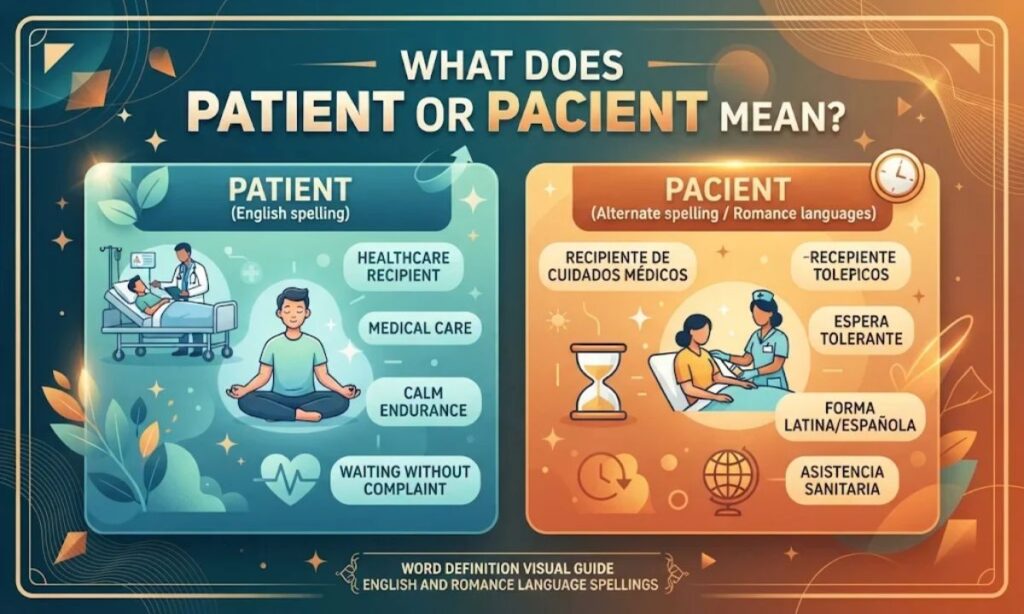
Only one of these has an English meaning. Patient carries two main senses, and they live side by side in everyday speech.
One describes someone who stays calm while waiting. The other names a person receiving medical care. Context tells you which one you’re reading.
Patient Meaning in English
The patient definition depends on its job in the sentence. As an adjective, it describes someone who stays calm and tolerant when things take time or go wrong. As a noun, it names someone under the care of a doctor, nurse, or other health professional.
That’s why the patient noun and adjective forms confuse people. Same spelling, different roles. The sentence around it does the sorting.
Patient as in Waiting or Staying Calm
Picture a long line at the pharmacy. The person who waits without sighing every thirty seconds is being patient. They show calm, tolerant behavior under mild stress.
This sense ties directly to endurance. A patient person can handle delays, slow progress, or irritating people without losing their cool. Parents of toddlers earn this trait fast.
Patient as a Person Receiving Medical Care
In healthcare, a patient is anyone receiving treatment, advice, or monitoring. That includes someone in a hospital bed and someone chatting with a doctor on a video call. You don’t need to be seriously ill to be called one.
Hospitals build whole systems around this word. A patient history records past illnesses, allergies, and treatments. Teams in clinical settings use it daily, so spelling accuracy matters.
Patient or Pacient Synonyms
Looking for alternatives? For the calm meaning, try tolerant, composed, even-tempered, or understanding. For the medical meaning, common substitutes include client, case, or inpatient and outpatient, depending on the setting.
There’s no true synonym for pacient, because the word isn’t English. Writers who type it are usually reaching for “patient” anyway.
The Origin and History of Patient
Words carry baggage from older languages. Patient is a great example. Its family tree explains both its meaning and its confusing spelling.
Once you see where it came from, the etymology helps the spelling stick. You’ll also understand why other languages spell it differently.
Latin and Old French Origins
The origin of patient traces back to the Latin word patiens, which means “suffering” or “enduring.” That comes from the verb patior, meaning “to suffer” or “to bear.” The Latin root of patient points to the idea of putting up with something difficult.
From there, the word moved into Old French as pacient. Yes, that’s the same spelling people mistakenly type today. It later entered Middle English around the fourteenth century as “patient,” with the “t” restored.
Some scholars also link the family to Greek paskhein (“to suffer”) and pathos (“feeling”). That connection is plausible but less direct, so treat it as a related thread rather than a proven line.
Why Confusion Happens Between Patient and Pacient
Blame sound and language overlap. Many bilingual writers carry spelling habits across languages. In Spanish and Portuguese, the word is “paciente.” Italian uses “paziente.” Polish writes “pacjent,” and Romanian writes “pacient.” French uses “patient,” like English.
So if you speak Romanian at home and write English at work, “pacient” feels natural. That’s multilingual spelling confusion at its most common. It’s not carelessness. It’s a habit from a language you already know.
Read More: Withdraw vs Withdrawal: Meaning, Usage & Grammar Guide
Patient vs Pacient in British and American English
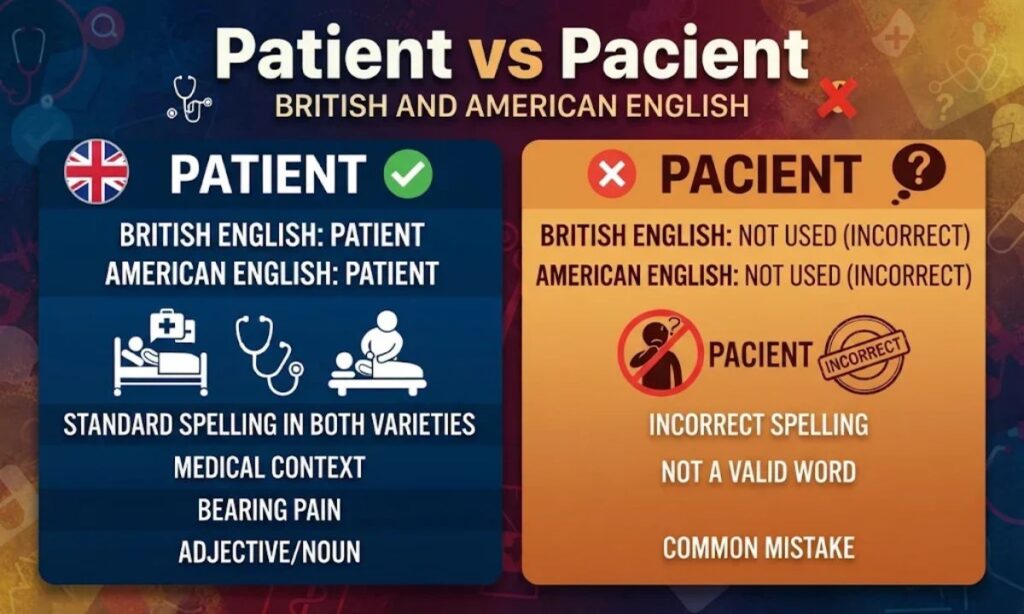
A common worry is whether the spelling flips across the Atlantic. It doesn’t. This isn’t like “colour” and “color.”
Both British English and American English use the same form. Neither accepts “pacient.”
Is the Spelling Different in British and American English?
No. The patient spelling in British English and the patient spelling in American English are identical. Both dialects write it with “t.”
Differences between English dialects show up elsewhere, like “paediatric” versus “pediatric.” Still, the word patient itself stays untouched. You can relax on this one.
Comparison Table: Patient vs Pacient
Here’s a side-by-side view to settle the debate once and for all.
| Feature | Patient | Pacient |
| Valid in English | Yes | No |
| British English | Correct | Incorrect |
| American English | Correct | Incorrect |
| Found in dictionaries | Yes | Only in other languages |
| Part of speech | Noun and adjective | Not applicable |
| Used in medical writing | Always | Never (in English) |
| Pronunciation | PAY-shunt | Not applicable in English |
Print it, bookmark it, or tape it near your desk if you write medical content.
Patient or Patience: Meaning and Usage
Another trap sits right next door. Patient and patience look almost identical, and they trip up native speakers all the time.
The good news is that one simple rule separates them. Let’s walk through it.
What Is the Difference Between Patient and Patience?
Patience is a noun. It names the ability to stay calm and wait. Patient is either an adjective describing someone calm or a noun for a person getting care.
Think of it this way. Patience is the personality trait. Patient is the person who has it, or the person in the hospital bed.
Patient vs Patience: Examples
Examples make the rule click. Read these aloud.
- She has patience with her younger brother.
- She is patient with her younger brother.
- The patient waited an hour for test results.
- Thank you for your patience during the delay.
Swap them and the sentence breaks. “She has patient” sounds odd, and so does “She is patience.” Your ear already knows the answer.
Patient vs Patience Pronunciation
The patient pronunciation is /ˈpeɪʃənt/, roughly “PAY-shunt.” Patience sounds like /ˈpeɪʃəns/, or “PAY-shunss.” Only the final sound changes.
That tiny gap makes it hard to catch errors by ear alone. Always double-check the ending when you proofread. A “t” means patient, and “ce” means patience.
How to Spell Patient in Different Contexts

Spelling pressure changes with the setting. A casual text can survive a typo. A hospital report often can’t.
Here’s how to get it right wherever you write.
How to Spell Patient in a Hospital
In medical records, accuracy affects safety and legal clarity. Staff should write “patient” in full, with the “t,” in every note, chart, and referral. Many teams use electronic health records (EHR) with built-in spell-check to catch slips.
Don’t rely on software alone, though. Read your entries once before saving. A misspelled label can confuse a handoff or slow a search in the system.
Hospital Patient vs Patience
Mix-ups also happen in busy wards. A tired clerk might type “patience” when they meant “patient,” especially in a hurried note. For example, “Patience reports chest pain” reads like a person’s name.
Always ask: am I naming a person or a quality? If it’s a person in care, you need patient.
Patient Plural: Patients or Patient’s?
This is where punctuation causes headaches. The patient plural form is simply patients, with no apostrophe. Use it when you mean more than one person: “The clinic saw forty patients today.”
The possessive form uses an apostrophe. “The patient’s chart” means the chart belongs to one patient. “The patients’ rooms” means rooms belonging to several. Understanding patient’s vs patients saves you from the most common apostrophe mistake.
Common Mistakes with Patient
Even confident writers slip. Spotting these patterns helps you catch them early.
Let’s look at the usual suspects.
Wrong Spelling
The big one is “pacient.” Close cousins include “patent,” “patiant,” and “pasient.” Each is a spelling mistake that autocorrect may or may not rescue.
If the word looks strange, slow down. Sound out each syllable: pay, shent. Then write it with the “t.”
Confusing the Noun and Adjective
Writers sometimes treat the noun and adjective as interchangeable with patience. They aren’t. “Be patience” is wrong, while “be patient” is right.
A quick test helps. If you can put “very” before the word, you want the adjective. “Very patient” works. “Very patience” doesn’t.
Using the Plural Incorrectly
Many writers add an apostrophe to make a plural. “Three patient’s arrived” is incorrect. It should be “three patients arrived.”
Save the apostrophe for ownership. If nothing belongs to the patient, skip it.
Mixing Languages
This one hits non-native speakers hardest. You know “paciente” or “pacient” from your first language, and it leaks into English. These non-native English spelling mistakes are totally normal.
A small habit helps. Whenever you write a medical term, pause and check whether it’s a cognate. Close spellings across languages are exactly where errors hide.
Typing Errors in Medical Notes
Speed creates typos. In a busy clinic, “patient” can become “patinet” or “paitent” in seconds. These medical spelling mistakes look small but they hurt search and records.
Turn on spell-check in your notes app. Then reread anything that goes to a colleague or a chart.
Patient Usage Examples in Everyday Writing
Rules stick better with real context. Here’s how the word behaves across different kinds of writing.
Each setting has its own tone, but the spelling never changes.
Medical Writing
In medical writing, patient appears constantly. “The patient presented with a persistent cough.” “Each patient received the same dosage.”
Clinical papers favor clear, neutral phrasing. Consistency matters more than style, so always keep the exact spelling.
Emails and Professional Messages
In a professional email, the word often means calm. “Thanks for being patient while we sort this out.” It softens a delay without sounding stiff.
Healthcare admin emails use the noun sense instead. “Your patient portal login is ready.” A misspelling here can look careless to clients.
News and Reports
Journalists use patient in headlines and body text. “Hospital sees record number of patients this winter.” Editors check spelling carefully because errors damage trust.
Short, sharp usage is the norm. Stick to the plain word.
Social Media
On a social media post, people get casual. “Be patient with yourself, healing takes time.” Typos spread fast online, though.
A misspelled “pacient” in a public post can draw replies you didn’t want. A quick reread takes five seconds.
Formal and Academic Writing
In academic papers and scientific literature, precision rules. Authors cite “patient outcomes,” “patient cohorts,” and “patient consent.” Databases like PubMed and Google Scholar index these exact spellings.
If you misspell it in a title or abstract, searchers may never find your work. That’s a real cost for researchers.
Patient: Google Trends and Usage Data
Curious how often people mistype this word? Google Trends lets you compare “patient” and “pacient” over time. You’ll see that the correct spelling dominates English searches by a wide margin.
I won’t quote exact figures here, because search volume shifts constantly. Run the comparison yourself for your own region. You’ll also spot spikes in “pacient” from countries where it’s a normal word.
Usage databases and corpora tell a similar story. Standard dictionaries list only one spelling, and large text collections show “pacient” mostly inside non-English sentences. That supports the point about spelling standardization.
Quick Tips to Avoid Spelling Patient Incorrectly
Knowing the rule helps, but habits help more. Try these simple tricks.
- Anchor the “t.” Link patient to “treatment” and “wait.”
- Say it slowly. Pronounce “pa-tient” and write what you hear.
- Use spell-check. Turn on autocorrect and review its suggestions.
- Proofread once. Read your text aloud before sending.
- Keep a cheat note. Write the correct form on a sticky note.
If you write often about health, add “patient” to your custom dictionary. Then your tools will flag the wrong version every time.
Frequently Asked Questions
Is “Pacient” Ever Correct in English?
No. Pacient is not a valid English word. It’s correct in Romanian, Polish (as “pacjent,” a slightly different form), and a few other languages, but English uses patient only.
What Does “Patient” Mean?
It has two meanings. As an adjective, it means calm and tolerant while waiting. As a noun, it means a person receiving medical care.
Why Do People Write “Pacient” Instead of “Patient”?
Mostly because of sound and language influence. The “sh” sound suggests a “c,” and many languages spell it that way. Bilingual writers carry the habit over without noticing.
Is Patient Spelled Two Different Ways?
No. There’s one correct English spelling. Any other version is simply an error.
How Do You Spell Patient as in Calm?
Exactly the same way: patient. The calm sense and the medical sense share a spelling. Only context changes the meaning.
What Does “Patience” Mean?
Patience is the noun for staying calm while waiting or facing difficulty. It’s a personality trait, not a person. “She has patience” is correct.
Can Autocorrect Fix “Pacient”?
Often, yes. Most tools suggest “patient” right away. Still, don’t depend on it, because autocorrect can miss errors in names, abbreviations, or fast typing.
Is the Spelling Different in British and American English?
No. Both use patient. The spelling stays the same everywhere English is written.
Conclusion
So, Patient or Pacient? The answer is patient, every single time in English. Pacient belongs to languages like Romanian, Spanish, and Polish, not to your medical writing or professional emails. Remember that patient works as a noun and an adjective, while patience names the personality trait.
The plural is patients, with no apostrophe unless something belongs to them. Turn on spell-check, reread your work once, and you’ll avoid nearly every spelling mistake. Have you ever typed pacient by accident? Share your story in the comments and pass this guide to a friend who writes in two languages.

Finn Bradley is a grammar and language writer at Megazine Tech, focused on making English easier to understand. He researches grammar rules, vocabulary, sentence usage, punctuation, and common writing questions. Through clear explanations and practical examples, Finn helps readers build stronger communication skills and write with greater confidence in everyday situations.