

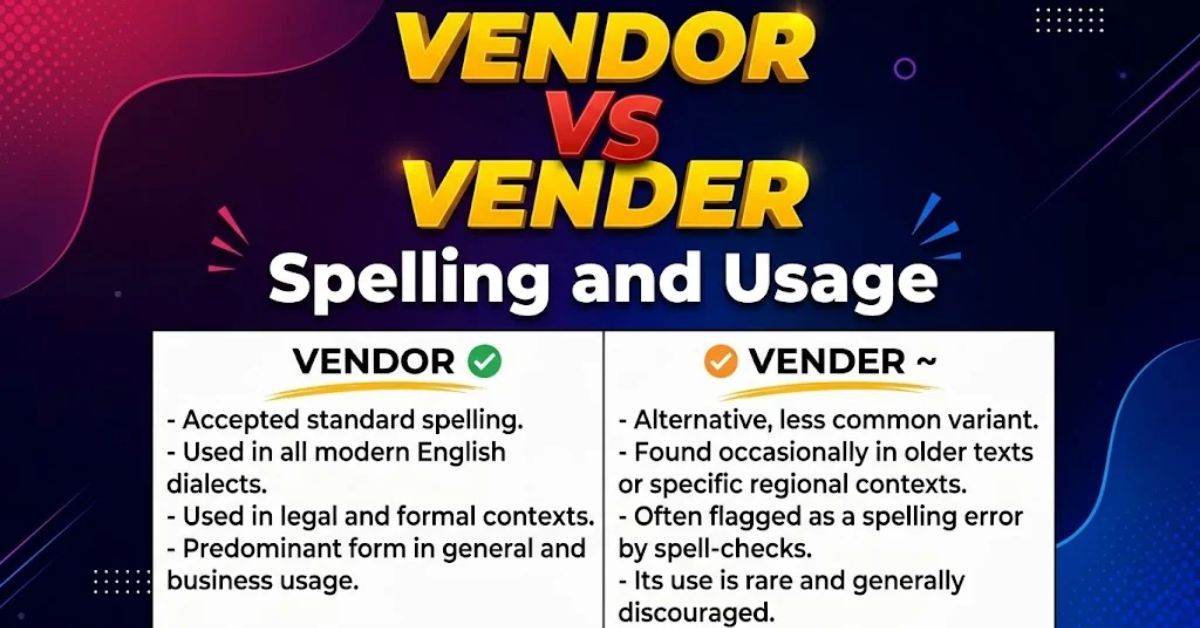
Vendor vs Vender is a common spelling confusion in English. Both words look similar, and many writers wonder which one they should use in everyday and professional writing.
The correct and widely accepted spelling is vendor. It is a noun that refers to a person, company, or business that sells products or provides services to customers. You’ll often see this word in business documents, retail, e-commerce, procurement, and contracts.
Vender is also a recognized historical spelling, but it is rarely used in modern English. Although some dictionaries still mention it as a variant, vendor remains the preferred choice in both American and British English.
In this guide, you’ll learn the difference between vendor and vender, including their meanings, pronunciation, origins, and practical examples. You’ll also discover when vender might appear, why vendor is more common, and how to use the correct spelling in professional communication.
The Quick Answer: Vendor Is Correct (Almost Always)
If you want a quick answer, vendor is the standard spelling in modern English.
Vendor, ending in -or, is widely accepted in both American and British English. It refers to an individual or company that sells products or provides services. You’ll commonly find it in business agreements, invoices, contracts, emails, and official documents.
Vender, ending in -er, is an older spelling that still appears occasionally. Some dictionaries recognize it as a historical or alternative form, but it isn’t commonly used today.
For professional writing, academic work, marketing content, and everyday communication, choose vendor. It’s the safest and most familiar option.
Why Vendor and Vender Keep Getting Confused
The confusion between vendor and vender comes from two common English spelling patterns.
The first pattern uses -er to describe someone who performs an action. For example:
- Seller: Someone who sells something.
- Buyer: Someone who buys something.
- Lender: Someone who lends money.
- Teacher: Someone who teaches.
The second pattern uses -or, which appears in many words borrowed from Latin or French. Examples include:
- Actor: Someone who acts.
- Editor: Someone who edits.
- Creator: Someone who creates.
- Creditor: Someone who is owed money.
Vendor belongs to the second group because of its historical development. However, the verb vend can make the spelling vender seem more natural to some writers.
This similarity creates confusion, especially among people who are unfamiliar with the word’s history.
Where the Word Vendor Actually Comes From
The word vendor has an interesting history. It entered English through Anglo-French, with roots in the French verb vendre, meaning “to sell.”
The French word developed from the Latin verb vendere, which also means “to sell.”
Its historical development can be understood through this sequence:
Latin vendere → Old French vendre → Anglo-French vendur/vendour → English vendor.
The -or ending remained part of the English spelling because of its historical connection with French commercial and legal vocabulary.
Several other words follow a similar pattern:
| Word | Meaning |
|---|---|
| Creditor | A person or organization owed money |
| Debtor | Someone who owes money |
| Grantor | Someone who transfers property |
| Executor | Someone responsible for carrying out a will |
| Vendor | Someone who sells goods or services |
Vendor became especially common in business and legal writing because it clearly identifies the selling party in a transaction.
The word also shares its origin with vending machine. Both are connected to the verb vend, meaning to sell.
Vender Isn’t a Typo, It’s a Genuine Historical Spelling
Many people assume that vender is simply a spelling mistake. However, that’s not entirely true.
Vender is an older English spelling that appeared in historical writing. Before English spelling became standardized, writers sometimes used different endings for the same words.
Historical records show that vender appeared in printed material centuries ago. Writers such as Herman Melville also used this spelling in older literary works.
At that time, spelling conventions were less consistent than they are today. Therefore, using vender wasn’t necessarily considered incorrect in every historical context.
Over time, however, vendor became the established spelling. Vender gradually disappeared from ordinary writing and remained mainly as an uncommon variant.
The New Yorker’s Famous Exception
One interesting exception to the usual spelling rule involves The New Yorker magazine.
The publication is known for following its own distinctive editorial style. It sometimes uses spellings that differ from those preferred by most American publications.
Vender is one example of this unusual preference.
The magazine also maintains certain traditional spelling choices and punctuation conventions that other publications have largely abandoned.
This doesn’t mean vender is the preferred spelling in modern English. It simply shows that individual publications can follow their own house styles.
Unless you’re writing specifically for a publication that requests this spelling, vendor remains the better choice.
Is Vender Ever Correct Today?
Vender is recognized as a historical or alternative spelling in some dictionaries. However, its use is limited in modern English.
Here are some situations where you should choose each spelling:
| Situation | Correct spelling |
|---|---|
| Business contracts | Vendor |
| Invoices and receipts | Vendor |
| Legal documents | Vendor |
| Professional emails | Vendor |
| Marketing content | Vendor |
| Academic writing | Vendor |
| Historical quotations | Vender, if used in the original |
| Following The New Yorker style | Vender, when required |
For almost every modern writing situation, vendor is the appropriate choice.
Although vender isn’t simply an invented word, using it in everyday business communication may look outdated or unusual.
Why Getting This Right Actually Matters
Choosing the correct spelling may seem like a small detail, but it can make your writing clearer and more professional.
1. Professional communication
Business emails, invoices, and contracts should use familiar and accepted spelling. Writing vendor instead of vender helps your message look polished and consistent.
2. Legal documents
Contracts often use the word vendor to identify the party responsible for selling products, property, or services. Consistent terminology makes agreements easier to understand and review.
3. Online content and SEO
People generally search for vendor rather than vender when looking for suppliers, software companies, or business services. Using the standard spelling helps your content match common search behavior.
4. Better readability
Readers recognize familiar words more quickly. Using vendor makes your writing sound natural and avoids unnecessary confusion.
A small spelling choice can improve the overall quality of your communication.
Vendor vs. Seller vs. Supplier vs. Vendee: What’s the Real Difference?
Vendor, seller, supplier, and vendee are related to buying and selling, but they don’t have exactly the same meanings.
Understanding their differences can help you use each term correctly.
Vendor: A person or business that sells products or services. The term is especially common in commercial and business transactions.
Seller: A general term for anyone who sells something. It can describe an individual, a small business, or a large company.
Supplier: A person or company that provides products, materials, or services to another business. Suppliers often operate within a larger supply chain.
Vendee: The person or organization that purchases something from a vendor. It refers to the buyer in a transaction.
The difference between vendor and vendee is particularly important.
- Vendor = Seller
- Vender = Older spelling of seller
- Vendee = Buyer
For example, imagine someone selling a house.
The person selling the property is the vendor, while the person purchasing it is the vendee.
Confusing these terms in a legal agreement could create serious misunderstandings because they identify opposite parties in a transaction.
Is Vendor vs. Vender a US vs. UK Spelling Difference?
No. Vendor and vender are not examples of American and British spelling differences.
Some English words have different accepted spellings depending on the region. For example:
- Color (American English) / Colour (British English)
- Center (American English) / Centre (British English)
- Organize (American English) / Organise (British English)
However, vendor is the standard spelling in both American and British English.
Neither region generally prefers vender in modern writing.
The difference is mainly related to historical usage and individual editorial preferences rather than geographical spelling rules.
Therefore, whether you’re writing for an American or British audience, vendor is the appropriate choice.
Vendor vs. Vender in Real Sentences
Examples make spelling differences easier to understand. Here are some sentences showing how to use vendor correctly.
Incorrect: The hardware vender delivered the replacement parts overnight.
Correct: The hardware vendor delivered the replacement parts overnight.
Incorrect: We’re finalizing the contract with our new software vender this week.
Correct: We’re finalizing the contract with our new software vendor this week.
Incorrect: Local artisans and venders gathered at the farmers market.
Correct: Local artisans and vendors gathered at the farmers market.
Incorrect: Please speak to the vender listed on your receipt for a refund.
Correct: Please speak to the vendor listed on your receipt for a refund.
Incorrect: Our procurement team is reviewing three potential venders for the new system.
Correct: Our procurement team is reviewing three potential vendors for the new system.
Notice that vendor works naturally in every example. Using the standard spelling keeps your sentences clear and professional.
The Bigger Pattern: Other -or vs. -er Word Mix-Ups
Vendor isn’t the only English word that creates confusion because of its ending.
Several other words have similar spelling patterns. However, their rules and accepted forms can be different.
Here are a few examples:
- Adviser or Advisor: Both spellings are accepted. Advisor is particularly common in business and financial contexts.
- Employer: This is the correct spelling, not employor.
- Indicator: This is the standard spelling, not indicater.
- Protester or Protestor: Both forms are used in modern English, although preferences can vary by publication and context.
These examples show why spelling based only on pronunciation can be unreliable.
The best approach is to learn the established spelling of each word rather than assume that every person or thing performing an action must end in -er.
Quick Recap: Vendor vs. Vender
Here are the most important points to remember:
- Vendor is the standard and preferred spelling in modern English.
- Vender is a genuine historical variant but is rarely used today.
- Both American and British English generally prefer vendor.
- The confusion comes from different English word-forming patterns.
- Some publications may use vender as part of their individual editorial style.
- Vendee means buyer, while vendor means seller.
- Use vendor in professional emails, contracts, invoices, and everyday writing.
When you’re unsure, remember that vendor is the safest choice.
FAQs
1. Which is correct: Vendor or Vender?
Vendor is the standard and widely accepted spelling in modern English. Vender is an older alternative that appears occasionally but is rarely used in everyday or professional writing.
2. What does vendor mean?
A vendor is a person, company, or business that sells products or provides services. The word is commonly used in retail, technology, procurement, and commercial transactions.
3. Is vender a misspelling of vendor?
Not exactly. Vender is a historically recognized spelling of the same word. However, vendor has become the standard form in modern English.
4. Why is vendor more common than vender?
Vendor became established through historical French and Anglo-French spelling conventions. Its widespread use in commercial, legal, and business writing helped make it the preferred spelling.
5. Can I use vendor and vender interchangeably?
Although both spellings have historically referred to someone who sells something, vendor is preferred today. Use it in professional documents, business communication, academic writing, and everyday conversations.
Conclusion
Understanding the difference between vendor and vender helps you avoid a common English spelling mistake. Both forms have historical connections with selling products and services, but vendor is the standard spelling used in modern American and British English.
Vender is an older variant that occasionally appears in historical texts and certain editorial styles. However, it isn’t the usual choice for everyday communication.
The easiest way to remember the rule is simple: use vendor whenever you’re referring to a person or business that sells goods or services. Whether you’re writing an email, preparing a contract, creating website content, or communicating with customers, vendor is the correct and professional choice.

Finn Bradley is a grammar and language writer at Megazine Tech, focused on making English easier to understand. He researches grammar rules, vocabulary, sentence usage, punctuation, and common writing questions. Through clear explanations and practical examples, Finn helps readers build stronger communication skills and write with greater confidence in everyday situations.