

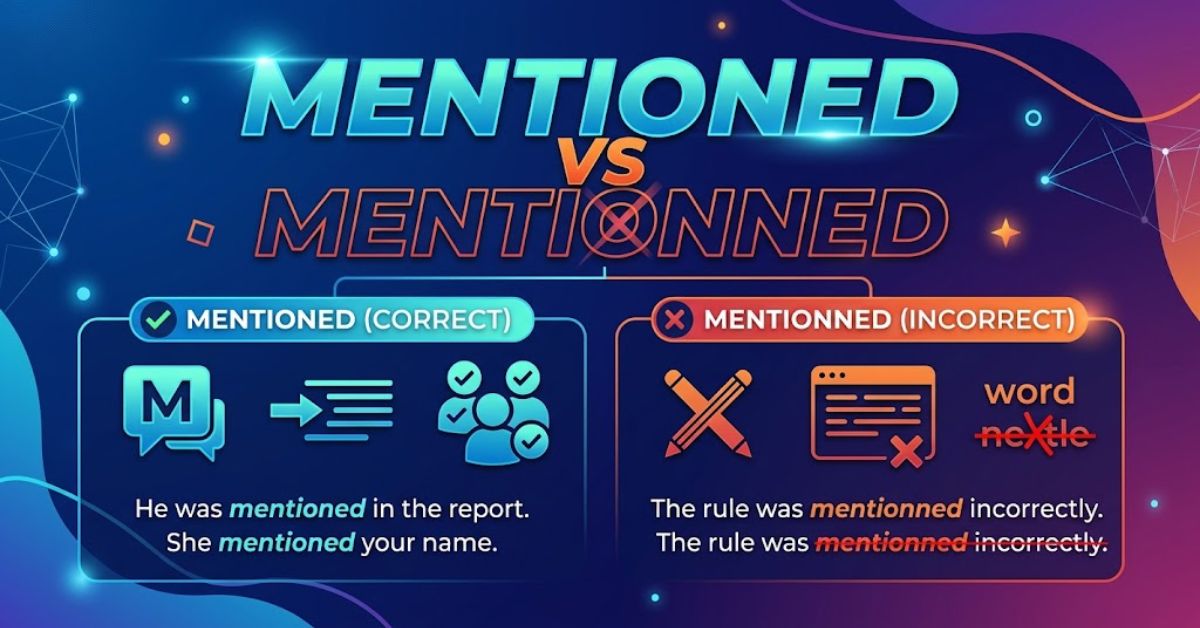
If you are unsure about mentioned vs mentionned, the answer is simple: mentioned is correct English, while mentionned is incorrect.
The word mentioned is the past tense and past participle of the verb mention. It means that someone referred to a person, idea, subject, event, or fact in speech or writing.
For example:
She mentioned your name during the meeting.
The spelling mentionned is a common mistake. It may look reasonable because English has many words that double a final consonant before adding -ed, but mention does not follow that pattern.
This guide explains the difference, grammar rules, correct usage, pronunciation, examples, professional phrases, synonyms, and common questions about mentioned vs mentionned.
Quick Answer
Mentioned is the correct spelling.
Mentionned is not a standard English spelling and should not be used in normal English writing.
| Word | Correct? | Meaning |
|---|---|---|
| mentioned | Yes | Referred to or spoke about something |
| mentionned | No | Incorrect spelling |
The easiest rule is:
mention + ed = mentioned
Not:
mention + ned = mentionned
Oxford lists mentioned as the past simple and past participle form of mention.
Mentioned vs Mentionned: The Difference
There is no meaningful difference in meaning between these two spellings because mentionned is not the standard English form.
Use mentioned when talking about something that someone referred to in the past or when using it as a past participle.
Examples:
- I mentioned the problem yesterday.
- She mentioned your idea during the meeting.
- The report mentioned several important concerns.
- We have mentioned this issue before.
Avoid:
- I mentionned the problem yesterday.
- She mentionned your idea.
- The report mentionned the issue.
The second spelling is simply an error.
What Does Mentioned Mean?
Mentioned Definition and Meaning in English
Mentioned means referred to, talked about, or wrote about something, usually without giving extensive detail.
Cambridge defines mention as referring to someone or something or speaking or writing about them, often with limited detail.
For example:
- He mentioned the new project.
- She mentioned that she was moving.
- The teacher mentioned the upcoming exam.
- The article mentioned several possible causes.
In each example, the person brings something into the conversation or writing without necessarily discussing it in depth.
How to Use Mentioned in a Sentence
Use mentioned when the action happened in the past.
Examples:
- I mentioned the deadline yesterday.
- Sarah mentioned your name at lunch.
- The manager mentioned the changes during the meeting.
- He mentioned that he needed more time.
- The report mentioned several possible solutions.
You can also use mentioned after have, has, or had:
- I have mentioned this problem before.
- She has mentioned your name several times.
- They had mentioned the issue before the meeting started.
What Does “You Were Mentioned” Mean?

You were mentioned means that someone referred to you or talked about you in a conversation, message, meeting, post, or document.
For example:
You were mentioned during today’s meeting.
This means someone talked about you or referred to you during the meeting.
It does not automatically mean that the person said something positive or negative. The surrounding context tells you why you were mentioned.
Why Is Mentioned Correct and Mentionned Incorrect?
The correct form comes directly from the base verb:
mention + ed = mentioned
English does not add another n here.
The mistake often happens because writers remember other words that double consonants before -ed, such as planned, stopped, or preferred. However, spelling rules depend on the word’s structure and pronunciation.
You should not apply the doubling pattern automatically to every verb.
Why Does Mentioned Have Only One N?
The base word is:
mention
When you add the regular -ed ending, you get:
mention + ed = mentioned
The existing n stays in place. No additional n is inserted.
A useful visual check is:
mention → mentioned
not:
mention → mentionned
Why Do People Confuse Mentioned vs Mentionned?
Several factors can cause the mistake:
- English has many consonant-doubling patterns.
- Writers may type quickly and add an extra letter.
- English learners may apply a spelling rule too broadly.
- Similar-looking words can create uncertainty.
- Autocorrect or previous exposure to misspellings can reinforce the wrong form.
The important point is that mentionned is not an alternative English spelling.
Mentioned Grammar Rules and Verb Forms
Mention Verb Forms
The main forms of mention are:
| Verb form | Example |
|---|---|
| Base form | I mention the problem. |
| Third-person singular | She mentions the problem. |
| Past tense | She mentioned the problem. |
| Past participle | She has mentioned the problem. |
| Present participle | She is mentioning the problem. |
Oxford lists mention, mentions, mentioned, and mentioning as the relevant verb forms.
Mention vs Mentioned: What’s the Difference?
Mention is the base form. Mentioned is the past tense and past participle.
Use mention after modal verbs and in many present or infinitive structures:
- I will mention it tomorrow.
- Please mention my name.
- They often mention the issue.
Use mentioned for a completed past action or after forms of have:
- I mentioned it yesterday.
- She has mentioned it already.
- They had mentioned the problem earlier.
A simple shortcut is:
present or future structure → mention
completed past action → mentioned
Mentioned vs Mentioning
Mentioned normally describes a completed action or functions as a past participle.
She mentioned the problem yesterday.
Mentioning uses the -ing form.
She is mentioning the problem now.
You can also use mentioning after certain verbs and prepositions:
Thank you for mentioning the issue.
Cambridge also gives examples of mention followed by an -ing form, such as “mentioned seeing.”
Mentioned vs Mentionned Examples in Everyday Writing
Correct Sentences With Mentioned
- I mentioned your suggestion yesterday.
- She mentioned the meeting time.
- He mentioned that he was tired.
- They mentioned the problem during the call.
- The article mentioned several important facts.
- I have mentioned this before.
- The issue was mentioned in the report.
Incorrect Sentences With Mentionned
These examples contain the common spelling error:
- She mentionned the problem.
- I mentionned your name.
- They mentionned the deadline.
- The report mentionned the issue.
Correct them by removing the extra n:
- She mentioned the problem.
- I mentioned your name.
- They mentioned the deadline.
- The report mentioned the issue.
A Practical Editing Example
Suppose you write:
I mentionned the deadline in my previous email.
During proofreading, identify the base verb first:
mention
Then add the regular past-tense ending:
mention + ed
The corrected sentence becomes:
I mentioned the deadline in my previous email.
This simple editing habit can prevent the error before you submit an email, assignment, report, or article.
How to Use Mentioned in Emails, Reports, and Documents
Mentioned in an Email
Mentioned works naturally in professional emails.
Examples:
As mentioned in our meeting, the deadline is Friday.
I mentioned the revised schedule in my previous email.
The points mentioned during the call are listed below.
For professional writing, be specific whenever possible. Instead of saying only “as mentioned,” identify the topic if the reader might not remember it.
As Mentioned Above vs As Mentioned Earlier
Both phrases can be correct.
As mentioned above refers to information that appears earlier in the same document.
As mentioned above, all applicants must submit the form by Friday.
As mentioned earlier refers to something previously discussed or stated. It can work in both speech and writing.
In formal writing, alternatives include:
- As noted above
- As stated earlier
- As discussed previously
- As explained earlier
- As noted previously
Cambridge specifically lists as mentioned above, as noted above, as demonstrated above, and as shown above as ways to refer back to earlier material.
Mentioned in a Report, Document, or Contract
In formal documents, mentioned can identify information already introduced.
Examples:
- The risks mentioned in Section 2 require further review.
- The terms mentioned above apply to all participants.
- The documents mentioned in this agreement must be submitted on time.
Clear references are usually better than vague phrases because readers should not have to search through a document to understand what you mean.
Mentioned by Name
Mentioned by name means that someone specifically used a person’s name.
Example:
The manager mentioned Sarah by name during the presentation.
It can also mean that a person was specifically identified rather than referred to generally.
Is Mentionned Ever Correct in English?
In standard English, mentionned is not the correct spelling of the verb mention.
Use mentioned in:
- American English
- British English
- Canadian English
- Australian English
- Academic writing
- Business writing
- Everyday communication
Is Mentionned a British English Spelling?
No.
Mentionned is not a British alternative to mentioned.
British and American English may differ in some spellings, such as colour and color, but mentioned remains the standard form in both varieties.
What About French and Other Languages?
Foreign-language spelling patterns can sometimes contribute to confusion, especially when writers switch between languages.
However, when you are writing in English, use the English form:
mentioned
Do not assume that a spelling pattern from another language should be transferred directly into English.
How to Remember the Correct Spelling of Mentioned
Start With the Base Word
Begin with:
mention
Then add:
ed
The result is:
mentioned
This is much easier than trying to memorize a separate spelling.
Check for the Extra N
When proofreading, look directly after mention.
Correct:
mentioned
Incorrect:
mentionned
If you see two n letters together before ed, check the word carefully.
Learn the Rule Instead of Memorizing the Error
Rather than memorizing “mentionned is wrong,” remember:
Mention already contains the n you need. Add -ed directly.
That mental shortcut works in emails, essays, reports, messages, and everyday writing.
How to Pronounce Mentioned
Mentioned is commonly pronounced approximately:
/ˈmenʃənd/
It sounds similar to:
MEN-shənd
The final -ed does not create a separate “ed” syllable here.
The base word mention is pronounced approximately /ˈmenʃən/.
Synonyms for Mentioned
The best synonym depends on the context.
Common choices include:
- referred to
- noted
- stated
- discussed
- brought up
- cited
- observed
- remarked
- alluded to
- identified
- named
- pointed out
For example:
She mentioned the problem.
can become:
She noted the problem.
or:
She referred to the problem.
or:
She brought up the problem.
Do not treat every synonym as an exact replacement. Mention often suggests a brief reference rather than a detailed discussion. Cambridge’s thesaurus includes options such as refer to, allude to, touch upon, name, and cite.
Practice Session: Mentioned vs Mentionned
Choose the correct word.
- She ______ the problem during the meeting.
- I have ______ this issue before.
- He ______ your name yesterday.
- The report ______ several risks.
- We will ______ the changes tomorrow.
- They are ______ the new policy now.
- The topic was ______ in the final paragraph.
- She ______ that she needed help.
Answers
- mentioned
- mentioned
- mentioned
- mentioned
- mention
- mentioning
- mentioned
- mentioned
Remember the three forms:
mention → mentioned → mentioning
FAQs
Which is correct: mention vs mentioned?
Both are correct, but they serve different grammatical purposes. Mention is the base form, while mentioned is the past tense and past participle.
Is it abovementioned or above mentioned?
Abovementioned is a recognized adjective meaning “mentioned above.” Above-mentioned is also used, especially when the compound modifies a noun.
Is “as mentioned” grammatically correct?
Yes. As mentioned is grammatically correct when the reader can clearly identify what was previously mentioned.
Which is correct: “I did mention” or “I did mentioned”?
I did mention is correct because did already carries the past tense. After did, use the base verb.
What is the past tense of mention?
The past tense of mention is mentioned.
What is a better word for mention?
Depending on context, you can use refer to, note, state, cite, discuss, bring up, or point out.
What is another way to say “as mentioned above”?
You can say as noted above, as stated above, as discussed earlier, or as explained previously.
Is it “below mentioned” or “mentioned below”?
Mentioned below is generally the more natural wording when referring to information that appears later in a document.
What does abovementioned mean?
Abovementioned means something that was already mentioned or written earlier in the document.
Is “you’ve mentioned” or “you mentioned” correct?
Both are correct. You mentioned uses the simple past, while you’ve mentioned uses the present perfect.
What can I say instead of “as mentioned”?
Try as noted, as stated, as discussed, as explained, or as previously noted.
Is “as I said earlier” grammatically correct?
Yes. As I said earlier is grammatical and natural, although as noted earlier may sound more formal in professional writing.
When should I use mention and mentioned?
Use mention for the base form and mentioned for a completed past action or past participle construction.
Is “I forgot to mention” correct?
Yes. I forgot to mention is completely correct because to is followed by the base verb.
What are the verb forms of mention?
The main forms are mention, mentions, mentioned, and mentioning.
What can I use instead of mentioned?
Depending on the meaning, use noted, stated, referred to, cited, discussed, observed, or brought up.
What does “I mentioned” mean?
I mentioned means “I referred to or talked about something,” usually in the past.
What is another way to say mentioning?
You can use referring to, discussing, noting, bringing up, or talking about, depending on context.
What is a stronger word for mention?
For a stronger sense of communicating information, consider state, emphasize, declare, specify, or highlight.
What is another word for stated or mentioned?
Useful alternatives include noted, expressed, reported, explained, cited, referred to, and observed.
How do you use mentioned in a sentence?
Use it for a past reference, such as: She mentioned the deadline during the meeting.
How can I professionally say “as I mentioned before”?
Use as noted earlier, as discussed previously, or as stated in my previous message.
What is another way to say “previously mentioned”?
You can say previously noted, previously stated, earlier mentioned, or aforementioned.
What is another word for mention in an essay?
Depending on your meaning, use discuss, refer to, note, cite, introduce, or address.
What does “under mentioned” mean?
Under mentioned is not a standard phrase for referring to information below. In documents, mentioned below is usually clearer.
Which is correct: “I have mentioned” or “I had mentioned”?
Both are correct. I have mentioned connects a previous action to the present, while I had mentioned describes an action completed before another past event.
What does “it is mentioned” mean?
It is mentioned means that something is referred to or stated in speech, writing, or another source.
What is a formal synonym for mentioned?
Formal alternatives include noted, stated, cited, referenced, observed, and referred to.
What should I say instead of “don’t mention it”?
After someone thanks you, you can say you’re welcome, my pleasure, not at all, or no problem. Don’t mention it is also a standard polite response to thanks.
What is another term for “as I have mentioned”?
Try as previously noted, as stated earlier, as discussed above, or as explained previously.
Is “What if I told you” grammatically correct?
Yes. What if I told you…? is a grammatical conditional-style question commonly used to introduce a hypothetical situation.
Which is correct: “as me” or “as I”?
It depends on the sentence. Use as I when it is the subject of a clause, such as as I mentioned earlier.
What should I say instead of “as I said”?
In formal writing, use as noted earlier, as stated previously, or as discussed above.
Why do we say “mention not”?
Mention not is not a normal modern English construction. Standard English normally uses do not mention or don’t mention.
Is “I forgot to tell you” grammatically correct?
Yes. I forgot to tell you is a natural and grammatically correct sentence.
Is “I forget” grammatically correct?
Yes. I forget is correct when describing a present habit, repeated situation, or current state. For a completed past action, use I forgot.
Is “I forgot to mention” or “I mentioned” correct?
Both are correct but have different meanings. I forgot to mention means you failed to say something, while I mentioned means you did say it.
Conclusion
The difference between mentioned vs mentionned is straightforward once you focus on the base verb.
Mentioned is the correct English spelling. Mentionned is an incorrect spelling.
Remember the basic pattern:
mention + ed = mentioned
Use mention as the base verb, mentioned for the past tense and past participle, and mentioning for the -ing form.
You will also see mentioned in common expressions such as as mentioned above, mentioned below, previously mentioned, and abovementioned.
If you are proofreading an email, essay, report, or professional document, check for the extra n. When in doubt, return to the base word:
mention → mentioned
That simple habit will keep your spelling accurate and your writing clear.

Finn Bradley is a grammar and language writer at Megazine Tech, focused on making English easier to understand. He researches grammar rules, vocabulary, sentence usage, punctuation, and common writing questions. Through clear explanations and practical examples, Finn helps readers build stronger communication skills and write with greater confidence in everyday situations.