

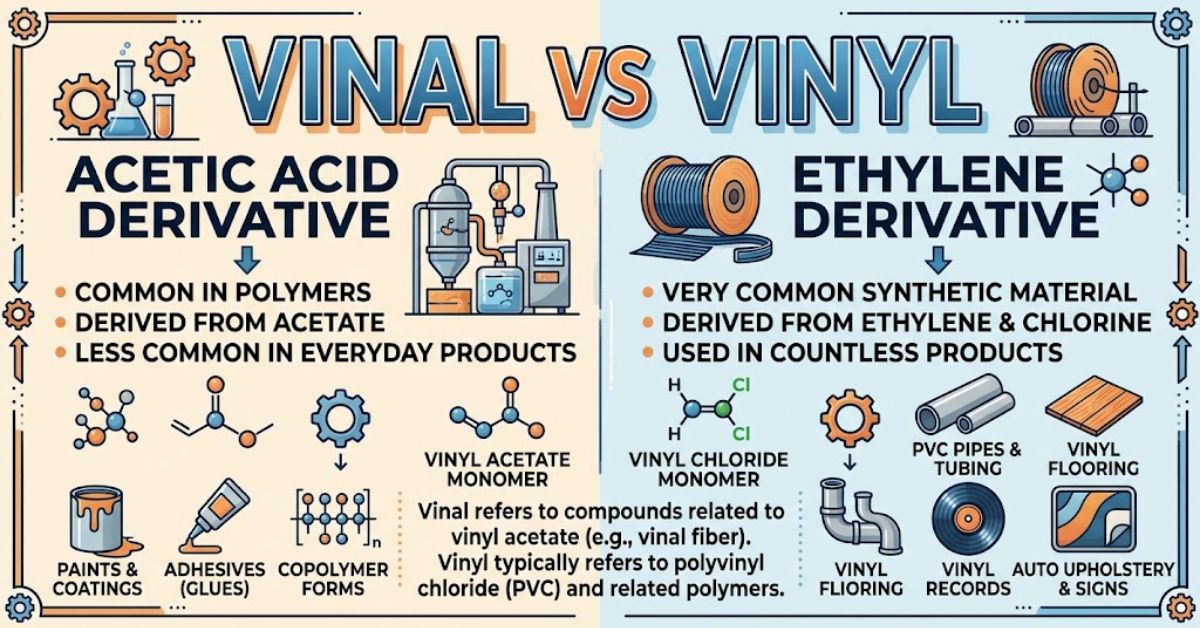
Vinyl is the correct spelling when you mean the common material used for flooring, siding, upholstery, stickers, decals, signs, and other products. It is also the standard word for records and music released on that format. Vinal, however, isn’t simply a misspelling in every possible context. It is a rare technical term for a type of synthetic fiber associated with vinyl alcohol units.
So, if you’re writing about vinyl flooring, vinyl records, vinyl siding, vinyl decals, or vinyl upholstery, use vinyl. If you’re reading specialized textile or materials literature, vinal may have its own specific meaning.
What Do Vinal and Vinyl Mean?
The difference between vinal vs vinyl comes down to both spelling and meaning.
Vinyl is the familiar everyday word. It can describe a strong plastic material and products made from it. It also refers to music records and the recording format associated with them.
Vinal is much less common. In technical textile terminology, it identifies a manufactured synthetic fiber whose fiber-forming substance contains a substantial amount of vinyl alcohol units. U.S. federal regulations also recognize vinal as a generic name for a particular manufactured fiber.
That distinction matters because one letter changes the word.
What Does Vinyl Mean?
Vinyl is a standard English noun with several connected uses.
In everyday writing, it commonly refers to a strong, flexible plastic used for products such as flooring, furniture, upholstery, clothing, signs, and other manufactured goods. It also refers to vinyl records or music recorded on vinyl.
Examples include:
- vinyl flooring
- vinyl siding
- vinyl upholstery
- vinyl stickers
- vinyl decals
- vinyl signs
- vinyl wraps
- vinyl records
- music on vinyl
In chemistry, vinyl also has a more specific meaning connected to the vinyl group. That technical meaning is broader than the way consumers normally use the word.
What Does Vinal Mean?
Vinal is a rare technical term for a synthetic fiber partly composed of vinyl alcohol units. Collins defines it as a type of synthetic fiber with this composition, while U.S. regulations provide a more detailed definition based on the polymer used to form the fiber.
You may encounter vinal in textile science, materials research, manufacturing references, or historical discussions of synthetic fibers.
That doesn’t make it an alternative spelling of vinyl. The two words have different meanings.
For ordinary writing, vinal flooring is almost certainly a spelling error if the writer means the familiar flooring material.
Why the Difference Matters
A one-letter spelling mistake can change the word you’re actually using.
Imagine a flooring company advertises “premium vinal flooring.” Most customers will understand the intended meaning. Still, the spelling looks incorrect and may make the business appear less careful.
The distinction matters in:
- Business websites
- Product descriptions
- School assignments
- Professional emails
- Construction documents
- Online advertisements
- Social media posts
- Academic writing
- Music discussions
There’s another reason to care. Since vinal is a legitimate technical term, spellcheck may not always identify it as an error. A dictionary can tell you that a word exists. It doesn’t always tell you whether that word belongs in your particular sentence.
The Core Rule
Use vinyl for ordinary materials, flooring, siding, upholstery, decals, signs, wraps, and music records. Use vinal only when you specifically mean the rare synthetic textile fiber or an established proper name.
A quick rule to remember:
Everyday material or music = vinyl.
Specialized textile fiber = vinal.
For most searches involving vinal vs vinyl, the intended word is vinyl.
How to Use Vinyl Correctly
Use Vinyl for Flooring
The standard expression is vinyl flooring.
Correct:
We installed waterproof vinyl flooring in the kitchen.
Incorrect for the ordinary flooring material:
We installed waterproof vinal flooring in the kitchen.
Vinyl flooring is a common use of the word in everyday English.
Use Vinyl for Music Records
Use vinyl record when referring to a physical music record associated with the vinyl format.
Correct:
I found an original vinyl record at the store.
You can also naturally say:
The album is available on vinyl.
The word vinyl is widely used for both the material and the record format.
Use Vinyl for Siding
The correct phrase is vinyl siding.
Correct:
The house has white vinyl siding.
Not:
The house has white vinal siding.
Here, vinyl identifies the material used for the siding.
Use Vinyl for Stickers, Decals, and Signs
Use vinyl in common product phrases such as:
- vinyl sticker
- vinyl decal
- vinyl lettering
- vinyl banner
- vinyl sign
- vinyl wrap
For example:
The business ordered a custom vinyl decal for its front window.
These phrases are natural because vinyl describes the material or product type.
Use Vinal Only in Its Specialized Meaning
Use vinal when the subject genuinely concerns the specialized synthetic fiber.
This can occur in:
- Textile science
- Fiber classification
- Materials research
- Manufacturing literature
- Historical textile references
- Technical documentation
The term has a documented technical definition. U.S. regulations describe vinal as a manufactured fiber based on long-chain synthetic polymers containing at least 50 percent vinyl alcohol units by weight, with additional composition requirements.
That is a very different meaning from everyday vinyl flooring or vinyl records.
Correct Examples of Vinyl
Here are natural examples across different situations:
- Conversation: “We’re putting vinyl flooring in the kitchen.”
- Music: “I finally found that album on vinyl.”
- Construction: “The contractor recommended vinyl siding.”
- Retail: “This design comes as a removable vinyl decal.”
- Business: “Please approve the vinyl lettering for the storefront.”
- Interior design: “The chairs have dark brown vinyl upholstery.”
- Automotive: “The company specializes in custom vinyl wraps.”
- Crafting: “Use permanent vinyl for the outdoor design.”
- Academic writing: “Vinyl compounds have important applications in polymer chemistry.”
- Product listing: “The banner is printed on durable vinyl.”
Notice the pattern. The spelling stays vinyl regardless of whether the context is casual, commercial, academic, or technical.
Incorrect vs Correct Examples
| Incorrect | Correct | Why |
|---|---|---|
| vinal flooring | vinyl flooring | Vinyl is the standard term for the common flooring material. |
| vinal records | vinyl records | The music format is called vinyl. |
| vinal siding | vinyl siding | Vinyl is the normal material term. |
| vinal sticker | vinyl sticker | The common product phrase uses vinyl. |
| vinal decal | vinyl decal | Vinyl decal is the established expression. |
| vinal lettering | vinyl lettering | Sign lettering commonly uses vinyl material. |
| vinal wrap | vinyl wrap | Surface and vehicle wraps commonly use vinyl. |
| vinal upholstery | vinyl upholstery | Upholstery made from this material is vinyl. |
| available on vinal | available on vinyl | Music is commonly described as being available on vinyl. |
| vynil record | vinyl record | Vynil is another misspelling. |
Why Do People Confuse Vinal and Vinyl?
The confusion is easy to understand. The words look almost identical, and vinyl doesn’t sound exactly like its spelling suggests to many learners.
Phonetic Similarity
The words vinal and vinyl look extremely similar and can be difficult to distinguish when heard quickly.
Cambridge lists the US and UK pronunciation of vinyl as /ˈvaɪ.nəl/.
Because the second syllable is unstressed, pronunciation doesn’t make the unusual spelling especially obvious.
The Y Does Not Sound Obvious
When people spell by sound, they may hear an ending that seems closer to -nal than -nyl.
That can produce:
vinal
instead of:
vinyl
English spelling often contains patterns that aren’t obvious from pronunciation alone. Learning VINYL as a complete visual form is therefore more reliable.
Familiar Spelling Patterns Cause Overgeneralization
English contains many familiar words ending in -al.
That pattern can make vinal look plausible at first glance. Someone who hasn’t seen vinyl written frequently may unconsciously replace the unusual y with a.
The mistake isn’t difficult to understand. It simply doesn’t produce the standard everyday spelling.
Autocomplete Is Not Perfect
Search engines and keyboards can often understand misspellings.
If you type vinal flooring, search results may still lead you toward pages about vinyl flooring. That doesn’t mean vinal is the correct spelling.
Autocomplete is designed to understand what you probably mean. It isn’t a grammar teacher.
Spellcheck Has Limits
Spellcheck can recognize many valid words without understanding your intended meaning.
Because vinal has a legitimate technical use, software may not always flag it. That creates an important lesson:
A word can be real and still be wrong for your sentence.
Always check meaning and context rather than relying on the red underline.
Translation and Second-Language Interference
English learners often spell unfamiliar words according to pronunciation or patterns from their first language.
That can make vinal seem more natural than vinyl when the word is heard rather than read.
The easiest solution is to memorize the complete form:
V-I-N-Y-L
Then connect it with familiar phrases such as vinyl flooring and vinyl records.
Common Mistakes Checklist
Before publishing, check these common errors:
- Writing vinal flooring instead of vinyl flooring
- Writing vinal records instead of vinyl records
- Treating vinal as the British spelling of vinyl
- Assuming vinal and vinyl are interchangeable
- Writing vynil instead of vinyl
- Trusting autocomplete as a spelling authority
- Assuming spellcheck understands your intended meaning
- Forgetting that vinal has a rare technical meaning
- Changing an official name spelled Vinal
- Treating vinyl and PVC as exact synonyms in technical writing
Vinal vs Vinyl in Real English
Grammatically Correct English
Vinyl works naturally as a noun and as a noun modifier.
Examples include:
vinyl flooring
vinyl siding
vinyl upholstery
vinyl record
vinyl decal
You can also say:
The album is available on vinyl.
These are standard, natural uses.
Grammatically Possible but Potentially Awkward English
The phrase “I bought a vinyl” can occur in informal music conversations. However, “I bought a vinyl record” is clearer when you’re referring to one individual record.
Likewise, vinyls can appear when people mean individual records or varieties of vinyl. Current dictionary evidence includes examples of this usage.
Still, in careful writing, vinyl record or records often sounds more natural.
Natural Everyday English
In ordinary conversation, people commonly say:
I collect vinyl.
It’s available on vinyl.
We need new vinyl flooring.
The house has vinyl siding.
Context usually tells the reader whether vinyl means the material or the music format.
Formal vs Informal Usage
The spelling vinyl does not change between formal and informal English.
Formal:
The facility uses commercial vinyl flooring.
Informal:
We’re putting vinyl in the kitchen.
Formal music writing may use vinyl record for precision.
Casual conversation may simply use:
I bought the album on vinyl.
The specialized word vinal belongs mainly in technical contexts where its specific fiber meaning is relevant.
Vinal vs Vinyl Comparison Table
| Feature | Vinal | Vinyl |
|---|---|---|
| Real word? | Yes, but rare | Yes, very common |
| Everyday word? | No | Yes |
| Flooring | No | Yes |
| Records | No | Yes |
| Siding | No | Yes |
| Decals | No | Yes |
| Upholstery | No | Yes |
| Technical textile meaning | Yes | Different meaning |
| Common spelling mistake? | Yes | No |
| US spelling | Not an alternative | Vinyl |
| UK spelling | Not an alternative | Vinyl |
| Main everyday choice | Usually not | Yes |
The Easiest Memory Trick
Remember:
VINYL keeps the Y.
A simple mental phrase makes it easier:
Why vinyl? Because vinyl has a Y.
You can also memorize the word visually:
V-I-N-Y-L
Don’t try to rebuild the spelling from its pronunciation every time.
Real-Life Situations
Job Interview
If you’re discussing sign production, say:
“I prepared vinyl lettering and decals for commercial clients.”
The standard spelling helps your professional communication look polished.
Business Meeting
For a flooring discussion:
“The vinyl option is easier to maintain.”
Here, vinyl clearly refers to the material.
Professional Email
A clear email might say:
“Could you confirm whether the vinyl flooring is available in light gray?”
Specific wording prevents unnecessary confusion.
Text Message
Casual writing still uses the same spelling:
“Found that album on vinyl today!”
Informal language doesn’t turn vinyl into vinal.
Exam
If an exam asks which spelling refers to the common material used for flooring and records, choose:
Vinyl
The spelling remains the same in academic English.
Expert Tips
Learn the Word as a Visual Unit
Don’t rely entirely on pronunciation.
Memorize:
V-I-N-Y-L
Then reinforce it with familiar phrases such as vinyl flooring, vinyl record, and vinyl siding.
Check Meaning, Not Just Spelling
If software accepts vinal, ask what you actually mean.
For example:
vinal fiber
may be correct in a specialized textile context.
But:
vinal kitchen flooring
almost certainly means vinyl kitchen flooring.
Context settles the question.
Pair Vinyl With Common Collocations
Learning complete phrases makes spelling easier.
Useful combinations include:
- vinyl flooring
- vinyl record
- vinyl siding
- vinyl decal
- vinyl sticker
- vinyl wrap
- vinyl upholstery
- vinyl tile
- vinyl banner
- vinyl lettering
- vinyl surface
- available on vinyl
- collect vinyl
Instead of memorizing one isolated word, remember the phrase you actually use.
Do Not Overcorrect Proper Names
Vinal can appear as a surname or part of an official name.
If a person’s legal name is Vinal, don’t change it to Vinyl simply because vinyl is the common English word.
Proper names follow their official spelling.
Be Precise With Vinyl and PVC
Vinyl and PVC are related, but they aren’t exact synonyms.
PVC stands for polyvinyl chloride, which is a specific polymer. Vinyl has broader chemical meanings and also has everyday meanings connected with materials and records.
For consumer writing, calling a product vinyl may be perfectly appropriate. In technical writing, however, specify PVC when the exact polymer matters.
This distinction prevents an otherwise simple spelling article from giving readers misleading chemistry information.
FAQ
Is Vinal a Real English Word?
Yes. Vinal is a rare technical term for a synthetic fiber associated with vinyl alcohol units.
Is It Vinal Flooring or Vinyl Flooring?
The correct phrase for the common flooring material is vinyl flooring.
Is It Vinal Records or Vinyl Records?
Use vinyl records when referring to music records.
How Do You Spell Vinyl?
The correct spelling is V-I-N-Y-L.
How Is Vinyl Pronounced?
In both US and UK English, Cambridge gives vinyl as /ˈvaɪ.nəl/.
Is Vinal the British Spelling of Vinyl?
No. Vinyl is the standard spelling in both American and British English.
Can Vinal Be a Person’s Name?
Yes. Vinal can occur as a proper name or surname. If it is someone’s official name, preserve that spelling.
Are Vinyl and PVC Exactly the Same Thing?
No. PVC means polyvinyl chloride, a specific polymer, while vinyl has broader chemical and everyday meanings.
Is Vynil Correct?
No. Vynil is a misspelling. The standard spelling is vinyl.
Is Vinyl Only Used for Records?
No. Vinyl also refers to materials used in flooring, siding, upholstery, decals, signs, furniture, clothing, and other products.
Should I Write Vinyl or Vinyls?
Use vinyl when referring generally to the material or music format. Vinyls can occur when referring to individual records or varieties, but vinyl records is often clearer in edited writing.
Mini Quiz
- Choose the correct phrase: vinal flooring or vinyl flooring?
Answer: Vinyl flooring. - Complete the sentence: “The album was released on ____.”
Answer: Vinyl. - Correct the sentence: “We ordered a vinal banner.”
Answer: “We ordered a vinyl banner.” - True or false: Vinal is never a real word.
Answer: False. It has a rare technical meaning. - Which spelling is correct for house siding?
A. vinal
B. vinyl
C. vinel
Answer: B. vinyl. - Complete the phrase: “She collects old ____ records.”
Answer: Vinyl. - Correct the sentence: “The shop makes custom vinal decals.”
Answer: “The shop makes custom vinyl decals.” - True or false: Vinal is the British spelling of vinyl.
Answer: False. - Which is clearest for one music disc?
A. a vinal
B. a vinyl record
C. a vynil
Answer: B. a vinyl record. - Which letter helps you remember the everyday spelling?
Answer: Y.
Quick Summary
Vinyl is the correct spelling for the familiar material used in flooring, siding, upholstery, stickers, decals, signs, wraps, and many other products. It is also the standard word for records and music released on that format.
Vinal is different. It is a rare technical term for a synthetic textile fiber associated with vinyl alcohol units, so saying that vinal is “never a word” is too broad.
The easiest rule is simple:
Everyday material or music → VINYL
Specialized synthetic textile fiber → VINAL
When you’re talking about flooring, records, siding, decals, upholstery, or similar everyday products, choose vinyl. And when spellcheck accepts vinal, don’t assume that makes it correct. Check the meaning first.

Finn Bradley is a grammar and language writer at Megazine Tech, focused on making English easier to understand. He researches grammar rules, vocabulary, sentence usage, punctuation, and common writing questions. Through clear explanations and practical examples, Finn helps readers build stronger communication skills and write with greater confidence in everyday situations.