

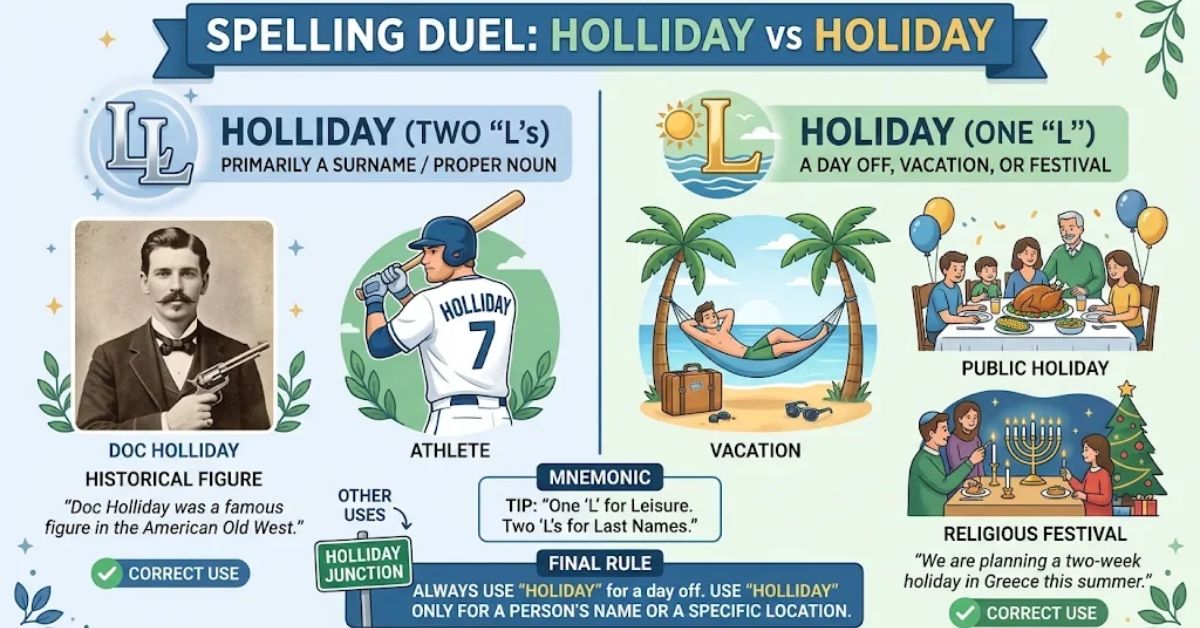
Holliday vs Holiday is a common spelling question that confuses many English learners and writers. Although both spellings look almost identical and sound the same, they have different uses. Understanding the difference can help you avoid spelling mistakes and improve your everyday writing.
Holiday is the correct English word used to describe a vacation, a public day off, or a special day of celebration. On the other hand, Holliday is generally used as a surname or proper name rather than a standard English word.
For example, you can write, “We are planning a holiday next week.” However, writing “We are planning a holliday next week” is incorrect.
This complete guide explains the difference between Holliday vs Holiday, including their meanings, origins, spelling rules, and everyday examples. You’ll also learn why people confuse these words and how to remember the correct spelling.
The Short Answer: Is It Holliday or Holiday?
In standard English, Holiday is the correct spelling when referring to a vacation, break, or special day. Holliday is generally a surname or proper name.
| Word | Meaning | Correct Usage |
|---|---|---|
| Holiday | Vacation or special day of celebration | Yes |
| Holliday | Surname or proper name | Only for names and places |
Correct Examples
- We are going on a holiday next week.
- Christmas is my favorite holiday.
- The office closes during the holiday season.
- My family is planning a summer holiday.
Incorrect Examples
- We are planning a holliday in Florida.
- I love the winter hollidays.
- I need a holliday after working all week.
Remember that Holliday is correct when referring to a person or place with that particular name.
What Does “Holiday” Mean?
The word holiday has several meanings depending on the context and the type of English being used.
It generally refers to a special day, a break from regular work or school, or a period spent relaxing and traveling.
Dictionary Definition
A holiday can mean:
- A day of celebration or religious observance.
- A day when businesses, schools, or government offices are closed.
- A period of leisure or vacation.
- Time away from regular work and responsibilities.
In simple words, a holiday is a special day or a break from your normal routine.
Different Types of Holidays
People celebrate different holidays throughout the year. Some last only one day, while others involve longer periods of celebration or relaxation.
Public Holidays
Public holidays are officially recognized days when government offices, schools, banks, and some businesses may close.
Examples include:
- Independence Day in the United States
- Canada Day
- Labor Day
- New Year’s Day
Religious Holidays
Religious holidays celebrate important events, traditions, and beliefs.
Examples include:
- Christmas
- Easter
- Eid al-Fitr
- Diwali
- Hanukkah
National Holidays
National holidays recognize important events, achievements, or historical moments in a country’s history.
Examples include:
- Bastille Day in France
- Australia Day
- Republic Day in India
- Pakistan Day in Pakistan
School Holidays
School holidays are scheduled breaks when students and teachers do not attend regular classes.
Examples include:
- Summer vacation
- Spring break
- Winter break
- Christmas holidays
Vacation Holidays
In British English, holiday commonly refers to a vacation or a trip away from home.
For example:
“We went on holiday to Spain last summer.”
Holiday in British and American English
Another reason people become confused is that the word holiday has slightly different meanings in different English-speaking countries.
| Country | Common Meaning |
|---|---|
| United States | Special day or celebration |
| United Kingdom | Vacation or special day |
| Australia | Vacation or public holiday |
| Canada | Both meanings are common |
Example in American English
“Thanksgiving is a national holiday.”
In American English, holiday usually refers to a special celebration or officially recognized day.
Example in British English
“We are going on holiday next month.”
In British English, holiday commonly means taking a vacation or traveling somewhere for relaxation.
Both uses are correct. The meaning depends on the context, not the spelling.
What Does “Holliday” Mean?
Unlike holiday, Holliday is not a standard English word used to describe a vacation or day off.
Instead, it is mainly recognized as a surname or proper name.
Examples include:
- Doc Holliday
- Matt Holliday
- Holliday Street
- Holliday Park
For example:
“Doc Holliday was a famous figure of the American Old West.”
Here, Holliday is correct because it is a person’s surname.
However, writing “I am taking a holliday next week” is incorrect because the sentence requires the common noun holiday.
The History of the Surname Holliday
The surname Holliday has historical connections to English naming traditions. It is related to older forms of the word holiday and expressions associated with holy days.
Historically, surnames could develop from religious celebrations, personal nicknames, occupations, and family traditions.
Over time, different spelling variations became established as family names.
Some historical variations include:
- Holiday
- Holliday
- Holyday
- Halliday
These spellings may appear in historical records and family names. However, they are not interchangeable when writing about a vacation.
Famous People Named Holliday
Several well-known people have carried the surname Holliday.
Doc Holliday
Doc Holliday was a famous American gambler, dentist, and gunslinger associated with the American Old West. He participated in the Gunfight at the O.K. Corral in 1881 and remains a recognizable historical figure.
Matt Holliday
Matt Holliday is a former professional baseball player who played in Major League Baseball. He was selected for seven All-Star games during his career.
Judy Holliday
Judy Holliday was an American actress and comedian. She won the Academy Award for Best Actress in 1951 for her performance in the film Born Yesterday.
These examples explain why people frequently encounter the spelling Holliday and sometimes assume it is another accepted spelling of holiday.
Why Do People Confuse Holliday and Holiday?
Although the difference is simple, several factors make these spellings confusing.
They Sound Almost Identical
Both words are generally pronounced the same way:
HOL-ih-day
Because there is no noticeable pronunciation difference, people may struggle to remember which spelling is correct.
English has many similar spelling and pronunciation problems, including:
- Their and there
- To and too
- Principal and principle
- Your and you’re
- Holliday and holiday
Names Appear Everywhere
People regularly encounter surnames such as Doc Holliday and Matt Holliday.
Seeing these names repeatedly can make the double-L spelling look acceptable when writing the common noun.
However, a correct surname does not automatically become a correct alternative spelling of another word.
Typing Errors
Fast typing is another common reason for this mistake.
Someone may accidentally type an additional L without noticing it. Since Holliday is a legitimate surname, some spelling tools may not identify it as incorrect.
Social Media and Informal Writing
Social media posts, comments, and text messages often contain spelling mistakes.
When people repeatedly see an incorrect spelling, they may begin to assume that it is acceptable.
This is one reason proofreading remains important, even when writing short and informal messages.
Is Holliday Ever Correct in Standard English?
Yes. Holliday can be correct when it is used as a surname, place name, or another proper name.
The important thing is understanding the context.
Correct Uses
- Doc Holliday was a famous historical figure.
- I visited Holliday Park last weekend.
- Mrs. Holliday teaches English.
- Matt Holliday played professional baseball.
Incorrect Uses
- Happy Holliday!
- Summer Hollidays are fun.
- We are planning a Holliday.
- I need a relaxing holliday.
In these sentences, holiday is the correct spelling because the word refers to a celebration, vacation, or break.
Quick Comparison Table
| Feature | Holiday | Holliday |
|---|---|---|
| Part of speech | Common noun | Proper noun |
| Means vacation | Yes | No |
| Means special day | Yes | No |
| Used in everyday writing | Yes | Only for names |
| Family name | Sometimes | Yes |
| Capitalized | Depending on sentence | Always |
The Origin of the Word Holiday
The word holiday has an interesting history connected to religious traditions.
It comes from the Old English expression hāligdæg, meaning holy day.
Originally, people used this expression to describe religious festivals and special days dedicated to religious observances.
Over time, the expression developed into the modern English word holiday.
Today, its meaning has expanded beyond religious celebrations. It can describe public holidays, school breaks, vacations, and other periods of rest.
Timeline of the Word Holiday
| Period | Meaning |
|---|---|
| Old English | Religious feast day |
| Middle English | Church celebration |
| 1700s | Day of rest |
| 1800s | Public celebration and leisure |
| Modern English | Vacation or special day |
This historical development explains why many holidays still have religious origins.
Examples include Christmas, Easter, and Good Friday.
However, modern holidays also include cultural, national, and secular celebrations.
Holiday Around the World
Different countries celebrate different holidays according to their traditions, cultures, and histories.
Here are some examples:
| Country | Major Holiday |
|---|---|
| United States | Thanksgiving |
| United Kingdom | Boxing Day |
| India | Diwali |
| China | Lunar New Year |
| Pakistan | Eid al-Fitr |
| France | Bastille Day |
| Australia | Australia Day |
Although celebrations differ across cultures, the general idea remains similar. A holiday marks a special occasion, celebration, or break from normal activities.
Common Mistakes Writers Make
Understanding common spelling mistakes can help you improve your English writing.
Adding an Extra L
This is the most common mistake when comparing holiday and Holliday.
Incorrect: I need a holliday after work.
Correct: I need a holiday after work.
Always remember that the standard word holiday contains only one L.
Capitalizing Holiday Incorrectly
The word holiday is generally written in lowercase unless it appears at the beginning of a sentence or as part of a proper name.
Correct: We traveled during the holiday season.
Incorrect: We traveled during the Holiday season.
However, the names of specific holidays should be capitalized.
Examples:
- Christmas
- Thanksgiving
- Memorial Day
- Independence Day
Assuming Both Spellings Are Acceptable
Some people believe holiday and Holliday are regional spelling variations.
This is incorrect.
English does have regional spelling differences, such as:
- Color and colour
- Center and centre
- Favorite and favourite
However, Holiday and Holliday are not interchangeable spelling variations.
A Simple Trick to Remember the Correct Spelling
Remembering the difference becomes easier when you use a simple spelling rule.
Think of “Holy Day”
The word holiday originally came from the expression holy day.
You can remember it this way:
Holy + Day = Holiday
Notice that holy contains only one L. Therefore, holiday also contains only one L.
Whenever you write about a vacation or special day, use holiday.
Remember the Name Rule
Holliday is commonly found in surnames and proper names.
For example:
- Doc Holliday
- Matt Holliday
- Holliday Park
A simple way to remember the difference is:
One L for a holiday, two Ls for Holliday as a name.
This small trick can help you avoid the spelling mistake in everyday writing.
Examples of Holiday in Everyday English
Here are some practical examples showing how to use holiday correctly in different situations.
In Business
“The company closes during the holiday season.”
In Education
“Students return to school after the winter holiday.”
In Travel
“We booked our summer holiday several months in advance.”
In Greeting Cards
“Happy holidays and best wishes to you and your family.”
These examples show that holiday is the appropriate spelling when discussing celebrations, vacations, and breaks.
Examples of Holliday in Real Life
Holliday can also appear in different situations when it is used as a proper name.
Person
“Doc Holliday became a legendary figure of the American West.”
Place
“We spent the afternoon at Holliday Park.”
Family Name
“Sarah Holliday published a new book.”
In each example, Holliday identifies a person or place rather than describing a vacation.
Case Study: Why Search Engines Show Both Spellings
When searching online, people often type phrases such as:
- Holliday meaning
- Holliday vs Holiday
- How to spell holiday
- Is Holliday correct?
Search engines may display results for both spellings because people frequently make spelling mistakes or search for specific names.
They also try to understand what users actually want to find.
For example, someone searching for “Holliday meaning” might be looking for the surname’s history rather than the meaning of the common word holiday.
This is why search results can include information about both spellings.
Similar spelling searches include:
- Receive vs recieve
- Separate vs seperate
- Definitely vs definately
- Proving vs prooving
Even when an incorrect spelling receives thousands of searches, that does not make it grammatically correct.
Holiday vs Holliday: Side-by-Side Comparison
The following table summarizes the main differences.
| Feature | Holiday | Holliday |
|---|---|---|
| Standard English word | Yes | No |
| Refers to vacation | Yes | No |
| Refers to a special day | Yes | No |
| Used as a surname | Sometimes | Yes |
| Used as a place name | Sometimes | Yes |
| Spelling | One L | Two Ls |
| Common usage | Everyday English | Proper names |
Common Sentences and Correct Spellings
Review these examples to understand which spelling belongs in each sentence.
| Incorrect or Correct | Correct Version |
|---|---|
| Merry Hollidays! | Merry Holidays! |
| I need a Holliday. | I need a holiday. |
| Doc Holiday was famous. | Doc Holliday was famous. |
| We enjoyed our holliday in Italy. | We enjoyed our holiday in Italy. |
| Christmas is my favorite holiday. | Correct |
| Mrs. Holliday is my teacher. | Correct |
Pay attention to the meaning of each sentence. If you are talking about a vacation or celebration, choose holiday. If you are writing someone’s actual surname, use the spelling they carry.
How to Avoid This Mistake Forever
You can improve your spelling accuracy by following a few simple habits.
Read Slowly
Take a moment to review your sentences before submitting an assignment, sending an email, or publishing an article.
Slow proofreading helps you notice additional letters and other common spelling errors.
Use Spell-Check
Modern spelling tools can identify many mistakes.
However, they may not recognize an incorrect word when it is also a valid surname. Always check the meaning and context.
Learn the Origin
Remembering that holiday comes from holy day makes the correct spelling easier to understand.
Memorize One Rule
Keep this simple rule in mind:
- Holiday = Vacation or special day.
- Holliday = Surname or proper name.
Once you understand this distinction, choosing the correct spelling becomes much easier.
5 FAQs About Holliday vs Holiday
1. Is Holliday the correct spelling?
No, Holliday is generally not the correct spelling when referring to a vacation, day off, or special celebration. The correct English word is holiday, with one L. However, Holliday is correct when used as a person’s surname or a proper name.
2. What does Holiday mean?
Holiday refers to a period when people take time away from work or school. It can also describe a special day associated with a celebration, tradition, or religious event. For example, “We’re going on holiday next week.”
3. Is Holliday a misspelling of Holiday?
In most everyday sentences, Holliday is a misspelling of holiday. However, it is not always incorrect because Holliday is also an established surname. The intended meaning determines which spelling you should use.
4. How do you remember the correct spelling?
A simple way to remember the spelling is to connect holiday with the expression holy day. Both holiday and holy contain one L. Use holiday when discussing vacations, celebrations, or days off.
5. Which is correct: Holliday or Holiday?
Holiday is correct when referring to a vacation, break, or special day. Holliday should only be used when referring to a proper name, such as Doc Holliday or a place called Holliday Park.
Conclusion
The main difference between Holliday vs Holiday is their meaning and usage. Holiday is the standard English spelling for a vacation, break, public holiday, or special celebration. Holliday, on the other hand, is generally used as a surname or proper name.
For example, you can correctly write, “I’m planning a holiday with my family.” However, if you’re discussing the famous historical figure Doc Holliday, the double-L spelling is necessary.
The easiest way to remember this difference is simple: Holiday means a vacation or special day, while Holliday usually refers to a name. Keep this rule in mind whenever you write, and you’ll avoid this common spelling mistake.

Finn Bradley is a grammar and language writer at Megazine Tech, focused on making English easier to understand. He researches grammar rules, vocabulary, sentence usage, punctuation, and common writing questions. Through clear explanations and practical examples, Finn helps readers build stronger communication skills and write with greater confidence in everyday situations.