

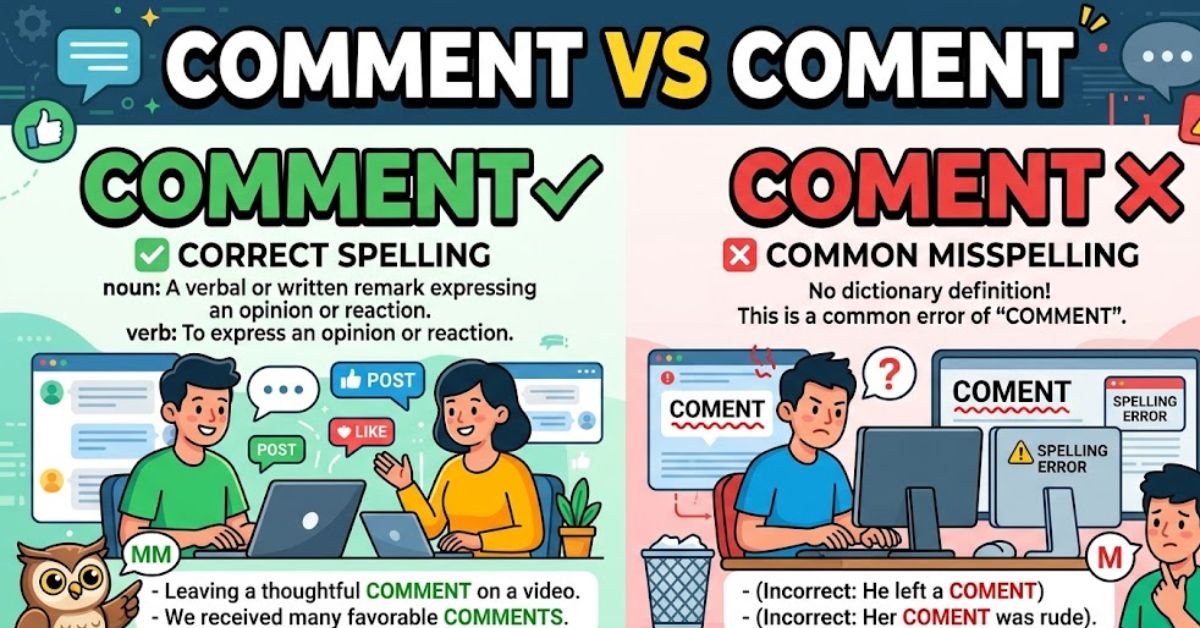
Comment is the correct spelling in standard English. Coment is a misspelling when you mean a remark, opinion, observation, or response.
The main difference is simple: comment has two m’s.
You can use comment as both a noun and a verb:
- Noun: She made a helpful comment.
- Verb: He decided to comment on the issue.
The same spelling remains in comments, commented, and commenting. Whether you are writing an email, school assignment, social media post, report, or text message, use comment, not coment.
What Is Comment?
Comment is an English word that refers to a spoken or written remark, opinion, observation, reaction, or explanation.
As a noun, it can describe something someone says or writes about a subject.
Her comment was very helpful.
As a verb, comment means to express an opinion or make a remark about something.
The teacher commented on my essay.
The word is common in everyday English and professional communication. It also appears frequently in online discussions, websites, news reporting, academic writing, and software development.
A useful point is that a comment does not have to be positive. It can be positive, negative, neutral, critical, humorous, or simply informative.
Why Correct Spelling Matters
Correct spelling makes your writing easier to understand and helps you appear careful and professional.
Writing coment instead of comment can make an otherwise good sentence look careless. This matters especially in:
- Job applications
- Emails
- School assignments
- Academic papers
- Business reports
- Website content
- Social media posts
- Professional messages
Spelling mistakes can also interrupt the reader. When a familiar word suddenly looks unusual, the reader may pause to figure out whether it is intentional.
The good news is that this mistake is easy to prevent. Remember one simple fact:
Comment always contains two m’s.
The Core Rule
The core spelling rule is straightforward:
Correct: comment
Incorrect: coment
The word is spelled:
C O M M E N T
The second m is not optional. You should keep both m’s when using the base word and its common forms.
| Form | Correct spelling |
|---|---|
| Base word | comment |
| Plural | comments |
| Past tense | commented |
| Present participle | commenting |
For example:
- I left a comment.
- Several people posted comments.
- She commented on the article.
- He is commenting on the discussion.
How to Use Comment Correctly
Comment as a Noun
As a noun, comment means a remark, opinion, observation, or response.
Examples:
- Your comment was helpful.
- She made an interesting comment about the book.
- I received several comments on my essay.
- His comment surprised everyone.
The noun can refer to something spoken or written. Online, it often means a written response posted beneath an article, video, photograph, or social media post.
Comment as a Verb
As a verb, comment means to express an opinion or make a remark.
Examples:
- She commented on the new policy.
- The manager refused to comment.
- He commented on my presentation.
- The teacher commented that the answer was incomplete.
The pattern comment on is especially common when you are talking about a particular topic.
For example:
Natural: She commented on the report.
Less natural in many contexts: She commented the report.
The verb usually does not take a direct object in the same way as verbs such as write or read. Instead, comment on something is one of the safest patterns to learn.
Comment, Comments, Commented, and Commenting
The double m remains in the common forms of the word.
| Word | Use | Example |
|---|---|---|
| comment | Base form | Please comment on the idea. |
| comments | Plural noun or third-person verb | Her comments were useful. |
| commented | Past tense | He commented on the issue. |
| commenting | Present participle | She is commenting on the post. |
Avoid these misspellings:
- ❌ coment
- ❌ coments
- ❌ comented
- ❌ comenting
Use:
- ✅ comment
- ✅ comments
- ✅ commented
- ✅ commenting
Correct Examples of Comment
Conversation
You can use comment in ordinary spoken conversation.
- “That was an interesting comment.”
- “I don’t want to comment on that.”
- “She made a funny comment during lunch.”
Comment is common in workplace and personal emails.
- “I have one comment about the proposal.”
- “Please send your comments before Friday.”
- “Could you comment on the attached draft?”
School
Students and teachers frequently use comment when discussing assignments.
- “The teacher left a helpful comment.”
- “Please comment on the reading.”
- “I received several comments on my essay.”
Workplace
In professional communication, comment can refer to an observation, opinion, or response.
- “The manager commented on the latest results.”
- “Do you have any comments about the proposal?”
- “The company declined to comment.”
Social Media
Online, a comment is often a written response to another person’s post or content.
- “I left a comment on her photo.”
- “The video received hundreds of comments.”
- “Please comment below and share your opinion.”
Academic Writing
In academic contexts, comment can refer to an observation, explanation, or critical response.
- “The researcher commented on the limitations of the study.”
- “The professor provided detailed comments on the paper.”
- “Students were asked to comment on the findings.”
Incorrect vs. Correct
Here are some common examples:
| Incorrect | Correct |
|---|---|
| Please leave a coment. | Please leave a comment. |
| She made a helpful coment. | She made a helpful comment. |
| He comented on the report. | He commented on the report. |
| I read all the coments. | I read all the comments. |
| She is comenting on the post. | She is commenting on the post. |
The problem in every incorrect example is the missing second m.
Why People Write Coment Instead of Comment

The misspelling coment is understandable because the two spellings look almost identical. Several factors can cause people to leave out the second m.
The Double Letter Is Easy to Miss
Double consonants can be visually easy to overlook, particularly when typing quickly.
The difference between these forms is only one letter:
comment
coment
Because the words look so similar, the missing m can go unnoticed during proofreading.
Pronunciation Does Not Clearly Reveal Two M’s
Spelling cannot always be predicted from pronunciation.
When people say comment naturally, the two m’s do not sound like two clearly separated consonants. The sound flows together.
As a result, someone who relies heavily on pronunciation may remember only one m.
Spelling by Sound
English spelling often creates problems for learners because letters and sounds do not always match perfectly.
A person may hear the word and think:
“I hear one m, so I will write one m.”
That strategy does not work reliably here. The correct written form is comment, regardless of how clearly the double letter is heard.
Spelling Overlap With Other Words
English contains many words with single and double consonants. Writers may unconsciously apply a spelling pattern from another word.
This is why learning the complete spelling is often more useful than trying to create a rule for every individual word.
Autocomplete and Spellcheck Have Limits
Spellcheck tools are useful, but they should not replace basic spelling knowledge.
A tool may catch coment after you type it. However, autocorrect can behave differently across applications, languages, and devices.
If you know that comment has two m’s, you can catch the mistake yourself.
Translation Interference
People who use more than one language may sometimes transfer spelling patterns from another language.
This can be especially noticeable when a word looks familiar across languages but follows a different spelling convention.
When writing English, rely on the standard English spelling:
comment
Common Mistakes Checklist
Before submitting your writing, check these points:
- Did I spell comment with two m’s?
- Did I write comments, not coments?
- Did I write commented, not comented?
- Did I write commenting, not comenting?
- Did I use comment on where appropriate?
- Did I accidentally write coment while typing quickly?
- Did I confuse comment with commend?
- Did I proofread the final version?
A quick visual check can prevent this entire spelling mistake.
Comment vs Coment in Real English
Grammatically Correct
Comment is grammatically correct as both a noun and a verb.
Examples:
- “That was a useful comment.”
- “She commented on the report.”
- “I read the comments.”
- “He is commenting on the discussion.”
Possible but Unnatural
Some constructions may be grammatically understandable but sound less natural than common alternatives.
For example:
“She made a comment about the problem.”
This is correct.
However, depending on context, a shorter sentence may sound more natural:
“She commented on the problem.”
Choosing natural word patterns helps your English sound fluent rather than merely understandable.
Natural Everyday English
Some common patterns are:
- make a comment
- leave a comment
- post a comment
- read the comments
- comment on something
- comment about something
- comment that something happened
- refuse to comment
Learning these common combinations can make the word easier to use correctly.
American vs. British English
There is no spelling difference between American and British English for comment.
Both varieties use:
comment
The pronunciation may vary slightly between accents, but the spelling remains the same.
So you should not write coment as a British variant. It is not an alternative regional spelling.
Formal vs. Informal Usage
Informal
Comment is completely normal in casual communication.
Examples:
- “Leave a comment below.”
- “What do you think? Comment here.”
- “I saw your comment.”
Formal and Professional
The word is also appropriate in formal and professional English.
Examples:
- “The committee declined to comment.”
- “Please provide your comments on the proposal.”
- “The researcher commented on the limitations of the study.”
The word itself is neutral. Its level of formality depends more on the surrounding sentence and context.
Comment vs Coment Comparison Table
| Feature | Comment | Coment |
|---|---|---|
| Correct English spelling | Yes | No |
| Standard English word | Yes | No |
| Number of m’s | Two | One |
| Noun | Yes | No |
| Verb | Yes | No |
| Plural | comments | coments is incorrect |
| Past tense | commented | comented is incorrect |
| Present participle | commenting | comenting is incorrect |
| Formal writing | Appropriate | Avoid |
| Social media | Appropriate | Misspelling |
| Academic writing | Appropriate | Avoid |
The key difference is simple: comment is the standard English word; coment is a spelling error.
Comment vs Commend
Comment and commend are different words with different meanings.
Comment means to make a remark or express an opinion.
She commented on the presentation.
Commend means to praise someone or officially recognize something as good.
The manager commended her for her hard work.
A useful way to remember the difference is:
- Comment = say something
- Commend = praise someone
Do not replace one with the other.
Memory Trick
Use this simple memory trick:
Com + ment = comment
Remember the double m in the middle.
Another trick is to associate the word with a familiar online action:
Comment = C + O + M + M + E + N + T
When you type comment, deliberately notice the two m’s.
If you remember only one thing from this article, remember:
Comment has two m’s. Coment does not.
Real-Life Situations
Interview
If an interviewer asks for your opinion, you might say:
“I’d like to comment on my experience with the project.”
Meeting
During a meeting, you could say:
“I have one comment about the proposed schedule.”
A professional email might say:
“Please review the document and send your comments.”
Text Message
In a casual message, someone might write:
“Did you see my comment?”
Exam
In a school or language exam, always use the standard spelling:
“The student made an important comment about the story.”
Expert Tips
1. Learn the Whole Word, Not Just the Rule
Instead of asking whether a double letter sounds necessary, memorize the complete spelling:
comment
Visual familiarity makes spelling faster over time.
2. Check the Base Word Before Adding Endings
Start with comment.
Then add the appropriate ending:
- comment + s = comments
- comment + ed = commented
- comment + ing = commenting
The double m remains part of the base word.
3. Learn Common Word Partnerships
Learning phrases is often easier than learning isolated vocabulary.
Useful combinations include:
- make a comment
- leave a comment
- post a comment
- write a comment
- receive comments
- comment on a topic
- comment on a report
- refuse to comment
These patterns also help you use the word naturally.
4. Do Not Treat Every Search Result as Proof of Correctness
You may see coment online because people make spelling mistakes.
A misspelling appearing on websites, social media, or comments does not make it a valid English spelling.
For spelling questions, reliable dictionaries and established language references are better evidence than random search results.
5. Be Careful With Names and Historical Forms
A word that resembles coment could theoretically appear as part of a proper name, username, brand, or non-English expression.
That does not make coment an alternative English spelling of comment.
For ordinary modern English, use comment.
6. Use “Comment on” When You Need a Safe Verb Pattern
If you are unsure how to structure the verb, comment on is a reliable choice.
Examples:
- comment on the issue
- comment on the report
- comment on the decision
- comment on the results
This pattern is especially useful in professional and academic writing. Major dictionary references also list comment on/upon something as a standard construction.
Quick Summary
Here is the answer in the simplest possible form:
Comment is correct. Coment is incorrect.
Use comment as a noun when you mean a remark, opinion, observation, or response.
She made a helpful comment.
Use comment as a verb when you mean to express an opinion or make a remark.
She commented on the proposal.
Remember the related forms:
- comment
- comments
- commented
- commenting
All keep the double m.
There is no American versus British spelling difference here. Both varieties use comment.
FAQ
Is comment or coment correct?
Comment is correct. Coment is a misspelling in standard English.
Is coment an English word?
Coment is not the standard English spelling of the word meaning a remark or opinion.
How do you spell comment correctly?
Spell it C-O-M-M-E-N-T. The word contains two consecutive m’s.
Why does comment have two m’s?
The standard spelling of the English word is comment, so the double m is part of the established word form. Pronunciation may make the second m easy to overlook.
Is it comments or coments?
The correct plural is comments, with two m’s in the base word.
Is it commented or comented?
The correct past tense is commented, with the original double m retained.
Is it commenting or comenting?
The correct form is commenting, which keeps both m’s from the base word.
Is comment a noun or a verb?
Comment is both a noun and a verb. As a noun, it means a remark or observation. As a verb, it means to express an opinion or make a remark.
Should I say comment on or comment about?
Comment on is a very common and safe pattern, especially for specific topics. Comment about is also possible in certain contexts.
Is comment spelled differently in British English?
No. Comment has the same spelling in American and British English.
What is the difference between comment and commend?
Comment means to make a remark or express an opinion. Commend means to praise or formally recognize someone.
Can comment mean something other than an online reply?
Yes. A comment can be a spoken remark, written opinion, observation, criticism, explanation, or online response. It is not limited to social media.
Conclusion
When choosing between comment vs coment, the answer is clear: comment is the correct standard English spelling.
The easiest rule is to remember the two m’s:
C-O-M-M-E-N-T
The word works as both a noun and a verb. You can make a comment, leave comments, commented on a topic, or keep commenting during a discussion.
The misspelling coment usually happens because the second m is easy to overlook when people type quickly or spell the word by sound. Once you recognize the pattern, the mistake becomes much easier to avoid.
Whether you are writing a school assignment, professional email, academic paper, social media post, or everyday message, use comment with confidence.

Finn Bradley is a grammar and language writer at Megazine Tech, focused on making English easier to understand. He researches grammar rules, vocabulary, sentence usage, punctuation, and common writing questions. Through clear explanations and practical examples, Finn helps readers build stronger communication skills and write with greater confidence in everyday situations.