

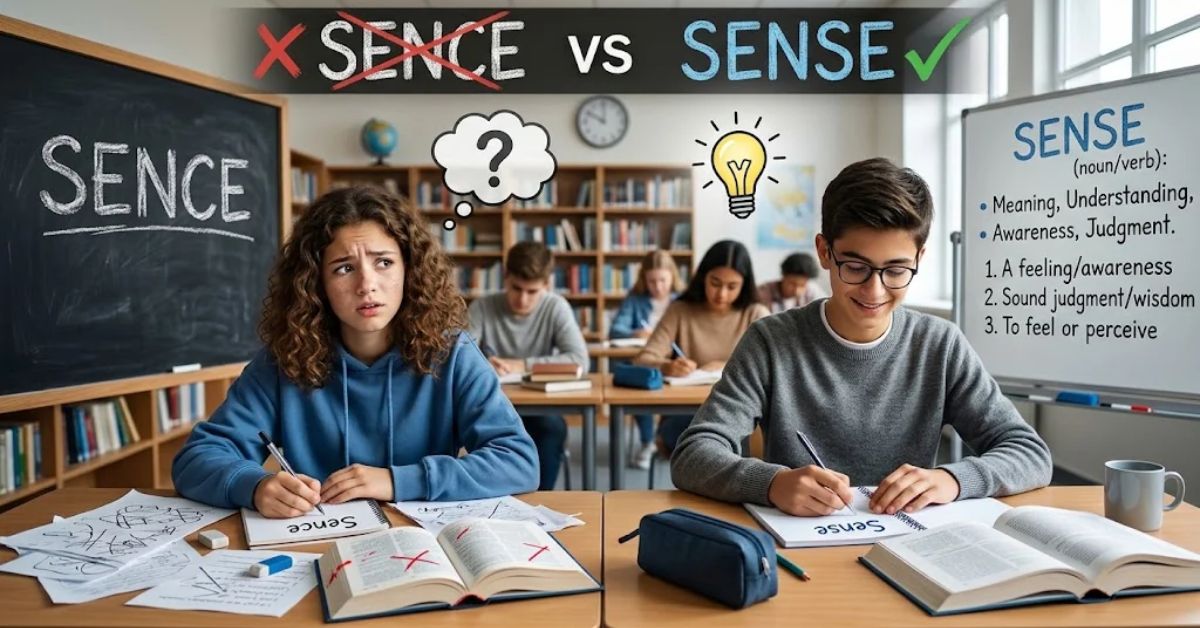
When comparing Sence vs Sense, many people wonder which spelling is correct. Both words sound almost identical, but only one is accepted in standard English.
Sense is the correct spelling, while Sence is a common misspelling. The word sense can refer to understanding, awareness, good judgment, feelings, or the five physical senses.
In this guide, you’ll learn the meaning of sense, why people mistakenly write sence, and how to use the correct word in everyday conversations and formal writing.
Quick Answer: Sence vs Sense
| Word | Correct? | Meaning |
|---|---|---|
| Sense | Yes | Understanding, awareness, judgment, or physical perception |
| Sence | No | Common misspelling of sense |
If you’re writing an email, essay, article, or social media post, always use sense.
Is “Sence” a Real Word?
In modern standard English, sence is not an accepted spelling. It is generally considered a spelling mistake.
You should avoid using sence in:
- Academic assignments
- Professional emails
- Business documents
- Blog posts and articles
- Everyday written communication
Readers will usually recognize it as an incorrect spelling of sense.
What Does “Sense” Mean?
The word sense has several meanings. It generally refers to the ability to understand, recognize, or experience something.
Depending on the context, it can mean:
- Understanding
- Good judgment
- Awareness
- Feelings
- Physical perception
Sense as Understanding
Sense can describe something logical or easy to understand.
Examples:
- Your explanation makes sense.
- The instructions didn’t make any sense.
- Suddenly, everything made sense.
Sense as Good Judgment
Sense can also refer to practical wisdom and the ability to make good decisions.
Examples:
- She has excellent business sense.
- He showed common sense during the emergency.
- My grandmother always gives sensible advice.
Sense as One of the Five Senses
The word sense also describes the physical abilities people use to experience the world.
| Sense | Function |
|---|---|
| Sight | Seeing |
| Hearing | Listening |
| Smell | Detecting odors |
| Taste | Recognizing flavors |
| Touch | Feeling physical contact |
Examples:
- Dogs have an incredible sense of smell.
- Her sense of hearing is excellent.
- My sense of taste improved after recovering from a cold.
Sense as a Feeling or Awareness
Sometimes, sense describes an instinctive feeling or awareness.
Examples:
- I had a sense that something was wrong.
- There was a sense of excitement in the room.
- She sensed danger immediately.
Why Do People Write “Sence” Instead of “Sense”?
The main reason is pronunciation. Sense and sence sound almost identical when spoken.
People sometimes confuse the spelling because several English words have similar endings, including:
- Fence
- Dense
- Hence
- Presence
However, similar pronunciation doesn’t mean words follow the same spelling pattern.
Remember that sense is the only correct spelling for the standard English word.
The History of the Word “Sense”
The word sense comes from the Latin word sensus, meaning feeling, perception, or understanding.
It later passed through Old French before becoming part of Middle English.
| Language | Word |
|---|---|
| Latin | Sensus |
| Old French | Sens |
| Middle English | Sense |
| Modern English | Sense |
Its historical roots help explain why the correct spelling contains an S.
How to Remember the Correct Spelling of Sense
Here are three simple tricks to remember the correct spelling.
Trick One: Think About the Five Senses
Remember the five physical senses:
- Sight
- Smell
- Hearing
- Taste
- Touch
This association can help you remember the correct word.
Trick Two: Memorize “Makes Sense”
Think of the familiar expression:
“That makes sense.”
Remembering this phrase makes it easier to recognize the correct spelling.
Trick Three: Remember the Latin Root
The Latin word sensus contains an S. This can help you remember that sense is spelled with an S rather than a C.
Examples of Sense in Sentences
Here are some everyday examples showing how to use sense correctly.
Understanding:
- This explanation finally makes sense.
- Your answer makes perfect sense.
Judgment:
- She has excellent business sense.
- He used common sense during the crisis.
Feeling:
- I had a strange sense of fear.
- There was a sense of calm in the room.
Physical Ability:
- My sense of smell returned after my cold.
- Cats have a strong sense of hearing.
Common Phrases That Use the Word Sense
English has many familiar expressions containing the word sense.
Common Sense
Means practical judgment or the ability to make sensible decisions.
Example: Common sense tells us not to touch a hot stove.
Sense of Humor
Means the ability to enjoy or understand funny things.
Example: She has a wonderful sense of humor.
Sense of Direction
Means the ability to find your way around.
Example: I have no sense of direction and often get lost.
Sense of Purpose
Means having clear goals or direction in life.
Example: Volunteering gave him a new sense of purpose.
Make Sense
Means something is logical or understandable.
Example: Your explanation makes complete sense.
In a Sense
Means in one way or to some degree.
Example: In a sense, we’re all teachers because we share knowledge.
Sense as a Noun and a Verb
The word sense can function as both a noun and a verb.
Sense as a Noun
Examples:
- She has a good sense of humor.
- I lost my sense of taste.
- He has a strong sense of responsibility.
Sense as a Verb
Examples:
- I sense danger.
- He sensed that something was wrong.
- Animals can sense changes in their surroundings.
Synonyms of Sense
The synonyms of sense depend on its meaning and context.
| Meaning | Synonyms |
|---|---|
| Understanding | Logic, reason, meaning |
| Awareness | Perception, consciousness, recognition |
| Judgment | Wisdom, prudence, insight |
| Feeling | Emotion, instinct, intuition |
Antonyms of Sense
Depending on the context, opposite words include:
- Nonsense
- Foolishness
- Ignorance
- Irrationality
- Absurdity
Example: Spending your entire paycheck in one day makes no sense.
Common Mistakes to Avoid
Here are some incorrect and correct examples.
| Incorrect | Correct |
|---|---|
| This doesn’t make sence. | This doesn’t make sense. |
| I have a good sence of humor. | I have a good sense of humor. |
| Her sence of direction is terrible. | Her sense of direction is terrible. |
| That makes no sence. | That makes no sense. |
Always use sense when you mean understanding, awareness, judgment, or perception.
Why Spell Checkers Flag “Sence”
Most modern spell-checking tools recognize sence as an incorrect spelling because it isn’t a standard English word.
Tools such as Microsoft Word, Google Docs, and Grammarly may suggest sense as the correct replacement.
However, spell checkers aren’t perfect. It’s still important to understand the difference and proofread your writing.
Words Commonly Confused With Sense
Here are some other spelling mistakes that English learners commonly make.
| Correct Spelling | Incorrect Spelling |
|---|---|
| Sense | Sence |
| Separate | Seperate |
| Receive | Recieve |
| Definitely | Definately |
| Occasion | Ocassion |
| Beginning | Begining |
Learning these differences can improve your spelling and everyday communication.
Why the Phrase “Makes Sense” Is So Popular
The phrase “makes sense” is common because it provides a simple way to express understanding or agreement.
Examples:
- That explanation makes sense.
- Your idea makes sense to me.
- It didn’t make sense at first.
- Now I understand why everything makes sense.
Its short and natural structure makes it useful in everyday conversations, emails, and online messages.
Interesting Facts About the Word Sense
The Word Has Ancient Roots
Sense comes from the Latin word sensus, which relates to feeling and perception.
It Has Multiple Meanings
It can describe physical abilities, emotions, understanding, logic, and judgment.
It Appears in Many Expressions
Common examples include sense of humor, common sense, sense of duty, sense of responsibility, and sense of belonging.
Why Learning the Difference Between Sence and Sense Matters
Knowing the correct spelling helps you communicate more clearly and confidently.
Professional Writing: Correct spelling makes business emails and documents look more polished.
Academic Work: Using the right words helps improve the quality of essays and assignments.
Online Content: Accurate spelling makes articles and website content easier to trust.
Job Applications: Correct grammar and spelling create a better impression on potential employers.
FAQs
1. Is “sence” a correct English word?
No. Sence is generally considered a misspelling. Sense is the correct spelling in standard English.
2. What does “sense” mean?
Sense can mean understanding, good judgment, awareness, feelings, or one of the five physical senses.
3. Why do people spell “sense” as “sence”?
People often make this mistake because both spellings sound almost identical. Similar English word patterns can also cause confusion.
4. How can I remember the correct spelling of “sense”?
Remember the phrase “common sense” or think about the five senses. Both can help you recall the correct spelling.
5. Can using “sence” affect my writing?
Yes. Using sence instead of sense can make your writing appear careless and reduce its professionalism. Always use sense in standard English.
Conclusion
Understanding Sence vs Sense is easy once you remember that sense is the correct spelling and sence is a common spelling mistake. Sense can describe understanding, good judgment, awareness, feelings, and physical perception.
Whether you’re writing an academic assignment, professional email, blog post, or social media caption, always choose sense. Remembering this simple spelling difference will help you improve your English vocabulary, avoid common mistakes, and communicate more confidently.

Finn Bradley is a grammar and language writer at Megazine Tech, focused on making English easier to understand. He researches grammar rules, vocabulary, sentence usage, punctuation, and common writing questions. Through clear explanations and practical examples, Finn helps readers build stronger communication skills and write with greater confidence in everyday situations.