

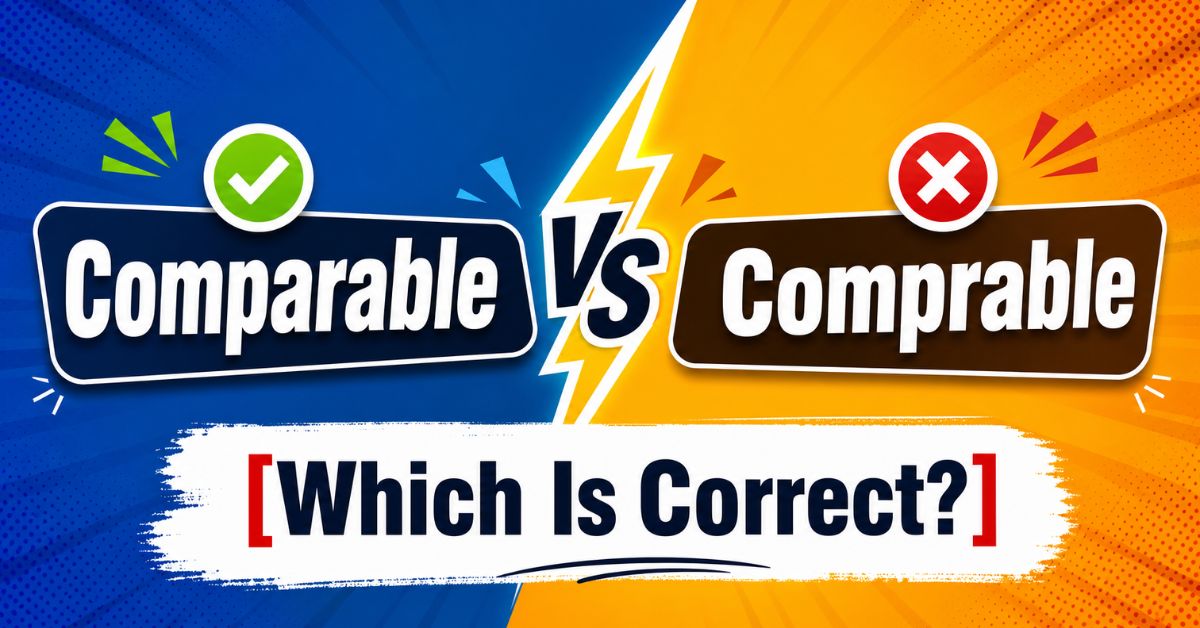
Have you ever paused while writing because you weren’t sure whether to spell a word as Comparable or Comprable? You’re not alone. These two spellings look almost identical, making it easy to miss an important letter.
However, only one spelling is correct in standard English: Comparable. It is an adjective that describes two or more things that can be compared because they share certain qualities, features, or characteristics. Comprable, on the other hand, is simply a spelling mistake and isn’t accepted as a standard English word.
Knowing the difference can help you write more clearly in emails, school assignments, business reports, and everyday conversations. In this guide, you’ll learn the correct spelling, meaning, pronunciation, origin, and practical uses of comparable. You’ll also discover why people often write comprable by mistake and how to remember the correct version.
The Quick Answer: Comparable or Comprable?
The correct spelling is Comparable, not Comprable.
Although both versions look similar, the second spelling leaves out the letter “a.” This small mistake makes the word incorrect.
| Word | Correct? | Meaning |
|---|---|---|
| Comparable | Yes | Something that can be compared with another thing |
| Comprable | No | Incorrect spelling of comparable |
Whenever you’re writing an email, assignment, report, or social media post, use comparable.
Correct Examples
- The salaries at both companies are comparable.
- These smartphones offer comparable performance.
- The two research studies used comparable methods.
- Both houses have comparable features.
Incorrect Examples
- The salaries at both companies are comprable.
- We found several comprable products.
- The results were comprable.
In each incorrect sentence, replacing comprable with comparable fixes the spelling.
Is “Comprable” a Real Word?
No. Comprable isn’t recognized as a standard English word.
You won’t find an accepted dictionary definition for it because it is simply a misspelling of comparable.
People usually make this mistake when typing quickly or relying on how the word sounds in everyday conversation.
For example:
- Incorrect: These two products are comprable.
- Correct: These two products are comparable.
The correct version should always be used in formal and informal writing.
Why Does It Look Correct?
English spelling can sometimes be confusing. Many words contain letters that aren’t strongly pronounced, especially during casual conversations.
Consider these common spelling mistakes:
| Incorrect | Correct |
|---|---|
| Recieve | Receive |
| Definately | Definitely |
| Seperate | Separate |
| Untill | Until |
| Comprable | Comparable |
The missing letter in comparable is easy to overlook because some speakers pronounce its middle syllables very quickly.
What Does Comparable Mean?
Comparable is an adjective used to describe things that can be reasonably compared.
It usually refers to two or more items that share certain qualities, values, sizes, features, or levels of performance.
For example, two laptops with similar prices and specifications may be described as comparable.
Simple Definition
Comparable means similar enough to be compared with something else.
It doesn’t always mean that two things are exactly alike. They simply need to share enough relevant characteristics to make a meaningful comparison possible.
Examples
- The two houses are comparable in size.
- Their professional experiences are comparable.
- These laptops have comparable features.
- Both companies offer comparable salaries.
- The students achieved comparable results.
Each sentence uses comparable to explain a meaningful relationship between two or more things.
The Origin of the Word Comparable
Understanding a word’s origin can make its spelling easier to remember.
Comparable comes from the word compare and the suffix -able.
The basic structure is:
Compare + -able = Comparable
The suffix “-able” generally means capable of doing something or suitable for something.
Therefore, comparable means capable of being compared.
This word structure also explains why the letter “a” appears after “p.” Removing it creates the incorrect spelling comprable.
Why People Misspell Comparable as Comprable
There are several reasons people accidentally leave out the letter “a” when writing comparable.
Fast Pronunciation
During everyday conversations, people often pronounce words quickly. Some vowel sounds become weak or less noticeable.
Comparable may sound like:
KOM-puh-ruh-buhl
Because the middle sounds aren’t always clear, someone may remember the word incorrectly and write comprable.
Typing Too Quickly
Typing mistakes happen when people write without checking their spelling.
This can happen more frequently when using:
- Smartphones
- Tablets
- Small keyboards
- Touchscreen devices
- Fast messaging applications
A missing letter can easily go unnoticed when you’re concentrating on the meaning rather than the spelling.
Autocorrect Errors
Autocorrect and spell-checking tools are helpful, but they aren’t perfect.
Some applications may fail to identify an error immediately. Others may suggest unrelated words.
That’s why it’s important to proofread your writing instead of depending entirely on automatic corrections.
Influence of Accents
Different English accents can change how certain vowel sounds are pronounced.
Words such as comparable, comfortable, and vegetable may sound different depending on the speaker.
When people become familiar with a shortened pronunciation, they may accidentally leave out letters while writing.
How to Pronounce Comparable Correctly
Comparable has slightly different pronunciation patterns in American and British English. However, its spelling remains the same.
American English
Pronunciation: /ˈkɑːmpərəbəl/
It sounds approximately like:
KOM-puh-ruh-buhl
British English
Pronunciation: /ˈkɒmpərəbəl/
The first vowel sound is slightly different, but the rest of the pronunciation is quite similar.
Easy Pronunciation Trick
Break the word into smaller parts:
- COM
- PAR
- A
- BLE
Now say the complete word slowly:
COM-PAR-A-BLE
Practicing each part can help you remember the missing vowel and avoid spelling mistakes.
How to Use Comparable in a Sentence
Comparable is commonly used in professional, academic, and everyday communication.
Here are some practical examples to help you understand its correct usage.
Business Examples
- The new software offers performance comparable to leading products.
- Prices are comparable across the three stores.
- We need comparable data before making a final decision.
- Both companies provide comparable customer support.
Academic Examples
- The researchers selected comparable groups of participants.
- Both experiments produced comparable results.
- The study examined two comparable teaching methods.
- Students achieved comparable scores in both examinations.
Everyday Examples
- These apartments are comparable in price.
- Their experiences are comparable despite their different backgrounds.
- Both restaurants offer comparable food quality.
- These two mobile phones have comparable features.
Negative Sentences
Comparable can also appear in negative sentences when something cannot reasonably be matched with another option.
Examples:
- No other athlete is comparable to her achievements.
- These two situations are not comparable.
- The quality of these products isn’t comparable.
- Nothing is comparable to a peaceful evening at home.
Comparable vs. Similar: Are They the Same?
Comparable and similar are closely related, but they don’t have exactly the same meaning.
Comparable means that two or more things have enough relevant qualities to make a comparison possible.
Similar means that two or more things share noticeable characteristics or features.
| Comparable | Similar |
|---|---|
| Able to be compared | Having qualities in common |
| Focuses on comparison | Focuses on resemblance |
| Things may have noticeable differences | Things share certain characteristics |
| Doesn’t require them to look alike | Usually suggests some resemblance |
Example
Imagine comparing two cars.
Both vehicles may be comparable because they belong to the same price range and serve similar purposes.
However, they may not be very similar in design.
For example:
- One car is electric.
- The other uses gasoline.
- One is a sports car.
- The other is an SUV.
They are still comparable because buyers can evaluate their prices, performance, and features.
Comparable vs. Compare
Comparable and compare come from the same word family, but they have different grammatical functions.
| Word | Part of Speech | Meaning |
|---|---|---|
| Compare | Verb | To examine similarities and differences |
| Comparable | Adjective | Able to be compared |
Examples
Compare:
Let’s compare the prices of these two smartphones.
Comparable:
The prices of these two smartphones are comparable.
Remember that compare describes an action, while comparable describes something that can be compared.
Industries That Frequently Use the Word Comparable
Comparable isn’t limited to everyday conversations. It also appears frequently in professional industries.
Real Estate
Real estate agents use comparable properties to estimate the market value of a house or apartment.
These properties usually share important characteristics, including:
- Similar square footage
- Similar locations
- Comparable property ages
- Similar numbers of bedrooms
- Matching property features
Example Table
| Feature | Property A | Comparable Property |
|---|---|---|
| Bedrooms | 3 | 3 |
| Bathrooms | 2 | 2 |
| Size | 2,000 sq. ft. | 1,950 sq. ft. |
| Location | Downtown | Downtown |
Real estate professionals examine these details to understand how much a property might be worth.
Finance
Financial analysts use comparable company analysis to evaluate businesses within the same industry.
They may compare companies based on:
- Annual revenue
- Profit margins
- Market value
- Business growth
- Financial performance
For example, an analyst might compare two technology companies to determine whether their shares are fairly valued.
E-Commerce
Online shopping platforms frequently use comparisons to help customers choose between products.
Examples include:
- Comparable laptops
- Comparable smartphones
- Comparable televisions
- Comparable headphones
Customers can examine prices, specifications, quality, and features before purchasing something.
Scientific Research
Researchers need comparable information when conducting studies and analyzing results.
For example, comparing two studies involving similar age groups and research conditions may produce more meaningful conclusions.
However, if one study examines adults and another focuses on young children, their findings may not be directly comparable.
Common Phrases That Use Comparable
The word comparable appears in many professional and everyday expressions.
Here are some frequently used combinations.
Business
- Comparable revenue
- Comparable growth
- Comparable products
- Comparable performance
- Comparable business results
Real Estate
- Comparable homes
- Comparable properties
- Comparable sales
- Comparable market prices
Education
- Comparable scores
- Comparable results
- Comparable standards
- Comparable learning outcomes
Healthcare
- Comparable outcomes
- Comparable treatments
- Comparable medical results
- Comparable recovery rates
These expressions are useful when discussing similarities between different options, results, or situations.
Examples of Comparable in Everyday Conversation
You don’t need to work in a professional industry to use comparable correctly.
Here are some natural examples from everyday life.
Workplace
“This year’s profits are comparable to last year’s.”
Shopping
“These two coffee makers are comparable in price.”
Education
“The test scores are comparable across both schools.”
Sports
“No other player has achievements comparable to hers.”
In each example, comparable helps explain how two things relate to one another.
Common Mistakes People Make with Comparable
Even familiar English words can cause confusion. Here are some mistakes worth avoiding.
Using “Comprable”
Incorrect:
The two products are comprable.
Correct:
The two products are comparable.
Always include the letter “a” after “p.”
Using Comparable Instead of Similar
Comparable and similar have related meanings, but they aren’t always interchangeable.
For example:
- These two designs are similar.
- These two products are comparable in price.
The first sentence describes resemblance. The second focuses on whether their prices can be compared.
Comparing Things That Cannot Be Compared
A meaningful comparison requires some shared characteristics.
For example:
“A bicycle and a galaxy are comparable.”
This sentence doesn’t make much sense without explaining the particular qualities being compared.
A clearer version would be:
“The size of a bicycle and the size of a galaxy are not comparable.”
A Simple Trick to Remember the Correct Spelling
The easiest way to remember comparable is to connect it with its root word: COMPARE.
Look at the spelling:
- C
- O
- M
- P
- A
- R
- E
Now remember:
COMPARE → COMPARABLE
Both words contain the important letter combination “PAR.”
When you remember this connection, you’re less likely to write comprable by mistake.
Memory Techniques That Actually Work
Here are three simple methods to improve your spelling.
Method One: Word Family
Learn these related words together:
- Compare
- Compared
- Comparing
- Comparable
- Comparison
Recognizing their shared spelling pattern makes the correct version easier to remember.
Method Two: Visual Reminder
Write the words like this:
COMPARE
↓
COMPARABLE
Notice how the same letters appear in both words.
Method Three: Read It Aloud
Practice saying each syllable slowly:
COM-PAR-A-BLE
This technique helps you remember the complete word instead of dropping a vowel.
Comparable Synonyms
Synonyms are words with similar meanings. Depending on the sentence, you can replace comparable with another suitable word.
| Synonym | Meaning |
|---|---|
| Similar | Having qualities in common |
| Equivalent | Equal in value or importance |
| Analogous | Similar in certain ways |
| Corresponding | Matching or related |
| Alike | Sharing similar characteristics |
| Comparable | Suitable for comparison |
Example
Original:
“The salaries at both companies are comparable.”
Alternative:
“The salaries at both companies are equivalent.”
However, remember that synonyms don’t always have exactly the same meaning. Choose one that fits your sentence.
Comparable Antonyms
Antonyms are words with opposite meanings.
Some common antonyms of comparable include:
- Different
- Dissimilar
- Unrelated
- Unequal
- Unlike
The word incomparable can also mean impossible or difficult to compare, depending on the context.
Example
“These two experiences are incomparable.”
This sentence suggests that the experiences cannot reasonably be compared.
Comparable in Business Writing
Professional communication requires accurate spelling and clear language.
Comparable is especially useful when discussing products, prices, services, performance, and financial results.
Correct Usage
Here are some common business expressions:
- Comparable pricing
- Comparable products
- Comparable services
- Comparable business results
- Comparable performance indicators
Example Email Sentence
“The proposed budget is comparable to last year’s spending.”
This sentence communicates the relationship between two budgets in a clear and professional way.
Using the correct spelling also helps maintain the quality of business emails, reports, and presentations.
Comparable in Academic Writing
Students and researchers often use comparable when discussing studies, data, research methods, and examination results.
It helps explain whether different groups or findings can be fairly compared.
Example
“The researchers selected comparable populations from both regions.”
Other academic examples include:
- The two research methods produced comparable findings.
- Both groups demonstrated comparable learning outcomes.
- The results were comparable across different testing conditions.
Using comparable correctly can make academic writing more precise and easier to understand.
Case Study: Why One Missing Letter Matters
Imagine a company preparing a message for potential customers.
The original sentence says:
“We offer comprable services at affordable prices.”
Although readers may understand the intended meaning, the spelling mistake makes the sentence look less professional.
Now consider the corrected version:
“We offer comparable services at affordable prices.”
The second sentence looks cleaner and communicates the same message without distracting readers.
A single missing letter may seem unimportant, but spelling mistakes can affect how people view your writing.
This is especially important when communicating with clients, employers, teachers, or business partners.
Other Commonly Misspelled English Words
Comparable isn’t the only English word that causes spelling confusion.
Here are some other examples worth learning.
| Incorrect | Correct |
|---|---|
| Definately | Definitely |
| Recieve | Receive |
| Occured | Occurred |
| Seperate | Separate |
| Goverment | Government |
| Comprable | Comparable |
| Untill | Until |
| Writting | Writing |
Learning the correct spelling of frequently confused words can improve your everyday communication.
Quick Reference Guide
Here’s a simple summary of everything discussed in this guide.
| Question | Answer |
|---|---|
| Is comparable a real word? | Yes |
| Is comprable a real word? | No |
| Which spelling is correct? | Comparable |
| What does comparable mean? | Able to be compared |
| Is comparable an adjective? | Yes |
| Is comparable the same as similar? | Not exactly |
| What is the root word? | Compare |
| What is the opposite of comparable? | Different or dissimilar |
FAQs
1. Is “Comprable” a real English word?
No. Comprable isn’t a recognized standard English word. It’s a common spelling mistake involving the word comparable. You should avoid using it in academic, professional, and everyday writing.
2. What does “Comparable” mean?
Comparable means similar enough to be compared with something else. It is commonly used when discussing quality, price, size, value, performance, or other shared characteristics.
3. Why do people spell “Comparable” as “Comprable”?
People often forget the letter “a” because the middle vowel sound can become weak during quick pronunciation. Typing too quickly and relying on incorrect spelling patterns can also cause this mistake.
4. Can I use “Comprable” in formal writing?
No. Comprable is an incorrect spelling and shouldn’t be used in formal documents, academic assignments, business emails, or casual messages. Always write comparable.
5. How can I remember the correct spelling of “Comparable”?
Connect comparable with its root word, compare. Both words contain the letters “PAR.” Remembering this connection can help you avoid leaving out the letter “a.”
Conclusion
Understanding the difference between comparable and comprable is easy once you remember one simple rule: Comparable is the only correct spelling. It describes things that share enough relevant qualities to make a meaningful comparison, while comprable is simply a spelling mistake.
Whether you’re writing a school assignment, preparing a business report, sending an email, or creating online content, always choose comparable. You can remember its spelling by connecting it with the root word compare.
A little attention to spelling can make your writing clearer, more professional, and easier for others to understand.

Finn Bradley is a grammar and language writer at Megazine Tech, focused on making English easier to understand. He researches grammar rules, vocabulary, sentence usage, punctuation, and common writing questions. Through clear explanations and practical examples, Finn helps readers build stronger communication skills and write with greater confidence in everyday situations.