

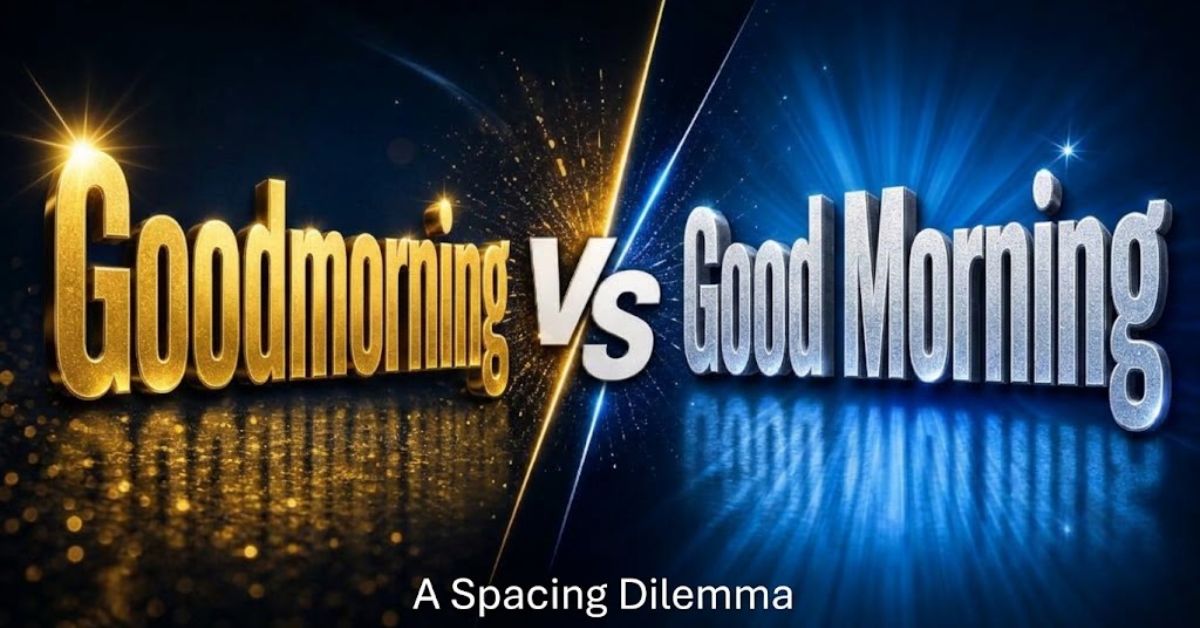
If you’ve ever wondered whether to write Goodmorning or Good Morning, you’re not alone. The difference looks tiny, but choosing the correct form matters in emails, texts, academic writing, and professional communication.
The correct spelling is Good Morning as two separate words. Goodmorning is not considered standard English. This mistake often happens because people type quickly, see similar words such as “goodnight,” or simply get used to informal texting habits.
Using Good Morning correctly can also make your writing look cleaner and more professional. It works as a polite greeting at the beginning of the day and helps create a friendly, respectful tone.
Grammatically, the phrase contains the adjective good and the noun morning. Because “good” describes “morning,” the two words remain separate. Understanding this simple pattern makes the rule much easier to remember.
Goodmorning or Good Morning: The Correct Answer
The answer is straightforward:
Good morning — Correct
Goodmorning — Incorrect
In standard English, Good Morning should always be written as two separate words.
Whether you’re greeting a friend, writing to your boss, or starting an important email, keeping a space between “good” and “morning” is the correct choice.
Why “Good Morning” Is Two Words
There’s a simple grammatical reason behind the spelling.
The phrase consists of:
- Good → adjective
- Morning → noun
The adjective “good” describes the noun “morning.” In this type of phrase, English normally keeps the two words separate.
Simple Examples That Follow the Same Rule
Consider these familiar expressions:
- Good day
- Good evening
- Good afternoon
You wouldn’t normally write “goodday,” “goodevening,” or “goodafternoon.”
The same principle applies to Good Morning.
The Exception That Trips People Up: Goodnight vs Good Night
A major reason people write “goodmorning” is the existence of the word goodnight.
Unlike “goodmorning,” goodnight is an accepted English word in certain contexts. However, “good night” can also be written as two words.
The difference depends on how the expression is being used.
How It Works
| Phrase | Correct? | Common Usage |
|---|---|---|
| Good morning | Yes | Morning greeting |
| Goodmorning | No | Nonstandard spelling |
| Good night | Yes | Evening expression |
| Goodnight | Yes | Farewell or noun |
For example:
“Good night, everyone.”
Here, “good night” is written as two words.
“She kissed the children goodnight.”
Here, “goodnight” works as one word.
However, Good Morning doesn’t follow the same pattern. It remains two words in standard English.
Why People Keep Writing “Goodmorning”
If Good Morning is correct, why is “goodmorning” so common online?
The main reason is informal digital communication. People often care more about speed than perfect grammar when texting or posting online.
Common Reasons People Get It Wrong
- Fast typing: People accidentally remove the space while rushing.
- Confusion with “goodnight”: The one-word spelling makes “goodmorning” seem logical.
- Texting habits: Grammar rules are often relaxed in casual messages.
- Autocorrect: Some keyboards may not immediately correct the mistake.
- Social media style: Hashtags and usernames often combine multiple words.
Seeing “goodmorning” frequently online doesn’t make it the standard spelling.
Does It Really Matter? (Yes, More Than You Think)
Writing “goodmorning” probably won’t stop someone from understanding your message. However, small language mistakes can affect how polished your writing appears.
Correct spelling shows attention to detail, especially when you’re communicating professionally.
In Professional Settings
Using the incorrect form may:
- Make an email look rushed
- Reduce the professional feel of your message
- Suggest weak attention to detail
- Distract careful readers
A small spelling choice can influence the overall impression of your writing.
In Personal Communication
The rules are naturally more relaxed when talking with friends or family.
Still, writing Good Morning correctly makes your message clear and natural. There’s little reason to use the incorrect form when the proper version is just as easy to type.
Real-World Usage: Emails, Texts, and Social Media

The setting can influence your tone, but the standard spelling remains the same.
Professional Emails
In business and professional emails, always use:
Good morning
Example
Good morning, James. I wanted to follow up regarding yesterday’s meeting.
This greeting sounds natural, respectful, and professional.
Avoid informal versions such as “goodmorning” or “gm” when writing formal emails.
Casual Text Messages
You can still use the standard spelling in casual conversations.
Example
Good morning! Hope you slept well.
It’s friendly, short, and grammatically correct.
You might see “goodmorning” in casual chats, but it remains a nonstandard spelling.
Social Media Posts
Social media is slightly different because creative styling is common.
For example, people sometimes combine words in hashtags such as #Goodmorning because hashtags cannot contain spaces.
In that situation, the combined form serves a technical or stylistic purpose rather than following normal sentence grammar.
Pro Tip
Using combined words for hashtags, usernames, or branding can be a deliberate style choice. In regular sentences, emails, articles, and professional writing, stick with Good Morning.
Memory Trick: Never Get It Wrong Again
Here’s an easy way to remember the correct spelling:
Morning needs space.
If you’re greeting someone in the morning, keep the two words separate.
Quick Mental Shortcut
Think about these expressions:
- Good morning
- Good afternoon
- Good evening
All three use a space.
If you remember this pattern, you’re much less likely to accidentally write “goodmorning.”
Common Mistakes to Avoid
Even when people understand the rule, a few common mistakes continue to appear.
Writing “Goodmorning” in Emails
Avoid writing:
Goodmorning, Sarah.
Instead, write:
Good morning, Sarah.
The second version looks more polished and follows standard English.
Mixing “Good Night” and “Goodnight”
Both forms can be correct, depending on their function.
“Good night” commonly appears as an expression, while “goodnight” can function as a farewell or noun in certain constructions.
Don’t use this variation as a reason to combine “good” and “morning.”
Incorrect Capitalization
Capitalization depends on where the phrase appears.
At the beginning of a sentence:
Good morning, everyone.
Within a sentence:
I wished everyone a good morning.
You don’t need to capitalize both words every time.
Quick Reference Table (Save This)
| Phrase | Correct? | Usage Context |
|---|---|---|
| Good morning | Yes | Standard morning greeting |
| Goodmorning | No | Nonstandard spelling |
| Good night | Yes | Evening expression |
| Goodnight | Yes | Farewell or noun in some uses |
| Morning! | Yes | Informal greeting |
Case Study: One Email, Two Impressions
Consider two versions of the same email opening.
Version 1
Goodmorning, Sarah. I wanted to check in about the report.
Version 2
Good morning, Sarah. I wanted to check in about the report.
Both versions communicate the same basic message, but the second looks more professional.
What Changed?
Only one space was added.
Yet Version 2 feels:
- Cleaner
- More polished
- Grammatically correct
- More appropriate for professional communication
Small details often have a noticeable effect on written communication.
A Simple Rule That Applies Beyond “Good Morning”
Understanding why Good Morning uses two words can also help you with other English expressions.
Adjective + Noun = Separate Words
Look at these examples:
- Strong coffee
- Bright day
- Cold weather
- Beautiful morning
- Good evening
The describing word and noun usually remain separate.
In the same way:
Good + morning = Good morning
Not “Goodmorning.”
What About “Morning” Alone?
Sometimes you don’t need to say “Good morning” at all.
In casual speech and messages, simply saying “Morning!” is perfectly natural.
Examples
Morning!
Morning, how are you?
Morning! Hope you’re doing well.
This shortened greeting works particularly well when speaking with friends, coworkers, or people you already know.
It may sound too casual in highly formal communication, so Good morning is generally the safer choice for professional emails.
Style vs Grammar: Where Lines Blur
English changes over time, particularly because of texting, social media, advertising, and internet culture.
Creative writing sometimes breaks traditional grammar rules intentionally.
When Style Wins
Combining words may work for:
- Hashtags
- Usernames
- Brand names
- Creative captions
- Informal online content
A hashtag such as #Goodmorning isn’t necessarily trying to follow normal sentence grammar.
When Grammar Wins
Standard spelling is more important in:
- Business emails
- School assignments
- Reports
- Articles
- Job applications
- Client communication
- Professional messages
The important thing is knowing when you’re making a deliberate stylistic choice and when you’re simply making a spelling mistake.
Expert Insight: Why Small Errors Stand Out
Readers often move smoothly through well-written sentences without thinking about the grammar.
Errors can interrupt that flow.
When someone sees “goodmorning,” they may pause because the spelling looks unusual. Even if the meaning remains clear, that tiny interruption can make the writing feel less polished.
Correct spelling helps your message flow naturally and keeps the reader focused on what you’re actually trying to say.
Practical Tips to Get It Right Every Time
You don’t need complicated grammar lessons to remember this rule. A few simple habits are enough.
Use These Strategies
- Remember that morning needs a space.
- Proofread the opening line of important emails.
- Think of “good afternoon” and “good evening.”
- Don’t assume “goodnight” creates the same rule.
- Use spell-checking tools as support, not as your only guide.
- Slow down slightly when writing professional messages.
Quick Checklist Before You Hit Send
Before sending an important message, ask yourself:
- Did I write Good morning as two words?
- Is the capitalization appropriate?
- Does the greeting match the situation?
- Is my message professional enough for the reader?
If the answer is yes, you’re ready to send it.
FAQs
1. Is Goodmorning or Good Morning correct?
Good Morning is the correct form. It should be written as two separate words because “good” is an adjective describing the noun “morning.”
2. Why do people write Goodmorning as one word?
People commonly write “goodmorning” because of fast typing, texting habits, social media hashtags, or confusion with the accepted word “goodnight.”
3. Where should I use Good Morning?
You can use Good Morning in emails, text messages, business communication, academic settings, social media posts, and everyday conversations.
4. Is Goodmorning ever acceptable?
“Goodmorning” is not the standard spelling in regular English sentences. However, you may see the combined form in hashtags, usernames, brand names, or other creative contexts where spaces aren’t used.
5. Why does this small detail matter?
Correct spelling improves clarity and helps your writing appear polished and professional. This is especially important in emails, workplace communication, school assignments, and other formal situations.
Conclusion
The difference between Goodmorning or Good Morning is easy to understand once you know the basic rule. Good Morning is the standard and correct form because “good” and “morning” are separate words. “Goodmorning” is a common nonstandard variation, often caused by texting habits, social media use, or confusion with “goodnight.”
Whether you’re sending an email, greeting a coworker, texting a friend, or writing an article, using Good Morning keeps your message clear and polished. Remember the simple trick: morning needs space. Once you keep that rule in mind, choosing between Goodmorning or Good Morning becomes easy.

Finn Bradley is a grammar and language writer at Megazine Tech, focused on making English easier to understand. He researches grammar rules, vocabulary, sentence usage, punctuation, and common writing questions. Through clear explanations and practical examples, Finn helps readers build stronger communication skills and write with greater confidence in everyday situations.