

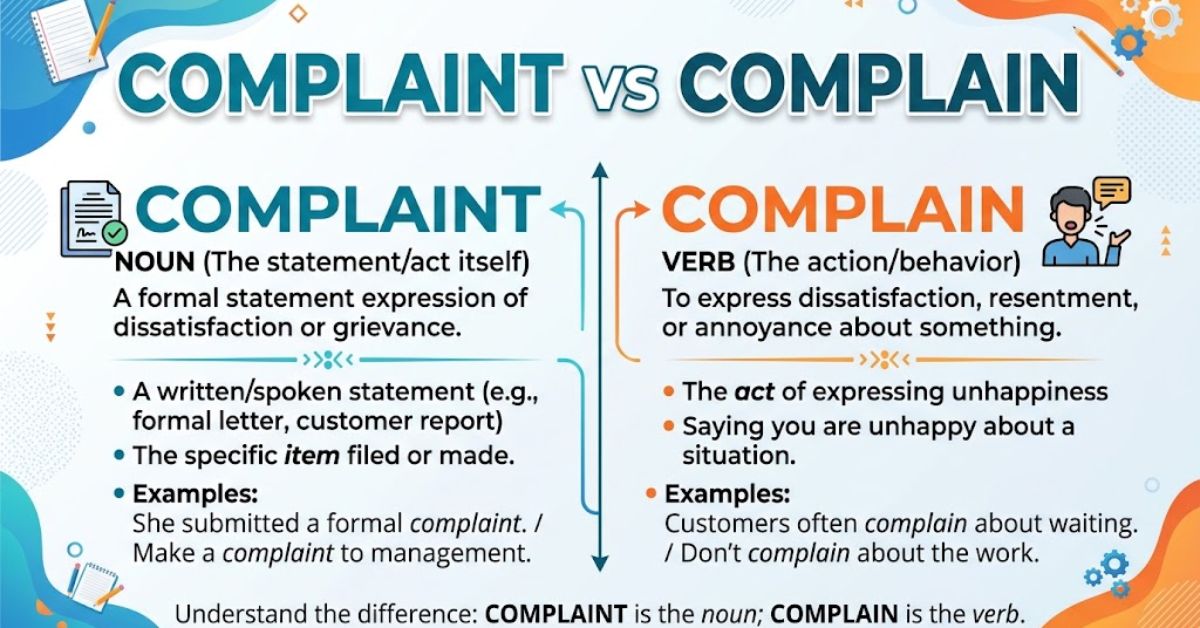
The difference between complaint vs complain may seem small, but using the wrong word can make a sentence grammatically incorrect. Both words relate to expressing dissatisfaction, annoyance, pain, or concern, yet they have different roles in English grammar.
Complain is a verb, which means it describes an action. Complaint is a noun, meaning it refers to the issue, statement, or expression of dissatisfaction itself.
For example:
- I want to complain about the poor service.
- I submitted a complaint about the poor service.
The easiest way to remember the difference is simple: complain = action, complaint = thing.
Understanding this distinction can improve your everyday writing, especially in emails, workplace communication, customer service messages, academic writing, and formal documents.
Complaint or Complain – The Quick Answer You Need First
The difference between complaint and complain comes down to grammar:
Complain = verb → an action
Complaint = noun → a thing, issue, or statement
Simple Examples
- I need to complain about the noise.
- She filed a complaint with the manager.
- Customers often complain about slow delivery.
- The company received several complaints yesterday.
A quick memory trick is:
Complain = action. Complaint = result.
If someone is expressing dissatisfaction, they complain. The dissatisfaction they express can become a complaint.
Why “Complaint vs Complain” Confuses So Many People
Complaint and complain look and sound similar because they belong to the same word family. However, their grammatical functions are different.
Three Real Reasons People Struggle
People commonly confuse these words because:
- They share almost the same spelling.
- Their meanings are closely connected.
- One describes an action while the other names the resulting issue or statement.
The difference becomes much easier once you stop focusing only on spelling and start looking at the word’s job in the sentence.
A Quick Analogy
Think about decide and decision.
You decide something, but you make a decision.
The same pattern applies here.
You complain about something, but you make or file a complaint.
The Core Grammar Rule Behind Complaint vs Complain
The simplest way to understand complaint vs complain is to identify their parts of speech.
Complain (Verb – The Action Word)
Complain is a verb. It describes the action of expressing dissatisfaction, discomfort, annoyance, or unhappiness.
Meaning
To complain means to say that you are unhappy or dissatisfied with something.
Examples
- People complain about traffic every day.
- She complained to the manager yesterday.
- Customers often complain about long waiting times.
- Don’t complain before you understand the situation.
Key Insight
If someone is doing the action of expressing dissatisfaction, use complain.
Complaint (Noun – The Thing You Express)
Complaint is a noun. It refers to an expression, statement, issue, or report of dissatisfaction.
Meaning
A complaint is something someone says, writes, or reports because they are unhappy about a situation.
Examples
- He submitted a complaint to HR.
- The company received several complaints.
- I made a complaint about the poor service.
- Her complaint was handled professionally.
Key Insight
If you can make, file, submit, receive, investigate, or resolve it, you probably need complaint.
Complaint vs Complain – Side-by-Side Breakdown
| Feature | Complain | Complaint |
|---|---|---|
| Word type | Verb | Noun |
| Main meaning | To express dissatisfaction | An expression of dissatisfaction |
| Grammar role | Describes an action | Names a thing or issue |
| Example | I complain about the noise. | I filed a complaint. |
| Common forms | complain, complains, complained, complaining | complaint, complaints |
The Simple Rule That Solves 90% of Confusion
When you’re unsure which word to choose, ask yourself what you’re describing.
If you’re describing an action, use complain.
If you’re referring to an issue, report, or statement, use complaint.
Quick Mental Test
Can someone do it? → complain
Can someone have, make, file, or receive it? → complaint
For example:
Customers complain.
Here, you’re describing what customers do.
Customers made a complaint.
Here, you’re talking about a thing they made.
Common Mistakes with Complaint vs Complain
These words are especially easy to mix up when writing quickly.
Mistake 1: Using “Complain” as a Noun
Incorrect: I have a complain.
Correct: I have a complaint.
You need a noun after “a,” so complaint is correct.
Mistake 2: Using “Complaint” as a Verb
Incorrect: I complaint about the noise.
Correct: I complain about the noise.
The sentence describes an action, so you need the verb complain.
Mistake 3: Wrong Phrasing in Formal Writing
Incorrect: She made a complain.
Correct: She made a complaint.
Quick Fix Rule
After expressions such as make a, file a, submit a, receive a, or handle a, use complaint.
Complaint vs Complain in Real-Life Contexts
Understanding grammar rules is useful, but real examples make the difference easier to remember.
Emails
Both words are common in professional and customer service emails.
Correct examples:
- I would like to complain about my delayed order.
- I am writing to submit a complaint about my delayed order.
- Several customers have complained about this problem.
- We have received your complaint.
Why It Matters
Professional emails should sound clear and grammatically correct. Writing “I want to complaint” can make an otherwise professional message look careless.
News Headlines
News headlines may use either word depending on whether the focus is an action or an issue.
Examples:
Customers complain about rising prices.
Here, complain describes what customers are doing.
Company receives 3,000 complaints about new policy.
Here, complaints refers to the issues or reports received by the company.
Pattern
Complain often emphasizes action.
Complaint often emphasizes an issue, report, or documented concern.
Social Media
Informal conversations frequently use complain because users often describe actions and reactions.
Examples:
- Why does everyone complain about Mondays?
- People complain about everything these days.
- I sent a complaint to customer support.
The grammar rule stays the same even when the conversation becomes casual.
Formal Writing
Precision matters even more in business, legal, academic, and workplace writing.
For example:
The customer filed a complaint regarding service quality.
Employees complained about excessive workloads.
The first sentence refers to a documented issue. The second describes an action.
Key Takeaway
Action → complain
Issue or statement → complaint
Origin of Complaint and Complain
Complaint and complain are historically related words.
Complain
Complain entered English through Old French and historically carried meanings connected with lamenting, expressing sorrow, or expressing dissatisfaction.
Complaint
Complaint developed as the noun associated with complaining and came to describe an expression of dissatisfaction, grievance, or sometimes a physical problem.
Interesting Insight
Modern English maintains a useful grammatical distinction:
Complain → action
Complaint → thing or expression
That difference explains why the two words cannot normally replace each other in a sentence.
British English vs American English Usage
There is no major spelling difference between British and American English for these words.
Both varieties use:
- complain
- complained
- complaining
- complaint
- complaints
Differences may appear in tone, phrasing, or formal procedures, but the basic grammar rule remains the same.
Complaint vs Complain in Customer Service
Customer service provides one of the clearest examples of the difference.
Customer Action vs Record System
A customer complains.
The company records a complaint.
Example Workflow
Step 1: A customer complains about a delayed delivery.
Step 2: The support team records the complaint.
Step 3: An employee investigates the complaint.
Step 4: The company resolves the complaint.
Why This Matters
The verb describes the customer’s action, while the noun describes the issue or record being handled.
Comparison Table: Real Usage Variations
| Context | Correct Word | Example |
|---|---|---|
| Describing an action | Complain | Customers complain about delays. |
| Naming an issue | Complaint | I have a complaint. |
| Customer service record | Complaint | We received your complaint. |
| Expressing dissatisfaction | Complain | Don’t complain about everything. |
| Formal documentation | Complaint | She filed a formal complaint. |
| Past action | Complained | He complained yesterday. |
| Multiple issues | Complaints | We received ten complaints. |
Quick Decision Flow – Use This Every Time
Ask yourself:
Am I describing an action?
Yes → Use complain.
No → Ask another question:
Am I talking about an issue, statement, report, or thing?
Yes → Use complaint.
For example:
“I want to ___ about the service.”
You need an action → complain.
“I want to file a ___ about the service.”
You need a thing → complaint.
Case Study: One Mistake, Two Meanings
A tiny word change can affect the professionalism of an entire message.
Email A
I want to complain about poor service.
Correct. The writer wants to perform an action.
Email B
I want to complaint about poor service.
Incorrect. Complaint cannot function as the verb in this sentence.
Correct Formal Version
I would like to file a complaint about the poor service I received.
What This Shows
Understanding the difference between complaint and complain isn’t just about passing a grammar test. It helps your writing sound clearer and more professional.
Advanced Insight: Why This Confusion Persists
English contains many related nouns and verbs with similar spellings.
Compare:
- decide → decision
- explain → explanation
- describe → description
- complain → complaint
The related words share meaning, but they don’t necessarily perform the same grammatical job.
That’s why memorizing meaning alone isn’t enough. You also need to understand how the word functions inside a sentence.
Practical Writing Tips You Can Use Immediately
Before choosing between complaint and complain, look at the sentence structure.
Simple Habits
Ask whether you need an action or thing.
Look for words such as a, the, my, your, file, submit, receive, and handle. These often signal that complaint is needed.
Look for a subject performing an action, such as I complain, customers complain, or she complained. These structures require the verb.
Quick Checklist
Am I describing an action? → Complain
Am I naming an issue? → Complaint
Did someone file or submit it? → Complaint
Is someone expressing dissatisfaction? → Complain
FAQs
1. What is the difference between complaint and complain?
Complaint is a noun referring to an expression or issue of dissatisfaction. Complain is a verb meaning to express dissatisfaction or unhappiness.
2. When should I use “complaint”?
Use complaint when referring to an issue, statement, report, or expression of dissatisfaction. For example, “I filed a complaint.”
3. When should I use “complain”?
Use complain when describing the action of expressing dissatisfaction. For example, “Customers complain about high prices.”
4. Are complaint and complain related?
Yes. They belong to the same word family and both relate to expressing dissatisfaction, but they have different grammatical functions.
5. Can I use complain as a noun?
In standard modern English, complain is used as a verb. Use complaint when you need the noun.
6. Can I use complaint as a verb?
No. Complaint is a noun. The verb is complain.
7. Why do people confuse complaint and complain?
They have similar spellings and closely related meanings. However, complaint is a noun while complain is a verb.
8. Where are these words commonly used?
Both words frequently appear in everyday conversations, emails, workplace communication, customer service, formal reports, and business writing.
9. What happens if I mix them up?
Using the wrong form can make your sentence grammatically incorrect and may reduce clarity or professionalism.
10. What is a simple way to remember them?
Remember this formula:
Complain = action. Complaint = thing.
Conclusion
Understanding complaint vs complain becomes easy once you focus on grammar rather than spelling. Complain is a verb describing the action of expressing dissatisfaction, while complaint is a noun referring to the issue, statement, or expression itself.
Whenever you’re unsure, ask one simple question: Do I need an action or a thing? If it’s an action, choose complain. If it’s a thing, report, or issue, choose complaint.
Mastering this small difference can make your emails, workplace messages, customer service communication, and everyday English clearer, more natural, and grammatically correct.

Finn Bradley is a grammar and language writer at Megazine Tech, focused on making English easier to understand. He researches grammar rules, vocabulary, sentence usage, punctuation, and common writing questions. Through clear explanations and practical examples, Finn helps readers build stronger communication skills and write with greater confidence in everyday situations.