

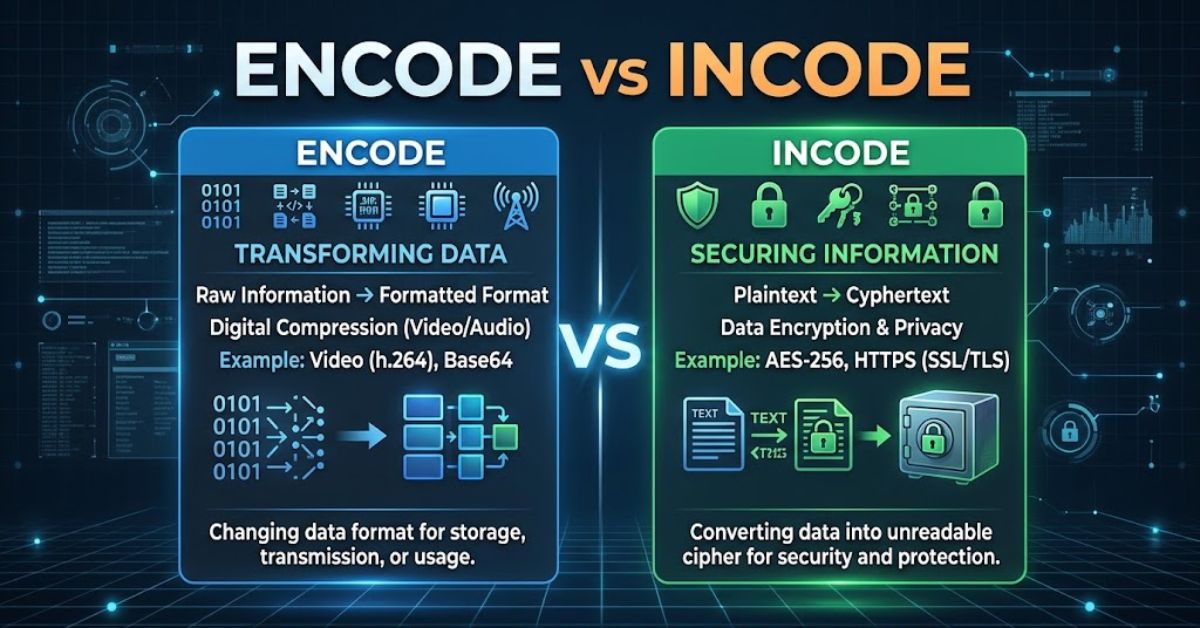
Encode is the correct English verb when you mean to convert or represent information in a particular code, format, signal, or system. Incode isn’t an alternative spelling of encode. However, it does have a specialized meaning in UK postal terminology.
For most everyday, academic, professional, and computing situations, the choice is easy. You encode data, encode a message, or encode a video.
The confusion makes sense, though. Encode and incode sound remarkably similar when spoken. English also contains plenty of words beginning with in-, which makes the incorrect spelling look believable.
Here is the quick answer:
Use encode for the action of converting or representing information. Use incode only in a recognized specialized context, particularly when referring to the inward part of a UK postcode.
What Is Encode vs Incode?
Encode is a verb meaning to convert or represent information using another form, code, or system. The process helps information get stored, transmitted, displayed, or processed.
For example:
- encode text in UTF-8
- encode a video for streaming
- encode information into a digital signal
- encode a message
- encode biological information
Incode isn’t the standard verb for any of these actions.
Incorrect: The program will incode the data.
Correct: The program will encode the data.
There is an important exception. In British postcode terminology, incode can function as a noun referring to the final three characters of a postcode.
Why the Difference Matters
One letter can make a surprisingly big difference.
Writing incode instead of encode in an assignment, business email, software guide, or technical report can make your work look careless. More importantly, confusing related terms can change the technical meaning of a sentence.
Accuracy matters particularly in:
- software documentation
- university assignments
- business communication
- programming tutorials
- cybersecurity content
- technical reports
- data-processing instructions
Knowing the difference also helps you separate encode, code, encrypt, decode, and in code.
The Core Rule
The rule is simple:
Use encode as the verb when something is converted or represented in another form. Use incode only when it has an established specialist or proper-name meaning.
Ask yourself what the sentence means.
If you mean “convert information into another representation,” choose encode.
If you’re specifically discussing the inward portion of a UK postcode, incode can be correct.
If you mean something is written using code, use the two-word phrase in code.
How to Use Encode Correctly
Encode usually acts on information, files, signals, messages, text, media, or other data.
Encode as a Verb
Encode is a regular verb.
Its common forms include:
- encode: base form
- encodes: third-person singular
- encoded: past tense and past participle
- encoding: present participle or gerund
- encoder: a person, device, or software component that performs encoding
Example: The software encodes each uploaded file automatically.
Encode Something in a Format
Use encode in when naming a specific format or encoding system.
The document is encoded in UTF-8.
The characters are encoded in Unicode.
This construction appears frequently in computing and technical writing.
Encode Something as Something
Use encode as when describing the resulting representation.
The program encodes the image as Base64 data.
The system encodes the value as a sequence of bytes.
Here, as tells you what form the information takes.
Encode Something Into Another Form
Use encode into when emphasizing transformation.
The device encodes the signal into digital information.
The wording works well when you’re focusing on a change from one form to another.
When Is Incode Correct?
Incode has a narrow but legitimate use in UK postcode terminology.
A UK postcode contains an outward portion and an inward portion. The inward portion, or incode, consists of the final three characters after the space.
Take this postcode:
NW6 4DP
Outcode: NW6
Incode: 4DP
Therefore, this sentence is correct:
The incode in NW6 4DP is 4DP.
However, that doesn’t make incode a substitute for encode.
Incorrect: Please incode the video.
Correct: Please encode the video.
Incode may also appear in company names, product names, software identifiers, or project names. Proper names keep the spelling selected by their owners.
Correct Examples of Encode
Seeing a word in everyday contexts makes its meaning easier to remember.
Conversation
“Can you encode this video before sending it?”
“My phone is still encoding the recording.”
“Please encode the exported file using the required character format.”
“We encoded the attachment successfully.”
School
“Students learned how computers encode letters as numerical values.”
“The class discussed how messages can be encoded and decoded.”
Workplace
“Our application encodes incoming information before processing it.”
“The team changed how the software encodes special characters.”
Social Media
“The platform encodes uploaded videos into suitable streaming formats.”
Academic Writing
“Language can encode complex relationships between ideas.”
“Researchers studied how the brain encodes information.”
Computing
“The browser displayed the text correctly because it was encoded in UTF-8.”
Incorrect vs Correct Usage
| Incorrect | Correct | Reason |
|---|---|---|
| Please incode the file. | Please encode the file. | Encode is the standard verb. |
| The app incodes images. | The app encodes images. | Encodes is the correct form. |
| We incoded the video. | We encoded the video. | Encoded is the correct past tense. |
| The server is incoding data. | The server is encoding data. | Encoding is the correct form. |
| The instructions are incode. | The instructions are in code. | In code is a two-word phrase. |
| The gene incodes a protein. | The gene encodes a protein. | Encode is used in this biological sense. |
Why People Confuse Encode and Incode
The error isn’t random. Several features of English encourage it.
They Sound Almost Identical
In normal speech, the first syllable of encode can sound similar to “in.” Someone who hears the word more often than they read it may naturally guess the wrong spelling.
English Contains Many Words Beginning With In-
Words such as input, include, inside, insert, and inspect make the prefix in- look familiar.
That can lead to a tempting assumption:
in + code = incode
Standard English uses encode for the verb instead.
The Prefix En- Can Sound Like In-
The prefix en- appears in verbs such as enable, encase, and encircle. It can carry the idea of causing something to enter a particular condition or state.
That spelling pattern can help you remember encode.
“In Code” Is Already a Valid Phrase
Compare these sentences:
The developer encoded the message.
The message was written in code.
The first describes an action. The second describes the form of the message.
Don’t combine in code into incode when you mean the second expression.
Autocomplete Does Not Always Fix It
Spellcheckers aren’t mind readers. Incode can appear as a proper name, technical identifier, username, or specialist term.
Always check the meaning instead of trusting autocorrect completely.
Translation Can Encourage the Wrong Prefix
Someone may interpret “put information in code” literally and assume the verb should be incode.
English doesn’t build the word that way. Learn encode as a complete vocabulary item.
Common Mistakes Checklist
Using Incode as a Verb
Incorrect: “The software incodes files.”
Correct: “The software encodes files.”
Writing Incoded
Don’t create the past tense from incode.
Incorrect: “The message was incoded.”
Correct: “The message was encoded.”
Writing Incoding
The correct form is encoding.
Incorrect: “Video incoding takes several minutes.”
Correct: “Video encoding takes several minutes.”
Confusing Encode With In Code
Use encode for an action and in code when describing a form.
Action: “We encoded the instructions.”
Form: “The instructions are written in code.”
Treating Encode and Encrypt as Synonyms
Encoding changes how information is represented. Encryption aims to protect information from unauthorized access.
Base64 encoding, for example, shouldn’t automatically be described as encryption.
Assuming Every Appearance of Incode Is a Typo
Context matters. Incode can legitimately describe part of a UK postcode. It may also form part of a proper name.
Check before correcting it.
Encode vs Incode in Real English
Knowing grammar rules is useful. Knowing what sounds natural is even better.
Grammatically Correct English
Natural standard forms include:
“The software encodes the data.”
“The message was encoded.”
“We’re encoding the video.”
These constructions work in professional and everyday English.
Grammatically Possible but Unnatural English
Technically possible wording can still sound clumsy.
For example:
“The system performed the encoding of the document.”
Usually, this sounds cleaner:
“The system encoded the document.”
Good writing doesn’t need extra machinery when one precise verb does the job.
Natural Everyday English
You don’t always need technical language.
Someone might say:
“Convert the video.”
“Save it in another format.”
“Turn the message into code.”
However, encode remains perfectly natural when the encoding process itself matters.
American vs British English
There is no normal US-versus-UK spelling difference for the verb.
American English: encode
British English: encode
Both use encoded and encoding too.
The important regional difference concerns postal terminology. British postcode systems can use incode for the inward portion of a postcode. American ZIP Codes don’t use incode as an equivalent structural term.
Encode vs Incode vs In Code
| Feature | Encode | Incode | In Code |
|---|---|---|---|
| Form | One word | One word | Two words |
| Main role | Verb | Specialist noun | Phrase |
| Standard computing verb | Yes | No | No |
| Converts information | Yes | No | No |
| UK postcode meaning | No | Yes | No |
| Example | Encode the message. | The incode is 4DP. | The message is in code. |
Encode vs Encrypt
Encoding and encryption both transform information, but they serve different purposes.
Encoding changes representation.
Encryption protects confidentiality.
For example:
“The application encodes text as Base64.”
This changes its representation. It doesn’t automatically secure the information.
By contrast:
“The application encrypts sensitive data before transmission.”
Here, protection is the goal.
A useful rule is:
Representation or compatibility = encode
Cryptographic protection or confidentiality = encrypt
Encode vs Code
Code has several meanings. It can describe programming instructions, a symbolic system, or the act of writing software.
Encode more specifically describes representing information according to a particular system or format.
Compare:
“Alex coded the new feature.”
This means Alex wrote computer code.
“The application encoded the text in UTF-8.”
This describes the representation of the text.
The Easiest Memory Trick
Remember this tiny connection:
ENter a new form = ENcode
Both ENter and ENcode begin with EN.
When information enters another coded representation, you encode it.
Simple enough to stick.
Real-Life Situations
Job Interview
Interviewer: “How does your application handle uploaded videos?”
Answer: “It encodes each video into a format suitable for streaming.”
Team Meeting
Manager: “Why are these characters displaying incorrectly?”
Developer: “The old system encoded the text using the wrong character set.”
Professional Email
“Please make sure the exported text is encoded in UTF-8 before sending the final file.”
Text Message
“The video is still encoding. I’ll send it when it’s finished.”
Exam
Question: “What does it mean to encode information?”
Answer: “To encode information means to represent or convert it according to a particular code, system, or format.”
Expert Tips
A few habits can prevent this spelling problem for good.
Learn the Whole Word
Don’t rebuild the word from in + code every time you write it.
Memorize encode as one complete word.
Remember Its Word Family
Learn the related forms together:
encode → encodes → encoded → encoding → encoder
Once you remember the en-, the entire family becomes easier.
Check Whether You Actually Mean In Code
Ask whether you’re describing an action or a state.
Action: We encoded the message.
State: The message is in code.
Do Not Use Encoding as a Security Claim
Encoded information isn’t automatically secure.
If protection matters, determine whether the process actually involves encryption, hashing, tokenization, or another security mechanism.
Be Precise With Password Terminology
Avoid vague statements such as “we securely encode passwords.”
If passwords are hashed, say hashed. If data is genuinely encrypted, say encrypted.
Precise terminology builds trust.
Preserve Incode When It Is a Defined Proper Name
Don’t automatically replace every occurrence of incode.
First check whether it refers to:
- a UK postcode component
- a company
- a product
- a project
- a software identifier
- another defined technical label
Context decides whether a correction is needed.
FAQ
Is Incode a Real Word?
Yes, in limited contexts. It can refer to the inward portion of a UK postcode, but it isn’t the standard verb meaning “encode.”
Is Incode Correct in Programming?
Not when you mean converting or representing data. In standard programming explanations, use encode or encoding.
Is Incoding Correct?
Normally, no. The standard -ing form of encode is encoding.
Is Incoded Correct?
Not as the normal past tense of encode. Use encoded, as in “The file was encoded successfully.”
Should I Write Encode or In Code?
Use encode for an action. Use in code when describing something written or expressed using code.
Does Encode Mean Encrypt?
No. Encoding changes representation, while encryption focuses on protecting information from unauthorized access.
Does Encode Mean Compress?
Not necessarily. Compression reduces data size, while encoding represents information according to a particular format or system.
Is “Encoded in UTF-8” Correct?
Yes. “The text is encoded in UTF-8” is a natural construction for identifying the character encoding used.
Why Is Encode Spelled With En Instead of In?
Encode follows the established en- spelling pattern. The pronunciation of the first syllable can resemble in, which causes confusion.
What Does Incode Mean in a UK Postcode?
The incode, or inward code, is the final three characters of a UK postcode. In NW6 4DP, the incode is 4DP.
Mini Quiz
- The application will ___ the video before upload.
Answer: encode - Which is correct: incoding or encoding?
Answer: encoding - Correct this: “The program incodes every file.”
Answer: The program encodes every file. - Which is correct: “written incode” or “written in code”?
Answer: written in code - The text was ___ in UTF-8.
Answer: encoded - Does encoding always protect information?
Answer: No. - What is the final portion of a UK postcode sometimes called?
Answer: incode or inward code
Quick Summary
Encode is the correct verb when you mean to convert or represent information in a code, format, signal, or system. Its standard forms are encode, encodes, encoded, encoding, and encoder.
Don’t use incode, incoded, or incoding as replacements for these forms. However, incode isn’t always an error. In UK postal terminology, it can mean the inward portion of a postcode.
Also keep encode, in code, and encrypt separate. Encode describes representation. In code is a two-word phrase. Encrypt refers to cryptographic protection.
When you’re stuck, remember the easiest trick: ENter a new form, ENcode.
Post navigation
Previous Post
Previous grammar and confusing-word guide.
Next Post
Next spelling and word-usage guide.
Comments
Share your questions, examples, or thoughts about encode vs incode.
Leave a Reply Cancel reply
Your email address will not be published. Add your comment below.
Recent Posts
Explore more spelling comparisons, confusing English words, grammar explanations, and practical usage guides.

Finn Bradley is a grammar and language writer at Megazine Tech, focused on making English easier to understand. He researches grammar rules, vocabulary, sentence usage, punctuation, and common writing questions. Through clear explanations and practical examples, Finn helps readers build stronger communication skills and write with greater confidence in everyday situations.