

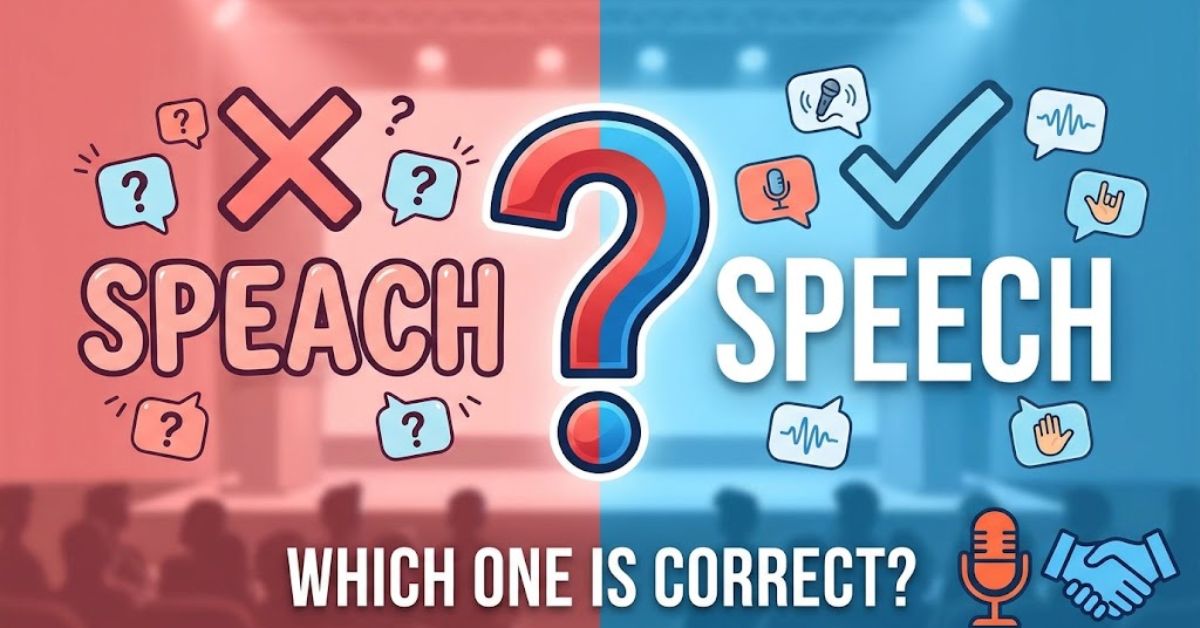
Wondering whether speach vs speech is the correct spelling? The answer is simple: speech is correct, while speach is a common misspelling.
Speech is a noun that can mean spoken communication, the ability to speak, or a formal talk presented to an audience. You might write a speech for school, listen to a wedding speech, study speech development, or discuss freedom of speech. In every case, you spell the word with ee.
A quick way to remember it is:
SP + EE + CH = SPEECH
The confusion often comes from words such as speak, teach, reach, and beach. They make the incorrect ea spelling look surprisingly convincing. However, standard English always uses speech.
What Is the Difference Between Speach and Speech?
The difference between speach and speech isn’t about meaning. It is simply a matter of correct versus incorrect spelling.
| Word | Correct? | Meaning |
|---|---|---|
| Speech | Yes | Spoken communication, the ability to speak, or a formal talk |
| Speach | No | Common misspelling of speech |
For example:
Correct: She gave an inspiring speech at graduation.
Incorrect: She gave an inspiring speach at graduation.
You don’t switch between the two depending on context. Whenever you mean spoken communication or a formal address, choose speech.
What Does Speech Mean?
Speech is primarily a noun. Its exact meaning changes slightly according to context.
Speech as spoken communication
Speech can describe the human ability to communicate using spoken words.
For example:
- Clear speech makes communication easier.
- The child is developing speech and language skills.
- Her speech became quieter when she entered the room.
Here, speech refers to speaking rather than a prepared presentation.
Speech as a formal talk
A speech can also be a prepared talk presented to an audience.
You might hear one at a wedding, graduation, conference, political event, or awards ceremony.
For example:
- Mia prepared a speech for graduation.
- The guest delivered a short speech.
- His wedding speech made everyone laugh.
In this meaning, speech is countable. One speech can become two or more speeches.
Speech as a person’s manner of speaking
Speech can also describe how a person speaks.
For example:
- His speech was slow and clear.
- Nervousness affected her speech.
- The actor changed his speech pattern for the role.
Context tells you which meaning applies.
Why Does the Correct Spelling Matter?
A tiny spelling mistake can make otherwise polished writing look careless.
Imagine submitting an assignment titled “My Graduation Speach.” Your teacher will probably understand you, but the misspelling stands out immediately.
Correct spelling matters particularly in:
- School and college assignments
- Business emails
- Presentations
- Professional documents
- Academic writing
- Website content
- Job applications
Using speech consistently keeps your writing clear and professional.
The Core Rule: Always Write Speech
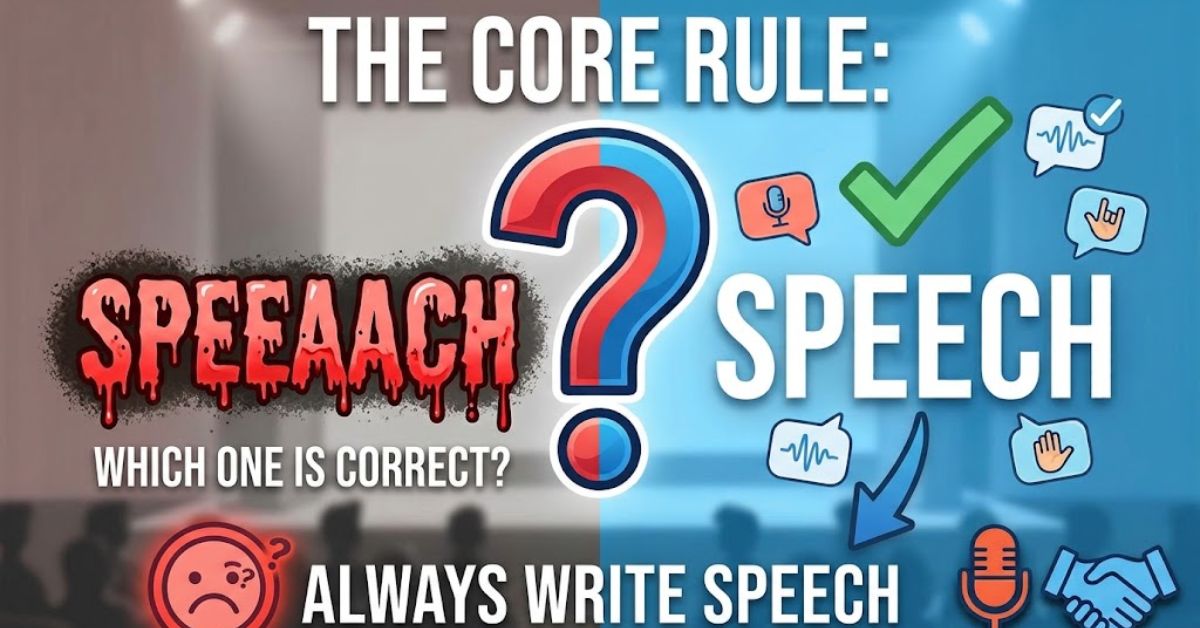
When choosing between speach vs speech, remember one rule:
Speech is correct. Speach is incorrect.
This applies to both American and British English.
The same rule applies inside common phrases:
speech therapy
freedom of speech
figure of speech
parts of speech
public speech
There isn’t a special context where you need to change ee to ea.
The spelling rule
Spell the word:
S-P-E-E-C-H
Not:
S-P-E-A-C-H
Keep these related forms in mind:
- Speech: noun
- Speeches: plural noun
- Speak: verb
- Speaker: noun
- Speaking: verb form or noun
- Spoken: past participle or adjective
The related word speak contains ea. That’s one reason people mistakenly carry the same spelling into speech.
How to Use Speech Correctly
Once you know the spelling, learning a few common patterns makes the word easier to use naturally.
Use speech when talking about public speaking
Use speech for a talk presented before an audience.
Examples:
- She gave a speech at the ceremony.
- He’s writing a speech for Friday.
- The winner delivered a powerful speech.
- We listened to three speeches.
Common combinations include give a speech, deliver a speech, write a speech, and prepare a speech.
Use speech when discussing communication
Speech can refer more broadly to spoken communication or the ability to speak.
Examples:
- Speech develops throughout early childhood.
- Clear speech helps listeners understand you.
- The course explores speech and communication.
- The software converts text into speech.
Use speech in common English expressions
You’ll regularly encounter speech in established expressions.
| Expression | Meaning |
|---|---|
| Freedom of speech | Freedom to express ideas and opinions |
| Figure of speech | A nonliteral or distinctive expression |
| Parts of speech | Grammatical word categories |
| Speech therapy | Support related to speech and communication |
| Direct speech | A person’s exact spoken words |
| Public speech | A talk delivered before an audience |
All these expressions use speech, never speach.
Understand speech and speeches
Speech is singular. Its plural is speeches.
Singular: The speech lasted ten minutes.
Plural: The students delivered three speeches.
Don’t write speachs or speaches. Both are incorrect.
Correct Examples of Speech in Everyday Writing
Seeing the word in realistic situations can make the spelling stick.
Conversation
“Have you finished your speech?”
“Almost. I still need to work on the ending.”
“Please send your final speech before Thursday so we can review it.”
School and college
“Our teacher asked us to write a speech about climate change.”
Workplace
“The director will deliver a speech during the annual meeting.”
Social media
“That graduation speech was exactly what I needed to hear today!”
Academic writing
“The study examined speech and language development in children.”
Public events
“The guest speaker gave the opening speech before the awards ceremony.”
Incorrect vs. Correct: Common Spelling Mistakes
| Incorrect | Correct |
|---|---|
| She gave a speach. | She gave a speech. |
| I wrote a speach. | I wrote a speech. |
| We heard two speaches. | We heard two speeches. |
| He needs speach therapy. | He needs speech therapy. |
| Freedom of speach matters. | Freedom of speech matters. |
| It’s a figure of speach. | It’s a figure of speech. |
| Learn the parts of speach. | Learn the parts of speech. |
The pattern is easy once you notice it: replace the incorrect ea with ee.
Why Do People Confuse Speach and Speech?
The mistake isn’t random. Several features of English make speach look believable.
1. Pronunciation can be misleading
Speech is pronounced approximately /spiːtʃ/. Its middle contains the long “ee” sound.
However, English represents that sound in several ways.
Think about:
- see
- speech
- team
- reach
- piece
They contain similar vowel sounds but different letter combinations. You can’t always spell an English word accurately just by hearing it.
2. English spelling is not perfectly predictable
English has collected spelling patterns from centuries of language development. As a result, one sound doesn’t always correspond to one letter combination.
That’s why memorizing common word forms can save you trouble.
3. The related word speak may cause confusion
Here’s the sneaky part.
Speak uses ea, while speech uses ee.
Compare:
- I speak English.
- I gave a speech in English.
- The speaker answered questions.
- Public speaking takes practice.
They’re closely related in meaning but don’t share exactly the same vowel spelling.
4. Autocorrect cannot replace proofreading
Spellcheck may catch speach, but don’t rely on technology for every error.
Before submitting important work, scan headings, titles, captions, and body text. A misspelling in a large heading is especially easy for readers to notice.
5. Translation can influence spelling
English learners often spell unfamiliar words according to pronunciation or patterns they already know.
That’s understandable. Still, repeated exposure to the correct form helps. Read it, write it, and use it in complete sentences.
Common Mistakes Checklist
Before publishing or submitting your work, check that you haven’t:
- Written speach instead of speech
- Used speaches instead of speeches
- Written speach therapy
- Confused the noun speech with the verb speak
- Assumed British English uses a different spelling
- Trusted pronunciation alone
- Forgotten to proofread headings and titles
One quick search for “speach” in your document can catch the error in seconds.
Speech in Real English
Correct spelling is only part of natural English. Word choice and context matter too.
Grammatically correct
“She delivered a speech at the conference” is correct.
So is:
“Speech plays an important role in communication.”
The first sentence refers to a specific talk. The second discusses speech generally.
Grammatically possible but unnatural
Some sentences may be understandable without sounding natural.
For example:
“She performed a speech.”
English speakers would normally say:
“She gave a speech.”
Or:
“She delivered a speech.”
Learning common collocations helps your English sound more natural.
Natural, everyday English
Useful everyday combinations include:
- give a speech
- write a speech
- prepare a speech
- deliver a speech
- hear a speech
- opening speech
- graduation speech
- wedding speech
Learning complete phrases often works better than memorizing one isolated word.
American vs. British English
There’s no speach vs speech regional difference.
| Usage | American English | British English |
|---|---|---|
| Singular | speech | speech |
| Plural | speeches | speeches |
| Formal talk | give a speech | give a speech |
| Communication support | speech therapy | speech therapy |
Some words change between American and British spelling, such as color/colour. Speech doesn’t.
Formal vs. Informal Usage
You can use speech in both formal and informal English.
Informal: “I’ve got to finish my speech tonight.”
Formal: “The chairperson delivered the opening speech.”
The surrounding vocabulary changes with the situation, but the spelling doesn’t.
Speech vs. Similar and Confusing Words
| Word | Type | Meaning |
|---|---|---|
| Speech | Noun | Spoken communication or formal talk |
| Speak | Verb | Communicate using spoken words |
| Speaker | Noun | Person who speaks |
| Speaking | Noun/verb form | Act of communicating orally |
| Spoken | Adjective/participle | Expressed orally |
| Conversation | Noun | Exchange of thoughts or ideas |
Remember the basic distinction: you speak, but you give a speech.
An Easy Memory Trick for Speech
Use this simple phrase:
“See the two E’s in speech.”
You can also break the spelling into three pieces:
SP + EE + CH
Visualize those two E’s sitting together in the middle.
Another useful sentence is:
A speaker speaks and gives a speech.
Repeat it a few times and the spelling soon becomes much harder to forget.
Speech in Real-Life Situations
The same word appears naturally across school, work, social, and professional settings.
At a job interview
“I prepared a short speech about my achievements” is grammatically correct, although presentation may sometimes fit the interview task better.
In a school examination
If you’re asked to write a speech, title it “A Speech on…”, not “A Speach on…”
In a business email
“Please review the speech before tomorrow’s meeting.”
This sentence sounds clear and professional.
In a text message
“I still haven’t finished my speech 😭”
Casual tone doesn’t change the spelling.
At a public event
“The host introduced the guest speaker before the opening speech.”
Here, speaker refers to the person while speech refers to the talk.
Expert Tips for Remembering the Correct Spelling
Don’t memorize speech in isolation. Connect it with phrases you actually use.
- Remember SP + EE + CH.
- Practice writing give a speech.
- Learn speech → speeches together.
- Separate speak the verb from speech the noun.
- Notice the word when reading.
- Proofread headings separately.
- Search your final document for speach.
With repetition, the correct spelling starts to look natural.
Frequently Asked Questions
1. Is it speach or speech?
Speech is correct. Speach is a common misspelling and isn’t the standard spelling of the English noun.
2. Is speach ever an acceptable spelling?
Not for the standard modern English word speech. If you’re referring to spoken communication or a formal talk, write speech.
3. What is the plural of speech?
The plural is speeches. For example, “The students prepared three speeches.”
4. How do you pronounce speech?
Speech is pronounced /spiːtʃ/, with a long “ee” sound.
5. Is speech a noun or a verb?
Speech is primarily a noun. The related verb is speak.
6. Why is speech spelled with ee instead of ea?
English uses several spelling patterns for the long “ee” sound. The established standard spelling of this word is speech.
7. Is speech spelled the same way in the UK and the US?
Yes. Both American and British English use speech and the plural speeches.
8. Which is correct: a speech or speech?
Both can be correct. Use a speech for one particular talk and speech without an article when discussing spoken communication generally.
9. Is speech therapy the correct expression?
Yes. Speech therapy is the correct expression. Speach therapy contains a spelling error.
10. How can I stop making this spelling mistake?
Remember SP + EE + CH and practice phrases such as give a speech and write a speech.
Mini Quiz: Test Your Knowledge of Speech vs. Speach
Test yourself before checking the answers.
- Which is correct: speach or speech?
- She gave a wonderful ______ at graduation.
- What is the plural of speech?
- Which is correct: speech therapy or speach therapy?
- Complete the sentence: “Please ______ clearly.”
- Is speech spelled differently in British English?
- Correct this phrase: “freedom of speach.”
- Which is the verb: speak or speech?
Answers:
- Speech
- Speech
- Speeches
- Speech therapy
- Speak
- No
- Freedom of speech
- Speak
If you got all eight right, you’ve nailed it.
Quick Summary
When comparing speach vs speech, there is only one correct choice: speech.
Speech is a standard English noun referring to spoken communication, someone’s manner of speaking, or a formal talk presented to an audience. Speach is a common spelling mistake, not an alternative spelling.
Remember the essentials:
- Correct: speech
- Incorrect: speach
- Plural: speeches
- Related verb: speak
- Pronunciation: /spiːtʃ/
- Memory trick: SP + EE + CH
American and British English both use the same spelling. Whether you’re writing a school assignment, business email, graduation speech, or academic paper, remember those two E’s and choose speech every time.

Finn Bradley is a grammar and language writer at Megazine Tech, focused on making English easier to understand. He researches grammar rules, vocabulary, sentence usage, punctuation, and common writing questions. Through clear explanations and practical examples, Finn helps readers build stronger communication skills and write with greater confidence in everyday situations.