

Emersion vs Immersion: Differences, Meanings, and Correct Usage
English has plenty of words that look almost identical but carry very different meanings. Emersion vs immersion is a perfect example. Change just one letter, and the direction of the meaning changes.
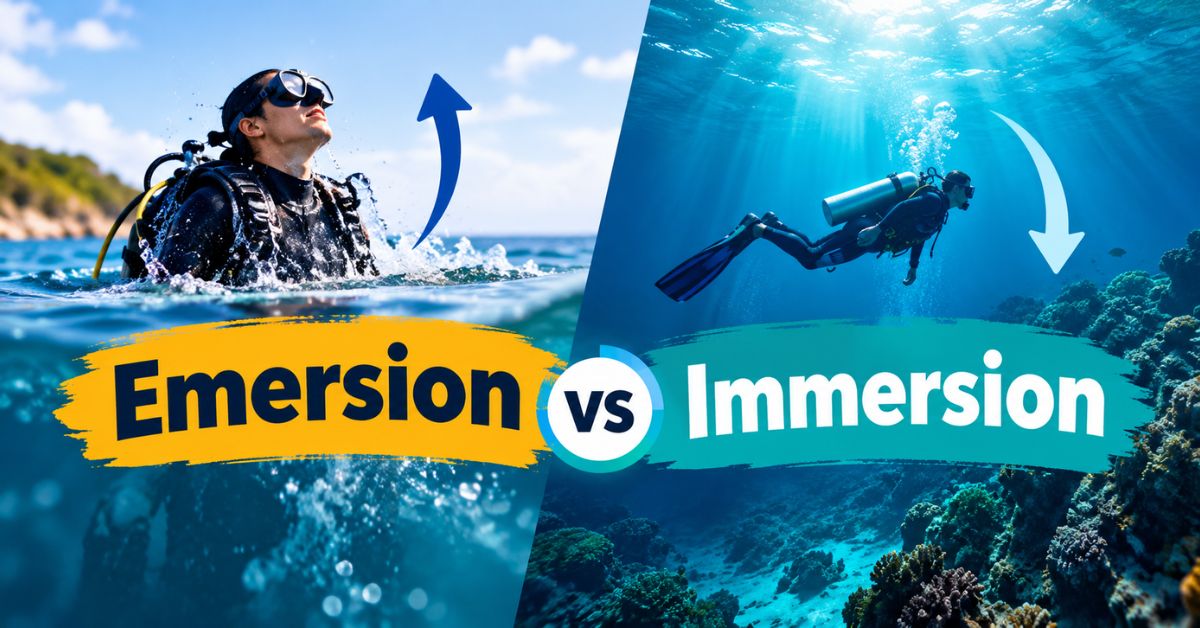
Immersion means going into something, being surrounded by it, or becoming deeply involved in an experience. Emersion, on the other hand, means coming out of something, especially from water or another submerged state.
Picture a swimmer. Going beneath the water represents immersion. Coming back above the surface represents emersion.
That basic difference sounds simple, but these words appear in several contexts, including science, education, psychology, technology, language learning, and everyday writing. This guide explains their meanings, differences, correct usage, and examples so you can confidently choose the right word.
Emersion vs Immersion: Quick Comparison
Here’s the easiest way to understand the difference:
| Feature | Emersion | Immersion |
|---|---|---|
| Basic meaning | Coming out or emerging | Going into or becoming deeply involved |
| Direction | Outward or upward | Inward or downward |
| Common usage | Scientific and technical contexts | Education, technology, culture, and everyday English |
| Physical idea | Rising from a submerged state | Being placed below or within something |
| Figurative idea | Emerging or transitioning out | Deep involvement or engagement |
| Frequency | Less common | Very common |
A useful memory trick is:
Emersion = E for Exit
Immersion = I for Into
If something is coming out, think of emersion. If something is going into or becoming deeply involved, think of immersion.
What Does Emersion Mean?
Emersion means the act or process of emerging from a submerged, covered, or hidden condition.
The word isn’t especially common in everyday conversations. You’re more likely to encounter it in scientific or technical writing.
For example, imagine a diver working underwater. When the diver rises above the water’s surface, that movement can be described as emersion.
Simple Emersion Definition
Emersion is the process of coming out of water or emerging from a previously submerged or hidden state.
Examples include:
- A diver rising above the water
- A submarine reaching the surface
- Rocks becoming exposed as the tide falls
- Marine plants becoming exposed during low tide
- A celestial object becoming visible after being hidden
In simple terms, emersion means coming out.
Emersion in Scientific Contexts
Although you probably won’t hear someone casually say, “What a wonderful emersion,” the term has useful scientific applications.
Emersion in Marine Biology
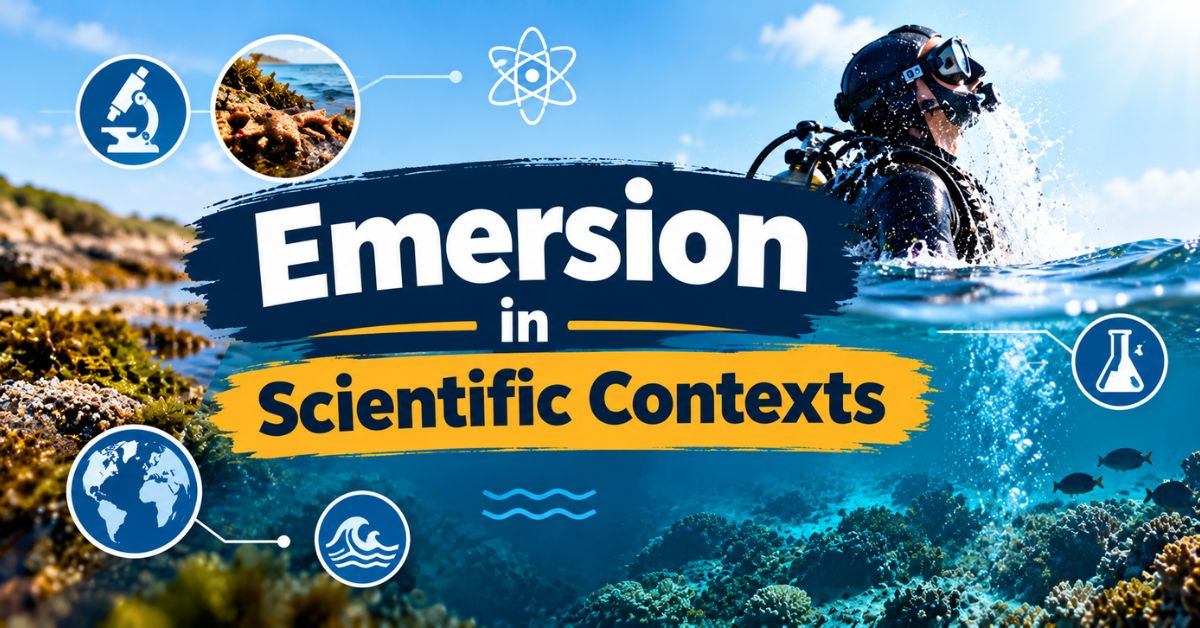
Marine environments constantly change because of tides. When the water level falls, organisms that were previously underwater may become exposed to air.
That period of exposure is called emersion.
For example:
Some coastal organisms can survive long periods of emersion during low tide.
Plants and animals living near shorelines often experience repeated cycles of immersion and emersion.
Emersion in Astronomy
The term also appears in astronomy.
Here, emersion can describe the point when a celestial object becomes visible again after being temporarily hidden by another object.
For example:
Astronomers recorded the star’s emersion after it became visible again.
The same core idea remains: something that was hidden becomes visible.
Emersion in Environmental Science
Researchers studying coastal environments may examine how plants and animals respond to periods underwater and periods exposed to air.
In this situation:
Immersion = underwater
Emersion = exposed above water
These changing conditions can influence temperature, oxygen availability, moisture, and the behavior of organisms.
Origin of the Word Emersion
The meaning of emersion becomes easier to remember when you connect it with the familiar word emerge.
Both carry the basic idea of coming out or becoming visible.
Think about someone emerging from a swimming pool. They’re moving from below the surface to above it. That image captures the central meaning of emersion.
Emersion in Figurative Writing
Emersion can occasionally be used beyond its physical meaning.
A writer might use it metaphorically to describe someone coming out of an intense period, difficult situation, or deeply absorbing experience.
For example:
The team entered a period of reflection after emerging from months of demanding research.
However, figurative uses of emersion are far less common than the ordinary and figurative uses of immersion. In most everyday writing, another word such as emergence, transition, or reflection may sound more natural.
What Does Immersion Mean?
Immersion means being submerged in something or becoming deeply involved in an activity, subject, environment, or experience.
Unlike emersion, immersion is a very common English word.
It can describe something physical:
The object remained under water during immersion.
It can also describe deep mental involvement:
Her immersion in the novel made her lose track of time.
That’s why immersion has a much broader range of uses.
Two Main Types of Immersion
You can generally understand immersion in two ways:
1. Physical Immersion
Physical immersion involves placing something into a liquid or surrounding substance.
Examples include:
- A person entering water
- An object being submerged in liquid
- Certain forms of baptism
- Scientific water experiments
- Cooking processes involving submerged ingredients or equipment
The meaning is literal: something goes into or remains within another substance.
2. Mental or Psychological Immersion

Immersion can also happen without water.
Have you ever become so interested in a movie, game, or book that you temporarily forgot what was happening around you?
That’s psychological immersion.
Examples include:
- Reading an exciting novel
- Playing an engaging video game
- Watching an intense movie
- Studying a fascinating topic
- Participating in virtual reality
- Becoming absorbed in a creative project
Here, immersion means deep involvement or complete attention.
Emersion vs Immersion: Key Differences
The biggest difference between emersion and immersion is direction.
Direction
Emersion: movement outward or upward
Immersion: movement inward, downward, or deeply into something
Think about swimming:
You jump into the pool — immersion.
You rise out of the pool — emersion.
Level of Involvement
Immersion can describe deep involvement in an experience.
For example:
She experienced complete immersion in the local culture.
Emersion doesn’t normally describe becoming involved. Instead, it focuses on coming out, emerging, or becoming exposed.
Frequency of Use
Another major difference is how frequently the words appear.
Immersion is common in:
- Education
- Language learning
- Gaming
- Technology
- Psychology
- Travel
- Culture
- Cooking
- Science
Emersion is much less common and appears mainly in:
- Marine biology
- Astronomy
- Environmental science
- Technical discussions
So, if you’re talking about deep engagement, learning, virtual reality, or culture, immersion is probably the word you need.
Emersion vs Immersion in Education
Education provides one of the clearest examples of how immersion is used.
What Is Immersion Learning?
An immersion learning program surrounds students with the subject or language they’re trying to learn.
Language immersion is a common example.
Instead of studying a language only through vocabulary lists and grammar exercises, students regularly hear, speak, read, and write it.
A language immersion classroom might include:
- Lessons taught primarily in the target language
- Regular conversations
- Practical speaking activities
- Reading exercises
- Listening practice
- Cultural activities
Students don’t simply memorize the language. They experience it repeatedly in meaningful situations.
Benefits of Immersion Learning
Immersive learning can make education more interactive and practical.
Potential benefits include:
| Benefit | How It Helps |
|---|---|
| More exposure | Learners regularly encounter the subject or language |
| Practical experience | Students apply knowledge instead of only memorizing it |
| Better confidence | Frequent practice makes unfamiliar tasks feel more natural |
| Stronger engagement | Interactive experiences can hold attention |
| Cultural awareness | Language learners can understand context as well as vocabulary |
Immersion is especially useful when students need practical experience rather than theory alone.
Emersion vs Immersion in Language Learning
Language learning is strongly associated with immersion.
Imagine that you’re learning Spanish. You move into an environment where people speak Spanish around you every day. You hear it at shops, use it during conversations, watch local media, and practice it naturally.
That’s language immersion.
You’re surrounded by the language rather than interacting with it for only a few minutes during a lesson.
After leaving that environment, you might spend time reviewing what you learned and adjusting to your regular surroundings. That transition can loosely resemble the idea of emersion, although emersion is not nearly as common a term in everyday language-learning discussions as immersion.
Emersion vs Immersion in Psychology
The difference also becomes interesting when discussing attention and mental engagement.
Psychological Immersion
Psychological immersion occurs when your attention becomes deeply focused on an experience.
You may temporarily pay less attention to outside distractions because your mind is heavily engaged.
Examples include:
- A gamer focused on a difficult level
- A reader absorbed in a mystery novel
- An athlete concentrating intensely during competition
- A student deeply engaged in a project
- A viewer completely absorbed in a film
This state is closely connected with the everyday idea of being “lost” in an activity.
What Happens After Immersion?
Once the intense activity ends, a person may begin reflecting on what happened.
They might:
- Review the experience
- Think about what they learned
- Connect new ideas with existing knowledge
- Evaluate mistakes
- Develop new insights
While emersion can metaphorically suggest coming out of an immersive state, the word is less commonly used this way in ordinary psychology discussions. Use it carefully when writing for a general audience.
Immersion in Technology
Modern technology has made the word immersive even more popular.
An immersive digital experience attempts to make users feel deeply involved in a virtual or interactive environment.
Virtual Reality
Virtual reality is a strong example.
VR systems may use:
- Visual environments
- Spatial sound
- Motion tracking
- Interactive controls
- Simulated surroundings
These elements can create a sense that the user is present inside a digital environment.
That’s why phrases such as immersive experience, immersive technology, and immersive environment are common.
Gaming
Game developers also aim to create immersion.
Players may become more absorbed when a game includes:
- Detailed environments
- Interesting characters
- Responsive gameplay
- Strong storytelling
- Realistic audio
- Meaningful choices
The goal is to make the virtual world feel engaging enough that the player wants to remain involved.
Emersion vs Immersion Examples
Seeing both words in sentences makes the difference much easier to remember.
Examples of Emersion
- The diver’s emersion was recorded by the research team.
- Some coastal plants tolerate repeated periods of immersion and emersion.
- Researchers observed the organism during its emersion from the water.
- The star’s emersion made it visible again to observers.
- Low tide caused the emersion of previously submerged rocks.
Every example involves something coming out, becoming exposed, or becoming visible again.
Examples of Immersion
- The school offers a French immersion program.
- Cultural immersion helped the travelers understand local traditions.
- Virtual reality can create a strong sense of immersion.
- Her complete immersion in the book made her forget the time.
- The experiment required full immersion of the sample in water.
These examples involve either physical submersion or deep involvement.
Cultural Immersion Meaning
Cultural immersion means deeply experiencing another culture rather than observing it from a distance.
For example, travelers may experience cultural immersion by:
- Living with local families
- Learning the local language
- Eating traditional food
- Participating in festivals
- Visiting community spaces
- Following local customs
- Speaking with residents
The goal is deeper participation and understanding.
Reading about a culture gives you information. Living within it gives you immersion.
Immersion Blender vs Emersion
Here’s an easy one.
The correct term is immersion blender, not emersion blender.
An immersion blender is a handheld kitchen appliance that you place directly into food or liquid to blend it.
Why is it called an immersion blender?
Because part of the blender is immersed in the mixture.
The word emersion isn’t normally used for this kitchen tool.
Submersion vs Immersion
These two words are also easy to confuse.
Submersion generally emphasizes being placed or going completely beneath the surface of a liquid.
Immersion can also involve being placed in liquid, but its meaning is broader.
For example:
The equipment remained in complete submersion beneath the water.
Meanwhile:
The student’s immersion in Japanese culture improved her understanding of the language.
You wouldn’t normally use submersion in the second sentence because the person isn’t literally underwater.
Immersion works both literally and figuratively.
Common Mistakes With Emersion and Immersion
The similar spelling makes these words surprisingly easy to mix up.
Mistake 1: Using Immersion for Coming Out of Water
Incorrect:
The diver’s immersion from the water happened at noon.
Better:
The diver’s emersion from the water happened at noon.
Why?
The diver is coming out, not going in.
Mistake 2: Using Emersion for Deep Engagement
Incorrect:
The game created an incredible sense of emersion.
Correct:
The game created an incredible sense of immersion.
The player is deeply engaged in the experience, so immersion is correct.
Mistake 3: Treating Them as Synonyms
Emersion and immersion aren’t interchangeable.
Their meanings point in different directions:
Immersion → into
Emersion → out
That one distinction can prevent most mistakes.
Easy Memory Trick for Emersion vs Immersion
Still mixing them up? Remember two letters:
E = Exit
Emersion begins with E.
Think:
E = Exit = Emerging out
I = Into
Immersion begins with I.
Think:
I = Into = Going in
So:
| Word | Memory Trick |
|---|---|
| Emersion | E = Exit |
| Immersion | I = Into |
Imagine someone jumping into a swimming pool and climbing back out.
Jump in = immersion.
Come out = emersion.
It’s hard to forget once you picture it.
Similarities Between Emersion and Immersion
Despite their different meanings, the two words have a few similarities.
Both can relate to:
- Water
- Changes in physical states
- Movement
- Scientific observations
- Experiences or transitions
They also sound very similar, which explains why writers sometimes confuse them.
However, their direction separates them.
Immersion takes you in. Emersion brings you out.
Which Word Should You Use?
Ask yourself one simple question:
Is something going in or coming out?
Use immersion when something:
- Goes into liquid
- Becomes surrounded
- Gets deeply involved
- Receives intense exposure
- Becomes absorbed in an experience
Use emersion when something:
- Comes out of water
- Emerges from a submerged state
- Becomes exposed
- Becomes visible again
For mental engagement, education, gaming, culture, and virtual reality, immersion is usually the natural choice.
For technical descriptions of emerging from water or becoming visible again, emersion may be appropriate.
Quick Recap
| Emersion | Immersion |
|---|---|
| Means coming out | Means going in or becoming deeply involved |
| Think “exit” | Think “into” |
| Less common | Very common |
| Often technical | Used in everyday and technical English |
| Common in marine and scientific contexts | Common in education, culture, gaming, technology, and psychology |
The simplest distinction is:
Emersion = emerging out
Immersion = going in or becoming deeply engaged
Frequently Asked Questions
What is the meaning of emersion vs immersion?
Emersion means emerging or coming out of a submerged or hidden state. Immersion means being submerged or becoming deeply involved in an experience.
What does emersion mean?
Emersion is the act of emerging from something, particularly water or another submerged state. The term is often found in scientific and technical contexts.
What does immersion mean?
Immersion means being submerged in something or becoming deeply absorbed in an activity, environment, culture, or experience.
Is emersion the opposite of immersion?
In many physical contexts, yes. Immersion can describe going into or being under water, while emersion describes coming out or becoming exposed.
What is immersion in psychology?
Immersion can describe a state of deep mental involvement in an activity or experience. A person may become highly focused and pay less attention to surrounding distractions.
What is immersion in education?
Educational immersion involves surrounding students with a language, subject, or learning environment so they gain knowledge through continuous exposure and practical participation.
Is it emersion blender or immersion blender?
Immersion blender is correct. The appliance is called an immersion blender because its blending end is placed directly into food or liquid.
What is the difference between submersion and immersion?
Submersion usually emphasizes being completely beneath a liquid’s surface. Immersion can refer to physical submersion, but it can also mean deep mental, cultural, or educational involvement.
What is cultural immersion?
Cultural immersion means actively experiencing another culture through its language, customs, food, traditions, communities, and everyday activities.
How can I remember emersion vs immersion?
Use this simple trick: E in emersion = Exit, while I in immersion = Into. Emersion brings something out, while immersion takes something in.
Final Thoughts
The spelling difference between emersion and immersion is tiny, but their meanings shouldn’t be treated as the same.
Immersion describes going beneath something or becoming deeply involved in an experience. You can experience immersion in water, education, gaming, virtual reality, language learning, or another culture.
Emersion moves in the other direction. It describes emerging from a submerged or hidden condition and is most common in scientific or technical contexts.
Just picture someone swimming.
They dive below the surface: immersion.
They rise back above it: emersion.
And if you forget, use the easiest trick of all:
I = Into. E = Exit.

Finn Bradley is a grammar and language writer at Megazine Tech, focused on making English easier to understand. He researches grammar rules, vocabulary, sentence usage, punctuation, and common writing questions. Through clear explanations and practical examples, Finn helps readers build stronger communication skills and write with greater confidence in everyday situations.