

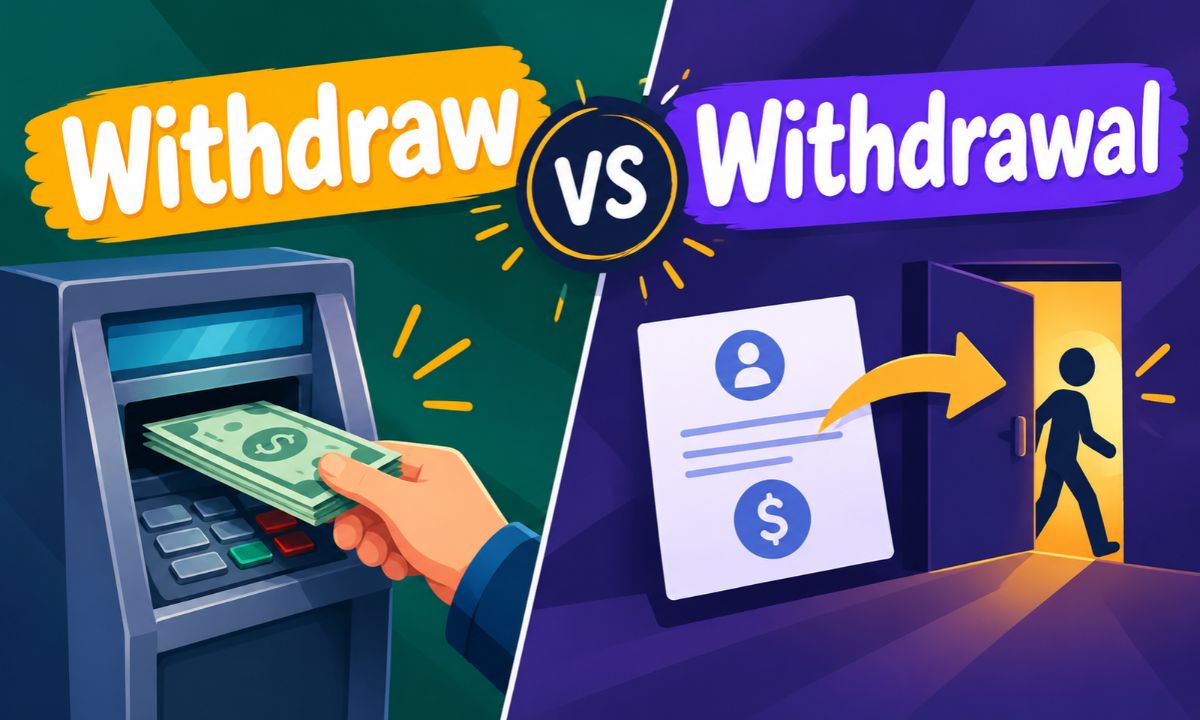
Ever typed “I need to make a withdraw” and felt a tiny doubt creep in? You’re not alone. Plenty of people mix up withdraw and withdrawal when they fill out a bank form, email a professor, or read a news headline about a military withdrawal.
Here’s the short answer to Withdraw vs Withdrawal. Withdraw is a verb, so you use it for the action, like taking out cash. Withdrawal is a noun, so you use it for the event, like a cash withdrawal or withdrawal symptoms. This guide covers correct usage, withdraw past tense, withdrawn, common spelling slips like withdrawl, and plenty of plain examples. So read on, and you’ll never second-guess these two words again. No grammar degree needed.
Withdraw or Withdrawal – Quick Answer
Withdraw Meaning and Definition
The withdraw definition is simple. To withdraw means to take something back, take it out, or pull away.
You can withdraw money, withdraw an offer, or withdraw from a meeting. The withdraw meaning in English always involves moving something or someone away from a place or commitment.
Withdrawal Meaning and Definition
The withdrawal definition points to the act or result of withdrawing. It names the event, not the action itself.
A bank slip says “withdrawal.” A doctor talks about “withdrawal.” The withdrawal meaning in English covers money, retreat, and even the body’s reaction when a substance stops.
Withdraw vs Withdrawal: Key Difference
Here’s the withdraw and withdrawal difference in one line. Withdraw is what you do, and withdrawal is what you call it.
Think of “run” and “a run.” You run to the store, and you went for a run. Same logic applies here.
Quick Examples of Correct Usage
Try these pairs. “I’ll withdraw $200 today.” “My withdrawal was approved.”
And two more. “She withdrew from the race.” “Her withdrawal surprised everyone.” That’s correct usage of withdraw and correct usage of withdrawal side by side.
What Does Withdraw Mean?
Withdraw as a Verb
So, is withdraw a noun or a verb? It’s a verb, full stop. It’s an action word that works as both a transitive verb and an intransitive verb.
Transitive means it takes an object: “He withdrew his application.” Intransitive means it stands alone: “The troops withdrew at dawn.”
Withdraw Synonyms
Need another word? Common withdraw synonyms include remove, retract, retreat, pull out, step back and take out.
Pick based on context. You retract a statement, retreat from a battlefield, and take out cash. Each synonym carries its own flavor.
Withdraw Money from a Bank
This is the use most people search for. When you withdraw money or withdraw cash, you take funds out of your checking account.
You can also withdraw funds from savings or an investment account. It’s the opposite of a deposit, which puts money in.
Withdraw in a Sentence
Seeing the word at work helps. Here’s withdraw in a sentence: “I want to withdraw my savings before the trip.”
Or: “The company will withdraw the product next month.” Notice the verb always follows a subject, like I or company.
Read More: Hustle vs Hussle: Which Is Correct Spelling and Usage?
What Does Withdrawal Mean?
Withdrawal as a Noun
Is withdrawal a noun or a verb? It’s a noun, a naming word. It labels an event, a process or a state.
You can count it. One withdrawal, two withdrawals. You can also put “a” or “the” in front of it, which verbs never allow.
Withdrawal Synonyms
Common withdrawal synonyms include retreat, removal, retraction, exit and pullout. In banking, people also say “debit.”
In medicine, you might hear “detox symptoms.” Choose the synonym that fits your setting, or just stick with the original.
Cash Withdrawal Meaning
Cash withdrawal means taking physical money out of your account. You might do it at a branch counter or through an ATM withdrawal.
Every bank withdrawal shows up as a bank transaction on your statement. Many cards also set a withdrawal limit per day.
Withdrawal in a Sentence
Here’s withdrawal in a sentence: “Your withdrawal will arrive in two business days.”
Another one: “The withdrawal of funding hurt the project.” See how a noun sits comfortably after “the” or “your.”
Withdraw or Withdrawal in Different Contexts
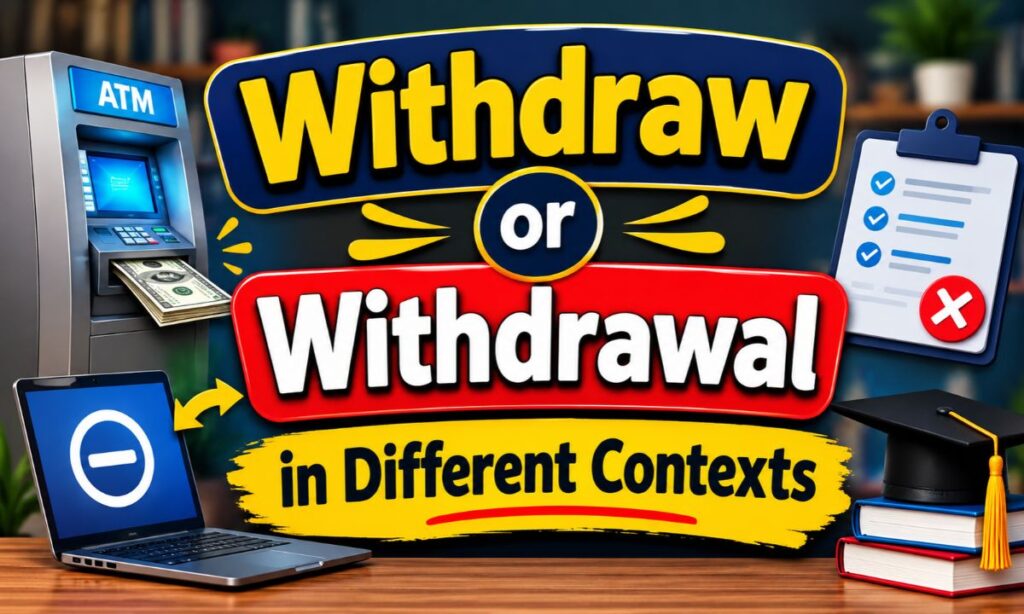
Withdraw or Withdrawal in Banking
Banking trips people up the most. You withdraw cash, but you make a withdrawal.
So “I’ll make a withdrawal” is right, and “I’ll make a withdraw” is wrong. Tricky? Only until you spot the article “a.”
Withdraw or Withdrawal from Drugs
In medicine, drug withdrawal describes what the body goes through after stopping a substance. Doctors list withdrawal symptoms like headaches, shaking, nausea and trouble sleeping.
The verb still exists too. A person can withdraw from a medication, but most writers use the noun. If someone is going through this, medical supervision matters.
Withdraw or Withdrawal from School
Students face this one often. You withdraw from a class, and the school records a course withdrawal.
Most colleges give you a withdrawal form. Check the deadline, because a late withdrawal can leave a mark on your transcript or cost you tuition.
Withdraw or Withdrawal from an Application
Changed your mind about a job or visa? You can withdraw your application. That’s the action.
The formal record is an application withdrawal. A candidate withdrawal happens when someone drops out of a hiring process or an election.
Withdraw or Withdrawal from a Competition
Athletes withdraw from a competition because of injury, illness or personal reasons. Teams do the same.
The news then reports a “late withdrawal.” You can also withdraw from a project at work, though that email needs careful wording.
Withdraw and Withdrawal in Everyday Examples
Banking Examples
“I’ll withdraw $50 from the ATM.” “The withdrawal failed because my balance was low.”
Or: “Your withdrawal limit resets at midnight.” Real bank apps use these phrases every day.
Email Examples
“I’d like to withdraw my complaint, since the issue is fixed.” That’s a polite, clear line.
Try this one too: “Please confirm my withdrawal from the workshop.” Short, neutral, and easy to answer.
News Examples
“Leaders announced the withdrawal of troops by spring.” Another version: “Forces will withdraw troops from the region.”
A military withdrawal headline uses the noun. A sentence about the action uses the verb.
Read More: Manuel vs Manual: When to Use Each One in Writing
Social Media Examples
“Taking a break, so I’m withdrawing from socials this week.” That’s the verb in its “-ing” form.
And: “This feels like withdrawal from my phone.” Here people use the noun for a feeling. It’s casual but correct.
Formal Writing Examples
“The board voted to withdraw support for the merger.” “The withdrawal of funding ended the study.”
In legal writing you might withdraw a statement before trial. Formal tone, same grammar rules.
Common Mistakes with Withdraw and Withdrawal
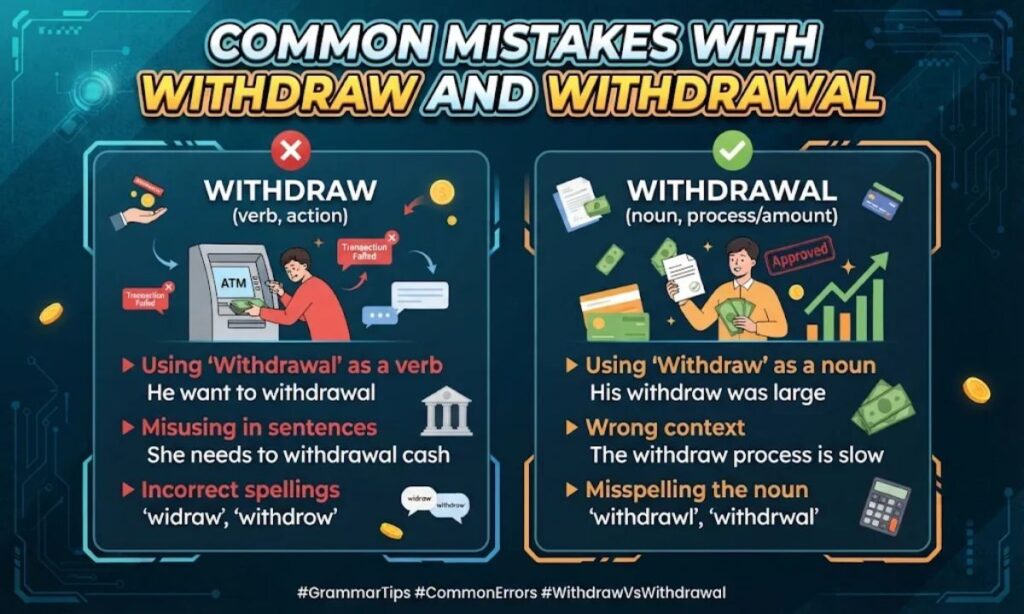
Using Withdrawal as a Verb
The most frequent slip? Writing “I will withdrawal money.” That’s a noun doing a verb’s job.
Fix it fast: “I will withdraw money.” These common withdrawal mistakes show up in emails, forms and even ads.
Using Withdraw as a Noun
The reverse also happens. “I made a withdraw yesterday” sounds close but breaks the rule.
Say “I made a withdrawal.” These common withdraw mistakes mostly come from rushing.
Confusing Withdraw, Withdrew, and Withdrawn
Three forms, one word. Withdraw is the base, withdrew is the past, and withdrawn is the participle.
You’ll see “Has withdrew” in the wild, which is wrong. It should be “has withdrawn.” Likewise, withdrawed isn’t a real word.
Withdrawl vs Withdrawal: Common Spelling Errors
The usual withdraw spelling mistakes include withdrawl and withdrwal. Both drop or swap letters.
The correct spelling of withdrawal ends in “-al.” Words like withdrawment and withdraught aren’t standard English, so skip them. These withdrawal spelling mistakes cause plenty of spelling confusion.
Withdraw vs Withdrawal: Grammar and Word Forms
What Is the Past Tense of Withdraw?
The withdraw past tense is withdrew. “She withdrew her offer yesterday.”
It’s an irregular verb, so don’t add “-ed.” Keep this in your back pocket for any English grammar check.
What Is the Past Participle of Withdraw?
The withdraw past participle is withdrawn. You pair it with “has,” “have” or “had.”
Example: “He has withdrawn his name.” Other forms include withdraws for third person and withdrawing for the continuous form.
Can Withdrawal Be Used as a Verb?
No. Withdrawal is a noun, so it can’t act as a verb. There’s no “withdrawaled” or “withdrawaling.”
When you need the action, switch to withdraw. This withdrawal grammar rule has no exceptions.
Is Withdraw a Noun or a Verb?
It’s a verb. The part of speech matters because verbs describe actions and nouns name things.
So for withdraw noun or verb, answer verb. For withdrawal noun or verb, answer noun. That’s the full grammar and word forms picture.
The Origin of Withdraw and Withdrawal
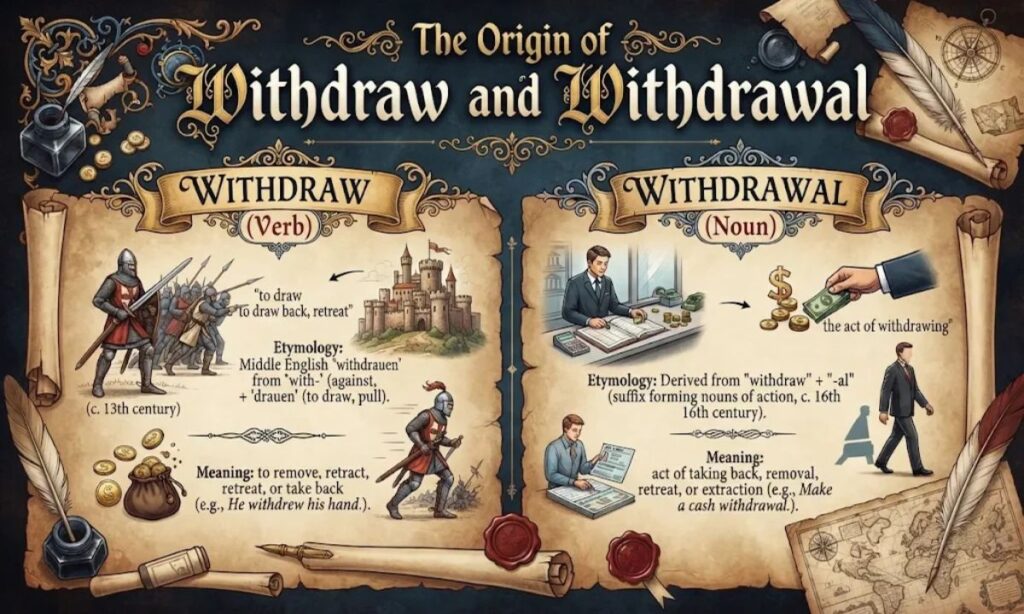
The word withdraw grew out of Middle English. It joins “with,” which once meant “against” or “back,” and “draw,” meaning to pull.
So it literally meant to pull back. That old sense still lives in every bank slip and battlefield report.
The noun withdrawal came later by adding the “-al” ending, a common way English turns verbs into nouns. Think of arrive and arrival, or refuse and refusal.
Seeing that pattern helps you remember it. If a verb takes “-al,” you usually get the noun form.
British English vs American English Spelling
Withdraw and Withdrawal Spelling Comparison
Good news here. In British English vs American English, both words are spelled the same way.
Unlike “colour” and “color,” there’s no regional split. So withdraw spelling and withdrawal spelling stay constant worldwide.
| Form | British English | American English |
| Base verb | withdraw | withdraw |
| Past tense | withdrew | withdrew |
| Past participle | withdrawn | withdrawn |
| Noun | withdrawal | withdrawal |
Withdraw vs Withdrawal: Comparison Table
A quick side-by-side makes the withdraw and withdrawal difference easy to scan. Save it for later.
| Feature | Withdraw | Withdrawal |
| Part of speech | Verb | Noun |
| Role | Action | Event or result |
| Plural | Withdraws (verb form) | Withdrawals |
| Banking example | I withdraw cash | I made a withdrawal |
| Medical example | Rarely used | Withdrawal symptoms |
| Common error | Used as a noun | Used as a verb |
Withdraw vs Withdrawal – Usage and Search Insights
People search Withdraw vs Withdrawal mostly because of banking forms and school paperwork. Typos like withdrawl also pop up constantly in search bars.
That tells you where confusion lives. Questions like “is withdrawal a noun or a verb” and “withdraw or withdrawal when taking money from a bank” appear again and again.
Here’s a simple memory trick. If you can put “a” or “the” before it, use withdrawal. If you can put “to” or “I” before it, use withdraw.
Try it with “the ___ was approved” and “I will ___ cash.” The answer jumps out every time.
Frequently Asked Questions
What Is the Difference Between Withdraw and Withdrawal?
Withdraw is a verb meaning to take out or pull back. Withdrawal is the noun for that act or result.
So you withdraw cash, and the transaction is a withdrawal.
Is It Cash Withdraw or Cash Withdrawal?
It’s cash withdrawal. Here “cash” describes a noun, so you need the noun form.
The verb phrase is “withdraw cash.”
Is Withdraw Money Correct?
Yes. “Withdraw money” is correct because withdraw is a verb followed by an object. Say “I’ll withdraw money from my account.”
Is Withdrawal the Correct Spelling?
Yes, withdrawal is the right spelling in every English variety. It ends with “-al” and has no extra letters.
Is “Withdrawl” a Valid Spelling?
No. Withdrawl is a misspelling, so use withdrawal instead.
How Do You Use Withdraw in a Sentence Correctly?
Place it after a subject. For example, “They withdraw funds every month.”
Change the form for tense: withdrew for past, withdrawn after “has.”
How Do You Use Withdrawal in a Sentence?
Treat it like any noun. For example, “Her withdrawal from the race shocked fans.”
You can also pluralize it: “Three withdrawals happened today.”
What Is the Difference Between Withdrawn and Withdrawal?
Withdrawn is the past participle of withdraw, and it can also be an adjective meaning shy or quiet. Withdrawal is a noun.
Example: “He seemed withdrawn after his withdrawal from the team.”
What Does Withdrawal Mean in a Medical Context?
In medicine, withdrawal means the physical and mental symptoms after stopping a substance. Examples include sweating, anxiety and cravings.
If you or someone you know faces this, talk to a doctor first. Stopping certain substances suddenly can be risky.
Can Withdrawal Be Used as a Verb?
No, it can’t. Use withdraw when you need an action word.
Conclusion
Now you know how Withdraw vs Withdrawal really works. Withdraw is the action word, and withdrawal is the naming word. You withdraw money from your checking account, and you make a withdrawal. Easy, right?
Practice makes it stick. Keep the forms straight too. Use withdrew for the past and withdrawn after “has,” and skip withdrawed and withdrawl. Whenever doubt creeps in, test the slot: verb or noun? Got a tricky sentence that still bugs you? Drop it in the comments below, and we’ll untangle it together. And share this English grammar guide with a friend who keeps mixing these up.

Finn Bradley is a grammar and language writer at Megazine Tech, focused on making English easier to understand. He researches grammar rules, vocabulary, sentence usage, punctuation, and common writing questions. Through clear explanations and practical examples, Finn helps readers build stronger communication skills and write with greater confidence in everyday situations.