

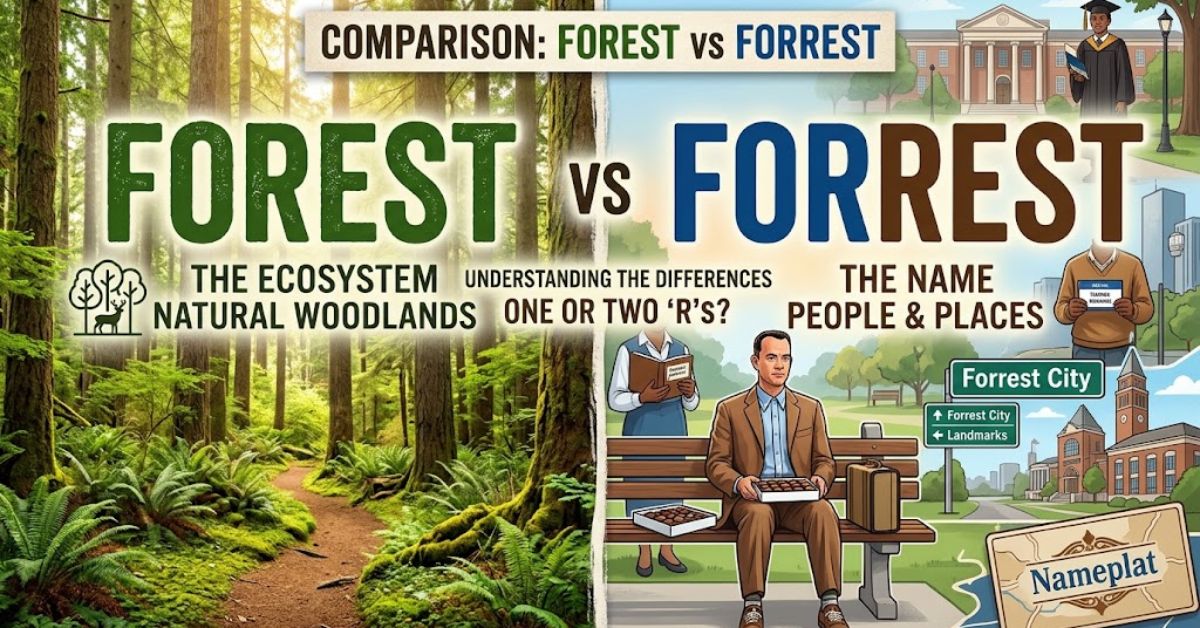
When comparing Forest vs Forrest, it’s easy to wonder whether one is a typo or both are correct. They look almost identical and sound the same when spoken, but their meanings and uses are quite different.
Forest is the standard English word for a large area of land covered with trees and other vegetation. You’ll see it in conversations about nature, wildlife, geography, parks, and the environment. Forrest, on the other hand, is mainly used as a person’s first name or surname.
Knowing the difference between Forest and Forrest can help you avoid a simple but noticeable spelling mistake. Whether you’re writing an essay, email, article, caption, or professional document, choosing the right spelling makes your writing clearer.
This guide explains the meanings, differences, examples, history, common mistakes, and easy tricks for remembering Forest vs Forrest.
Quick Answer: Forest or Forrest?
Here’s the easiest way to understand the difference:
| Word | Meaning | Correct Usage |
|---|---|---|
| Forest | A large area of land covered with trees | Common noun |
| Forrest | Usually a person’s first or last name | Proper noun |
Simple Rule
- Forest = Trees and nature
- Forrest = A person’s name
If you’re talking about trees, wildlife, nature, parks, or ecosystems, you almost always want forest.
What Does Forest Mean?
A forest is a large area of land where trees and other plants grow closely together. Forests can also provide habitats for countless animals, insects, fungi, and other living organisms.
The word is a common noun, so it usually appears in lowercase unless it begins a sentence or forms part of an official name.
Dictionary Definition
In simple terms, a forest is:
A large area of land mainly covered with trees and other vegetation.
Forests are important natural ecosystems. They provide wildlife habitats, store carbon, influence climate, protect soil, and support human communities.
Examples of Forest in Sentences
- We spent the afternoon walking through the forest.
- The forest looks beautiful during autumn.
- Many wild animals live deep inside the forest.
- A wildfire damaged part of the forest.
- The hikers followed a narrow path through the forest.
- Local authorities are working to protect the forest.
Why Forests Matter
Forests aren’t simply beautiful places filled with trees. They perform important environmental and economic functions that affect both wildlife and people.
Forests Help Produce Oxygen
Trees use photosynthesis to absorb carbon dioxide and release oxygen. Forest ecosystems therefore play an important role in the natural processes that support Earth’s atmosphere.
Forests Store Carbon
Trees absorb carbon dioxide as they grow. Much of this carbon is stored in their trunks, branches, roots, leaves, and surrounding soil.
For this reason, healthy forests are important parts of the global carbon cycle.
Forests Protect Wildlife
Forests provide food, shelter, nesting areas, and breeding grounds for countless species.
From tiny insects to large mammals, many creatures depend on forest habitats for survival.
Forests Support Human Life
People around the world also depend on forests for resources and livelihoods, including:
- Food
- Medicine
- Timber
- Building materials
- Employment
- Recreation
- Clean water
- Natural resources
Protecting forests can therefore benefit both ecosystems and human communities.
Types of Forests Around the World
Not every forest looks the same. Climate, rainfall, temperature, soil, and location influence which plants and animals can survive in a particular forest.
| Forest Type | Common Location | Main Characteristics |
|---|---|---|
| Tropical Forest | Near the equator | Warm and rainy |
| Temperate Forest | North America, Europe, and Asia | Distinct seasonal changes |
| Boreal Forest | Northern regions such as Canada and Russia | Long, cold winters |
| Mangrove Forest | Tropical and subtropical coastlines | Salt-tolerant trees |
Tropical Forests
Tropical forests usually receive significant rainfall and support rich biodiversity.
Well-known tropical rainforest regions include:
- The Amazon
- The Congo Basin
- Southeast Asian rainforests
These environments support an enormous variety of plants and animals.
Temperate Forests
Temperate forests experience noticeable seasonal changes. Depending on the region, common trees may include:
- Oak
- Maple
- Birch
Many temperate trees lose their leaves during autumn and grow new ones in spring.
Boreal Forests
Boreal forests are also called taiga. They stretch across large northern regions and are adapted to cold climates.
Coniferous trees such as pine, spruce, and fir are common in these forests.
What Does Forrest Mean?
Unlike forest, Forrest is generally a proper noun.
It may be used as:
- A first name
- A surname
- A place name
- Part of an organization or business name
Because it’s usually a proper name, Forrest commonly begins with a capital letter.
Examples
Examples include:
- Forrest Gump
- A person named Forrest
- Someone with the surname Forrest
- A location containing Forrest in its official name
The key point is that Forrest does not normally mean an area filled with trees.
Is Forrest a Real Word?
Yes, Forrest is legitimate as a name.
People sometimes assume forrest is always a misspelling of forest. That’s not completely accurate because Forrest is an established first name and surname.
However, if you’re talking about:
- Trees
- Nature
- Wildlife
- Rainforests
- Wooded land
- Forest ecosystems
the correct spelling is forest, not forrest.
For example:
Correct: We walked through the forest.
Incorrect: We walked through the forrest.
But this is correct:
Forrest joined us for dinner.
Here, Forrest is someone’s name.
The History of the Word Forest
The English word forest has a long history. Its development can be traced through Latin and Old French before it entered English.
Over time, its meaning became closely associated with large wooded areas and land containing trees.
Today, forest is the standard spelling used when discussing wooded landscapes, ecosystems, wildlife habitats, and similar natural environments.
The History of the Name Forrest
Forrest developed as a surname and later became a given name.
Like many traditional surnames, its history is associated with places, occupations, and family naming traditions. A surname could historically identify where someone lived or the kind of environment connected with that family.
Eventually, Forrest became established as both a family name and a first name.
That history helps explain why the spelling is valid even though it isn’t the standard word for wooded land.
Forest vs. Forrest: The Key Differences
The easiest way to understand Forest vs Forrest is to compare them directly.
| Feature | Forest | Forrest |
|---|---|---|
| Typical Use | Common noun | Proper noun |
| Meaning | Wooded area | Usually a person’s name |
| Spelling | One “r” | Two “r” letters |
| Capitalization | Usually lowercase | Usually capitalized |
| Related to Nature | Yes | Usually no |
| Example | tropical forest | Forrest Gump |
So, if trees are involved, forest is probably the word you need. If you’re writing someone’s name, Forrest may be correct.
Why Do People Confuse Forest and Forrest?
The confusion is understandable. The words look similar and are generally pronounced the same way.
Several other factors make the mistake even more common.
Double-Letter Patterns
English contains plenty of words with doubled consonants, such as:
- Address
- Success
- Occasion
- Parallel
Because double letters are common, a writer may accidentally assume forest needs another “r.”
It doesn’t.
Typing Errors
Sometimes the explanation is much simpler: fast typing.
If you press the “r” key twice, forest quickly becomes forrest. Since Forrest is also a legitimate name, the mistake may not immediately look wrong.
Autocorrect
Spell-checking tools don’t always understand context perfectly.
Because Forrest is a valid name, some software may accept it even when you actually meant forest.
For example:
The children played in the forrest.
A spelling tool might fail to identify the problem because “Forrest” exists as a name. A human reader, however, can see from the context that forest is required.
Pop Culture Influence
The name Forrest is familiar to many people because of Forrest Gump.
Seeing this spelling repeatedly can make two “r” letters feel natural, even when you’re trying to write about trees.
Remember the context rather than relying only on how the word looks.
Examples of Correct Usage
Seeing both words in complete sentences makes the distinction much easier.
Using Forest Correctly
- We camped in the forest for two nights.
- The forest contains many species of plants.
- Heavy rain covered the forest floor with water.
- A wildfire spread through part of the forest.
- The national forest attracts thousands of visitors.
- Animals depend on the forest for food and shelter.
- We followed the trail deeper into the forest.
In each example, forest refers to a natural wooded area.
Using Forrest Correctly
- Forrest arrived at the meeting early.
- We watched Forrest Gump last night.
- My new neighbor’s first name is Forrest.
- James Forrest entered the competition.
- Forrest called me yesterday afternoon.
In these sentences, Forrest functions as a person’s name.
Common Mistakes With Forest and Forrest
Understanding the rule is easy, but mistakes can still happen when you’re typing quickly.
Here are three common problems.
Mistake One: Adding an Extra R
Incorrect:
The children explored the forrest.
Correct:
The children explored the forest.
You’re talking about a wooded area, so forest is correct.
Mistake Two: Using Forrest in Geography
Incorrect:
The Amazon forrest is enormous.
Correct:
The Amazon forest is enormous.
Geographical discussions about wooded areas require forest.
Mistake Three: Assuming Both Words Mean the Same Thing
Forest and Forrest are not interchangeable.
Forest describes a wooded area.
Forrest is generally a name.
One extra “r” changes how the term functions in writing.
Forest vs. Forrest in Search Engines
People frequently type phrases such as:
- Forest or Forrest
- Forest vs Forrest
- Is it forest or forrest?
- Which spelling is correct, forest or forrest?
- Is Forrest another spelling of forest?
- How do you spell forest?
The confusion makes sense because both forms appear in real writing.
You may see forest in articles about nature and geography while Forrest appears in names, movies, books, and personal profiles.
The context tells you which spelling is correct.
Famous People Named Forrest
Forrest has long been used as a first name and surname.
You may encounter the name in history, entertainment, sports, literature, and everyday life.
The fictional character Forrest Gump is probably one of the most widely recognized examples. This familiarity may be one reason people occasionally add an extra “r” when spelling forest.
Just remember:
Forrest = name
Forest = trees
Forest in Popular Expressions
The word forest also appears in common expressions and phrases.
Understanding them can improve both your vocabulary and your ability to recognize the correct spelling.
Can’t See the Forest for the Trees
This expression describes a situation where someone focuses so heavily on small details that they fail to notice the bigger picture.
Example:
You’re worrying about one tiny design detail and can’t see the forest for the trees.
In other words, don’t become so focused on individual trees that you forget there’s an entire forest around them.
Into the Forest
The phrase into the forest can literally describe entering a wooded area.
In stories and creative writing, however, a forest may also represent:
- Adventure
- Mystery
- Discovery
- Danger
- Exploration
- Personal growth
Its exact meaning depends on the context.
Forest Fire
A forest fire is a fire burning through a wooded area.
The term may overlap with broader terms such as wildfire, depending on the location and type of vegetation involved.
National Forest
A national forest generally refers to forest land officially designated and managed by a national government.
Notice again that the correct spelling is forest, with one “r.”
Forest Vocabulary You Should Know
Several words are closely related to forests and wooded landscapes.
| Word | Simple Meaning |
|---|---|
| Woodland | Land covered with trees |
| Rainforest | Dense forest receiving substantial rainfall |
| Jungle | Area with dense tropical vegetation |
| Grove | A relatively small group of trees |
| Timberland | Forested land associated with timber |
| Canopy | Upper layer formed by tree branches and leaves |
| Undergrowth | Plants growing beneath larger trees |
Learning these related terms can make your nature and geography vocabulary more precise.
Forest vs. Woods: Are They the Same?
Forest and woods have similar meanings, and people sometimes use them interchangeably.
However, they can carry slightly different impressions.
| Feature | Forest | Woods |
|---|---|---|
| Typical Size | Often larger | Often smaller |
| Usage | Geography, ecology, and everyday speech | Common in everyday speech |
| Meaning | Large tree-covered ecosystem or area | Wooded area |
The distinction isn’t always strict in casual conversation. A person may say they’re “walking in the woods” even when the area could technically be described as a forest.
The important point for Forest vs Forrest is that both forest and woods refer to tree-covered areas, while Forrest generally does not.
A Real-World Example of the Confusion
Imagine a student writes:
The Amazon forrest contains an incredible variety of wildlife.
There’s one small spelling problem.
The corrected sentence is:
The Amazon forest contains an incredible variety of wildlife.
The meaning of the original sentence may still be understandable, but the extra “r” makes the spelling incorrect in this context.
That’s why context matters when choosing between Forest and Forrest.
Why Correct Spelling Matters
One extra letter might seem harmless, but spelling affects the quality of your writing.
Correct spelling can:
- Improve clarity
- Make writing look professional
- Build reader confidence
- Reduce misunderstandings
- Show attention to detail
Imagine a business website repeatedly referring to a beautiful “forrest.” Readers may understand what the writer means, but the mistake can make the content look poorly edited.
Small details often shape a reader’s impression.
Memory Tricks to Remember Forest vs. Forrest
Still mixing them up? A few simple memory tricks can help.
Trick One: Trees Need One R
Think:
Forest = Trees = One R
When you’re describing a natural area full of trees, use forest.
Trick Two: People Get an Extra Letter
Forrest contains an extra “r” and is usually associated with someone’s name.
So remember:
One R = nature
Two R’s = usually a name
It’s not a universal spelling rule for all names, of course. It’s simply a quick way to remember this particular pair.
Trick Three: Think of Forrest Gump
When you see Forrest with two “r” letters, think of Forrest Gump.
That gives you an immediate reminder:
Forrest = person’s name
Then, when you’re talking about trees, remove the extra “r”:
Forest = wooded area
Quick Quiz
Test what you’ve learned about Forest vs Forrest.
Sentence One
We walked through the ______ after lunch.
Answer: Forest
The sentence describes a wooded area.
Sentence Two
______ won the championship.
Answer: Forrest
Here, the blank represents someone’s name.
Sentence Three
The national ______ covers a large area.
Answer: Forest
A national forest is a wooded area, so forest is correct.
Sentence Four
I met John ______ yesterday.
Answer: Forrest
Here, Forrest functions as a surname.
If you got all four right, you’ve already mastered the basic difference.
Case Study: Why Spell-Check Doesn’t Always Help
Modern spelling tools are useful, but they aren’t perfect.
Consider this sentence:
The children played in the forrest.
You intended to write forest, but a spelling checker may not always recognize the contextual error because Forrest exists as a legitimate name.
The problem isn’t necessarily whether the spelling exists. The problem is whether that spelling makes sense in the sentence.
Compare:
The children played in the forest.
This is correct because forest describes the location.
Now compare:
Forrest played with the children.
This is also correct because Forrest is being used as a person’s name.
That’s why proofreading still matters. Software can assist you, but context determines which word you actually need.
Dictionary Definitions of Forest and Forrest
The basic distinction can be summarized simply:
| Term | Typical Meaning |
|---|---|
| Forest | A large area of land covered mainly with trees |
| Forrest | A personal name or surname |
You don’t need to memorize a complicated grammar rule.
Ask yourself one question:
Am I talking about trees or a person’s name?
If the answer is trees, choose forest.
If it’s a person’s name, Forrest may be correct.
FAQs
1. Is “Forest” or “Forrest” the correct spelling?
Both spellings can be correct, but they have different uses. Forest is correct when referring to an area covered with trees and vegetation. Forrest is generally used as a first name, surname, or other proper name.
2. Why do some people spell forest as Forrest?
The two forms sound alike and differ by only one letter. Forrest is also a legitimate name, so people may see it frequently and accidentally use it when they mean forest.
3. Is Forrest ever used as a common noun?
In standard modern English, Forrest is generally treated as a proper name rather than the common noun for wooded land. When discussing trees, woodland, or natural ecosystems, forest is the standard spelling.
4. How can I remember the difference between Forest and Forrest?
Remember the simple rule: Forest = trees; Forrest = name. You can also associate the two “r” letters in Forrest with Forrest Gump, which makes the name spelling easier to remember.
5. Are Forest and Forrest pronounced differently?
They are generally pronounced the same way. That’s one reason they’re easy to confuse in writing. Their main differences are spelling, meaning, and usage.
Conclusion
Understanding Forest vs Forrest becomes simple once you focus on context. Forest is the standard English word for a large area covered with trees and other vegetation. Forrest, with two “r” letters, is primarily used as a first name, surname, or other proper name.
A quick memory trick can prevent most mistakes: forest means trees, while Forrest usually means a name. If you’re writing about nature, wildlife, woodland, rainforests, or ecosystems, choose forest. If you’re referring to a person named Forrest, the double-“r” spelling is appropriate.
Remembering this small difference can make your writing clearer, more accurate, and more professional.

Finn Bradley is a grammar and language writer at Megazine Tech, focused on making English easier to understand. He researches grammar rules, vocabulary, sentence usage, punctuation, and common writing questions. Through clear explanations and practical examples, Finn helps readers build stronger communication skills and write with greater confidence in everyday situations.