

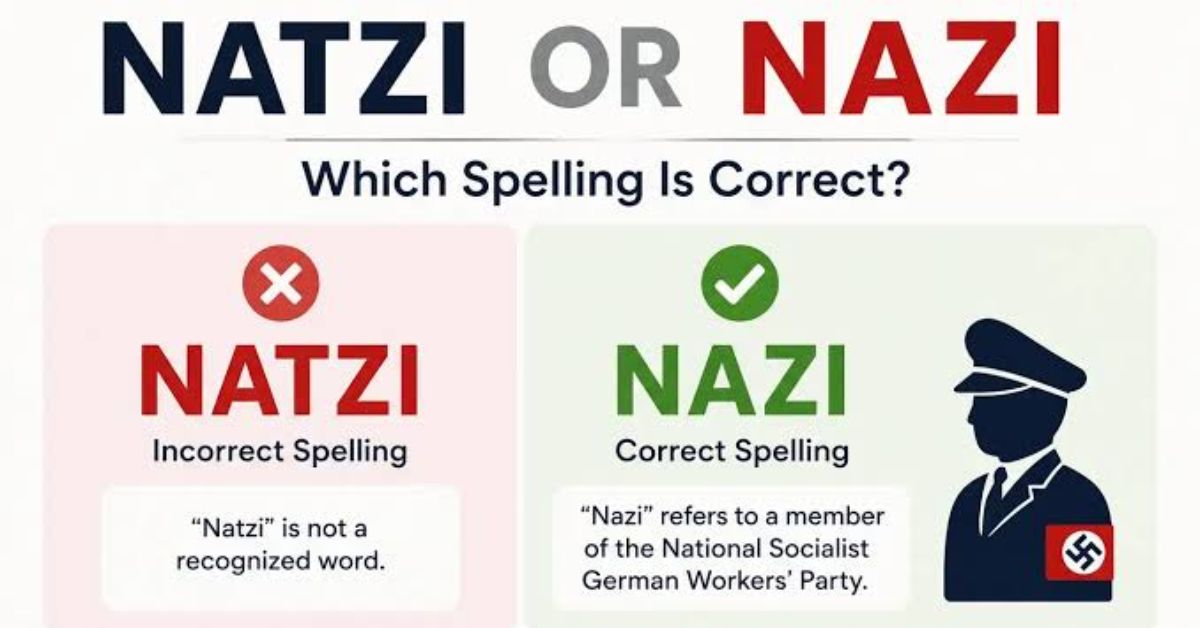
When you come across Natzi or Nazi, it’s easy to wonder which spelling is correct. The two forms look almost identical, and the way the word sounds can make the incorrect version seem reasonable.
However, only one spelling is standard: Nazi.
“Natzi” is a misspelling. It often appears because people try to spell the word according to its pronunciation or accidentally add a t while typing. Although the difference is only one letter, accuracy matters because the term is connected to an important and painful period of history.
Understanding the correct spelling can help you communicate more clearly in school assignments, articles, conversations, social media posts, and other forms of writing.
Table of Contents
- Natzi vs Nazi: The Correct Spelling Explained
- Simple Breakdown
- Pronunciation Tip
- Why “Natzi” Exists
- Common Causes of the Misspelling
- Quick Comparison Table
- The Historical Weight Behind the Word “Nazi”
- Key Historical Facts
- Why Accuracy Matters More Than You Think
- What Happens When You Write “Natzi”
- Linguistic Insight: Why “Z” Works Without “T”
- Why Not?
- Examples of Similar German Words
- What People Commonly Search For
- Real-World Example: When Spelling Affects Credibility
- Case Study: Student Essay
- How to Never Misspell “Nazi” Again
- Memory Hacks That Work
- Quick Reminder
- Common Mistakes People Make
- The Psychology Behind Spelling Errors
- Practical Tips to Improve Your Writing Accuracy
- A Quick Visual Guide
- Why This Topic Still Matters Today
- Final Takeaway: Precision Builds Trust
- Bonus: Other Commonly Misspelled Historical Terms
- FAQs
- Conclusion
Natzi vs Nazi: The Correct Spelling Explained
The correct spelling is Nazi.
Natzi is incorrect in standard English. Other forms such as Natsi and Nazzi are also misspellings when referring to the historical political movement or its members.
The term Nazi comes from the German Nationalsozialist, meaning a member or supporter of the National Socialist movement. In particular, it is associated with the National Socialist German Workers’ Party, which was led by Adolf Hitler.
Simple Breakdown
| Spelling | Status | Explanation |
|---|---|---|
| Nazi | Correct | Standard English spelling |
| Natzi | Incorrect | Common spelling mistake |
| Natsi | Incorrect | Phonetic variation |
| Nazzi | Incorrect | Extra-letter variation |
So, if you’re writing about the historical movement, its members, or Nazi Germany, use Nazi.
Pronunciation Tip
One reason people write Natzi is pronunciation.
The word Nazi is commonly pronounced roughly like “NAHT-see.” When people hear the sharp ts sound, they may assume that the word contains the letters t and z.
That assumption leads to the spelling Natzi.
Remember that pronunciation and spelling don’t always match perfectly. In this case, the standard English spelling is simply Nazi.
Why “Natzi” Exists
The misspelling Natzi is understandable because English speakers often try to spell unfamiliar words based on how they sound.
The combination of sounds in Nazi can make the extra t feel natural. Someone may hear “nat-see” and automatically write “natzi.”
It can also happen when someone has encountered the word mostly through conversation rather than reading.
Common Causes of the Misspelling
Phonetic confusion:
People may spell the word according to the sound they hear.
Fast typing:
When people type quickly, an unnecessary letter can slip into a familiar word.
Limited exposure:
Someone who has rarely seen the word in writing may not remember its standard spelling.
Overthinking the pronunciation:
The “ts” sound can make writers assume the spelling should contain “tz.”
Simple typing mistakes:
Sometimes the answer is even simpler: people make mistakes.
Quick Comparison Table
| Version | Correct? | Reason |
|---|---|---|
| Nazi | Yes | Standard spelling |
| Natzi | No | Extra “t” |
| Natsi | No | Incorrect letter arrangement |
| Nazzi | No | Extra “z” |
The Historical Weight Behind the Word “Nazi”
The word Nazi carries significant historical meaning. It commonly refers to a member or supporter of the National Socialist German Workers’ Party and, more broadly, to the regime and ideology associated with Adolf Hitler’s rule in Germany.
The Nazi regime controlled Germany from 1933 until 1945. Its policies included aggressive expansion, extreme racial ideology, persecution, mass imprisonment, and systematic murder.
Because of this history, the word is more than an ordinary vocabulary item. It often appears in serious discussions about World War II, the Holocaust, antisemitism, fascism, genocide, and modern history.
Key Historical Facts
- The Nazi Party rose to power in Germany under Adolf Hitler in 1933.
- Nazi ideology promoted extreme nationalism and racist beliefs.
- Nazi Germany played a central role in starting World War II in Europe.
- The Holocaust resulted in the systematic murder of approximately six million Jews.
- Millions of other people were also persecuted, imprisoned, displaced, or killed by the Nazi regime.
Knowing the correct spelling helps you discuss this history accurately and respectfully.
Why Accuracy Matters More Than You Think
At first, Natzi may look like a harmless spelling mistake. In serious historical writing, however, repeated errors can make a piece appear careless.
Readers often judge the reliability of writing by small details. If an article contains several obvious mistakes in important names or terms, readers may begin questioning the rest of its information.
Correct spelling doesn’t automatically make writing accurate, but incorrect spelling can weaken otherwise strong work.
What Happens When You Write “Natzi”
Using Natzi instead of Nazi can:
- Make your writing look less polished
- Distract readers from your main point
- Reduce credibility in academic or professional writing
- Create confusion for readers unfamiliar with the term
- Make an important historical discussion appear careless
A single typo isn’t the end of the world. Repeating the same error throughout an article, essay, or report is more noticeable.
Linguistic Insight: Why “Z” Works Without “T”
The confusion partly comes from the way certain sounds are represented in German and English.
German contains words in which tz represents a sound similar to “ts.” This can lead English speakers to assume that a word with a similar pronunciation must also contain tz.
But Nazi is conventionally spelled without a t.
Why Not?
The spelling Nazi became established in English as a shortened form connected to the German term Nationalsozialist.
English uses the established form Nazi, rather than changing it to Natzi to match the sound.
That’s an important point to remember: a word’s pronunciation doesn’t always tell you exactly how it should be spelled.
Examples of Similar German Words
Some German-origin words contain letter combinations that may sound similar to the pronunciation of Nazi, but their spellings are different.
| Word | Meaning or Use |
|---|---|
| Blitz | A German-origin word used in English for a sudden or intense attack |
| Pretzel | A baked food with German origins |
| Nazi | A historical and political term |
The spelling of each word follows its own history. You shouldn’t use the spelling of one German-origin word to guess another.
What People Commonly Search For
People who are unsure about this spelling may search for phrases such as:
- Natzi meaning
- Natzi vs Nazi
- How do you spell Nazi?
- Is Natzi a word?
- Nazi correct spelling
- Natzi or Nazi which is correct?
These searches usually come from the same basic question: Which spelling should I use?
The answer is straightforward: Nazi.
Real-World Example: When Spelling Affects Credibility
Imagine a student writing an essay about World War II.
The research is strong. The argument is thoughtful, and the references are relevant. However, the student repeatedly writes Natzi instead of Nazi.
The mistake doesn’t necessarily make the historical argument wrong, but it can make the work look poorly reviewed.
A teacher may immediately notice the repeated spelling error. The same thing could happen when a writer discusses history in a professional article or educational publication.
Case Study: Student Essay
Consider this example:
“The Natzi government introduced discriminatory policies.”
The corrected sentence is:
“The Nazi government introduced discriminatory policies.”
The difference is only one letter, but the second version follows standard spelling.
What Happens Next
A repeated spelling mistake can:
- Distract the reader
- Reduce confidence in the writer
- Make proofreading seem incomplete
- Take attention away from the actual argument
That’s why checking important historical names and terms before submitting an assignment is worth the extra minute.
How to Never Misspell “Nazi” Again
You don’t need a complicated spelling rule.
Simply remember:
Nazi = N-A-Z-I
There is no T between the A and Z.
Memory Hacks That Work
Try thinking of the word as two simple parts:
Na + zi = Nazi
Don’t break it into:
Nat + zi
You can also connect the spelling with the historical term you’re studying. The more often you see the correct form, the more familiar it becomes.
Quick Reminder
Nazi is four letters. Natzi is five.
If you’re writing about the historical group or ideology, choose the four-letter spelling: Nazi.
Common Mistakes People Make
The most common errors usually involve adding or changing one letter.
Mistake Patterns
Natzi — adds an unnecessary “t.”
Natsi — changes the position of the letters.
Nazzi — adds an unnecessary “z.”
These forms may appear in casual online writing, but they are not the standard spelling of the historical term.
Better Approach
When writing about an important historical subject:
- Check unfamiliar names and terms.
- Use a reliable dictionary or reference source.
- Proofread your work before publishing.
- Don’t rely only on pronunciation.
- Pay special attention to repeated terms.
The Psychology Behind Spelling Errors
Why can you read a word several times and still miss a typo?
Your brain doesn’t always process every letter individually. When reading familiar words, it often recognizes the overall shape and meaning quickly.
That efficiency is useful, but it can also allow small mistakes to slip past.
Why Your Brain Misses It
A few factors can contribute:
- Familiar word patterns
- Fast reading
- Expectation of the correct spelling
- Lack of proofreading
- Reliance on pronunciation
This is why a writer can type Natzi, read the sentence, and still fail to notice the mistake.
Practical Tips to Improve Your Writing Accuracy
You can improve spelling accuracy with a few simple habits.
Simple Strategies
Slow down:
Take extra care with important names, places, and historical terms.
Proofread twice:
The second reading often catches errors that the first reading misses.
Read aloud:
Hearing your sentences can reveal awkward wording and missing details.
Use spellcheck:
Spellcheck is useful, but don’t rely on it completely.
Check repeated words:
If an important term appears many times, make sure you have used the same correct spelling throughout.
A Quick Visual Guide
Correct vs Incorrect at a Glance
| Usage | Example |
|---|---|
| Correct | Nazi Germany played a major role in World War II. |
| Incorrect | Natzi Germany played a major role in World War II. |
The difference is small visually, but the standard spelling is clear.
Why This Topic Still Matters Today
The word Nazi still appears in historical, political, educational, and social discussions.
People use it when discussing World War II, the Holocaust, fascism, antisemitism, political extremism, and related historical subjects. Because these topics can involve serious events and real human suffering, accuracy matters.
Using the correct spelling also helps prevent unnecessary confusion.
Good writing isn’t only about complicated vocabulary. Sometimes, it’s about getting a simple word right.
Final Takeaway: Precision Builds Trust
The difference between Natzi and Nazi is easy to understand once you know the correct form.
Nazi is the standard spelling.
Natzi is a misspelling caused mainly by phonetic confusion, typing mistakes, or unfamiliarity with the word.
When you use the correct spelling, your writing becomes clearer and more professional. More importantly, accurate language helps you discuss historical subjects with the care they deserve.
Bonus: Other Commonly Misspelled Historical Terms
Here are a few examples of similar spelling mistakes:
| Incorrect | Correct |
|---|---|
| Hittler | Hitler |
| Facism | Fascism |
| Comunism | Communism |
| Holocost | Holocaust |
| Mussolinii | Mussolini |
Learning common spelling patterns can help you catch these mistakes before they appear in your final work.
FAQs
1. Why do people confuse “Natzi” and “Nazi”?
The confusion usually comes from pronunciation. The sound of Nazi can make people think the word contains a t, leading them to write Natzi.
2. Which spelling is correct?
Nazi is the correct standard spelling. Natzi is a misspelling.
3. Does one letter really matter?
Yes. A single incorrect letter can make a word nonstandard and may distract readers, especially in academic or professional writing.
4. Where does the confusion usually appear?
You may see the mistake in social media posts, comments, school assignments, casual messages, online searches, or informal discussions.
5. Why is correct usage important?
Correct spelling improves clarity and credibility. It also helps you discuss an important historical subject accurately and respectfully.
Conclusion
The difference between Natzi and Nazi is simple: Nazi is the correct spelling, while Natzi is incorrect.
The extra t usually appears because people try to spell the word according to how it sounds. Once you remember that Nazi contains only four letters, the mistake becomes much easier to avoid.
Whether you’re writing a school assignment, creating an article, posting online, or discussing history, accurate spelling makes your message clearer. With this simple distinction in mind, you can confidently use Nazi whenever the historical term is appropriate.

Finn Bradley is a grammar and language writer at Megazine Tech, focused on making English easier to understand. He researches grammar rules, vocabulary, sentence usage, punctuation, and common writing questions. Through clear explanations and practical examples, Finn helps readers build stronger communication skills and write with greater confidence in everyday situations.