

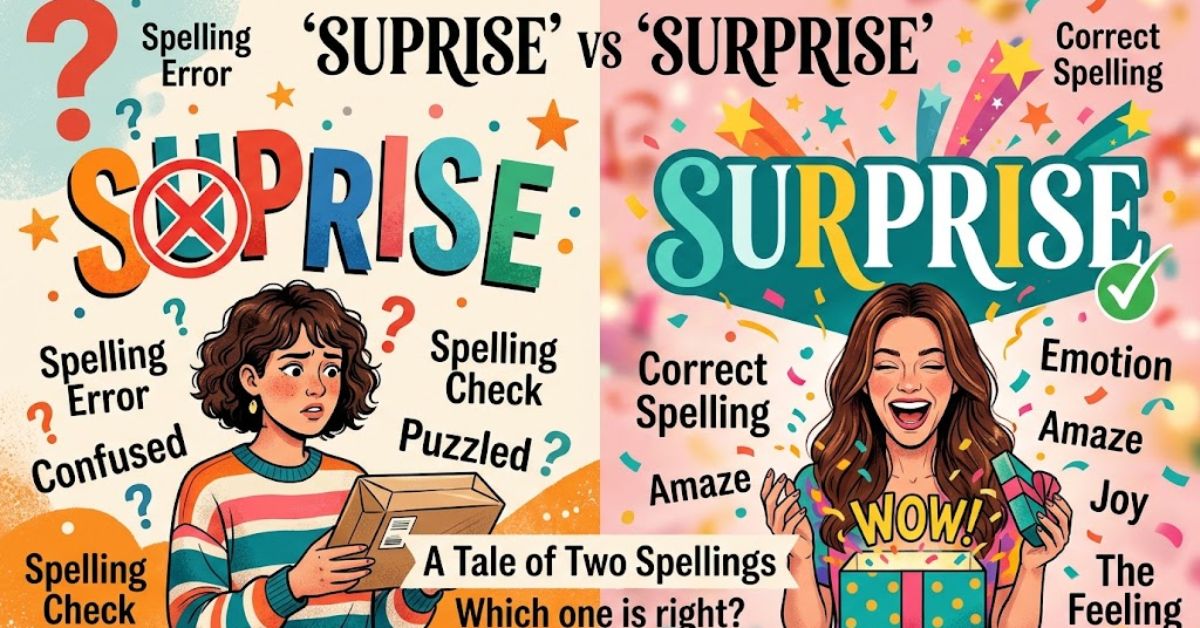
Surprise is the correct spelling. Suprise is a common misspelling that leaves out the first r.
The correct form is S-U-R-P-R-I-S-E. The incorrect form is S-U-P-R-I-S-E. If you’re writing an email, school assignment, business document, text message, or social media caption, always use surprise.
The confusion makes sense because the first part of the word can sound weak in natural speech. When people hear the word quickly, they may not notice the first r, then accidentally leave it out when writing. English pronunciation doesn’t always give you a perfect map of English spelling.
There is also no modern American versus British spelling difference here. Both varieties use surprise. The older spelling surprize has historical use, but it isn’t the standard spelling for modern English.
What Is the Difference Between Suprise and Surprise?
The difference is straightforward:
| Spelling | Correct? | Meaning |
|---|---|---|
| surprise | Yes | Something unexpected or the act of causing someone to feel surprised |
| suprise | No | A misspelling of surprise |
Surprise contains two r letters:
S-U-R-P-R-I-S-E
Suprise contains only one:
S-U-P-R-I-S-E
That missing letter changes the spelling, not the intended meaning. When someone writes suprise, readers generally understand what they mean because the error closely resembles the correct word.
However, familiarity doesn’t make the spelling acceptable. Suprise is treated as a misspelling of surprise, not as a separate modern English word.
Correct: The birthday party was a surprise.
Incorrect: The birthday party was a suprise.
Why It Matters
A missing letter might look like a tiny issue, but spelling affects how polished your writing appears.
In casual texting, a typo may pass without much attention. In an essay, application, report, website, or professional email, repeated spelling errors can make your writing look less careful.
Correct spelling matters especially in:
- School assignments and exams
- College and university papers
- Professional emails
- Business reports
- Job applications
- Resumes and cover letters
- Website content
- Marketing materials
- Social media posts
- Customer communications
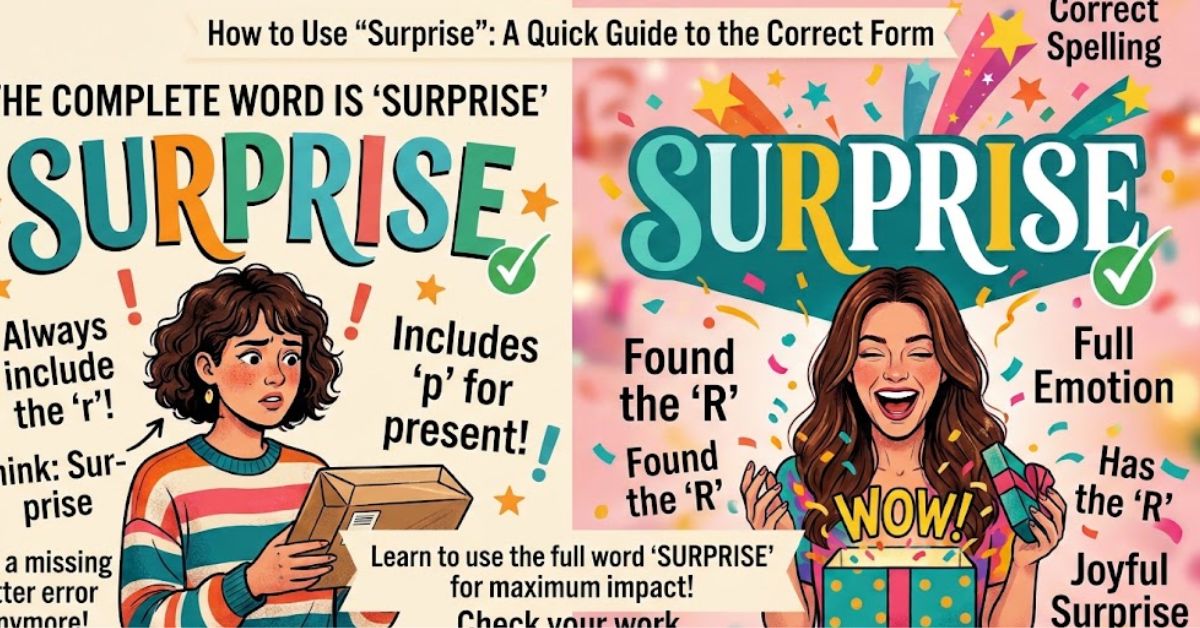
The good news is that this mistake is easy to prevent. Once you remember SURP at the beginning, suprise becomes much easier to catch.
The Core Rule
Always spell the word as SURPRISE, with an r immediately after “su.”
Use:
SUR + PRISE = SURPRISE
Not:
SU + PRISE = SUPRISE
A quick proofreading trick is to check the first four letters.
SURP = correct
SUPR = incorrect
This simple check can save you from the most common spelling mistake associated with the word.
How to Use “Surprise”
The word surprise has several everyday uses. It can work as a noun or a verb, while related forms include surprised and surprising.
Surprise as a noun
As a noun, surprise refers to something unexpected or the feeling caused by an unexpected event.
Examples:
- The birthday gift was a surprise.
- Her reaction showed genuine surprise.
- The announcement came as a complete surprise.
- To my surprise, everyone agreed.
- His visit was a pleasant surprise.
In these sentences, surprise names an event, feeling, reaction, or unexpected situation.
Surprise as a verb
As a verb, surprise means to cause someone to feel surprised or to catch someone unexpectedly.
Examples:
- The news surprised everyone.
- We wanted to surprise our teacher.
- Her answer surprised the interviewer.
- The results surprised the researchers.
- I didn’t expect to surprise him.
Notice that the spelling remains surprise. Changing the grammatical function doesn’t make suprise correct.
Related forms of “surprise”
The same spelling pattern appears in several related forms:
| Word | Function | Example |
|---|---|---|
| surprise | Noun / verb | The result was a surprise. |
| surprises | Noun / verb | Life often brings surprises. |
| surprised | Verb / adjective | She looked surprised. |
| surprising | Adjective | The result was surprising. |
| surprisingly | Adverb | Surprisingly, nobody complained. |
Remember the shared beginning: surpr-.
That pattern helps you avoid errors such as suprised and suprising.
Correct Examples
Here are natural examples showing how surprise works in different contexts:
- Conversation: “What a surprise! I didn’t expect you here.”
- Birthday: “They planned a surprise party for their mother.”
- Email: “The announcement came as a complete surprise to the team.”
- Workplace: “The results were a pleasant surprise.”
- School: “The teacher gave us a surprise quiz.”
- Academic writing: “The findings were surprising because they differed from the original prediction.”
- Social media: “What a beautiful surprise from my friends!”
- Business: “The increase in demand was a welcome surprise.”
- Personal message: “I have a little surprise waiting for you.”
- Interview: “The unexpected question surprised the candidate.”
The spelling stays the same regardless of the setting.
Incorrect vs. Correct
| Incorrect | Correct | Reason |
|---|---|---|
| It was a suprise. | It was a surprise. | The first r is missing. |
| What a suprise! | What a surprise! | Suprise is a misspelling. |
| A suprise party | A surprise party | The noun needs both r letters. |
| She looked suprised. | She looked surprised. | The related form keeps the first r. |
| A suprising result | A surprising result | The spelling begins with surpr-. |
| I wanted to suprise him. | I wanted to surprise him. | The verb requires the standard spelling. |
| The gift suprised her. | The gift surprised her. | The past form retains both r letters. |
| It was a suprize. | It was a surprise. | The modern standard ending is -ise. |
Why Do People Spell “Surprise” as “Suprise”?
The error isn’t random. Several factors can make the correct spelling easy to forget.
1. The first “r” can be easy to miss in speech
The word surprise normally places stress on the second syllable. The first syllable is weaker, so the initial r may not stand out clearly.
That creates a gap between what you hear and what you write.
Someone may hear the opening as something close to “suh” and unconsciously assume there is no r there. Spelling, however, preserves the letter even when pronunciation makes it less noticeable.
2. People often spell from sound
English spelling doesn’t always match pronunciation letter for letter.
If you learn a word mainly by hearing it, you may try to reconstruct the written form from its sounds. That strategy can work with simple words, but it becomes unreliable when a sound is weak or less obvious.
With surprise, memorizing the visual pattern is safer than guessing from pronunciation.
3. Fast typing encourages omissions
A person can know the correct spelling and still type suprise accidentally.
This happens during:
- Fast typing
- Phone messaging
- Informal conversations
- Note-taking
- Multitasking
- Writing quickly under pressure
A typo doesn’t necessarily mean the writer doesn’t know the word. Sometimes one finger simply skips a letter.
4. Visual familiarity can hide the mistake
Compare these two forms:
surprise
suprise
They’re extremely similar. Your brain often reads familiar words as complete patterns rather than examining every individual letter.
That’s why you might overlook the missing r during proofreading.
Reading slowly for a final check can expose errors that normal reading misses.
5. Translation can contribute to spelling confusion
English learners sometimes learn pronunciation before spelling. If their first language represents the sounds differently, they may naturally rebuild the English word according to familiar spelling patterns.
The safest approach is to memorize the complete written form:
SURPRISE
Once the word becomes visually familiar, the missing-r mistake becomes easier to recognize.
Common Mistakes Checklist
Mistake 1: Dropping the first “r”
Wrong: suprise
Right: surprise
The first r comes immediately after su.
Mistake 2: Writing “suprised”
Wrong: suprised
Right: surprised
The correct past form still begins with surpr-.
Mistake 3: Writing “suprising”
Wrong: suprising
Right: surprising
Keep the r before the p in the spelling family.
Mistake 4: Confusing spelling with pronunciation
The first syllable can sound weak, but that doesn’t mean the written r disappears.
Pronunciation can explain the mistake. It doesn’t change the spelling.
Mistake 5: Trusting visual familiarity
Because suprise looks almost right, your eyes may glide over the missing letter.
When proofreading important work, check the first four letters specifically.
Mistake 6: Assuming frequent online use makes it correct
You may see suprise in comments, posts, messages, or user-generated content.
That doesn’t make it a standard spelling. A common typo can remain a typo no matter how often people repeat it.
Surprise in Real English
Everyday English: “What a surprise!”
“What a surprise!” is a natural expression when something unexpected happens.
For example:
“What a surprise! I didn’t know you were coming.”
The phrase works in casual conversation, personal messages, and many informal situations.
“To my surprise”
“To my surprise” means that something happened differently from what you expected.
Example:
“To my surprise, the meeting ended early.”
It’s perfectly natural in both everyday and formal writing.
“A surprise”
The noun surprise can describe an unexpected event, gift, result, or reaction.
For example:
“The gift was a surprise.”
A surprise doesn’t have to be positive. You can have a pleasant surprise, an unpleasant surprise, or simply an unexpected surprise.
“Surprised” vs. “surprising”
These words are related but serve different purposes.
Surprised usually describes the person experiencing the reaction:
“I was surprised by the result.”
Surprising describes the thing that causes the reaction:
“The result was surprising.”
A simple rule helps:
People feel surprised. Things are surprising.
“Surprise” as a verb
As a verb, surprise means to cause someone to feel unexpected astonishment or to catch someone off guard.
“The news surprised me.”
Here, the news causes the reaction, while me experiences it.
American vs. British English
There is no modern American versus British spelling difference for surprise.
| Variety | Standard spelling |
|---|---|
| American English | surprise |
| British English | surprise |
The pronunciation can vary. In many British accents, the first r may not be pronounced when it doesn’t come before a vowel. American speakers commonly pronounce that r more clearly.
That pronunciation difference does not change the spelling. Both varieties write the word surprise.
Formal vs. Informal Usage
Surprise works naturally in both formal and informal English.
Formal examples
- “The findings came as a surprise to the research team.”
- “The unexpected result surprised the researchers.”
- “The announcement generated considerable surprise among employees.”
Informal examples
- “What a surprise!”
- “I have a surprise for you.”
- “You really surprised me!”
- “That was such a surprise.”
The spelling doesn’t change with the level of formality.
Suprise isn’t an informal version. It’s simply incorrect.
Comparison Table
| Feature | Surprise | Suprise |
|---|---|---|
| Standard spelling | Yes | No |
| Modern English | Yes | No |
| Noun | Yes | No |
| Verb | Yes | No |
| Formal writing | Yes | No |
| Informal writing | Yes | No |
| American English | Yes | No |
| British English | Yes | No |
| Meaning | Something unexpected or an act of surprising | No separate standard meaning |
| Main issue | Correct spelling | Missing first r |
Memory Trick
The easiest trick is to remember the first four letters:
SURP
Not:
SUPR
You can also split the word visually:
SUR + PRISE = SURPRISE
Another useful strategy is to learn the whole spelling family together:
- surprise
- surprises
- surprised
- surprising
- surprisingly
Once surpr- becomes familiar, your brain has a stronger pattern to follow.
Real-Life Situations
In an interview
Interviewer: “Were you surprised by the result?”
Candidate: “Yes. It was a complete surprise.”
The noun surprise describes the unexpected result.
In a meeting
“The sudden change in the deadline came as a surprise to the team.”
Here, surprise refers to an unexpected situation.
In an email
“Thank you for the gift. It was a lovely surprise.”
This wording works naturally in a personal or professional message.
In a text message
“Guess what? I have a surprise for you!”
The casual setting doesn’t change the spelling.
In an exam
Question: Choose the correct spelling.
A. Suprise
B. Surprise
C. Suprize
D. Surprize
Answer: B. Surprise
In academic writing
“The unexpected finding was a surprise to the researchers.”
The standard spelling is appropriate for academic writing.
Mini Quiz
Test yourself before moving on.
- Which is correct: suprise or surprise?
Answer: Surprise. - Complete the sentence: “The result was a complete ______.”
Answer: surprise. - Which is correct: suprised or surprised?
Answer: surprised. - Complete the sentence: “The news ______ everyone.”
Answer: surprised. - Which is correct: suprising or surprising?
Answer: surprising. - Complete the phrase: “To my ______, he agreed.”
Answer: surprise. - Is suprise an accepted informal spelling?
Answer: No. - Does British English use suprise?
Answer: No. British English uses surprise. - Is surprize the normal modern spelling?
Answer: No. - What should you remember at the beginning of the word?
Answer: SURP.
Expert Tips
1. Memorize the spelling, not just the sound
Don’t depend entirely on pronunciation. English contains many words whose written forms aren’t obvious from their sounds.
Learn the visual pattern SURPRISE.
2. Remember the related words together
Create a small spelling family:
surprise → surprised → surprising → surprisingly
The shared surpr- beginning gives you a reliable visual anchor.
3. Proofread for small omissions
Not every spelling mistake involves a complicated rule. Sometimes one tiny letter disappears.
During proofreading, look specifically for letters that you tend to skip when typing quickly.
4. Do not rely completely on spellcheck
Spellcheck can catch many errors, but it shouldn’t replace your own proofreading.
A strong writer recognizes the correct form before a software tool points it out.
5. Watch the first four letters
If you’re in a hurry, don’t inspect every letter.
Just check the opening:
SURP
If you see:
SUPR
stop and add the missing r.
6. Remember that pronunciation is not a spelling guide
The way a word sounds can help you learn it, but English pronunciation doesn’t always reveal every written letter.
For surprise, remember the spelling independently from the sound.
FAQ
Is “suprise” a word?
In modern standard English, suprise is treated as a misspelling of surprise, not the standard spelling of a separate word.
Why is “suprise” wrong?
Suprise is missing the first r. The correct spelling is s-u-r-p-r-i-s-e.
How do you spell surprise?
The correct spelling is SURPRISE, with two r letters and two s letters.
Is “surprise” a noun or a verb?
It can be both. As a noun, it describes something unexpected; as a verb, it means to cause someone to feel surprised.
Is “surprised” spelled with one or two r’s?
Surprised is spelled with two r letters: s-u-r-p-r-i-s-e-d.
Is “suprising” correct?
No. The correct spelling is surprising, which keeps the surpr- beginning.
Is “surprize” correct?
Not as the normal modern spelling. Surprize is a historical variant that is now rare or considered archaic, so modern writing should use surprise.
Is surprise spelled differently in British English?
No. British English and American English both use surprise. The pronunciation can differ, but the spelling does not.
Can I use “surprise” in academic writing?
Yes. Surprise is a standard English word and is appropriate in academic writing when its meaning fits the context.
What is the easiest way to remember the spelling?
Remember SURP, not SUPR. You can also break it into SUR + PRISE.
Why does “suprise” look correct?
It’s visually very close to surprise, and the first r may be less noticeable in natural speech. That combination makes the typo easy to overlook.
Conclusion
The answer to “Suprise vs Surprise” is simple: surprise is correct, while suprise is a misspelling.
The easiest way to remember it is to focus on the first four letters: SURP. The correct spelling contains two r letters, and the same surpr- pattern appears in surprised, surprising, and surprisingly.
The mistake often happens because pronunciation, fast typing, and visual familiarity can make the first r easy to overlook. Still, the spelling remains the same in American and British English.
So before you send that email, submit that assignment, or publish that caption, give the word one quick check:
SURPRISE ✓
SUPRISE ✗

Finn Bradley is a grammar and language writer at Megazine Tech, focused on making English easier to understand. He researches grammar rules, vocabulary, sentence usage, punctuation, and common writing questions. Through clear explanations and practical examples, Finn helps readers build stronger communication skills and write with greater confidence in everyday situations.