

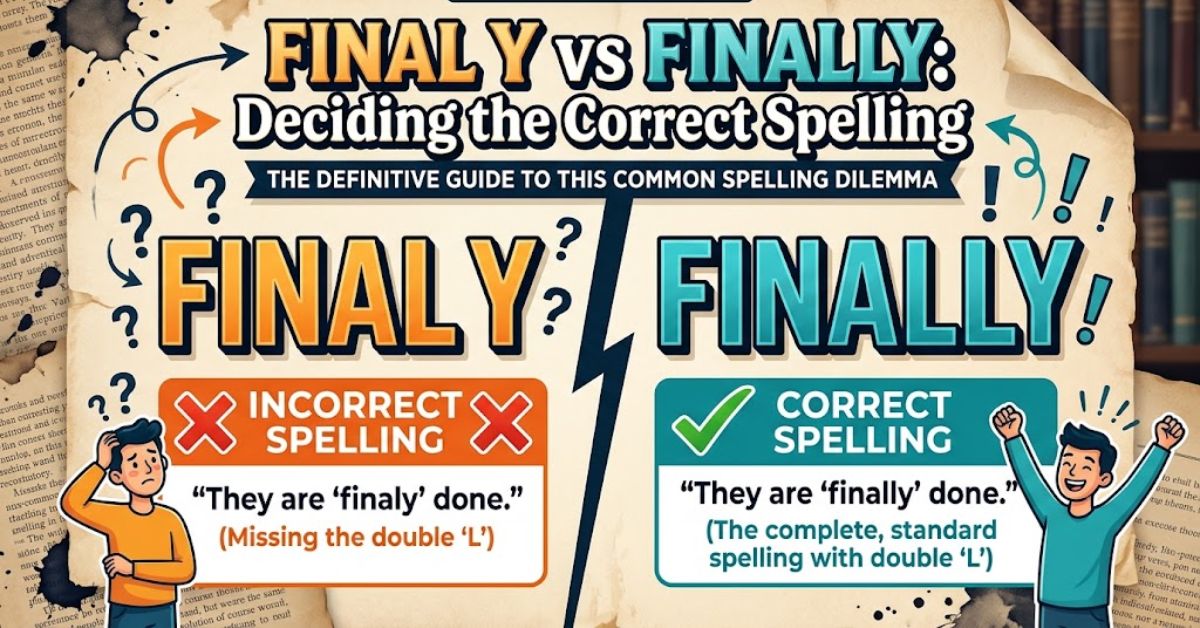
Have you ever typed finaly and wondered whether it needs one “l” or two? You’re not alone. Finaly vs Finally is a common spelling confusion, especially when you’re writing quickly.
The answer is simple: Finally is the correct spelling. Finaly is incorrect.
Finally is an adverb that can mean at last, in the end, or as the last point in a sequence. You can use it when something happens after a long wait or when introducing the final step or idea.
For example:
- We finally finished the project.
- Finally, add the sugar to the mixture.
- She finally received her exam results.
The easiest way to remember the spelling is to break it into two parts: final + ly = finally. Because final already ends in “l” and -ly begins with “l,” the finished word contains two consecutive l’s.
Finaly vs Finally: The Quick Answer
| Word | Correct? | Meaning |
|---|---|---|
| Finally | Yes | At last, in the end, or as the final point |
| Finaly | No | Misspelling of finally |
Example
Correct: Finally, the meeting started.
Incorrect: Finaly, the meeting started.
The second sentence is incorrect because finaly is not a standard English spelling.
What Does Finally Mean?
Finally is an adverb with several closely related meanings. It commonly means:
- At last
- After a long wait or delay
- In the end
- As the final point or step
Examples
- We finally finished our homework.
- She finally called me back.
- The bus finally arrived.
- Finally, let’s discuss the project budget.
In each example, finally refers to something happening at the end, after waiting, or as the last part of a sequence.
What Is the Definition of Finally?
Finally generally means at last, in the end, or as the last action or point.
For example:
The rain finally stopped.
Here, finally suggests that the rain continued for some time before it stopped.
You can also use it to introduce a final idea:
Finally, remember to check your work before submitting it.
Is Finaly a Real Word?
No. Finaly is not the correct standard English spelling.
It is simply a common misspelling of finally.
If you write:
I finaly finished my assignment.
You should correct it to:
I finally finished my assignment.
Whether you’re writing an essay, email, report, social media post, or text message, finally is the form you need.
Why Do People Write “Finaly”?
The mistake usually happens because the double “l” isn’t obvious when you pronounce the word.
People may write finaly because they:
- Type too quickly
- Forget the second “l”
- Spell the word according to its sound
- Misunderstand how the suffix -ly works
- Don’t notice the error while proofreading
English has plenty of spelling patterns that can trip you up. Fortunately, this one becomes easy once you understand how the word is formed.
Why Does Finally Have Two L’s?
The spelling becomes much clearer when you separate the word:
Final + ly = Finally
The adjective final ends with the letter l.
The adverb suffix -ly begins with another l.
When you combine them, both letters remain:
Final + ly → Finally
So, the double “l” isn’t random. It comes naturally from joining the base word and suffix.
Understanding the Suffix -ly
The suffix -ly often changes an adjective into an adverb.
Here are some examples:
| Adjective | Adverb |
|---|---|
| Quick | Quickly |
| Happy | Happily |
| Sudden | Suddenly |
| Final | Finally |
| Easy | Easily |
An adverb can tell you how, when, where, or to what degree something happens.
For example:
We finally arrived home.
In this sentence, finally tells you when the action happened in relation to the waiting or journey.
How to Pronounce Finally
Finally is commonly pronounced like:
FYE-nuh-lee
You can break it into syllables:
Fi + nal + ly
Because you don’t strongly hear two separate “l” sounds, it’s easy to accidentally write finaly.
Remember that pronunciation doesn’t always tell you exactly how an English word is spelled.
When Should You Use Finally?
You can use finally in several everyday situations. The meaning changes slightly depending on the context.
Using Finally to Mean “At Last”
This is probably its most familiar use.
Examples:
- I finally found my keys.
- They finally sold their old house.
- The rain finally stopped.
- She finally answered my message.
In these sentences, something happened after waiting, trying, or experiencing a delay.
Example in Context
Imagine you have been waiting at the airport for your luggage for two hours.
When your suitcase appears, you might say:
I finally got my suitcase!
Here, finally shows both the delay and your relief that the wait has ended.
Using Finally for the Last Step
You can also use finally to introduce the last step in a process.
For example:
- Mix the flour and sugar.
- Add the eggs and milk.
- Stir everything together.
- Finally, bake the mixture for 30 minutes.
This use is common in recipes, tutorials, instructions, presentations, and step-by-step guides.
Using Finally to End a Discussion
Finally can introduce the last point in a speech, essay, presentation, or discussion.
For example:
Finally, I’d like to thank everyone who helped with this project.
It tells your audience that you’re moving to your last idea.
Examples of Finally in Everyday Life
In Conversation
- We finally met after ten years.
- She finally bought her dream car.
- He finally apologized for his mistake.
At School
- The teacher finally announced the results.
- I finally understood the math problem.
- We finally completed our group project.
At Work
- The manager finally approved the proposal.
- We finally completed the report.
- The client finally responded to our email.
In Sports
- The team finally won the championship.
- She finally broke the school record.
- He finally scored his first goal of the season.
Finaly vs Finally in Sentences
The difference becomes even easier to understand when you compare the two spellings directly.
| Incorrect | Correct |
|---|---|
| Finaly, I passed my exam. | Finally, I passed my exam. |
| We finaly arrived home. | We finally arrived home. |
| She finaly called me. | She finally called me. |
| Finaly, the storm ended. | Finally, the storm ended. |
| I finaly completed my work. | I finally completed my work. |
Whenever you see finaly, change it to finally.
Common Mistakes People Make With Finally
Writing Finaly Instead of Finally
This is the main spelling error.
Incorrect: Finaly, we can leave.
Correct: Finally, we can leave.
Remember: final + ly = finally.
Using Finally Too Often
Even though finally is useful, repeating it too frequently can make your writing sound unnatural.
Awkward:
Finally, I woke up. Finally, I ate breakfast. Finally, I got dressed. Finally, I went to work.
Better:
I woke up, ate breakfast, got dressed, and finally went to work.
Use the word when it adds meaning rather than inserting it into every sentence.
Finally vs Eventually
Finally and eventually have similar meanings, but their emphasis can differ.
| Word | Main Meaning |
|---|---|
| Finally | At last or at the final point |
| Eventually | After some time or a series of events |
Example
She eventually became a doctor.
This emphasizes that becoming a doctor happened after a long process.
She finally became a doctor.
This emphasizes reaching the anticipated or desired result.
Key Difference
A useful way to think about the difference is:
Eventually often focuses on what happened after time passed.
Finally often emphasizes reaching the end or achieving something after waiting.
The meanings can overlap, so context matters.
Finally vs Ultimately
Finally and ultimately can both refer to an ending, but they aren’t always interchangeable.
| Word | Meaning |
|---|---|
| Finally | At last or as the final point |
| Ultimately | In the end, after everything has been considered |
Examples:
Finally: The concert finally started.
Ultimately: We ultimately decided to move to another city.
Ultimately often works well when talking about a final decision, result, or conclusion.
Finally vs Lastly
Finally and lastly can sometimes introduce the final item or point.
However, their meanings aren’t exactly the same.
| Word | Common Use |
|---|---|
| Finally | At last, after waiting, or as a concluding point |
| Lastly | Introducing the last item in a list or series |
Example
Lastly, add the decorations.
This clearly introduces the final step.
Finally, I’d like to thank my family.
This introduces a concluding statement.
In some contexts, either word can work.
Synonyms of Finally
Using synonyms can help you avoid unnecessary repetition.
Common alternatives include:
- At last
- At long last
- Eventually
- Ultimately
- In the end
- Lastly
- In conclusion
Examples
Original: The package finally arrived.
Alternative: At last, the package arrived.
Original: Finally, we decided to leave.
Alternative: In the end, we decided to leave.
Choose the synonym that best matches your intended meaning.
Antonyms of Finally
Words with an opposite or contrasting sense include:
- Initially
- First
- Originally
- At first
- At the beginning
- Early on
Example
Initially, we planned to stay for one week.
Finally, we decided to stay for an entire month.
The contrast between initially and finally shows the beginning and ending stages of the situation.
Why One Missing Letter Matters
Consider these two sentences in a professional email:
Finaly, I have attached the completed report.
Finally, I have attached the completed report.
Only one letter separates them, but the second sentence looks more polished.
Small spelling errors can distract readers and make professional or academic writing look careless. Proofreading words such as finally can therefore improve the overall quality of your writing.
Why Correct Spelling Is Important
Correct spelling supports:
- Clarity
- Readability
- Professionalism
- Credibility
- Writing confidence
Think of spelling as the finishing touch on your ideas. Even strong information can lose some of its impact when obvious spelling mistakes distract the reader.
Common Expressions Using Finally
You’ll often see finally in phrases such as:
- Finally finished
- Finally arrived
- Finally done
- Finally succeeded
- Finally got it
- Finally understood
- Finally decided
- Finally happened
Example Sentences
- We finally reached an agreement.
- She finally got her driver’s license.
- They finally bought their first house.
- I finally understood the lesson.
- He finally finished his assignment.
How Finally Works in Different Types of Writing
Academic Writing
Finally, the results highlight the importance of early intervention.
Here, the word introduces a concluding point.
Business Writing
Finally, please review the completed document before Friday.
It introduces the last instruction or request.
Creative Writing
After hours of heavy rain, the clouds disappeared and the sun finally appeared.
Here, finally emphasizes waiting and change.
Everyday Communication
I finally got your message!
In casual conversation, it can express relief, excitement, frustration, or satisfaction depending on the situation.
Memory Trick for Remembering the Correct Spelling
The easiest trick is:
Final + ly = Finally
Look carefully:
finaL + Ly = finaLLy
The two “l” letters come together naturally.
You can also remember this simple rule:
Final has one “l,” and -ly brings another “l.”
Together, they make finally.
FAQs
1. Is “Finaly” a Correct English Word?
No. Finaly is a misspelling. The correct standard spelling is finally.
2. Why Do People Write “Finaly” Instead of “Finally”?
People often leave out one “l” because they type quickly or spell the word according to how it sounds. The double “l” isn’t strongly noticeable in pronunciation.
3. What Does “Finally” Mean?
Finally is an adverb meaning at last, in the end, or as the final point or step. It can describe something that happens after waiting or introduce the last part of a sequence.
4. How Can I Remember the Correct Spelling of “Finally”?
Remember the simple formula: final + ly = finally. The base word final ends with “l,” while the suffix -ly starts with another “l.”
5. Can Using “Finaly” Affect My Writing?
Yes. Since finaly is a spelling error, it can make academic, professional, or published writing look less polished. Using finally keeps your writing accurate and clear.
Conclusion
The difference between Finaly vs Finally is easy to understand once you know the spelling rule. Finally is the correct English word, while finaly is a common misspelling.
Finally can mean at last, in the end, or as the final point. You’ll see it in everyday conversations, essays, emails, instructions, business writing, and academic work.
To remember the spelling, simply break the word apart: final + ly = finally. The final “l” of final and the first “l” of -ly create the double “l.” Keep that simple pattern in mind, and you’ll finally stop confusing finaly with finally.

Finn Bradley is a grammar and language writer at Megazine Tech, focused on making English easier to understand. He researches grammar rules, vocabulary, sentence usage, punctuation, and common writing questions. Through clear explanations and practical examples, Finn helps readers build stronger communication skills and write with greater confidence in everyday situations.